The CEX front, DeFi back model is starting to look like a repeatable playbook.
Coinbase has already shown this pretty clearly with Morpho on Base: users stay inside Coinbase, while the lending engine and most of the infrastructure run onchain behind the scenes.
Now Bitget is following a similar structure for BTC yield.
Users deposit BTC on Bitget → BTC gets wrapped into $bgBTC → Gauntlet runs the strategy on Aera → Morpho provides the lending markets → @MorphNetwork handles settlement.
The interesting part for me is where @redstone_defi sits in this stack:
+ RedStone provides the price feeds @Morpho uses to value collateral and trigger liquidations.
+ When liquidation happens, ATOM, one of RedStone’s core products, continues the flow by running the auction in under 300ms and recapturing OEV
So RedStone covers more of the liquidation stack: price discovery → liquidation trigger → OEV recapture
It doesn’t directly create yield. It helps the same collateral operate more efficiently while reducing value leakage.
That’s why capital efficiency is becoming a bigger part of the oracle thesis.
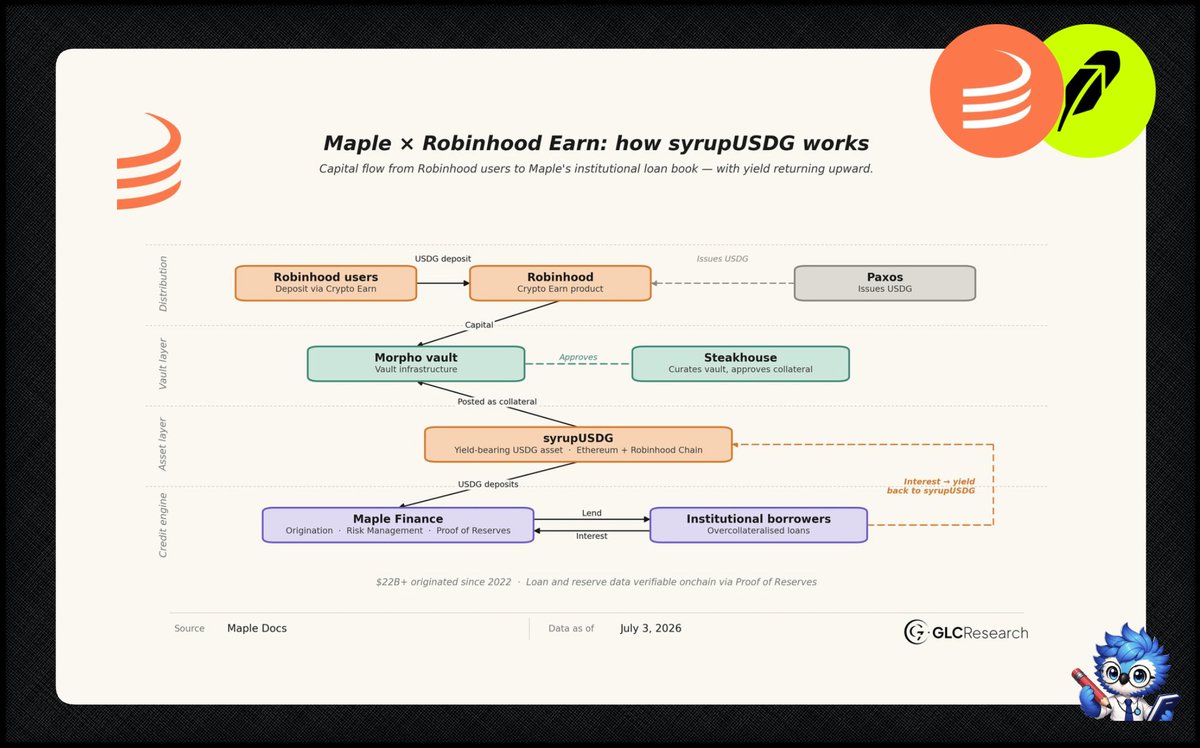
Maple attracted billions in liquidity through syrupUSDC on Ethereum.
Now they are bringing the same playbook to @RobinhoodCrypto with syrupUSDG.
The biggest difference, syrupUSDG is being set up as a core liquidity layer inside Robinhood Earn.
I’m genuinely excited about this deal.
Structurally, it’s pretty smart because it creates demand from both sides:
+ Lenders come through Robinhood, while borrowers access capital through Maple.
+ @maplefinance gets a new distribution channel without changing its core credit engine.
It also taps into the regulated stablecoin trend, with $USDG issued by @Paxos.
$200M in the first week of launch is a strong early signal that the demand is real.
Model and data from @GLC_Research
Tokenized stocks are becoming one of the fastest-growing RWA segments in 2026.
According to @RWA_xyz, the top 10 tokenized stock projects now total over $2.8B in value.
The sector is splitting into four main directions:
1. DeFi-native/Composable Tokenized Stocks: @xStocksFi, @BackedFi
2. Institutional/Compliance-focused Exposure: @OndoFinance, @Securitize, @WisdomTreeFunds, @Figure, @stokr_io, @centrifuge
3. Native On-chain Issuance: @SuperstateInc
4. Retail Brokerage Distribution: @RobinhoodApp
They are becoming a full stack across DeFi liquidity, institutional access, native issuance, and retail distribution.
1. xStocks - Market leader
xStocks dominates with $1.7B TVL and 60%+ market share. Its growth is driven by strong distribution through Kraken, Bybit, and Solana DeFi, making it popular among traders and DeFi users.
2. Ondo Global Markets - Institutional scale
Ondo ranks second with $944M across 232 assets. Its advantage is broad stock coverage and a more institutional-grade exposure model.
3. Securitize - Compliance focus
Securitize has $67.4M with only 2 assets, but stands out as one of the most institutionally trusted players, especially due to its connection with the BlackRock ecosystem.
4. WisdomTree - TradFi entering on-chain stocks
WisdomTree brings a traditional asset manager profile into tokenized equities, with $26.6M across 6 assets.
5. Figure - From private credit to stocks
Figure’s presence shows how private credit-focused RWA platforms are expanding into public equities.
6. Superstate Opening Bell - Native issuance model
Superstate is different because it focuses on issuing real SEC-registered shares directly on-chain, rather than only wrapping existing stocks.
7. Robinhood - Retail distribution play
Robinhood leads in product count with 1,733 assets, but only $18.4M in value. This suggests its focus is retail access and user growth rather than institutional capital.
8-10. STOKR, Centrifuge, Backed Finance
These players represent specialized RWA infrastructure: European compliance, DeFi-native RWA rails, and tokenized stock issuance support.
The tokenized stocks market may remain concentrated in the short term, with xStocks leading DeFi liquidity and Ondo leading institutional exposure.
But over time, the market share battle will shift from "who lists more stocks" to "who controls distribution, liquidity, compliance, and on-chain utility".
@real_enola@MMTFinance Cross-chain + RWA compliance in one roadmap is rare. Wonder how liquidity dynamics change once non-crypto assets start flowing does it pull in TradFi market makers or stay retail-led?