MB Ghalibaf, Iranian Parliament Speaker and last Tweeter standing, posted a cryptic statement which we'll decrypt here. He said OQX26|USGG10YR|DOESSPR, short harder, or pray to the salt gods of Bryan Mound. 1/7
Mekke Anlaşmasının Özeti:
170 nükleer savaş başlığı 🇵🇰
G20 üyeliği 🇸🇦🇹🇷
OPEC liderliği 🇸🇦
NATO üyeliği ve NATO’nun en büyük ordularından biri 🇹🇷
Toplam 3 trilyon dolarlık ekonomik büyüklük 🇵🇰🇸🇦🇹🇷
1.000 savaş uçağı 🇵🇰🇸🇦🇹🇷
Ordularda toplam 2 milyon personel 🇸🇦🇹🇷🇵🇰
7.000 tank 🇸🇦🇹🇷🇵🇰
90 bin zırhlı araç 🇸🇦🇹🇷🇵🇰
34 denizaltı 🇹🇷🇵🇰
500 savaş ve deniz platformu 🇸🇦🇹🇷🇵🇰
Toplam 4 milyon kilometrekare yüzölçümü 🇸🇦🇹🇷🇵🇰
Yakında Suudi Arabistan ve Türkiye için F-35 🇸🇦🇹🇷
WARREN BUFFETT JUST SAID SOMETHING HE ONLY SAID ONCE BEFORE.
Right before markets crashed 78%.
1999: "Euphoria is the enemy.
" Walked away. Result: Dot-com crash. Down 78%.
2026: $400B in cash. Zero purchases.
"Worse than 1999."
Michael Burry: $1B short on AI.
Warren Buffett: $400B in cash.
Same year. Same warning. Same answer.
Cash.
He has been right every single time.
He just gave the warning again.
Are you listening?
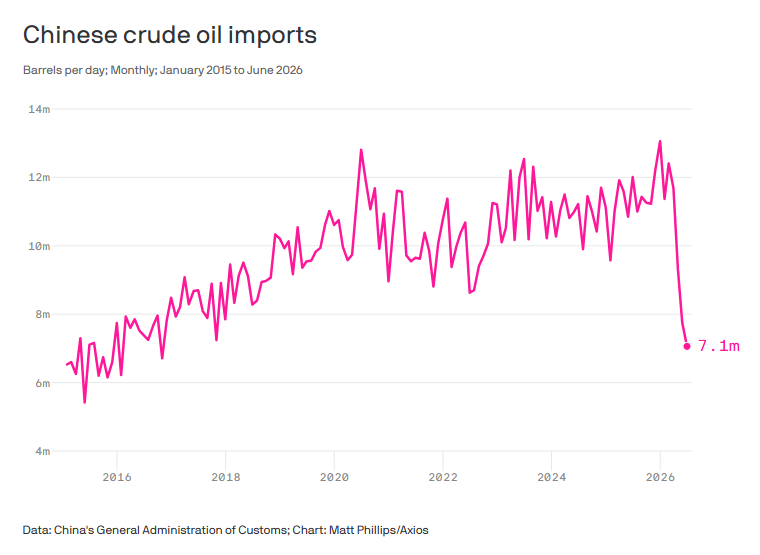
🇨🇳🇺🇸 China stopped buying oil, and that did more to hold prices down than anything the US Navy managed
Chinese crude imports have fallen more than 40 percent from last year, and the economy kept humming anyway.
Beijing burned more domestic coal, pulled from its own reserves, and let its huge fleet of electric cars pick up the slack.
Goldman analysts noticed traffic congestion stayed normal even as gasoline use dropped, which shows where all those trips went.
Pulling the world's largest buyer off the market at the same moment a fifth of global supply got trapped behind Hormuz explains most of why the predicted price explosion never arrived.
That should sit badly in Washington.
America fought partly to prove it still guarantees the sea lanes, and what actually held the global economy together was Chinese industrial policy built for Chinese reasons.
It is also temporary. July purchases are already climbing back.
Source: Axios / Writer: Daniel
Warren Buffett reveals the underpricing test behind Apple's iPhone: a $1,000 device can be worth more than a $1 million plane.
"I do not focus on the sales in the next quarter or the next year."
"Hundreds and hundreds and hundreds of millions of people practically live their lives by it."
"That little piece of whatever it is, that is some of the most valuable real estate in the world."
"They spend hours a day."
"It is part of their habit of living."
"If we did not have it, you could not sell them anything else. They either went next door or they came back."
"The iPhone 10 cost $1,000 and that is a lot of money."
"I have a plane that costs me maybe a million dollars a year."
"I would rather give up the plane, which is a million or a million and a half a year, for something that costs $1,000."
"The iPhone is enormously underpriced."
That is the replacement-friction test.
The moat is not just usage. It is what customers refuse to substitute when supply disappears, prices rise, or a cheaper alternative shows up.
Before you optimize conversion, pricing, or retention, ask the Buffett question: what would your best customer give up before giving up you?
- Warren Buffett on CNBC
Warren Buffett just warned that some of the biggest names in AI might collapse soon.
And he said it while revealing he had personally put $31 billion into one of them...
Google, Microsoft, and Amazon are now laying out hundreds of billions in capex to stay in the AI race.
Buffett called that real money, the kind that was never required back when software was cheap to run. He said these companies have no choice but to keep spending at this scale, because none of them can afford to be the one that blinks.
In his own words, they are "playing a game they don't want to play."
But the one AI company Buffett actually bought is Google. Berkshire now holds a stake worth more than $31 billion, and for weeks Wall Street assumed the credit belonged to Greg Abel, who took over as CEO in January and ran the position up on his watch.
But Buffett admitted he "initiated" the investment.
He usually never reveals who makes a call.
The Google position already sits behind only Apple and American Express in Berkshire's stock portfolio, and last month Berkshire bought $10 billion of it directly from the company in a private placement.
Then he undercut his own trade.
When asked why he chose Alphabet over the rest of the Mag 7, Buffett said he does not even like it as much as four or five other businesses Berkshire already owns. He bought it the way he buys anything, as a good company available at a fair price.
For years he waved off the Apple question by calling it a consumer company. This time he let the AI label on Google stand, and bought it anyway.
Buffett also said the vast majority of what Wall Street pushes, on the order of 90 to 95%, is merchandising, because Wall Street only cares whether it can sell you something. He said he cannot remember the last research report that dug into the actual returns a business earns. Everyone fixates on next quarter instead.
He also brought up IBM, which owned its market for decades until a rival offered its customers a better deal and its best business cracked. He brought up A&P, the biggest retailer in America in the 1930s, a company he said held a commanding position that later vanished completely.
Buffett was describing the AI leaders as much as anyone: The most dominant company on Earth today is not promised to be dominant in ten years.
So the most famous technology skeptic in investing put $31 billion into the AI trade and at the same time warned that the companies leading it are stuck in a war with no exit.
What does Buffett see coming that the rest of the market doesn't?
96 out of every 100 US companies never made their investors any money.
A new study from Arizona State tracked every stock listed on US markets from 1926 to 2025. That is 29,754 stocks over 100 years.
The market created $90.96 trillion in that time. All of it came from just 1,082 companies. The other 27,999 gave investors nothing. Most stocks lose money. Only 48% of stocks made any money at all. Only 41% beat a savings account. 59% of companies lost money for shareholders.
The median stock lost 6.87%.
But the average stock returned 30,621%. That gap is the whole story. A few enormous winners pull the average up while most stocks bleed.
So who were the winners?
• Apple: $5.02 trillion
• Nvidia: $4.58 trillion
• Microsoft: $4.03 trillion
• Alphabet: $3.57 trillion
• Amazon: $2.27 trillion
These are not market caps. This is total wealth created for shareholders since the company listed, measured against what that money would have earned sitting in Treasury bills.
Apple and Nvidia alone made 10.6% of all the wealth the US market has created since 1926.
The same researcher ran this study in 2018 with data through 2016. Back then it took 89 companies to make up half of all the wealth ever created. Nine years later, it takes only 46.
In the 90 years up to 2016, the top 30 companies made 31% of all the wealth. In the nine years since, the top 30 made 61%. Nvidia by itself made 9.32% of everything created since 2017.
Concentration doubled in nine years. And those nine years are exactly the years the AI trade took over the market.
The typical company got worse at the same time. In the first six decades of the study, the median stock returned 63.6% per decade. In the last four decades, it dropped to 5.8%. The market kept going up. Most companies stopped going up with it.
People keep saying the S&P is being carried by a handful of AI stocks, as if this is something new. It is not. The market has always run on a tiny number of winners. What changed is how few of them there are now.
Trump: Iran just called. They want to make a deal very badly.
Reporter: If they want to make a deal, why did they attack commercial vessels?
Trump: Because… they’re sort of crazy. But they want to make a deal badly.
BREAKING: The White House just confirmed the US Strategic Bitcoin Reserve is being formally structured right now.
The US already holds 328,372 Bitcoin worth around $25 billion, making it the largest known government holder of Bitcoin in the world.
That is 1.56 percent of the entire Bitcoin supply currently in circulation.
Not a single coin was purchased. Every Bitcoin in the reserve was seized from criminals through civil and criminal asset forfeitures.
The government has committed to never selling any of it.
A separate Digital Asset Stockpile will hold everything else seized, including Ethereum, XRP, and other altcoins.
The word "structure" matters here. The reserve exists on paper but the legal and operational framework to formally manage it is still being built.
That is what the White House is now working on.
Congress is separately working on legislation called the American Reserves Modernization Act that would direct the Treasury to buy 1 million Bitcoin over five years.
If that passes, the US becomes the first country in history to actively purchase Bitcoin as a formal national reserve asset, with a 20 year minimum hold period.
INSTEAD OF WATCHING AN HOUR OF NETFLIX TONIGHT.
This 1 hour Stanford lecture by Joel Peterson will teach you more about negotiation and getting what you want than most people learn in years.
Bookmark it and give it an hour, no matter what.
Michael Burry has spent the last two months buying the one thing the entire market is terrified of: software.
While everyone screamed AI would murder it, “The Big Short” guy averaged DOWN into the crash:
• Spring: added $ADBE in the low $250s
• This Monday (June 8): bought MORE — “committed to a low normal position” in $ADBE and $ADSK, plus $VEEV
• Also loaded up on $PYPL, calling it a “complete” position
• All while he’s short $NVDA and $PLTR
And he’s not alone. The Q1 13Fs show the value legends crowding into the exact names retail dumped:
• Bill Nygren (Oakmark) — made $CRM his #1 holding, added $ADBE + $NOW, after a letter titled “Why we’re buying software today”
• Akre Capital — initiated new $CRM and $NOW
• Bryan Lawrence (Oakcliff), who almost never trades — grew $GWRE 73%
The math they see:
$ADBE — 12x earnings, down 50%, gross margins near record highs. Priced like it’s dying.
$CRM — 19x earnings, down 40%.
The crowd is selling AI fear. The legends are buying the math.
One side is usually wrong.
🚨 THE US REGULATORY SYSTEM JUST BROKE
In 48 hours, SpaceX goes public at $1.77 TRILLION - the biggest IPO ever
I've been trading for over a decade, and I have never seen them rewrite the rulebook like this
Nasdaq, MSCI, and the biggest brokers in America all bent their own rules for ONE private company
That doesn't happen by accident
Let me show you exactly what they did:
First, Fidelity dropped its minimum account size from $500,000 to $2,000
A 99.6% cut
Think about that:
The most exclusive door on Wall Street, thrown wide open to millions of small investors - days before the biggest debut in history.
Ask yourself one question
Why do they suddenly want YOU in?
Because somebody needs people to sell to.
SpaceX reserved 30% of the deal for retail
THREE TIMES the normal share
And even then, most people didn't get a full allocation.
So to grab more at Thursday's open, they're dumping everything else TODAY to raise cash.
That's half of the selling you're seeing.
The other half? The smart money front-running July.
Here's the trick:
SpaceX doesn't join the Nasdaq 100 on day one.
It joins 15 days later, because Nasdaq cut its own waiting period from 3 months to 15 days
Just for this.
The moment it joins, every QQQ fund on Earth is FORCED to buy.
$22–27 billion in automatic buying.
Translation: imagine 50 buses all forced to pull into the same gas station on the same morning.
The funds know the stampede is coming.
So they're selling now to free up cash for it. Retail selling. Institutions selling. At the exact same time.
THAT is your selloff.
Now here's the part nobody will say out loud:
When the most connected money on the planet builds a $1.7T exit door and hands the keys to the smallest investors in the market…
That's NOT generosity
That's distribution at the top.
We've seen this movie twice:
➮ 2000 Dotcom
➮ 2021 SPAC mania
Insiders cash out at insane valuations while the crowd chases the hype.
The math ain't mathing.
So you've got two choices in the next 48 hours:
Chase the most expensive IPO in history at the open…
Or read the prospectus and realize you might BE the exit.
The next few days will be INSANE, but don't worry - I'll break down every move as it happens, like I always do.
Like it or not, I called every major top and bottom of the last decade publicly. I'll call this one too.
Many people are going to wish they followed me before June 12, 2026.
Soon, you'll understand why.
🚨JEFF BEZOS JUST PUT $100 MILLION INTO A STARTUP WITH NO PRODUCT.
Their entire pitch is that the AI industry is doing everything wrong.
And that your brain already solved the problem everyone is burning billions trying to fix.
The whole AI industry is trapped in one brutal equation:
Smarter models need more compute.
More compute needs more power.
Companies are now building dedicated nuclear plants just to run AI data centers.
A single AI server GPU burns over 1,500 watts.
Your brain runs on 20.
Yet your brain is doing something far more complex than answering a chat prompt. It's learning, reasoning, controlling your body, and processing everything you see and hear on less power than a light bulb.
A startup called Flourish just raised $500 million at a $2.5 billion valuation to exploit that gap.
Their thesis is simple but radical:
The AI industry is optimizing at the wrong layer.
Everyone is racing to build more powerful chips. Flourish says the real problem isn't the hardware. It's the architecture.
Today's AI models activate enormous portions of their networks for almost every task.
Your brain doesn't.
It's sparse. Only the neurons needed for a task light up. Everything else stays quiet, consuming almost no energy.
Flourish wants to copy that.
Their approach comes from a field called connectomics: mapping biological brains neuron by neuron to understand how intelligence actually works.
In 2024, scientists fully mapped a fruit fly brain.
And here's the punchline:
That tiny brain appears dramatically more efficient than modern AI systems performing similar tasks.
Flourish wants to extract that efficiency and turn it into software.
The man leading the effort has one of the strangest résumés in tech.
Thomas Reardon created Internet Explorer at Microsoft.
Then he left software, earned a PhD in computational neuroscience, built a brain-computer interface company, and sold it to Meta for up to $1 billion.
Now he's trying to reverse-engineer the core algorithm of human intelligence itself.
If it works, the implications are staggering.
Advanced AI could run locally on laptops and phones instead of massive data centers.
The energy requirements of AI could collapse.
And the $30,000 GPUs the industry depends on today could become optional.
For 70 years, we've built computers that think nothing like brains.
Flourish is betting the answer was sitting inside our skulls the whole time.
🚨Michael Burry says Nvidia has 3 big customers and if they stop buying the whole thing is over.
Those 3 customers now account for 64% of Nvidia's entire accounts receivable.
In 2020 that number was 33%. It jumped 8 percentage points in a single quarter.
Nvidia's revenue is not spread across a broad market. It is almost entirely dependent on a handful of buyers.
Burry's argument is about why those buyers may slow down or stop entirely.
He calls it the "bezzle." The bezzle is not that AI is fake. It is that a massive portion of current AI spending is coming from companies that are benchmarking models, testing systems, and competing on AI leaderboards.
That activity is temporary. It will end. But it is being counted and financed today as if it is permanent growing demand.
He says: "They are just flying empty airplanes around."
When that benchmarking phase ends those 3 concentrated customers have far less reason to keep ordering chips at the current pace.
And because Nvidia's revenue is this concentrated even a partial slowdown from those buyers creates a massive hole in its numbers.
Now here is where it gets more alarming.
Microsoft, Amazon, Alphabet, Meta, and Oracle together have $662 billion in off balance sheet AI commitments according to Moody's.
Standard accounting rules allow companies to keep this completely hidden from their reported numbers.
To fund this infrastructure private equity firms have been buying life insurance companies.
But why?
A PE firm owns illiquid investments that need financing. It buys an insurance company which collects premiums from ordinary policyholders. That insurance company then invests those premiums into the PE firm's own illiquid assets.
The PE firm then sets up a captive reinsurer in Bermuda with lighter capital requirements and pushes the insurance risk onto that offshore balance sheet.
Burry's point is that all of this is connected. The same PE firms own the insurance companies funding the AI debt. The same Bermuda structures hold the risk.
If any major hyperscaler walks away from a data center commitment everything hits at the same time because every counterparty in the chain is linked to the same underlying assets.
The AI boom is being measured during the most artificial phase of the buildout.
Nobody knows what real demand looks like when the benchmarking phase is over and $662 billion in hidden commitments needs to be serviced.
In 1 year, $NBIS blew up 10x from $20 → $270.
Recently, Leopold owns 6% stake in it.
These 6 stocks under $30 can easily 10x:
1. $CIFR ~$23
$AMZN + $GOOG 15-year leases. $9.3B contracted. Analyst target: $70
2. $WULF ~$27
Google-backed Fluidstack deal. 1GW+ capacity. Analyst target: $80
3. $CORZ ~$28
CoreWea's landlord. $3.3B raised. 12-year $10B deal. Analyst target: $60
4. $BTDR ~$13
170% revenue growth. Owns its own AI chips. Analyst target: $50
5. $KEEL ~$6
Leopold accumulating. First colo deal Q3 2026 expected. Analyst target: $18
6. $HIVE ~$4
$30M AI cloud contracts signed. Liquid-cooled GPU clusters. Analyst target: $16
$NBIS $CRWV $IREN are Neocloud companies with deals with $MSFT $NVDA $GOOG $AMZN. They are providing compute to everyone.
♻️ RESHARE this post and write 1 comment, the best under $10 to buy and hold.
$NOW is #1 position in President Trump's portfolio.
1 month ago, I called it out at $85 →$125 up 50% so far.
This is going past $250+ and here's why:
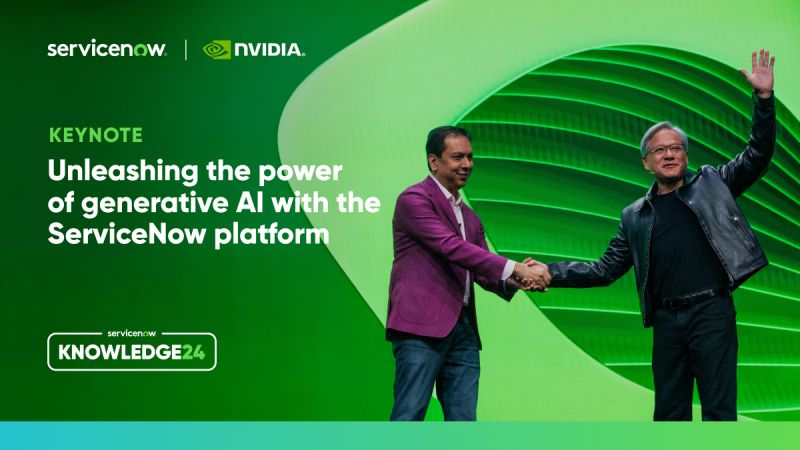
1. $NVDA picked $NOW as its enterprise AI partner. Jensen Huang on stage with McDermott. NOW runs NVDA's AI Factory.
2. Every AI agent needs an orchestration layer. $NOW is that layer. Token demand exploding = NOW's workflows process every single one.
3. $10.9B in contracted future revenue. 21%+ growth. Trump holds it. Smart money doesn't leave this trade.
♻️ RESHARE this post and write 1 comment how I helped you make money. I'll DM right now 1 stock under $5 that will 1000% from here.
$NOW was at $225 before it crashed to $80.
It's probably going to 20x-40x in 2 years.
Remember, CEO $NVDA Jensen Huang and President Trump said buy it.
It's playing out exactly for these:
$DELL at $230 → $430
$INTC at $20 → $130
$SNOW at $121 → $240
$DDOG at $120 → $225
$QCOM at → $125 → $250
$ORCL at $138 → $300 (target for earnings)
♻️RESHARE this post and write 1 comment, I'll DM the buy zone for $ORCL and $DELL