Category Labs is proud to introduce Cadence, our multiple-concurrent-proposers (MCP) consensus protocol that matches the optimal good-case latency of single-leader consensus while supporting arbitrarily short block intervals. When combined with BTX, our design for encrypted mempools, this represents a significant step towards solving the problem of MEV at the protocol level.
In nearly every blockchain today, a single party ends up in control of each block: it decides which transactions get in, and can reorder them at will. MCP is the natural fix, but most recent designs pay for it with a separate aggregation phase, adding two extra communication rounds per block.
Cadence makes the proposers part of consensus itself. Its fast path finalizes in an optimal three communication rounds, even when proposers are offline. Cadence also offers speculative finality, similar to MonadBFT, after just two rounds, revertible only if a proposer provably equivocated. In a simulation using estimated network delays between Monad mainnet's 200 globally distributed validators, finalization takes 219 ms on average, speculative finality 167 ms.
Cadence pushes pipelining to the extreme: each block is proposed and finalized in its own independent consensus instance, without waiting on preceding blocks. The block interval then becomes a protocol parameter that can be arbitrarily small. At our initial target of 100 ms, a transaction waits on average just 50 ms to enter a proposal, and oracle prices, liquidations, and auctions can update every 100 ms. Cadence dynamically throttles the opening of new instances to bound the number of outstanding slots even during periods of network instability.
When the network is healthy (under synchrony), a transaction included by an honest proposer can be neither dropped nor deferred (short-term censorship resistance), and no proposer can see the others' proposals in time to react (hiding). We prove both, together with safety and liveness under partial synchrony at the optimal 3f+1 fault bound.
The Cadence protocol is modular: each module is simple on its own, and any of them can be swapped out without touching the rest.
Cadence also builds on components already being deployed: proposals are disseminated as erasure-coded chunks over Deterministic RaptorCast, now rolling out on Monad, and validators vote on proposal digests, so voting does not wait for the full data to arrive.
Start with the interactive tutorial: https://t.co/U39juw7lWf.
Full paper: https://t.co/TVAzvaKHL8.
Joint work by Kushal Babel, Fatima Elsheimy, Lioba Heimbach, Mohammad Mussadiq Jalalzai, Tobias Klenze, Jovan Komatovic, Jason Milionis, Mike Setrin, and Victor Shoup.
Claude Science is incredible. I gave it some sequencing data, and in 8 hours it did a full analysis, generated figures, wrote a paper, submitted it for publication, got rejected, revised and resubmitted, got rejected again, it is now applying for positions in industry
2026 IC3 Blockchain Camp Recap:
Fatima Elsheimy, @Yale PhD student, presents IC3 research on Censorship Resistance vs Throughput in Multi-Proposer BFT Protocols.
Transaction censorship is a growing concern. Recent data shows 34.98% of Ethereum builders engage in some form of censorship.
Multi-proposer BFT architectures were designed to help, but introduce a fundamental tension:
It's disheartening to see so many root against Zcash.
We owe so much to the courage of the Zcash team: ten years ago, Zcash was a moonshot.
They were the 1st to deploy a *fully* anonymous payment system and the 1st to deploy a zkSNARK-based cryptosystem.
Rooting against the team being able to recover from this bug is rooting against all other serious privacy efforts for cryptocurrencies: they are all based on the same nullifier techniques via circuit-based zkSNARKs.
This is not a zero-sum game.
Zcash has been showing us the way for over a decade and will continue to do so.
e.g., Zcash will soon be the 1st team to deploy a *formally-verified* zkSNARK circuit implementation for anonymous payments.
Avi Wigderson is the only person in history to have won both a Turing Award (computer science) and Abel Prize (math). I interviewed him all about his field. We discussed:
• His intuition on a proof of P vs NP
• Why we use SAT solvers for most NP problems
• Zero knowledge proofs and their impact
• Quantum computation and implications
• Math and computer science's relationship
Where to watch:
• YouTube: https://t.co/zViqAulFCo
• Spotify: https://t.co/iat08Xob17
• Apple Podcasts: https://t.co/jOYDGtGVnt
• Transcript: https://t.co/k4zS7yOhnw
Thank you to this episode's sponsors for supporting my work:
• WorkOS: makes your app Enterprise Ready with easy to use APIs to add SSO, SCIM, RBAC, and more in just a few lines of code, check them out at https://t.co/y8noBzFEem
Timestamps:
00:00 - Intro
01:08 - P vs NP
14:51 - What if you relaxed correctness
25:38 - Why NP complete problems are equivalent
30:33 - Space vs time complexity
43:06 - Why people use SAT solvers
45:53 - Randomness is a resource
55:48 - Randomness depends on computational power
01:21:20 - Zero knowledge proofs and their significance
01:38:30 - Quantum computation and why it matters
01:56:24 - Math vs computer science
02:08:16 - Major breakthroughs and his experience
02:12:31 - Advice for his younger self
02:14:48 - Outro
Happy to share Proximity signatures, a note with @angeris!
What if we want to verify signatures on messages that are way too big? And in addition, get some guarantees on them?
Verifiers are then in a problem!
1/8
Recent weeks have brought a range of new ideas in quantum error correction for fault tolerant-quantum computing, along with deeper exploration of their implications. We introduce a new approach: a method for achieving high-threshold decoding of non-Pauli codes aimed at two-dimensional universality. Our results suggest that genuinely non-Clifford quantum operations in two-dimensional codes can perform comparably to those of a simple quantum memory. Central to this framework is a just-in-time decoding strategy, which proves to be remarkably effective.
https://t.co/FtY5xVjRYX
Warm thanks to Julio Carlos Magdalena de la Fuente, @noafeldman6, and Andreas Bauer of @FU_Berlin, @helmholtz_de Berlin and @MIT for the collaboration.
Crypto is not just a ledger of transactions---it’s a ledger of truth and trust. That’s what makes Bitcoin valuable. For Bitcoin this requires burning energy on random number guessing. What if we could instead leverage massive, real-world computation to achieve the same level of security? This has been an outstanding open problem for more than 30 years in academia, and since the emergence of blockchains in industry.
Last year, we proposed the first solution (https://t.co/awRFIzchqi). Our mathematical breakthrough suggests piggy-backing on matrix multiplications, the native operation of GPUs that power the AI revolution, from pre-training, post-training, to inference. The potential applications are endless: improving the unit-economics of LLMs, shifting AI-generated wealth back to users, and enabling new primitives such as settlement and even UBI systems for AI agents.
Since then, we've worked hard turning the math into a fully operational system. From the algebra and CUDA kernels to a working L1 blockchain and a production LLM inference pipeline implementing this “2-for-1” technology. Today, we’re excited to share that the @prlnet is ready, and will soon enable serving SoTA LLMs while mining the blockchain at negligible additional cost.
Along the way, we encountered many fascinating challenges. We’re now publishing them as a collaborative Polymath challenge, spanning open questions in math, systems and economics. If you’re interested, take a look and feel free to reach out: https://t.co/zwVQdTzJWK.
#PRL
#AIMoney
nobody accidentally swaps $50M into a pool with $36K of liquidity lol. fresh wallet, $50.4M from Binance, zero slippage protection, routed through the jankiest Sushiswap path possible. and then an MEV bot just happens to flash borrow $29M from Morpho in the same block and pocket $9.9M?
cmon. 0xngmi called this exact play a year ago - construct a deliberately terrible swap, let a friendly bot extract the value, dirty money comes out the other side as "legit MEV profit."
$154K per AAVE isn't a fat finger. it's a laundering fee
1/ Concerns for AI-generated content, age verification, and money laundering are driving online ID requirements. Zk proofs about your ID are not enough to do this privately or securely. Some new ( and less new) work from my lab addresses this. https://t.co/7uF8U30XFF
Always a good reminder that the people making these products are not using them. Zuck is spending his time doing MMA training, running a business, reading, buying Hawaiian real estate and talking to people.
This is meant for you. Not him.
He sells you plastic and rubber so he can buy wood and stone
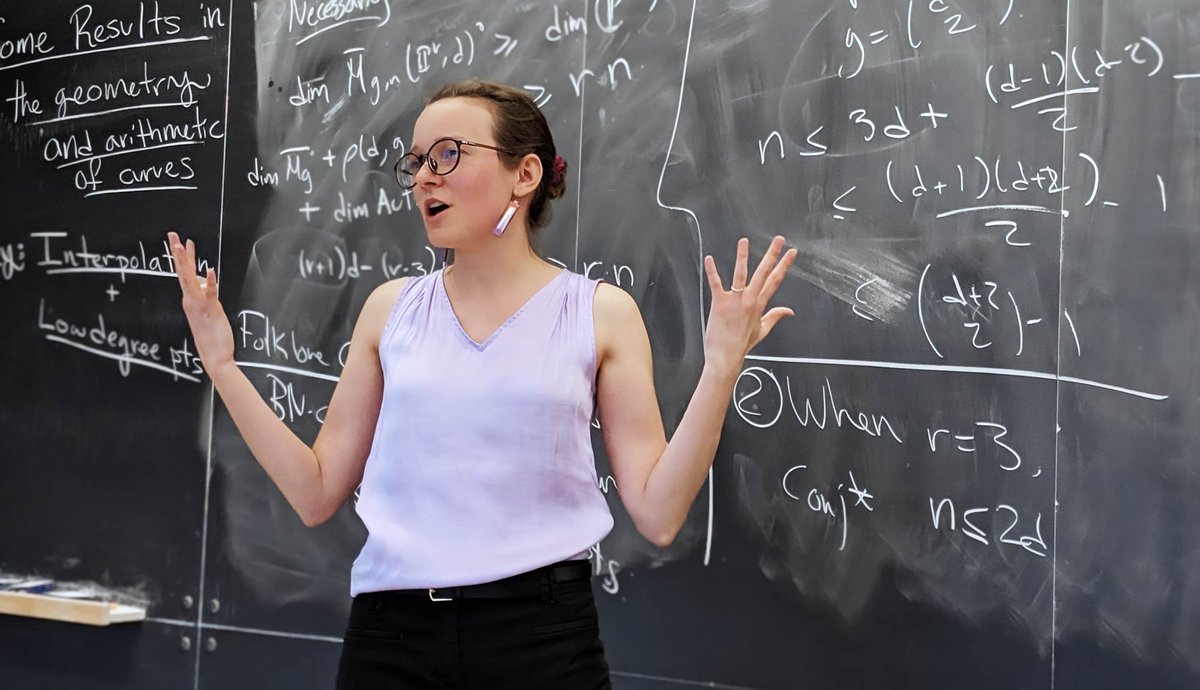
The married mathematicians Eric Larson and Isabel Vogt often found themselves discussing ideas after dinner, working through problems on the chalkboards they have in their home. The pair recently proved a centuries-old question about algebraic curves. https://t.co/sAO5CZPvHa