If you’ve got evidence that could expose misconduct by Kalshi, send it anonymously to:
[email protected]
Bring receipts pls
Screenshots, emails, data, timestamps etc
Hearsay is hard for us to use
If you’re not sure whether something matters
Send it anyway
Doing this again.
Borrowing USDG to subscribe to more robinhood:0xca9c78dd337a67f6e0077f65f5e9218719d30edf bonds.
But remember keep your LTV in check so you don't get liquidated.
You can buy $NET with USDG in size, skip the 5% tax and not move the market, or squeeze more staking yield out of the NET you already hold. Two ways to stack more.
After talking in DMs with @Network_Hustler we figured out:
1. My strat: Buying PT makes sense if you want to accumulate sNET with size and are buying with USDG, and/or if bond markets are still closed but you like the current price.
Sometimes PT can give u more net NET than bonds, even if you claim bonds and stake them after vesting.
That was my strat, paired with borrowing against my already existing wsNET even before the Credit Tab existed in UI (i went straight to the Morpho market, but you can do it in the UI now too). Turbo loop was too aggressive and I didn't want to lose my NET through liquidation while accumulating more, so I borrowed USDG against my NET and:
a) Subscribed to bonds whenever they were available.
b) Bought PT whenever Pendle PT buying net NET was equal to or greater than net NET of bond purchasing and subsequent staking.
These were automated with grokbot/agents so they ping u whenever bonds open and whenever net NET pt buying >= bond subscription.
2. @Network_Hustler strat - if you already have NET and want to accumulate more.
Buying YT when they are cheap makes sense if you bet on NET rebases not stopping or slowing down, so you buy rights to increased yield.
So basically if you are a NET bull and u do not believe rebases are going to stop, you bet on YT (really low chance of rebases stopping or slowing down, because that would mean a big big big dump to NAV prices - low possibility anytime soon).
currently not yet, but it will!
right now it shows per venue and combined view where , let's say i have btc spot + btc short perp hedge, so it shows net exposure in combined view. options is coming to combined view as well
cuz i was trying to understand myself what is my total exposure lmao
Mind is melting sometimes with too many trading terminals and open positions across venues. Crypto: spot, perps, options, defi positions, memes. Tradfi: spot, perps, options.
Working on combining all of them in one place to keep my sanity.
Been building Newfin for personal use - all in one finance/trading/investment app, personal finance, trading desk, powered by AI. Planning to outsource it, reply if you need/want something similar.
Planning to integrate @minara there as well as second brain running alongside and feeding data to my personal CFO/CIO agent who knows my context, trading style, my weaknesses and all my positions across all venues.
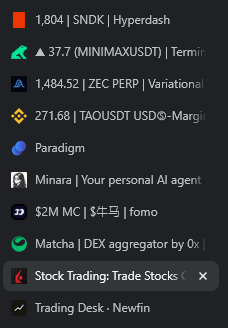
Apps/terminals I'm currently using (but it's more than that periodically):
@hypurrdash@InsilicoTrading@variational_io@binance@paradex@minara@fomo@matchaxyz@IBKR
In the future: Newfin + telegram gateway.
I read 10+ articles and watched 5 hours of content to understand what Jev actually is.
This is my attempt to put it all in one place, from how it works and what you can build + list of useful resources needed to go deeper. https://t.co/0Ofz3KKlQz
Jokes apart,
If you're trying to get genuinely good at LLM inference / AI systems, i think one of the best projects you can do is build an inference system yourself.
take a small open-weight model and start from basically nothing.
1. understand the inference path
take a pretrained model and figure out what actually happens on the GPU when you generate every token.
2. build a naive inference server
don't touch vLLM yet.
make the dumb version work first, then watch it fall apart.
3. add batching
understand why continuous batching matters.
measure TTFT, ITL/TPOT and throughput.
4. implement KV caching
then actually understand why decode becomes heavily memory-bandwidth bound.
5. build a scheduler
queues, priorities, backpressure, cancellation, timeouts...
now you're not just serving a model, you're managing a system.
6. fix your KV memory management
paged KV cache, block allocation, fragmentation, prefix caching.
7. optimize the GPU path
CUDA graphs, kernel fusion, quantization, attention kernels, CPU/GPU synchronization.
8. add speculative decoding
and figure out when it actually makes inference faster, and when it doesn't.
9. add observability
TTFT, ITL, throughput, GPU utilization, KV cache usage, queue time, preemptions...
10. throw real traffic at it
run concurrent requests with different prompt/output lengths.
find where throughput stops scaling and figure out what's actually bottlenecking you.
11. THEN read vLLM, SGLang, TensorRT-LLM and other serving engines.
now you can look at their design decisions and actually understand why they made them.
12. keep going deeper
multi-GPU, distributed inference, prefill/decode disaggregation, KV offloading, routing...
you don't need to build a production-ready serving engine.
the point is to get to the point where you can look at an inference system and understand why every ugly little optimization exists.
that's basically what i've been doing with my vLLM Inference Engine project.
and ngl, every time i thought i understood inference, the next bottleneck humbled me lol 😭
build the dumb version first.
let the bottlenecks teach you the architecture.
Link : https://t.co/bFY39lWJz4
Same here brother. Long way to go still.
But don’t look back, delete that ath / pre-10/10 number from your head.
It’s the past, it’s history.
And future is a mystery.
But today is a gift that’s why it’s called “the present”.
🍵~
A long way to go for me to recover my losses on 10/10 but I am confident I’ll get there even if it takes a while. Feel free to follow along on hyperdash.
Turns out Jev is not new or a breakthrough. Nandakishor Mukkunnoth built the same thing and released a paper and weights in 2025.
You can find more details on the same here: https://t.co/SYHpbXUzXU
Cannot emphasize this enough: "show your work".
You might have built something extraordinary, but if you cannot make it reach the world and make the world take notice of it, then you are doing a complete disservice to yourself, your efforts, and your sacrifices.
Respect the pump and pump will come to your coins whether it’s 2017 era shitcoin or 100k mc niggabut or useless governance token of the future of finance protocol farmer by everyone and their mothers.
But most likely it won’t.
High tides aren’t lifting all boats anymore like it used to.
Know your game, have thesis, build conviction and adapt to current meal of the day/week/month.
Be water my friend
🍵~
I just had a Citadel Quant send me this internal alpha they were all told to study over the weekend
He told me that this may be one of the most important videos any trader can ever watch
If NetNet's $100M by Oct 17 model lands:
~$555 of assets behind every $NET, it's $215 now
~$1,950 a token at today's 3.5x multiple
~$2,200 if the team's bid goes to 4x like they said
~3.7x for anyone staked, because balances grow ~1.44x along the way
about flat for stakers even if the premium goes to zero
$NET is $758. All speculative and all of it hangs on the model, which doesn't even count Predict, sportsbook, casino and other releases yet
That's the @NetNetCap bear case
FY-HI (🥅,🥅)
Same here brother. Long way to go still.
But don’t look back, delete that ath / pre-10/10 number from your head.
It’s the past, it’s history.
And future is a mystery.
But today is a gift that’s why it’s called “the present”.
🍵~