We use our treasury to support the growth of the Solana economy. That is, definitionally, DeFi.
But economies don’t exist in isolation. For Solana to be healthy, all of defi has to be healthy.
We like competition. We compete hard. But if we zoom out, we’re all pushing toward open finance and open systems.
We’ve deployed our treasury into Solana DeFi for many years. We supported Tether’s recovery plan for Drift.
In moments like these, it’s important to show up for the broader ecosystem too.
That’s why we are lending USDT into @aave for the first time to support their recovery efforts, and we will also be bringing $AAVE to Solana this weekend.
DeFi United
NFTs aren’t a trade. They’re a property system.
Before NFTs, digital culture had infinite distribution but zero ownership. Everything spread, nothing could be truly owned. Value went to platforms.
NFTs changed that.
Now culture can spread infinitely and be owned finitely.
That’s a big deal. Especially for art, where value has always come from provenance, story, and cultural relevance. NFTs don’t change those, they upgrade them:
- perfect, global provenance
- infinite distribution without breaking ownership
- borderless, liquid markets
People keep waiting for NFTs to “come back.”
But what’s actually happening is quieter: a parallel system for owning digital culture is compounding in the background.
And most people will miss it.
Because this isn’t about speed or hype like the first NFT cycle. It’s about owning pieces of the internet that matter.
The real question isn’t if NFTs return.
It’s how much of culture moves onchain and who owns it when it does.
I have been asked by several people what I meant when I said “we are in a world war” in my most recent note. To be clear, I didn’t mean to convey that I expect a shooting war between the U.S. and China (or any of the great powers) anytime soon. What I meant is that we are in the phase of the Big Cycle when major powers are in military wars and that the various wars happening now are interrelated, hence we are in a “world war," with the sides lined up as I described and with the implications for each of the main players and the whole unfolding in relatively classic interrelated ways that I describe as a progression of the Big Cycle.
For example, it is now widely believed that if the U.S. fails to open the Strait of Hormuz to have free shipping and to protect its Gulf Allies from attacks, countries all around the world (most importantly in Asia) will conclude that the U.S. might not be the strong ally and countervailing force to China that they thought it would be. which will lead some to tilt economically and geopolitically more toward China in a number of ways - e.g. to buy less U.S. debt (which is what happened to the British in the Suez Crisis, bringing about the ultimate end of their Empire) - and it could lead others to build up their military capabilities. As I complete my nearly three-week trip in Asia, I can convey that what I am saying is based on a lot more than conjecture.
The reason I do not expect a U.S.-China military war soon, but I do expect a lot of brinksmanship, is because both nations realize that such a war would be devastating and that it would be impossible to fully win over the other, at the same time as they won’t want to give much. Also, each country believes in its own economic and political systems and that the outcomes of those systems will determine their relative powers. And both nations have critically important domestic issues to deal with. Some people in leadership positions, especially in China, believe that the relative health, wealth, and power levels between countries is not as important as their own absolute health, wealth, and power levels, and that helping each other build these rather than tear them down is most important. For example, they believe that the world will be a dangerous place if the U.S. and China don't have AI cooperations and controls, and they are concerned that AI can be weaponized. Most countries know that most wars in history were won by one of the sides secretly developing new technologically advanced weapons and showing them to their opponents.
So, I believe that both sides think that their wars will be non-military wars that will yield evolutionary changes in relative powers. As for how the Chinese will fight, and how the world order related to it will evolve, it will probably look more like the type of war described in the “Art of War” (which I suggest you read if you haven't), and for how the new international world order will evolve, to the extent that it is influenced by the Chinese, it will evolve to be more like the tribute system (which I suggest you understand if you don’t) than the existing world order.
At the same time, I expect that there will continue to be trade, capital, technology, cyber, and geopolitical influence wars between these great powers and that both will continue to have justifiable fears of being cut off from essential goods, services, and capital that will necessarily will greatly reduce imbalances and interdependencies as well as efficiencies in production and trade of goods, services, and capital. I also believe we will increasingly see these two powerful nations pressure each other because there is no other way to resolve disputes now that the rules-based multilateral world order has been replaced by a power-based, self-serving world order.
Said differently, I expect that China will be very strong in its defense without being very aggressive in its offense. That is not just for tactical reasons; it is also because China has strong cultural inclinations to be that way.
I hope this is helpful in clarifying my thinking and as always I'd be happy to answer any other questions or hear your thoughts.
Ray
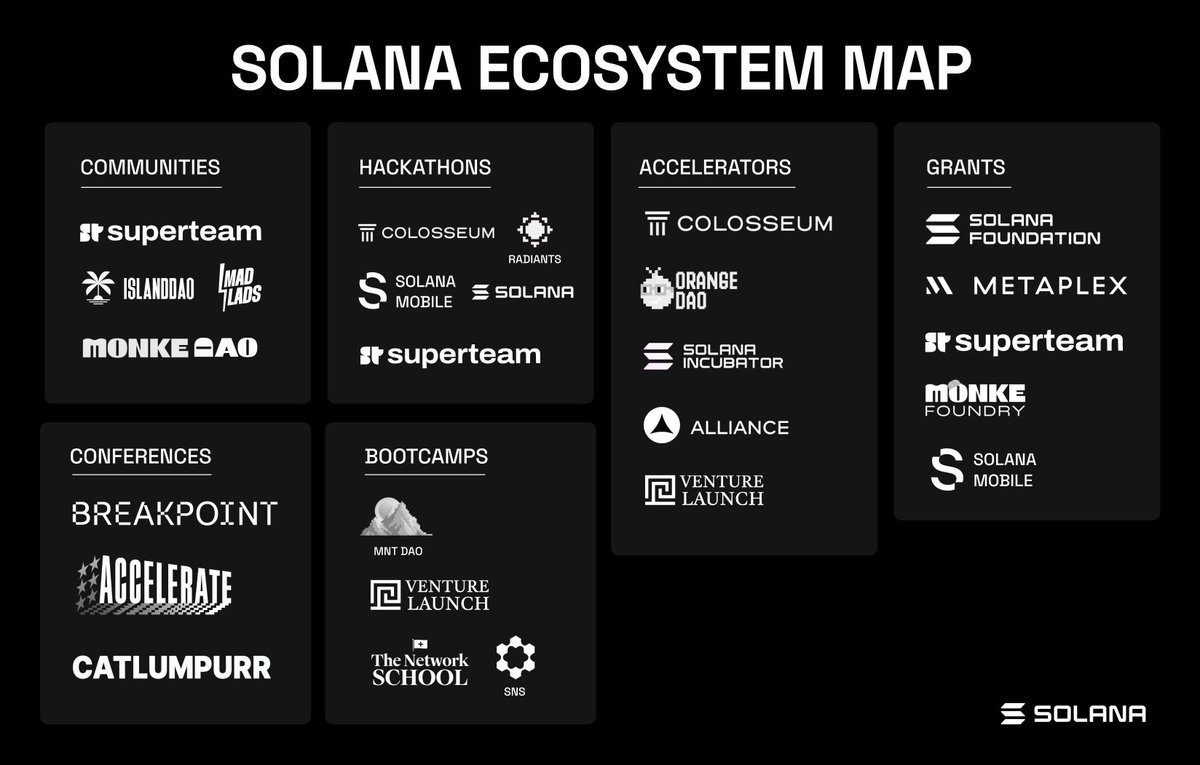
Solana Ecosystem Map 2026 for Founders.
@solana remains the strongest ecosystem to build on in crypto.
As the founder of @NOMADZxyz, I have spent years navigating the ecosystem end to end. From communities and hackathons to grants, accelerators, and fundraising, I have personally gone through each stage.
Based on that experience, here is a clear roadmap of the sources that deserve your attention in 2026.
1. Communities
Your starting point should be people. Surround yourself with founders, builders, and contributors who are already active in the ecosystem.
Start with:
➩ Global @superteam and local Superteams such as @SuperteamAE, @SuperteamDE, @SuperteamPOL, @SuperteamUKR, and others.
This is also one of the strongest entry points to access experienced builders and early-stage funding through Instagrants (up to $10k grants).
➩ Solana-native communities such as @MonkeDAO, @islanddao, and @MadLads.
2. Hackathons
Hackathons allow you to test your product in real conditions, receive feedback, secure early funding, and build long-term relationships.
Programs worth your attention:
➩ @colosseum, including main (twice a year) and Eternal tracks.
➩ @solanamobile & @RadiantsDAO, focused on mobile apps for the Solana dApp Store.
➩ Solana hackathons by @Arcium and @magicblock with multiple additional bounties.
➩ Local hackathons organized by Superteams.
3. Grants (Non-Dilutive Funding)
At an early stage, raising large amounts of venture capital is rare. Start with smaller, strategic funding that validates your project and extends your runway.
Key sources:
➩ @SolanaFndn ($40k on average)
➩ @MetaplexFndn (based on DAO decision)
➩ @superteam (up to $10k)
➩ @solanamobile (up to $10k)
➩ @MonkeFoundry (up to $10k)
4. Accelerators
Accelerators provide structured support in product development, go-to-market strategy, fundraising preparation, and network access.
Leading programs:
➩ @colosseum
➩ @OrangeDAOxyz
➩ @incubator led by @solanalabs
➩ @venture_launch
➩ @alliance
5. Conferences and IRL Events
Physical presence accelerates trust and relationship building. Strategic conversations at events often lead to partnerships, funding, and distribution opportunities.
Events that consistently generate outcomes:
➩ Solana Breakpoint and Accelerate by @SolanaEvents.
➩ Regional events hosted by Superteams.
➩ Events organized by ecosystem companies such as @Backpack, @MeteoraAG and @JupiterExchange.
6. Bootcamps
Bootcamps provide focused education and deep ecosystem immersion. They strengthen both expertise and relationships within specific verticals.
Strong options include:
➩ @mtndao
➩ @venture_launch
➩ @sns Month at the @ns
This roadmap is based on personal experience.
I have gone through almost all of these programs and understand the practical value they bring to founders.
Comment “Founder” and I will send you additional opportunities I am currently tracking inside the Solana ecosystem.
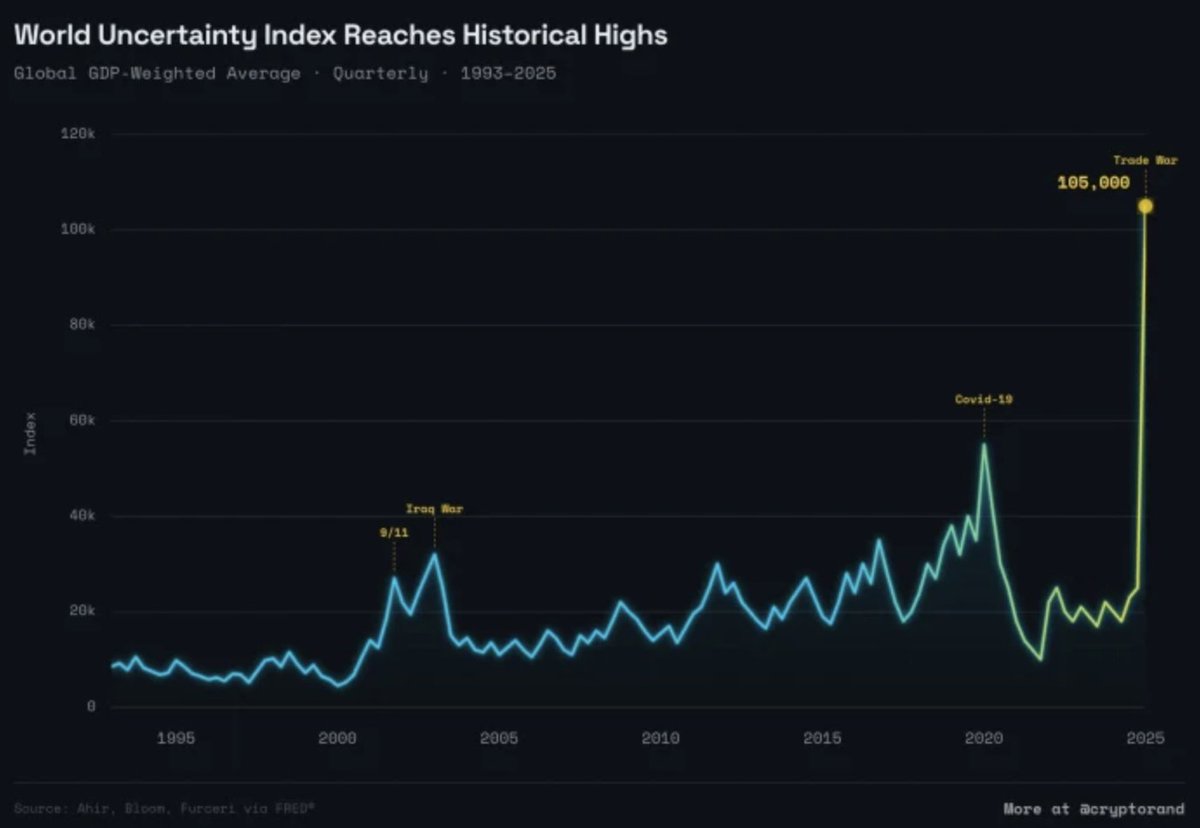
BREAKING 🚨: The World
The World reaches highest level of uncertainty in history, surpassing Covid, the Global Financial Crisis, and the Dot Com Bubble 👻🤯👀
The story isn’t “money printer go brr" anymore.
Lyn Alden calls it “the gradual print”:
“We are away from… fed balance sheet reduction.”
instead “we have shifted toward gradual fed balance sheet increases.”
“I tend to take the under those that are calling for calling for like major printing… those aren’t in my base case.”
How to Survive The Gradual Print Era — Fed Chair Warsh, Gold & Bitcoin
w/ @LynAldenContact🎬
Out on Mon Feb 16 📆