This is the story of Hyperliquid, the most profitable startup per employee on earth, told from a guarded office in Singapore.
Last year, its team of 11 generated $900 million in profit. It's 3 years old, has never taken a dollar of venture capital, and is beginning to change how century-old markets work.
Its founder, Jeffrey Yan (@chameleon_jeff), had never taken a physics class when he picked up a textbook at 16. Two years later, he won gold at the International Physics Olympiad. In 2019, he started trading with $10,000 from a living room in Puerto Rico—working off a television because he didn't own a monitor.
Within 3 years, he was running one of the largest anonymous crypto trading firms.
Then he shut it down. Yan was rich and free, but he had spent years inside crypto, watching it betray itself. Bitcoin's central premise was decentralization. Yet the biggest exchanges were centralized. Crypto kept reintroducing the dependence on trust it was built to eliminate. He set out to create what should have existed.
Hyperliquid is a blockchain with a trading exchange on top, and anyone can build on it. Yan's vision is to house all of finance. In 3 years, it has done over $4 trillion in volume. And in the past few months, it has begun to outgrow crypto.
Markets for oil, silver, and the S&P 500 now trade on Hyperliquid around the clock, weekends included, and are growing roughly 40% week on week. When the US and Israel bombed Iran on a Saturday in February, Hyperliquid was the venue traders turned to.
Hyperliquid's success has cost Yan his freedom. He works out of a secret office in Singapore and cannot travel without two bodyguards. Even the team's housekeeper doesn't know what they do.
In January, @domcooke spent a week at their office. Read his profile on Yan and @HyperliquidX below.
HyperCore will support outcome trading (HIP-4). Outcomes are fully collateralized contracts that settle within a fixed range. They are a general-purpose primitive that are useful for applications such as prediction markets and bounded options-like instruments. There has been extensive user demand in both of these areas, and builders will likely think of novel applications as well.
Outcomes bring non-linearity, dated contracts, and an alternative form of derivative trading that does not involve leverage or liquidations. The outcome primitive expands the expressivity of HyperCore, while composing with other primitives such as portfolio margin and the HyperEVM.
Outcomes are a work in progress and currently only being tested on testnet. Canonical markets based on objective settlement sources will be deployed once technical development is complete. Canonical markets will be denominated in USDH. Pending user feedback, the infrastructure will be extended to permissionless deployment.
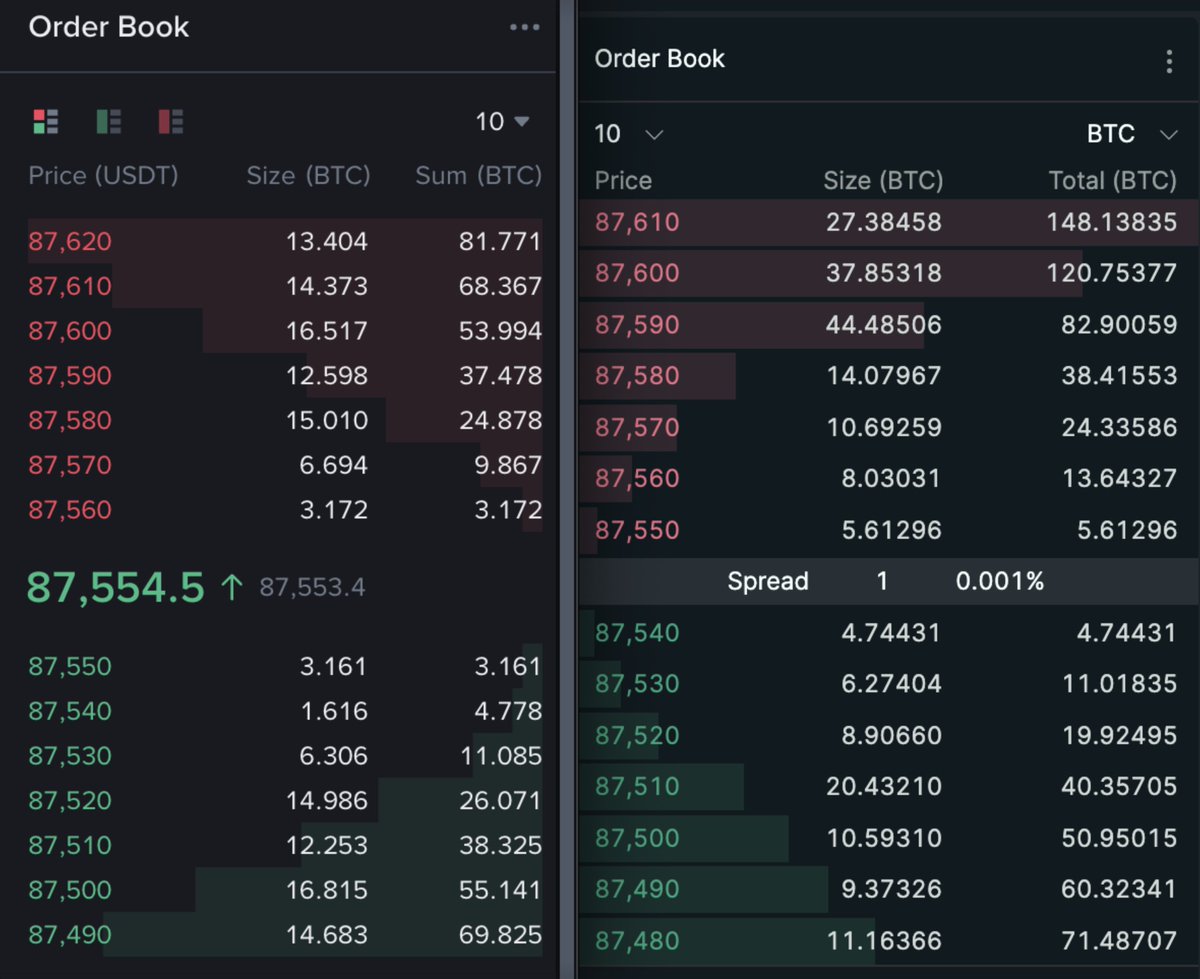
Hyperliquid has quietly achieved an important milestone of becoming the most liquid venue for crypto price discovery in the world. See below for side by side comparison of BTC perps on Binance (left) and Hyperliquid (right).
With HIP-3 teams leading the way, Hyperliquid has also grown to become the most liquid venue for perps on tradfi assets. Thank you to everyone's hard work as we upgrade the financial system and house all of finance.
Hyperliquid today looks very different from Hyperliquid a year ago. This time last year, the HyperEVM hadn’t even launched, and there were only a handful of early believers building exclusively on Hyperliquid. Now, there are hundreds of teams building, dozens of regional communities with local events, and trillions more in volume traded.
This was achieved without any external funding and giving all protocol fees to the community. Hyperliquid was built with a strong belief in returning to the core ethos of crypto - changing entrenched and predatory practices to be fair and permissionless.
This art piece is meant to celebrate Hyperliquid’s growing ecosystem and commemorate how far we’ve come as a community in building the house of all finance. You’ll find many of your favorite apps and teams interwoven in the piece if you zoom in. A special thank you to @Degen_Alfie for bringing the community to life. Many great teams didn’t make it due to limited space and time, but your contributions have not gone unnoticed!
Notable product and tech releases in 2025 included:
+ HyperEVM launch with HyperCore composability via precompiles and CoreWriter
+ Spot assets bridged by Unit
+ Fully permissionless validator set
+ Native utility to staking, with fee discounts for traders and permissionless HyperCore deployment capabilities for builders
+ Permissionless spot quote assets
+ Hypurr NFTs
+ USDH governance vote and launch by Native Markets
+ HIP-3 permissionless perp deployment
+ Native USDC integration
+ Portfolio margin pre-alpha launch
+ Assistance Fund HYPE officially burned
Compared to 2024, ATHs in 2025 reached:
+ $32B in 24h volume from $15B in 2024
+ $16B in open interest from $4B
+ $6B in TVL from $2B
+ $20M in 24h protocol revenue from $3.5M
+ 1.4M users from 300k
Excited to see what the ecosystem looks like another year from now. Thank you to all the builders, users, and supporters who have come together to push forward Hyperliquid’s vision.
Integrity has always been one of Hyperliquid's core values.
The house of all finance must be credibly neutral. This means no private investors, no market maker deals, and no protocol fees to any company.
The initial state of any blockchain is a crucial part of its story that can never be erased. The original ethos of Bitcoin was a permissionless network accessible to all. Hyperliquid's genesis distribution followed this spirit, going entirely to early users with core contributors excluded. The full distribution is verifiable onchain without obfuscation.
This principle of fairness frustrates a few users and builders who are used to special treatment. It means that Labs has zero tolerance for team members with integrity yellow flags. It means we do things the hard way as a community. But the world deserves a financial system owned by the people, where fairness to all users is in the DNA. Nothing else is worth building.
We are announcing the Lighter Infrastructure Token (LIT)! Lighter is building infrastructure for the future of finance and the native token is key to aligning incentives. In this thread, we will describe the structure of the token, broader vision, and roadmap of use cases.
HYPE in the Assistance Fund system address of 0xfefefefefefefefefefefefefefefefefefefefe has been formally recognized as burned.
The governance vote was based on stake-weighted consensus, with 85% of stake voting for burning, 7% against, and 8% abstaining.
Coinbase announced that Lighter (LIGHTER) has been added to its asset listing roadmap. The launch of trading will depend on the availability of market-making support and the readiness of technical infrastructure, with the trading start to be announced once conditions are met. https://t.co/jSiZAj6yQR
HYPE will die due to heavy competition
rn there are too many perps on the market, which means hyperliquid is facing way too much competition
in this segment, the monopolist wins, the market is structured so that the bigger your project’s market share, the more influence and demand it has
which means more collaborations, new builder interest, and consequently higher token demand
right now lighter, @StandX_Official, and other perps are ready to offer much more than hyperliquid
and we can see that hyperliquid is gradually losing its market dominance
what happens next? we can only watch, these are just my thoughts, but i think it’s time for hyperliquid to offer something new
“Ultimately, HL can evolve to become and open financial system for everything”
“main step right now is to… improve it until HL dethrones Binance as the place to trade futures period”
Hyperliquid’s fully onchain liquidations cannot be compared with underreported CEX liquidations
Hyperliquid is a blockchain where every order, trade, and liquidation happens onchain. Anyone can permissionlessly verify the chain’s execution, including all liquidations and their fair execution for all users. Furthermore, anyone can verify the solvency of the entire system in real time. Transparency and neutrality are key reasons that fully onchain defi is the ideal infrastructure for global finance.
Some CEXs publicly document that they dramatically underreport user liquidations. For example on Binance, even if there are thousands of liquidation orders in the same second, only one is reported. Because liquidations happen in bursts, this could easily be 100x under-reporting under some conditions. Source below.
Hopefully the industry will see transparency and neutrality as important features of the new financial system, and others will follow.
TLDR: During recent volatility, Hyperliquid had 100% uptime with zero bad debt. This was Hyperliquid’s first cross-margin ADL in more than 2 years of operation. ADL does not change the outcome for any liquidated users. While some specific ADL providing trades were unfavorable, the aggregate effect of ADL was that traders realized significant pnl by closing positions at favorable prices that were only briefly available.
--
It’s sad to see some people attack Hyperliquid to deflect from their own platforms’ issues. Solvency and uptime are the two most important properties of a financial system. These are table stakes for any trading system, and gaslighting to convince users otherwise is unethical and irresponsible.
Below is more analysis on how Hyperliquid’s margining system handled the extreme volatility.
Background on liquidations
For a perps system to be solvent, every position must be backed by a minimum amount of collateral. This is called the “maintenance margin.” When positions do not meet the maintenance margin requirement, they are taken over by the system to be liquidated. Earlier today, many altcoins dropped by more than 50% in a short period of time. When this happens, long positions at 2x or higher leverage must be liquidated, or else the system accrues bad debt.
There were billions of dollars worth of positions liquidated on Hyperliquid in a matter of minutes. In a permissionless system, each user chooses their own position sizing and collateralization. Any system that does not liquidate the necessary users is irresponsibly gambling with other users’ funds. On Hyperliquid, every order, trade, and liquidation is transparently verifiable onchain. Many other venues significantly under-report liquidation data. This cannot be compared apples-to-apples against the fully onchain picture of Hyperliquid.
Background on HLP
HLP is a protocol vault with permissionless deposits that 1) provides order book liquidity and 2) performs backstop liquidations. The first role is negligible, with HLP trading less than 1% market share. The focus of this post is liquidations.
Liquidations are first attempted against the order book, and any user can provide liquidity to these market liquidations. Backstop liquidations occur when the order book does not have enough liquidity to absorb an undercollateralized position. In this case, HLP takes over the position along with its collateral. For improved risk management, HLP is split into several child vaults, and each liquidation is only sent to one child vault.
Background on ADL
Auto-deleveraging (ADL) is the liquidation mechanism of last resort, when market and backstop liquidations do not work. See Doug’s thread (link in reply) for a thorough explanation on the details of ADL.
Every ADL event has two sides: the “triggered” side is undercollateralized, while the “providing” side is decided as a function of profitability and leverage used.
Similar to backstop liquidations, even though providers to ADL are profitable on average, there are no guarantees for any specific event. Some ADL providing trades were unfavorable, such as when only some components of long/short portfolio were closed. The system is designed to minimize ADLs because they are unpredictable even if ADL providing trades are profitable on average. Because HLP is a non-toxic backstop liquidator, ADL is a rare settlement of last resort. As far as I know, this was the first cross-margin ADL event on Hyperliquid mainnet (ADL is more common for isolated-only assets such as hyperps, which are not backstop liquidated by HLP).
Summary of events
Over the course of 20 minutes, HLP backstop liquidated billions of dollars worth of positions.
HLP's philosophy has always been to provide liquidity of last resort. Contrary to misconceptions, HLP is a non-toxic liquidator that does not pick profitable liquidations. Instead HLP is a public good for maintaining system solvency. In particular, Hyperliquid has no liquidation fees. HLP’s design, including its multi-component child vault system, is the product of countless simulations, and allows HLP to maximally serve the benefit of the protocol while managing its own risk.
In fact, the liquidator child vaults of HLP themselves became undercollateralized in the course of backstop liquidating as many user positions as possible. This is by design, where child vaults are isolated from the other components of the overall strategy. HLP is treated no differently from other users when participating in ADL. In aggregate, HLP's child vaults were the largest addresses on the triggered side of ADL by more than an order of magnitude. The addresses on the providing side of ADL against HLP’s child vaults realized hundreds of millions of dollars in additional profit relative to the prices shortly before and after the dislocation.
On other venues, the liquidation engine is not transparent and therefore may not be subject to the same strict margin requirements as for normal users. On these venues, the exchange could have backstop liquidated more positions, bearing increased solvency risk to extract hundreds of millions in business revenue. This is not an acceptable tradeoff for Hyperliquid.
Finally, I know that this is a difficult time for many traders, and I hope the community can continue to support each other and grow together. As a contributor to Hyperliquid, I’ll continue to work my hardest to build the best possible platform that can house all of finance. Times like this highlight the importance of transparency and fairness in the financial system.