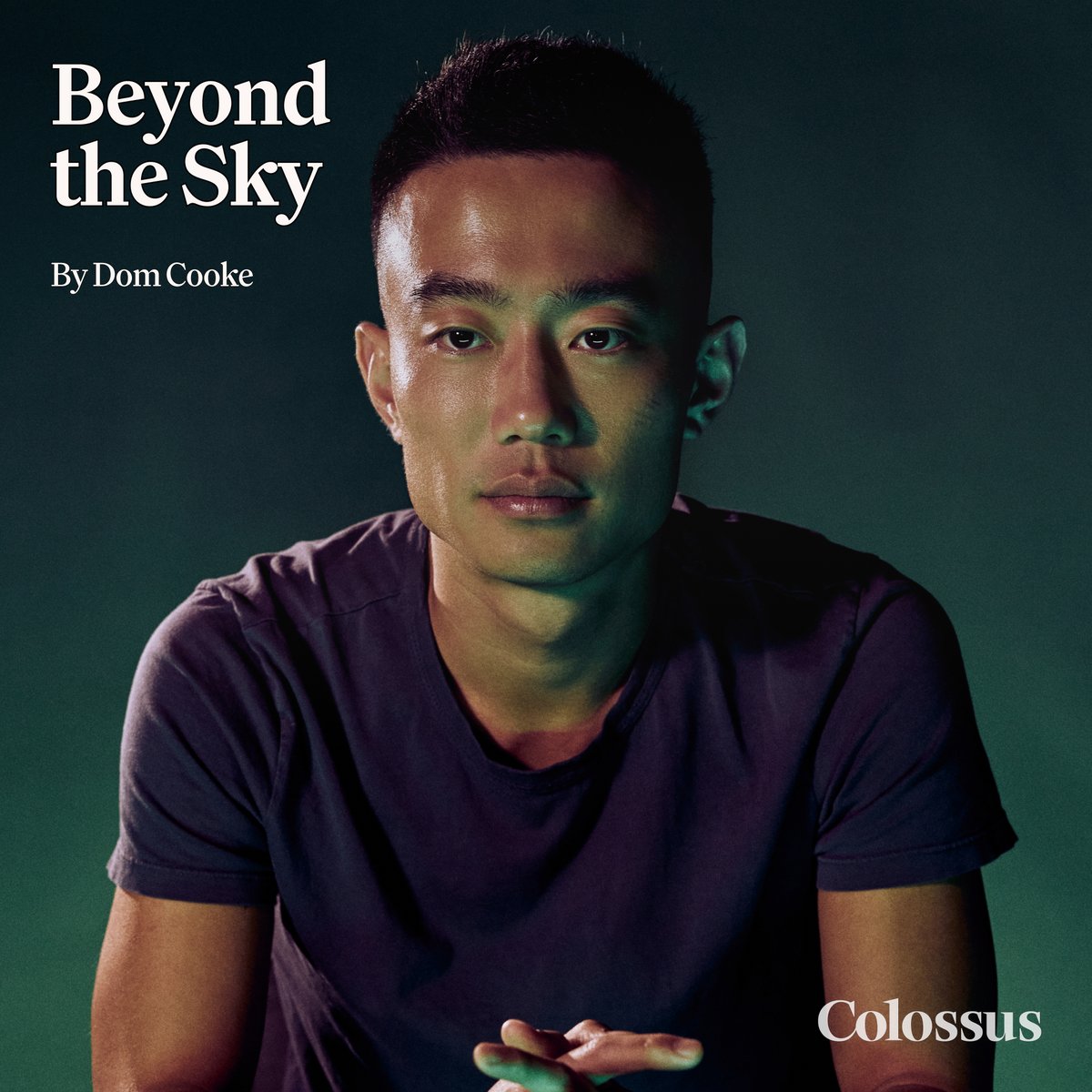
This is the story of Hyperliquid, the most profitable startup per employee on earth, told from a guarded office in Singapore.
Last year, its team of 11 generated $900 million in profit. It's 3 years old, has never taken a dollar of venture capital, and is beginning to change how century-old markets work.
Its founder, Jeffrey Yan (@chameleon_jeff), had never taken a physics class when he picked up a textbook at 16. Two years later, he won gold at the International Physics Olympiad. In 2019, he started trading with $10,000 from a living room in Puerto Rico—working off a television because he didn't own a monitor.
Within 3 years, he was running one of the largest anonymous crypto trading firms.
Then he shut it down. Yan was rich and free, but he had spent years inside crypto, watching it betray itself. Bitcoin's central premise was decentralization. Yet the biggest exchanges were centralized. Crypto kept reintroducing the dependence on trust it was built to eliminate. He set out to create what should have existed.
Hyperliquid is a blockchain with a trading exchange on top, and anyone can build on it. Yan's vision is to house all of finance. In 3 years, it has done over $4 trillion in volume. And in the past few months, it has begun to outgrow crypto.
Markets for oil, silver, and the S&P 500 now trade on Hyperliquid around the clock, weekends included, and are growing roughly 40% week on week. When the US and Israel bombed Iran on a Saturday in February, Hyperliquid was the venue traders turned to.
Hyperliquid's success has cost Yan his freedom. He works out of a secret office in Singapore and cannot travel without two bodyguards. Even the team's housekeeper doesn't know what they do.
In January, @domcooke spent a week at their office. Read his profile on Yan and @HyperliquidX below.
This is the story of Hyperliquid, the most profitable startup per employee on earth, told from a guarded office in Singapore.
Last year, its team of 11 generated $900 million in profit. It's 3 years old, has never taken a dollar of venture capital, and is beginning to change how century-old markets work.
Its founder, Jeffrey Yan (@chameleon_jeff), had never taken a physics class when he picked up a textbook at 16. Two years later, he won gold at the International Physics Olympiad. In 2019, he started trading with $10,000 from a living room in Puerto Rico—working off a television because he didn't own a monitor.
Within 3 years, he was running one of the largest anonymous crypto trading firms.
Then he shut it down. Yan was rich and free, but he had spent years inside crypto, watching it betray itself. Bitcoin's central premise was decentralization. Yet the biggest exchanges were centralized. Crypto kept reintroducing the dependence on trust it was built to eliminate. He set out to create what should have existed.
Hyperliquid is a blockchain with a trading exchange on top, and anyone can build on it. Yan's vision is to house all of finance. In 3 years, it has done over $4 trillion in volume. And in the past few months, it has begun to outgrow crypto.
Markets for oil, silver, and the S&P 500 now trade on Hyperliquid around the clock, weekends included, and are growing roughly 40% week on week. When the US and Israel bombed Iran on a Saturday in February, Hyperliquid was the venue traders turned to.
Hyperliquid's success has cost Yan his freedom. He works out of a secret office in Singapore and cannot travel without two bodyguards. Even the team's housekeeper doesn't know what they do.
In January, @domcooke spent a week at their office. Read his profile on Yan and @HyperliquidX below.
Anyone who knows Matt will know this. He is the best.
It's been such a privilege to work with him and learn from him. I'm sad this era has come to an end, but I'll remember it so fondly.
He did once take me up a bear-infested mountain that was closed, for good reason, to hikers. But other than that, it's been all smiles. Excited to see what he comes up with next.
Henry Ellenbogen ran T. Rowe Price's New Horizons Fund for a decade before founding Durable Capital.
He explains the limitations of quant strategies and the opportunities for traditional (human) investors:
"I went to spend time with the principal at Two Sigma. I realized there were real limitations to what the quants could do.
If it's a repeat actor problem based on known data, the quants are pretty good.
[But] one of the limitations is if you work at a firm that deeply measures your risk every day, and then if you have a bad period of time –– measured by a month but certainly three months –– you get your capital cut back, or there's a good chance you get let go.
It probably means you can't have a time horizon longer than your career horizon.
If you study earnings volatility, [Q2 2025] was more volatile than any earning season since the financial crisis.
The reason for that is that we estimate somewhere between 80-90% of the institutional flow is driven either by the firms that have one month and three month agency, or the quants that have to take these price signals into account, and then their models are optimized for this.
But if you're like what we were at the time, people who are really good at understanding people and really good at understanding change, that was really advantaged.
At my old firm, I did an internal teach-in on man versus machine, and I said as a result what the New Horizons Fund is gonna go do is we're gonna go double down on these two things."
From our conversation in December 2025
My conversation with @DanielSLoeb1, his first ever podcast and one I've been wanting to do for years.
Dan started Third Point in 1995 with $3 million. Today the firm manages over $24 billion across equities, credit, venture, and insurance.
Along the way he wrote some of the most iconic activist letters.
We discuss:
- Why deep value stopped working
- The power of writing
- The Twitter and XAI credit trades
- Lessons from FTX and Danaher
- The Sony and Sotheby's stories
- What makes a great analyst today
- The importance of kindness
I feel lucky we all get to learn from one of the greats.
Enjoy!
Timestamps:
0:00 Intro
2:48 Macro Views and Tech Trends
5:13 The Roots of Third Point
10:30 Evolving to Quality and Thematic Investing
19:07 Market Psychology and Inefficiencies
24:10 Good and Bad Corporate Governance
29:19 Activism
31:23 Sotheby's
41:37 AI
44:28 Sony
52:50 Danaher's Operating System
56:31 Building an Insurance Business
59:25 FTX
1:05:17 What Makes a Great Analyst Today
1:07:24 The Next Decade
1:10:00 Kindest Thing
I think @colossusjeremy is among the great writers…
In past lives he helped run the US embassy in Germany, and for years before that was an EOD officer in the Army.
He wrote this for Memorial Day.
I feel extremely lucky to work with him, and that people like him serve us all
In a previous life, @colossusjeremy was a bomb squad technician in the U.S. Army. From 2014 to 2019, he deployed to five countries in the Middle East and Central Asia.
For Memorial Day, he wrote about a soldier who killed himself shortly after their deployment, and a memorial service that became less about the man who died than the people left in the room.
There is little that’s redemptive or feel-good in the story, and it has nothing to do with business, investing, or technology. But it will leave you thinking about how often we fail to see a person clearly until it’s too late, and sometimes not even then.
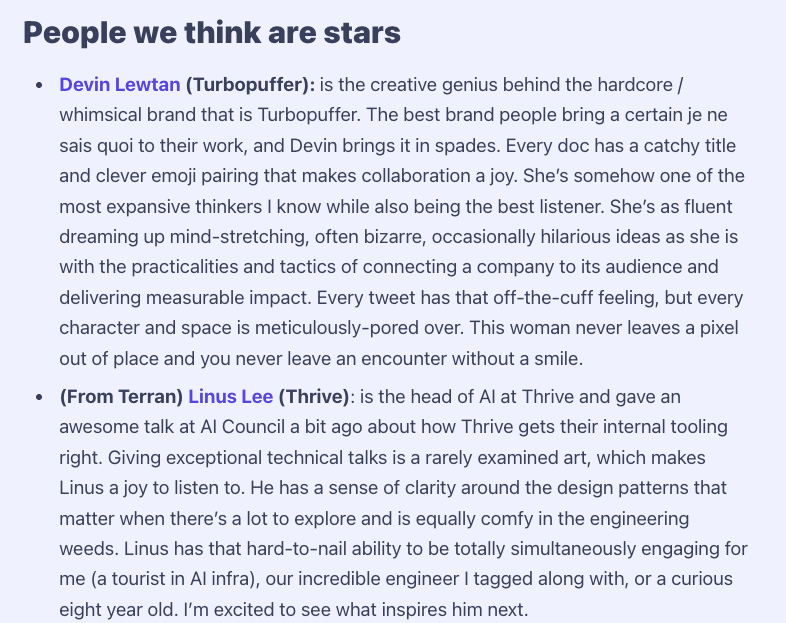
favorite part of worklife: learning from incredible people
favorite part of writing early days: showing them off
in today's edition, love for @DevinLewtan and @thesephist & a cameo from @TerranMott
This is my sixth conversation with @GavinSBaker.
As always with Gavin, the conversation covers a lot of ground, but we spend the most time on watts and wafers.
We discuss:
- Why the wafer shortage may prevent an AI bubble
- Data centers in space (reframed)
- Elon's Terafab and the new chip companies challenging Nvidia
- Usage-based pricing
- The disaggregation of GPUs
- DRAM, frontier tokens, and open source
Enjoy!
Timestamps:
0:00 Intro
7:55 Anthropic and OpenAI Valuations
12:58 Watts, Wafers, and Infrastructure
14:39 Orbital Compute and Data Centers in Space
22:49 Avoiding the AI Bubble
28:26 Terafab and the Future of US Manufacturing
32:16 Returns to the Frontier
37:23 Continual Learning
42:03 New Chip Companies
48:52 Extending GPU Lifespans and Private Credit
51:22 The Application Layer
57:32 The Token Path and Open-Source Dynamics
1:01:37 Cybersecurity
1:05:46 Diversity Breakdown
1:11:59 Assessing the Big Tech Players in AI
1:19:02 Geopolitics, Personal Safety, and the AI Horizon
.@camillericketts and I first got introduced to @eigenhq by Akshay, Notion’s COO, who said its founder, @paulscherer, reminded him of Ivan, Notion’s exquisitely high-taste founder.
Then there was Benchmark’s $15M seed bet and Peter Fenton’s tweet putting Eigen in the lineage as “TheFacebook, Twitter, Instagram, and SnapChat.”
Stuff like this gets said pretty often about founders–especially by investors–but after spending time with Paul and the team, we think there’s something special going on here.
A dispatch from a month with Eigen and their honestly 🤯'ing mutual friend.
Who would you love us to profile in @colossusmag ?
Our sweet spot has been: incredible people who’ve not been covered or interviewed often.
Who would you suggest we try for?
And right after the below, I hired him as the graduate level algorithms TA for the next semester. As a sophomore. 🥰
'During the spring semester of his freshman year, Yan enrolled in computer science 124, data structures and algorithms. It is a course taken mainly by sophomores and juniors, and it has a reputation for misery. Students in Harvard’s course guide have described it as “a necessary evil.” One review warned, “No social life. You will be maiden-less.” There were 150 students. Yan, the freshman, finished first, and it was not close.'
If you don't know Jeremy Stern, you probably know his work
He's the man behind the profiles of Palmer Luckey, Neil Mehta, Shyam Sankar, Josh Kushner, and Scott Wu
We talked about :
- what makes someone worth writing about
- how founders can give better interviews
- what to expect if you get profiled
- how to become a better writer
Thank you @colossusjeremy and @colossusmag for what you do!















![InvestLikeBest's tweet photo. Henry Ellenbogen ran T. Rowe Price's New Horizons Fund for a decade before founding Durable Capital.
He explains the limitations of quant strategies and the opportunities for traditional (human) investors:
"I went to spend time with the principal at Two Sigma. I realized there were real limitations to what the quants could do.
If it's a repeat actor problem based on known data, the quants are pretty good.
[But] one of the limitations is if you work at a firm that deeply measures your risk every day, and then if you have a bad period of time –– measured by a month but certainly three months –– you get your capital cut back, or there's a good chance you get let go.
It probably means you can't have a time horizon longer than your career horizon.
If you study earnings volatility, [Q2 2025] was more volatile than any earning season since the financial crisis.
The reason for that is that we estimate somewhere between 80-90% of the institutional flow is driven either by the firms that have one month and three month agency, or the quants that have to take these price signals into account, and then their models are optimized for this.
But if you're like what we were at the time, people who are really good at understanding people and really good at understanding change, that was really advantaged.
At my old firm, I did an internal teach-in on man versus machine, and I said as a result what the New Horizons Fund is gonna go do is we're gonna go double down on these two things."
From our conversation in December 2025](https://pbs.twimg.com/media/HJfjqPlXUAILgYZ.jpg)