I chimed in on @zebriez and @camillericketts' Early Days today, which you subscribe to bc its the closest thing to literally following them around finding the coolest projects and the most amazing people doing their best work
favorite part of worklife: learning from incredible people
favorite part of writing early days: showing them off
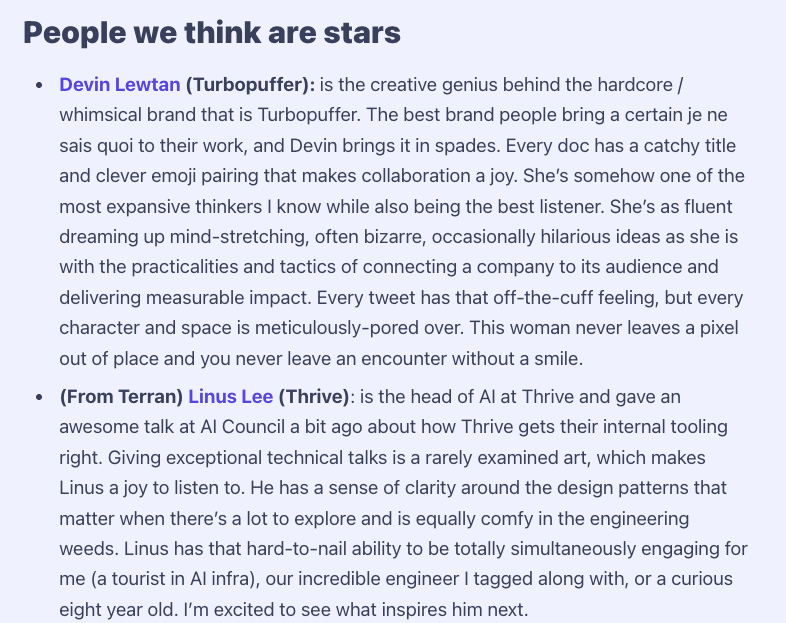
in today's edition, love for @DevinLewtan and @thesephist & a cameo from @TerranMott
I spent my phd studying good and harmful ways people can interact with social robots. Eigen makes me more optimistic about social tech than I’ve ever been, this is such a fun and compelling window into what they’re up to
I’d follow Brie and Camille around anywhere, can’t wait to see where this series takes the next!
.@camillericketts and I first got introduced to @eigenhq by Akshay, Notion’s COO, who said its founder, @paulscherer, reminded him of Ivan, Notion’s exquisitely high-taste founder.
Then there was Benchmark’s $15M seed bet and Peter Fenton’s tweet putting Eigen in the lineage as “TheFacebook, Twitter, Instagram, and SnapChat.”
Stuff like this gets said pretty often about founders–especially by investors–but after spending time with Paul and the team, we think there’s something special going on here.
A dispatch from a month with Eigen and their honestly 🤯'ing mutual friend.
.@camillericketts and I first got introduced to @eigenhq by Akshay, Notion’s COO, who said its founder, @paulscherer, reminded him of Ivan, Notion’s exquisitely high-taste founder.
Then there was Benchmark’s $15M seed bet and Peter Fenton’s tweet putting Eigen in the lineage as “TheFacebook, Twitter, Instagram, and SnapChat.”
Stuff like this gets said pretty often about founders–especially by investors–but after spending time with Paul and the team, we think there’s something special going on here.
A dispatch from a month with Eigen and their honestly 🤯'ing mutual friend.
Scott Wu is the co-founder of Cognition AI, one of the fastest-growing companies in history. He’s also the greatest competitive programmer the US has ever produced. You may have seen him doing impossible card tricks and mental math.
You’ve never seen him asked about weed, Michael Jordan, cancer, and human consciousness over a punnet of strawberries. That is what Colossus editor-in-chief Jeremy Stern did on a recent visit to San Francisco.
For those less familiar with @ScottWu46: In 2nd grade, he entered a math competition for 7th graders, lost, and was so furious he still fumes about it 20 years later. The next year he entered the 9th-grade division as a 3rd-grader and got a perfect score.
Then he won first place at the US national middle-school math competition and three straight gold medals at the International Olympiad in Informatics, where he became the greatest American gold-medalist and coach in history.
Most of the people running the biggest AI companies met as teenagers, competing for their countries on international math and science teams. OpenAI’s Greg Brockman, Anthropic’s Dario Amodei, Meta’s Alexandr Wang, to name just a few.
Most agree that the von Neumann among them was Scott Wu.
In November 2023, a few weeks after his mother died of lung cancer, on the day Sam Altman was fired from OpenAI, Wu founded his own AI company: Cognition.
He was 26 and saw earlier than almost anyone that AI would converge on agents that work in the background, 24/7, like coworkers. He shipped Cognition’s AI software engineer Devin in March 2024. It worked poorly, and he took intense public criticism for it.
Now, in its first 18 months of service, Devin has generated $445 million of revenue run rate and usage has doubled every eight weeks. The US Army, Goldman Sachs, and Mercedes-Benz are all customers. Cognition is raising at a valuation around $25 billion.
@JeremySternLA sat down with Wu, the emperor of the nerds, to ask the questions we’d all ask one of the smartest people in America—building the most consequential technology of our generation—if we ever got the chance.
As well as MJ and weed, they talk about the cluster of competitive math prodigies behind so much of AI, what makes us human when AGI arrives, and why Wu believes he was put on this earth to teach AI how to code.
Read the piece below.
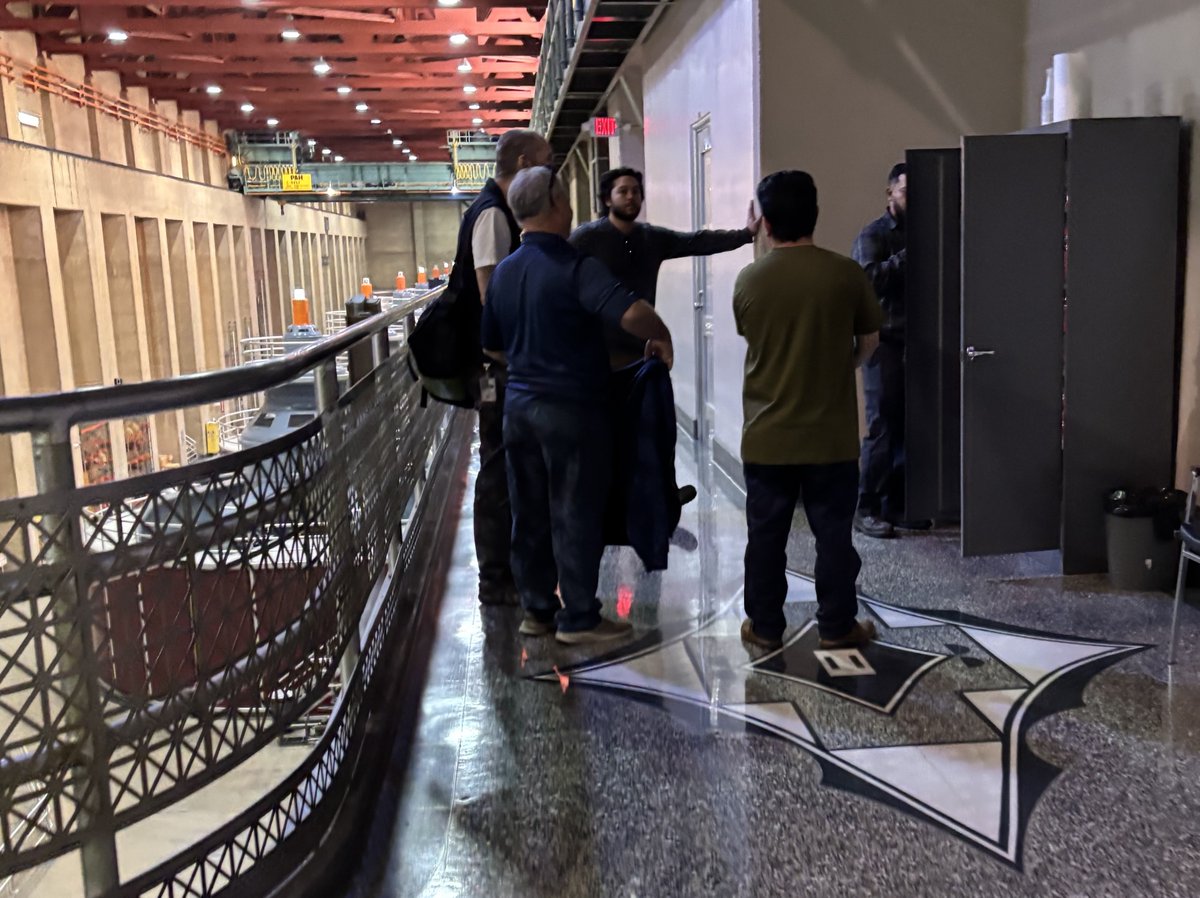
The Hoover Dam has all these wonderful art deco details, such a cohesion of the design + civilization-scale projects of its time. Made me curious if anyone is creating era-defining design for compute
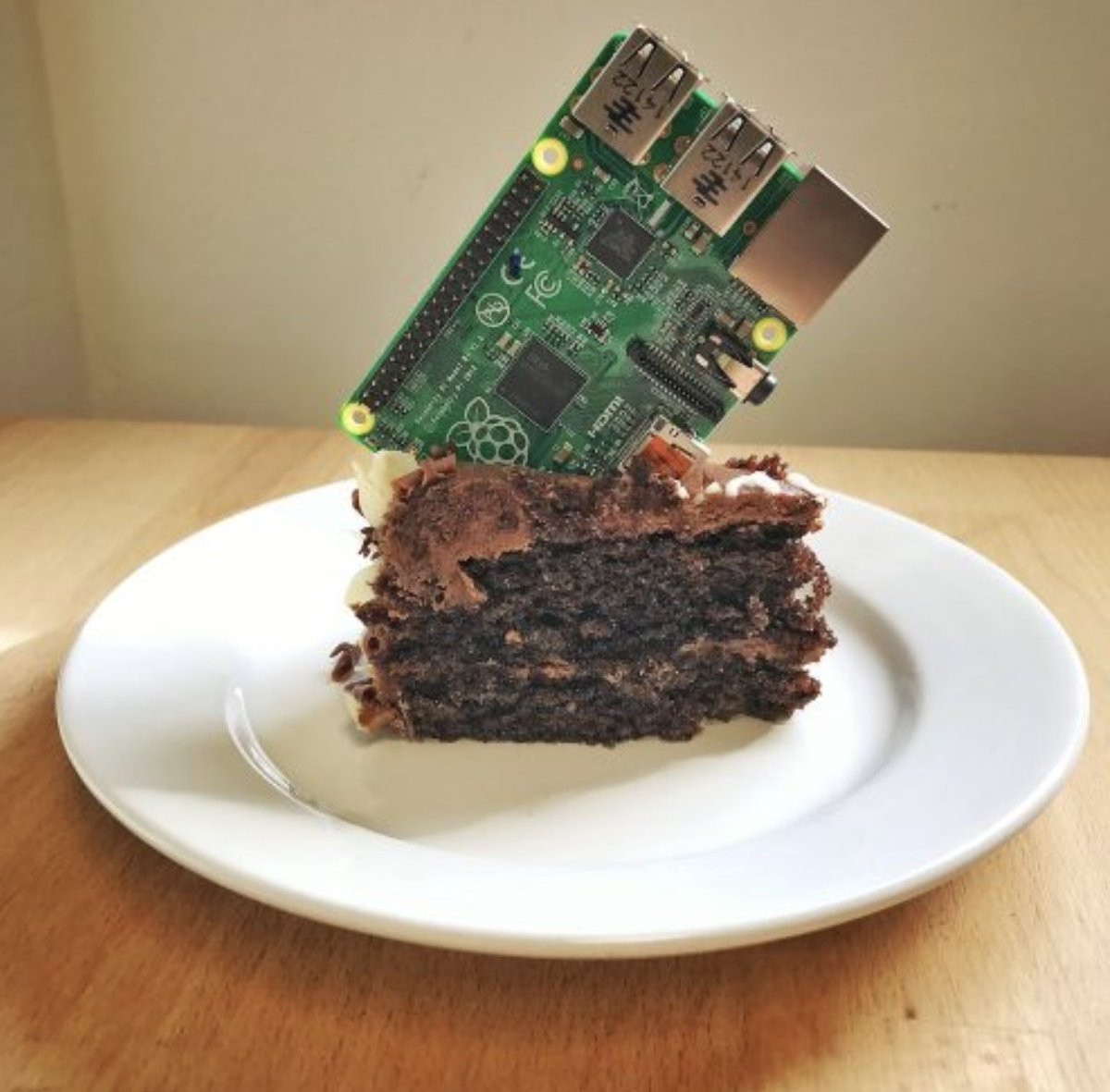
The third best-selling computer platform in history, after Windows PCs and the Mac, began as a recruiting tool for Cambridge University's computer science department.
It's the size of a credit card, has no case, and costs less than a pair of shoes.
Eben Upton built Raspberry Pi in 2012 to get more applicants into Cambridge's computer science course, then the easiest to get into. He thought kids needed the real thing: a general purpose programmable computer (like his childhood BBC Micro) to fall in love with the unbounded creativity of coding. He was more right than he could have imagined.
On launch day in 2012, he sold 100,000 computers. A million shipped before Raspberry Pi hired an employee. Computer science is now the hardest course to get into at Cambridge, and Raspberry Pi is a $1.5 billion public company that has sold over 73 million units. 80% of its revenue comes from industry.
Every digital display at Heathrow runs on a Pi. Schindler uses them in its elevators. The International Space Station has carried one in orbit since 2015.
You'll also find the tiny computers wherever the next thing is. Bitcoin mining farms ran on them. So did the first wave of hobbyist drones. Pis now run LLMs. In five years, Upton thinks Claude Sonnet-class intelligence will fit in your pocket.
Most tech conversation is about the frontier: the newest chips, the biggest models, trillion-dollar training runs. Raspberry Pi is a case study in the opposite. It shows what cheap, general-purpose, and performant-enough can achieve. It's also a rare British hardware success story, designed in Cambridge, manufactured with Sony in Wales, and reshored from China a decade before the rest of the industry caught on.
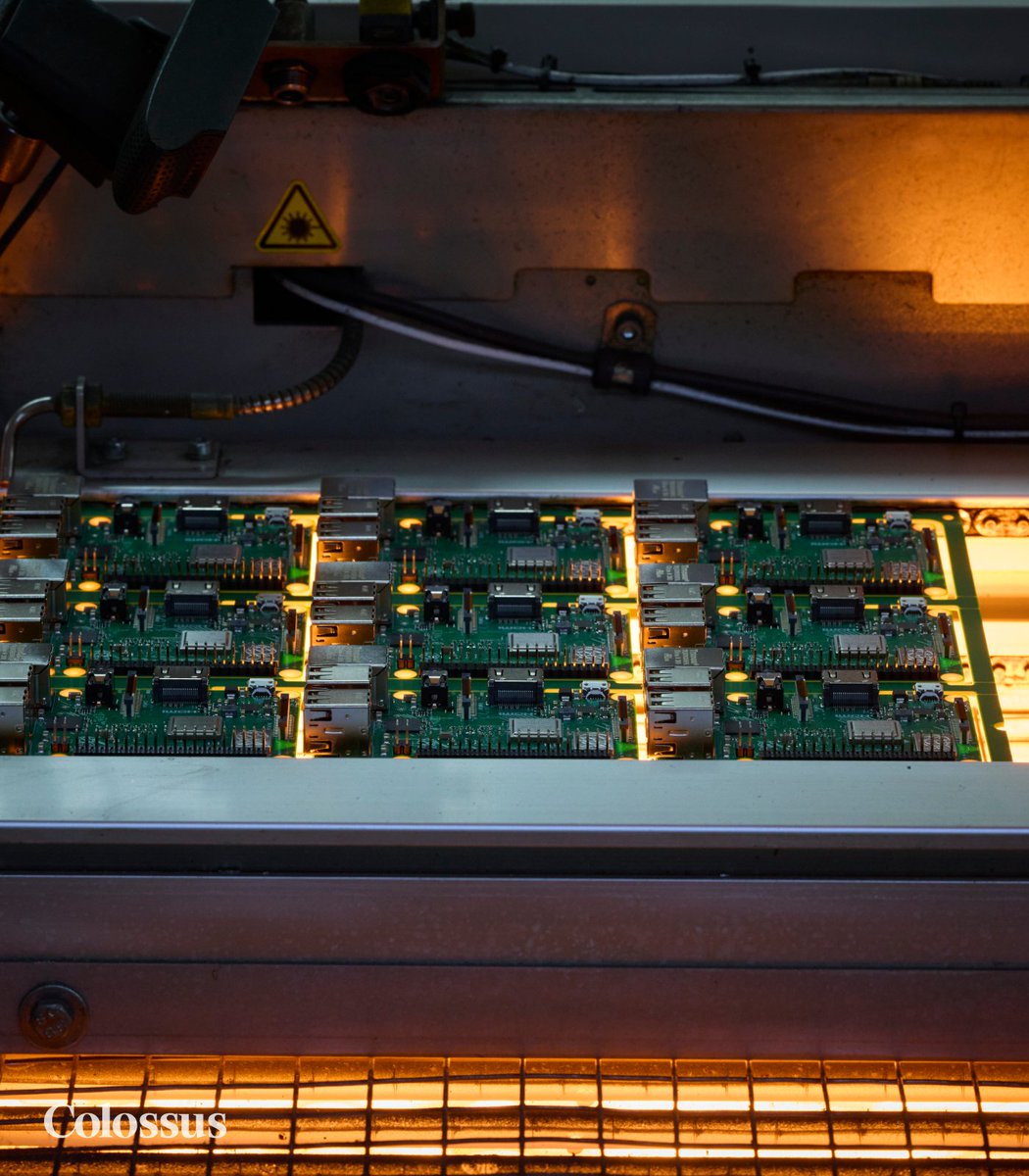
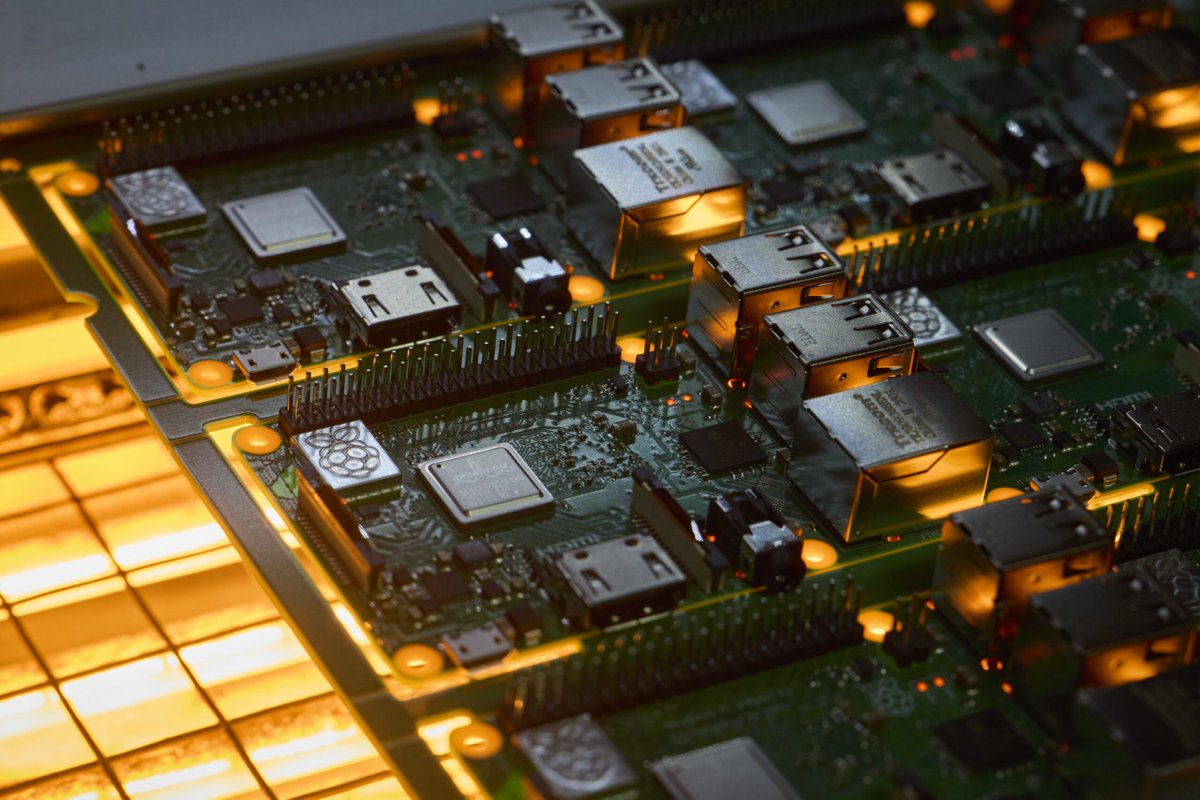
Read @TerranMott's interview with Upton below. It comes with extraordinary photos of Pis baking in the Welsh factory, and covers the journey of automation, teaching children to program in the era of agents, and putting foundation models in your pocket.
I think this is the most timeless idea I learned from Eben.
*Computers, not consoles* is a cool design lens to make boundless tools for kids and everyone else, no matter how technology changes
Eben Upton learned to code as a kid in the ’80s by playing with real computers.
By the 2000s, many like him were stuck with video game consoles or other tools for bounded creativity.
People like Calculator Boy are why Raspberry Pi was created -- to restore kids having the real thing.
When @TerranMott tells me to pay attention to something, I lean in way hard.
She has the best nose for incredible things hiding in plain sight. I learn so much from being her colleague!
Raspberry Pi has been iterating on manufacturing automation for a decade, and it turns out the right answer so far as the company scaled was people -> people + dextrous robot arms -> redesigning components for a different, faster machine
They don't believe an automation journey is ever over, might even be back to better robots in the future
Why Raspberry? Because it's the rudest fruit. When @Raspberry_Pi was founded, there was a rumor that people at MIT were making a successor to the Apple 2. They wanted to “blow a raspberry at the idea”
PS they call Apple “the other fruit company”
The third best-selling computer platform in history, after Windows PCs and the Mac, began as a recruiting tool for Cambridge University's computer science department.
It's the size of a credit card, has no case, and costs less than a pair of shoes.
Eben Upton built Raspberry Pi in 2012 to get more applicants into Cambridge's computer science course, then the easiest to get into. He thought kids needed the real thing: a general purpose programmable computer (like his childhood BBC Micro) to fall in love with the unbounded creativity of coding. He was more right than he could have imagined.
On launch day in 2012, he sold 100,000 computers. A million shipped before Raspberry Pi hired an employee. Computer science is now the hardest course to get into at Cambridge, and Raspberry Pi is a $1.5 billion public company that has sold over 73 million units. 80% of its revenue comes from industry.
Every digital display at Heathrow runs on a Pi. Schindler uses them in its elevators. The International Space Station has carried one in orbit since 2015.
You'll also find the tiny computers wherever the next thing is. Bitcoin mining farms ran on them. So did the first wave of hobbyist drones. Pis now run LLMs. In five years, Upton thinks Claude Sonnet-class intelligence will fit in your pocket.
Most tech conversation is about the frontier: the newest chips, the biggest models, trillion-dollar training runs. Raspberry Pi is a case study in the opposite. It shows what cheap, general-purpose, and performant-enough can achieve. It's also a rare British hardware success story, designed in Cambridge, manufactured with Sony in Wales, and reshored from China a decade before the rest of the industry caught on.
Read @TerranMott's interview with Upton below. It comes with extraordinary photos of Pis baking in the Welsh factory, and covers the journey of automation, teaching children to program in the era of agents, and putting foundation models in your pocket.
Steve Jobs implored: “make something wonderful”
I find the story of HOW Eben Upton built Rasberry Pi every bit as interesting as the tiny little computers he makes, “a general purpose programmable computer to fall in love with the unbounded creativity of coding.”
“Most tech conversation is about the frontier: the newest chips, the biggest models, trillion-dollar training runs. Raspberry Pi is a case study in the opposite. It shows what cheap, general-purpose, and performant-enough can achieve.”
Imagine when we can run Opus in our pocket, for no cost.
I hope this story makes you wonder, what’s something wonderful I could build?
Conveyor turned all my half-hearted imagining of tools I wish I had at work into something tangible and also much more playful. Pushes me to just create the things I want, makes it so fun to try
@_joe_berg_ is a singularly good systems thinker of software
Some early thoughts after building real apps by myself for the first time…
We built an internal tool called Conveyor
It’s an app builder, and internal App Store
It is connected to all of our data, context, and external data APIs
I’m completely and utterly useless as an engineer, but I’m good at knowing what I want a tool to do.
I’d previously struggled to make useful programs with pure CLIs. Our wrapper made it easy for me.
In the first 3 days of having this tool, I’ve built several fairly complicated applications, two of which I’ve used a ton for real work.
I’ve only used a couple hundred million tokens so far.
Some early feelings:
1) It’s obvious to my that my companies Positive Sum and Colossus will have fully bespoke operating systems, built in house. They will manage as much of our work as possible. This is already exploding for things like research and reporting. Every business will want this for themselves. Sure we won’t built our own slack, but we will built everything that pertains specifically to our shape as a firm, which is a lot.
2) x402 protocol (which enables AI agents and users to pay for API access and digital services instantly, without accounts or subscriptions) is immediately interesting to me. Many times I’ve wished I could just stream payments for individual data points.
3) right now each loop of prompt to output takes 5 to 15 minutes. As models and ASICs (@Etched !) make this faster, it’s going to be so much more fun. Even 5 minutes makes it hard to get in the flow. Can’t wait for seconds instead of minutes.
4) it’s so much easier to design things by starting with a shitty first draft of an app and seeing what’s wrong and iterating than nailing a full design ahead of time. When I had directed the design of software before this was always maddening and slow.
5) this has made me realize that my imagination had atrophied. Use it or lose it is real. Very quickly I’m finding it easier to have good ideas by building more stuff. I encourage everyone to do the same. So fun and rewarding.
6) We need more compute