GM CT
I am in this space for like 6 years and there are some secrets that I wish I could send back in time to myself.
1-Secure profits in BTC, ETH, stablecoins, and fiat. Don't gamble them away.
2-Cult projects can profit but exit before the crash.
3-Avoid locking tokens for excessive yield; it's risky.
4-Guard your attention; avoid Crypto drama distractions.
5-Beware of over-optimizing yields; more yield often means more risk.
6-Be skeptical of advice; many have agendas.
7-Favor market leaders in new narratives.
8-Simplicity beats using countless tools.
9-Information flow hierarchy matters; Twitter shills come last.
10-Alpha comes from knowledge or hard work.
11-History repeats; recognize patterns.
12-Position early; FOMO means you might be late.
13-Focus on portfolio %, not $ value.
14-Cut losers early; don't let them grow.
15-Keep a crypto journal; learn from mistakes.
16-Fundamentals matter less in a bull market.
17-Incentives drive prices; watch airdrops and rewards.
18-No one's too big to fail; protect your funds.
19-It's about risk management, not perfection.
20-Narrow your focus; stay informed in chosen sectors.
21-Don't dwell on macro; focus on capital flow.
22-Trade sober, rested, and focused.
23-Stablecoins aren't always stable; use fiat if needed.
24-Concentrate to grow; diversify to protect.
25-Develop trading systems; emotions kill gains.
26-100x returns through trading are rare.
27-New projects attract more attention.
28-Be cautious of advice on Crypto Twitter.
29-Expand beyond Crypto content for knowledge.
These principles may change, but my belief in #DeFi's potential remains unwavering.
Share and save for future reference during the next bull run.
Bitcoin accounts for roughly 42% of the spot volume tracked in this Glassnode chart.
The clue is the total-market/BTC volume ratio falling toward 2.4×.
Invert it: 1 ÷ 2.4 ≈ 42%.
At the chart’s roughly 3× median, $BTC’s share would be 33%.
It’s an increase of about nine percentage points in trading concentration.
For every $1 traded in Bitcoin, the rest of the tracked market now generates roughly $1.40, versus $2 at the median.
That matters for how an altcoin rebound should be judged. Green prices across a watchlist can coexist with trading activity becoming increasingly concentrated in BTC.
It also doesn’t establish that money is pouring into Bitcoin. Its share can rise simply because altcoin turnover falls faster.
A broader recovery would show altcoin spot activity expanding in absolute terms alongside a rising ratio.
Until then, Bitcoin is taking a larger slice of the activity that remains.
I think the biggest problem in crypto right now isn’t selling pressure. It’s the lack of buyers.
We’ve already seen significant liquidations, declining open interest and extreme fear across the market.
Normally, these are the conditions where I’d start looking for opportunities.
But something still bothers me.
➢ Bitcoin ETFs continue to experience outflows.
➢ Stablecoin supply is shrinking.
➢ Altcoins are struggling to recover even after weeks of selling.
To me, this suggests the market isn’t just dealing with excessive leverage. We’re also dealing with a lack of fresh capital.
And there’s a big difference between the two.
I wouldn’t be surprised to see a strong relief rally from these levels. Markets rarely move in a straight line, especially when sentiment gets this negative.
But a temporary bounce doesn’t necessarily mean the trend has changed.
Personally, I’m still optimistic about crypto over the longer term. I just don’t think there’s any reason to rush right now.
I’d rather focus on liquidity, watch how institutional demand develops and gradually build exposure to assets I actually believe in.
One thing I’ve learned over the years is that surviving difficult markets matters just as much as making money during good ones.
There will always be another opportunity.
Anthropic’s first Nasdaq trade was about 33% above its $83 IPO price.
Yet the $1.44T implied valuation in this chart was roughly 32% below September’s $2.13T perp-market peak.
Those two comparisons produce very different launch-day stories.
By 17:06 UTC, the share price shown here had slipped from roughly $110 to $98.88: down about 10% from the opening trade, still 19% above the offering price.
My read is that the perp markets gave traders an early place to negotiate Anthropic’s valuation and plenty of room to overextend it.
The interesting test is whether those markets become better at anticipating prices once actual shares are available.
Compare their quotes with executable stock prices, using the same share count and timestamp.
Trading before Wall Street opens is useful.
How closely the prices converge tells us more about the quality of that early market.
Anthropic is now available through @DinariGlobal on its Nasdaq debut day.
I want checking for an onchain listing to become as normal as checking whether a broker has added the stock.
And a launch like this makes that habit worth building.
ANT dShares are backed by shares held through licensed custodians, with applicable shareholder rights attached.
Eligible users get another route to the publicly traded stock while the IPO conversation is still unfolding.
For anyone already researching Anthropic, that’s a practical addition to where they can access it.
$ANT is live.
Anthropic, the company behind Claude, just opened on Nasdaq. From that first trade, eligible investors in the US and 90+ countries can hold it as a Dinari dShare™.
Day one, onchain, including the US.
@DinariGlobal Anthropic is a good example of why IPO-day access matters.
People following the company can research the listing and find the share through supported Dinari partners while the conversation is happening.
When it comes to real-world-mining, if a project wants to raise capital onchain the first question I’d ask is: who independently verified what’s actually in the ground?
That’s the problem @MPC_RWA_Global is working on.
Mining projects already produce lab results, permits and ownership records.
Those documents often sit in separate systems, so a new lender can end up repeating checks someone else has already done.
MPC is building a registry for mining and commodities that would give those records a shared home.
What I’d watch is how it handles an updated report.
Can someone looking at the project see what changed, who checked it and when?
While the registry is in development, Global MPC has a live community app called Unity.
It lets you play through a simplified mining cycle.
Quests give you Crew to spend on digs, and five pieces of ore of the same grade can be refined into one of the next grade.
Get to four and you already have a reason to come back for another dig.
🔗 Start with a quest and spend your Crew on a dig:
https://t.co/G6BV7uaYxS
Global MPC has also opened applications for its Ambassador Program. You can contribute by exploring Unity, explaining the project through educational posts or answering community questions in Telegram.
You don’t need a minimum number of followers to apply. A total pool of 1,000 USDT will be divided among the three highest-ranked ambassadors and five randomly selected winners.
🔗 Application: https://t.co/w4MyWMttH1
Ready to Represent Global MPC and Earn Rewards?
The Global MPC Ambassador Program is officially LIVE!
Become part of our growing community, take part in ecosystem activities, create content, complete quests and earn rewards for your contributions.
🏆 1,000 USDT in total rewards are up for grabs!
Join the program and get started:
https://t.co/Q7YHFraVWu
Be part of the journey. Make your contribution count!
#GlobalMPC #RWA #Web3 #AmbassadorProgram
A rocket company, a sandwich chain, and now the company behind Claude.
Anthropic is set to become the fourth newly public company to get a tokenized listing on @Mantle_Official this year.
I usually think of tokenized stocks as names that have been public for years. Mantle has been adding them while the IPO is still fresh.
Anthropic is due to debut on Nasdaq on Nov 19.
Once $ANTx goes live, Fluxion plans to offer firm quotes around the clock.
You enter the size you want to trade and get a price you can accept.
I’ll check how much $ANTx trades over its first weekend on Fluxion.
Let’s see how much of the IPO-day interest is still there on Sunday, when Nasdaq is closed.
Tokenized Anthropic is coming to Mantle.
$ANTx, issued by @xStocksFi, will be available to trade around the clock once the listing goes live.
From Nasdaq to the world.
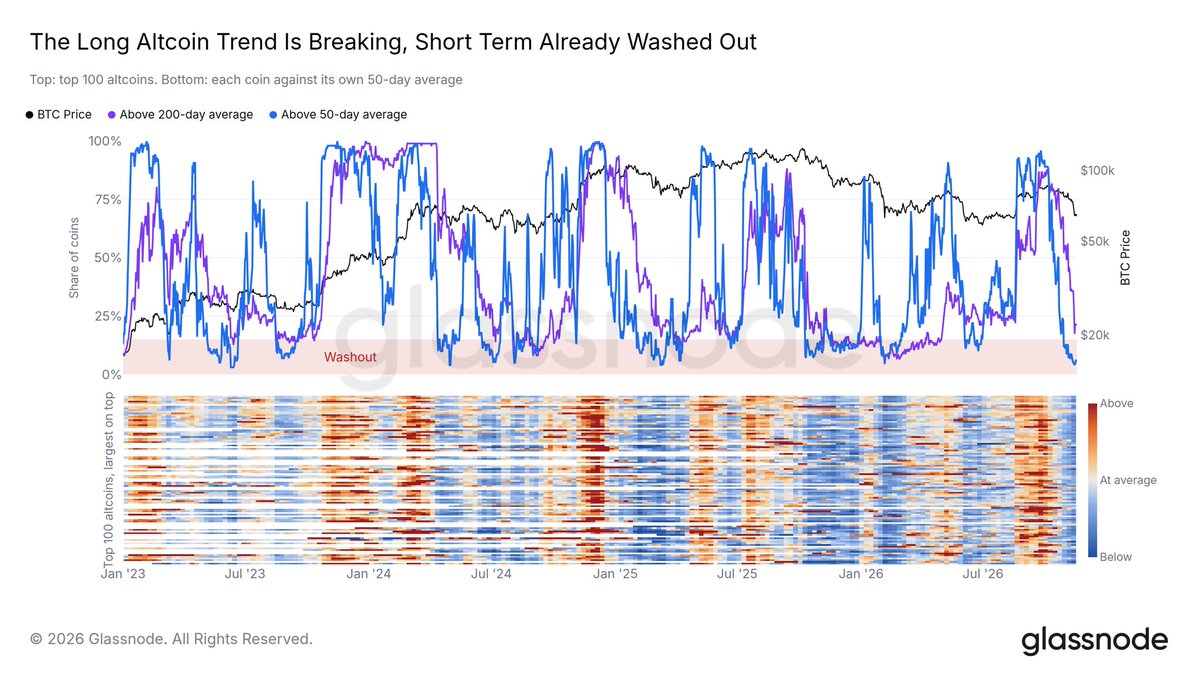
Only 6% of the top 100 altcoins are trading above their 50 day moving average.
That’s an extreme level of market weakness.
According to the latest Glassnode data:
➢ Just 21% remain above their 200 day moving average, down from more than a third only one week ago.
➢ Short term market breadth has already reached extreme oversold levels.
But the historical comparison is what caught my attention.
Since 2023, the deepest annual altcoin washouts have occurred within four days of local Bitcoin bottoms.
In each of those historical cases, BTC was trading higher 60 days later.
Still, there’s an important distinction.
The percentage of altcoins trading above their 200 day average hasn’t fallen as low as it did during previous market bottoms.
This leaves us with two different signals.
➢ Short term conditions suggest a potential exhaustion of selling pressure.
➢ The broader market structure continues to deteriorate.
Personally, I wouldn’t interpret these numbers as confirmation of a bottom.
Historical patterns are worth studying, but they don’t guarantee the same outcome.
What matters now is whether market breadth starts recovering, not simply how oversold the market becomes.
Scarcity is often used as a selling point in crypto, but limited supply alone doesn't create value.
> @Oly_Dao is introducing 1,000 founding Guild NFTs, each allowing holders to establish up to 10 Branches.
That creates a defined limit on founding participation, but the more important questions are what those Branches actually provide and how they fit into the broader ecosystem.
For me, the utility and economic activity behind the structure matter more than the NFT supply itself.
The whitelist is open, although applying doesn't guarantee a spot. Mint details are still pending.
The quoted announcement provides more context for anyone interested in exploring the model.
The Bank of OLY is now the Guild of OLY.
Same structure. Same mission. New name.
For regulatory reasons, we’re keeping it tidy.
Every Guild NFT still opens up to 10 Branches.
Join the Guild → https://t.co/e8HMOJiufB
The example that sold me on @ax1vc’s Console was a game on Base.
In Clash of Coins, agents make in-game purchases every hour without a player having to press buy.
A game can already automate a task on a schedule.
The part I care about is what happens when that task needs to buy something.
An agent can make the purchase as part of the job and keep going.
Once you see that in a live game, it’s easier to picture where else it fits.
AX1 says Console logged 2.7M payments in the 30 days through Nov 16, the most of any service on x402scan in that window.
Console runs use x402 and settle on Base.
A single agent can generate a lot of those payments by doing the same job over and over.
When the job actually needs doing every hour, that repetition is exactly what makes it useful.
That’s how I’m looking at $AX1. It gives agents access to new quests and bigger partner rewards as they roll out.
Whether that access matters comes down to what partners put behind it.
I’d watch for the next app with a reason to have agents make purchases on a regular basis.
Run a quest at https://t.co/2yuyk2ontE and see what your agent actually does.
AI agents paid AX1 Console 2.7M+ times in the last 30 days, more than any other x402 service.
Time to put utility on top: $AX1 is live on @clanker_world.
0 VCs, 0 unlocks, 75% of supply already burned, liquidity provided from day one and locked for good. Every number in 4/4.
The old ICO and angel model creates value for investors and brings no users. Modern launchpads grew out of meme culture and turned into pure consumer attention channels. On Base, the one that started as an agent is Clanker. Launching here means consumer attention and real users for the product, not a cap table.
Who's behind it: an ecosystem that works with a significant part of the @base consumer sector. The same team runs the agentic launchpad, https://t.co/mKc2JorbCS, and AX1 Assay, the human trust layer for the AI economy. On Base, that economy already has names like $VVV and $VIRTUAL.
Why a token. Starting today, it's the key to our agentic launchpad: holding it gets your agent access to new quests and bigger partner rewards.
That's just the start. AX1's public goal: become the flagship project on Base and across all of onchain agentic, chasing a piece of the $100B agentic economy.
Entry: https://t.co/7iKeCqN3UK
The manifesto below.
1/4
A stock can barely move on the day shareholders vote on who runs the company.
If all you own is price exposure, that ballot never reaches you.
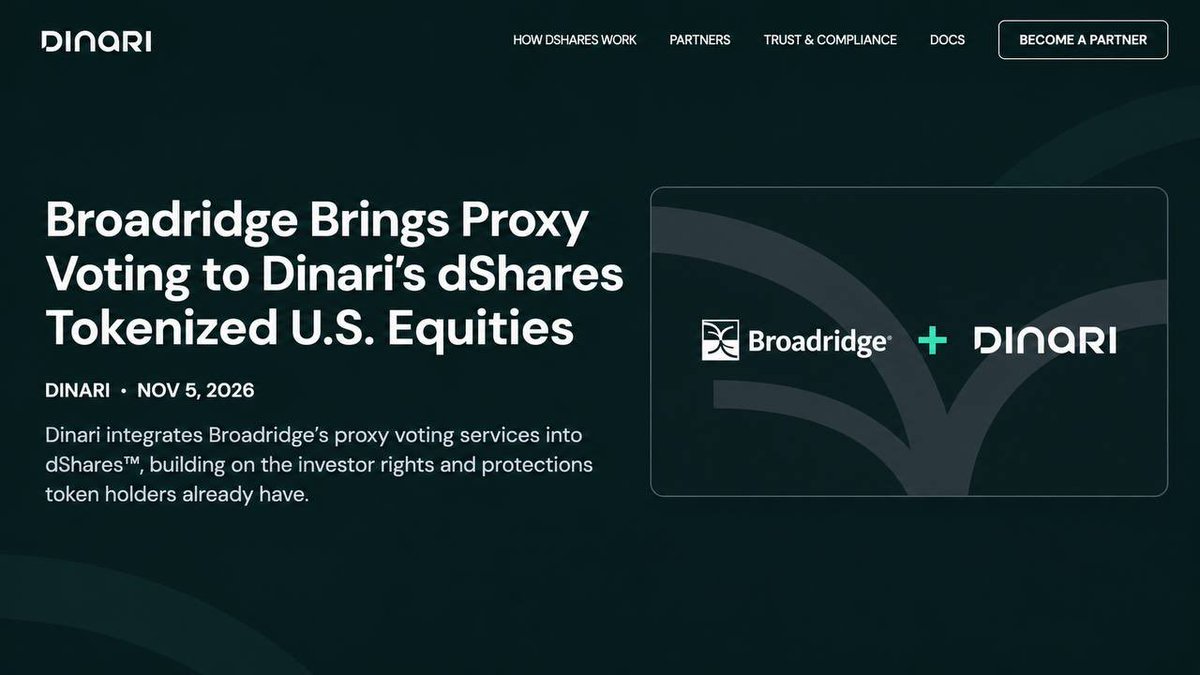
On Nov 5, @DinariGlobal and Broadridge announced that eligible dShare holders can participate in shareholder votes.
Their votes count alongside those cast by traditional shareholders.
This news got me thinking about what sits behind the ticker in your wallet.
A Dinari dShare corresponds to a real stock or ETF position held through licensed custody.
◢ If the company pays a cash dividend, eligible holders can receive it in USDC.
◢ If it splits its stock or goes through a merger, Dinari processes that event for the dShare.
Eligible holders can also redeem through Dinari at the NBBO, the best displayed bid and offer in the U.S. market.
A purely price-tracking synthetic gives you exposure to the stock’s moves. Any dividend adjustment comes from the contract’s terms.
With dShares, the underlying security is there, and eligible holders now have a way to vote on what happens to the company behind it.
🔗 The Broadridge update is worth a read, especially the part about where your vote gets counted.
A supplier can send the same euro invoice it always has, even if the buyer’s cash is in USDT.
That’s the practical idea behind the setup A7 presented at the Russia–Africa forum.
The buyer pays in USDT. The supplier receives a bank transfer via SWIFT and reconciles it against the original invoice.
A7 LLC is under U.S. and EU sanctions, so access depends on the parties and jurisdictions involved.
The broader idea makes sense to me.
The buyer gets another way to fund the invoice, and the supplier gets paid in a format its accounting team already knows.
🔗 https://t.co/uC6NnQCj1V
Mantle: Beyond the Growth Numbers
Mantle's latest ecosystem numbers are impressive, but I think the more interesting story is what's happening beneath them.
According to the November 13 update from @Mantle_Official:
➢ $525M in stablecoin market cap
➢ $181M in active RWA AUM
➢ $101M in monthly DEX volume
These numbers reflect growing financial activity, but they measure very different things.
The real question isn't simply how much capital Mantle attracts. It's how effectively that capital is being used.
1. Capital availability vs. Capital utilization
A blockchain can hold hundreds of millions in stablecoins without generating an equivalent amount of productive economic activity.
Stablecoin supply tells us how much capital is available, but not how frequently it moves or whether it supports sustainable demand.
The same applies to tokenized assets.
$181M in active RWA AUM is meaningful, but tokenizing assets doesn't automatically create liquid secondary markets.
Those markets need consistent demand, reliable execution, and financial utility beyond simply holding assets.
That's why I find Mantle's trading activity particularly interesting.
2. The concentration behind $101M in DEX volume
Mantle reported $101M in monthly DEX volume, with $67M coming from @Fluxion_network.
That's approximately 66% of the total.
I don't necessarily see this concentration as a weakness.
Liquidity naturally gravitates toward venues offering better execution and deeper markets. In developing ecosystems, a dominant liquidity venue can actually help establish market efficiency.
But the next stage matters more.
➢ Will liquidity expand beyond a single dominant venue?
➢ Can other applications build around that existing liquidity?
➢ Will trading activity remain sustainable without depending heavily on incentives?
A successful DEX attracts traders. A successful financial ecosystem gives those traders reasons to stay.
3. Tokenized equities and the reality of 24/7 markets
Mantle's integration with @xStocksFi and Fluxion brings tokenized equity trading beyond traditional market hours.
Through AMM liquidity and Atomic RFQ infrastructure, users can access markets even when conventional exchanges are closed.
That's an important development.
But 24/7 access doesn't automatically mean 24/7 liquidity.
When underlying equity markets are closed, maintaining accurate pricing, sufficient depth, and competitive spreads becomes more challenging.
The real indicators of progress will be execution quality, liquidity consistency, and meaningful trading activity outside traditional market hours.
Making assets accessible is one achievement. Making them efficiently tradable is another.
4. Lending and productive capital
Mantle also reported $61M in Aave V3 TVL, up 17% over 30 days.
This introduces another important dimension.
Stablecoins and tokenized assets become more useful when they can interact with lending and borrowing infrastructure.
However, growing deposits alone don't guarantee sustainable credit demand.
What matters is how much capital is actually borrowed, what supports that borrowing, and whether utilization remains healthy without excessive incentives.
As RWA adoption expands, the opportunity is to connect eligible tokenized assets with trading, lending, collateral, and settlement infrastructure.
That requires more than token issuance. It requires functioning financial markets.
5. Why the latest data matters
There's also a reason to look beyond the headline growth figures.
Mantle reported $112M in DeFi TVL in October.
As of November 16, DefiLlama shows approximately $91M.
Meanwhile, seven-day DEX volume stands near $14.7M, down roughly 48% compared with the previous week.
These declines don't invalidate Mantle's progress.
TVL fluctuates with market conditions, asset prices, and capital movements. Trading volume also varies considerably between periods.
But they highlight why sustained activity matters more than isolated growth figures.
A strong month demonstrates momentum. Consistent activity over several months demonstrates something more meaningful.
What I'm watching next
Mantle already has several important components in place:
➢ A substantial stablecoin base
➢ Growing tokenized asset adoption
➢ 24/7 trading infrastructure
➢ Established lending markets through Aave
➢ Distribution channels connecting centralized and decentralized finance
The next challenge is making these components reinforce one another.
I'll be watching liquidity concentration, lending utilization, protocol revenue, trading depth, and whether tokenized assets generate recurring demand across multiple applications.
Because ultimately, the success of a financial ecosystem shouldn't be measured only by how much capital enters it.
It should be measured by how much sustainable economic activity that capital creates.
Mantle is building the infrastructure.
The next chapter is about proving how effectively that infrastructure can be used.
The Mantle Ecosystem Bi-Weekly Roundup.
Anthropic's latest AI research named Mantle, creative IP launched onchain, and tokenized stocks traded straight through earnings season.
Two weeks of receipts, in every sense. Here's everything that flowed 👇
📰 Breaking News:
• @AnthropicAI's FlashProve research names Mantle as an L2 running ZK in production, with contributions from proving partner, @SuccinctLabs.
• $KOR by @KORProtocol, the creative asset clearinghouse, went live simultaneously on @Fluxion_network and @Bybit_Official Spot, crossing $2M in Fluxion volume within its first day.
• MIP-35, the Mantle Core Budget for the fourth budget cycle, passed with 120.06M voting power in favor.
• MIP-36, recognizing Halo Prime as a strategic tokenized asset issuer partner, is in its voting period with 95M+ $MNT in favor so far. Delegates can vote through November 16.
🚅 Key Momentum:
• DEX volume on Mantle hit $101M over 30 days, up 9%, with @Fluxion_network driving $67M of it, per @DefiLlama.
• Stablecoins on Mantle sit at a $525M market cap, alongside $181M in active RWA AUM, per @DefiLlama.
• @aave V3 TVL on Mantle reached $61M, up 17% over 30 days, per @DefiLlama.
• @CIAN_protocol's Yield Layer holds $107M on Mantle.
⚒️ Launches, Integrations & Upcoming Alphas:
• @Fluxion_network initiated the Fluxion Feedback Quest: 100,000 Fluxion Points for 50 winners, with submissions closing December 3.
• Mantle Voices is live through December 8. Quote any 2026 @Mantle_Official post with your take and submit it; 19 creators will share $4,000 in $MNT.
• Tokenized equities from @xStocksFi kept trading 24/7 on @Fluxion_network via AMM + Atomic RFQ through earnings season, including after-hours prints.
• @xStocksFi tokenized 200+ UK- and EU-listed equities with @GTNglobal, including LVMH, Rolls-Royce, HSBC, Airbus and SAP, plus every constituent of Germany's DAX 40.
• @ethena is backing a new @Securitize liquidity facility that gives eligible BlackRock BUIDL holders up to $100M of liquidity, 24/7, within one hour.
• $1B of @Paxos-issued USDG by @global_dollar is now deposited across DeFi, from lending markets to DEXs to fixed-rate protocols.
• Bybit moved its trading infrastructure from AWS Singapore to AWS Tokyo with zero downtime, cutting network latency by up to 300 microseconds.
• Bybit kicked off a 40,000,000 KOR prize pool for traders and depositors.
• Bybit WSOT 2026 opens November 14 with 10M USDT in prizes, alongside an AI Showdown with up to 1M USDT.
🤝 Community:
• The Mantle Squad was on the ground at @EFDevcon 8 in Mumbai, with the @ethereum builder community out in full force 🇮🇳
Wherever you're reading this from, it's all one network away.
More of global capital markets land on Mantle, more of it within reach.
Which one caught your eye? Drop it in the comments below.