I’ve heard the podcasts — but “ETH as money” isn’t a mechanism, it’s a destination. Money isn’t a property you declare; it’s a competitive outcome. An asset becomes a store of value by winning against the alternatives a saver actually has. So the real question is: why would the marginal saver pick ETH?
Right now Bitcoin is the stronger monetary asset — harder, simpler, clearer narrative. For ETH to compete it needs an edge BTC doesn’t have, and the obvious one is staking: a real yield that compensates holders for choosing ETH. That’s the lever that could move the balance.
The problem is the Foundation’s own roadmap pushes that lever the wrong way. Staking yield has already fallen from ~4.5% (2022) to ~2.4%, and the Scourge / issuance-curve proposals explicitly aim to flatten it toward zero — even negative beyond a target — to deter staking. The stated motivation is protocol security, not monetary competitiveness.
But you can’t have it both ways. You can’t say “ETH’s value is anchored in its role as money” while simultaneously reducing the yield paid to holders of that money. No monetary authority that wants to defend demand for its currency makes it less attractive to hold — weak-currency central banks raise rates to compensate holders; Ethereum’s debate points the opposite way.
So yes, the mechanism is clear. The trouble is the protocol is steering against it. “ETH as money” as the thesis, and policy that weakens the one incentive that could win the monetary competition, can’t both be the plan.
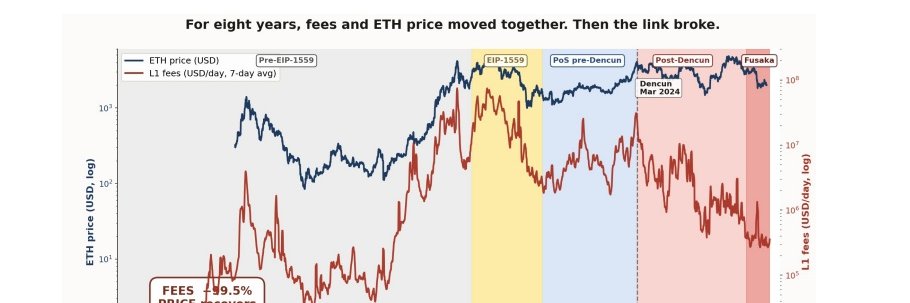
That’s a testable claim, and I tested it: the economy DID grow — TVL above its 2021 peak, stablecoins at all-time highs — yet the activity→ETH link went to zero. Correlation +0.88 → ~0 post-Dencun, elasticity 2.0 → 0. The mechanism you’re describing stopped working. Not opinion — data.
https://t.co/oi5OWNmiZD
As a success thesis, you’re right: “Ethereum not ETH” is incoherent. You can’t declare victory on Ethereum’s original terms while ETH is weak — the covenant was that activity would accrue to the asset. On that, I fully agree with you.
Where I push back is the binary: strong ETH or failure. There’s a third state, and we’re already in it — the chain keeps growing while the asset decouples. TVL is above its 2021 peak, stablecoin supply is at all-time highs, and DeFi is increasingly denominated in dollars, not ETH (stables are ~40% of the on-chain monetary stock). So empirically, “strong DeFi starts and ends with strong ETH” hasn’t held: DeFi has grown precisely on dollars while ETH decoupled. That’s the part the data won’t let me call simple failure.
What it actually is, is a mutation: Ethereum is becoming Linux. Incredible software, used everywhere, that works — but can’t fund its own evolution from its own economy. The chain doesn’t need a strong asset to keep running; this whole decline proves that. (The asset side of this is what I argued here — a currency that thinks it’s a commodity: https://t.co/QoPnHW5ZKE)
The resilience properties probably aren’t the same in that world — but it’s an architecture that can grow without a strong native asset, and it has.
So I wouldn’t say “Ethereum is failing” either. I’d say Ethereum is succeeding as infrastructure and failing as an economy. And the real risk isn’t a price collapse — it’s the Linux endgame: without resources to keep evolving, users migrate to the next “OS,” and Ethereum ends up as hidden plumbing maintained by technologists, while the value and the users live elsewhere.
Exactly — and that’s the honest conclusion most people avoid. You can’t find the A→B mechanism because under the current architecture there isn’t one. That’s not rhetoric, it’s the empirical finding: the correlation between on-chain activity and ETH value has gone to zero. The noble-properties story is real, but it never actually translates into the asset.
So the Foundation has, in practice, made a choice: move from an economy financed by the asset — fees → burn → ETH value → public-goods funding — to one financed by donations and discretionary support. A Linux-style model. And yes, in part that’s the ecosystem’s DNA: open source, public good, minimize rent-seeking.
But Ethereum is not Linux. Linux doesn’t have a $300B+ native asset whose balance sheet is supposed to fund its own infrastructure. Today the model works only because the ETH treasury is large enough in USD terms. The problem is the refill: the only sustainable way to refill it is fee flow from on-chain activity into the asset — and that flow is gone. $113M/year in L1 fees cannot finance the infrastructure of a $300B+ settlement network indefinitely.
Which leaves two honest options. Either (1) we build the mechanism — make part of the economic activity Ethereum hosts finance the protocol itself (that’s the S in SCROPS: economic sustainability as a first-class design principle), or (2) we admit ETH is a pure belief/narrative asset and the protocol runs on donations. There is no third option where “noble properties” silently price themselves into ETH.
My point isn’t that the price must go up. It’s that a protocol of this scale should normally finance itself through the economy it hosts — not float on its own reflection while the infrastructure depends on a depleting treasury.
https://t.co/3h2W6rtheS
I actually agree with your premise — ETH and Ethereum are one economic engine, you can’t be bullish one without the other. But the Foundation doesn’t share that approach, and it proves it in how it defines its mission. CROPS — censorship resistance, open source, privacy, security — has no sustainability dimension, and therefore nothing that ties the network’s economy back to the asset. Value accrual to ETH isn’t a first-class objective; at best it’s an implicit assumption. Ethereum is framed as an “escape hatch,” not a growth vehicle.
That’s exactly why I proposed SCROPS: adding economic Sustainability as a first-class principle, at the same rank as the other four — not as a slogan, but as a real filter for evaluating technical decisions.
Because here’s the core problem: there used to be a real link between Ethereum’s economic activity and the value of ETH. Dencun broke it — and it broke precisely because technical decisions have never been evaluated from an economic standpoint. The rollup-centric roadmap optimized L2 cost without ever measuring what it did to L1 value capture.
This isn’t an opinion, I show it in numbers. The 90-day rolling correlation between log(price) and log(fees) fell from +0.88 (2015–2022) to +0.32 post-Dencun to ~0 post-Fusaka. HAC elasticity collapsed from β≈2.0 to ≈0. Johansen cointegration is formally rejected at 5%. L1 fees are down 99.5% from peak ($23.5B/yr → ~$113M/yr) — a $5B+/year wedge versus the pre-Dencun relationship. Four independent econometric tests, one verdict.
And note: activity didn’t collapse. TVL is above its 2021 peak, stablecoin supply is at all-time highs. What collapsed is the translation of that activity into ETH. The asset now floats on reflexive, narrative-driven demand — ETFs, treasury vehicles like Bitmine — not on the economy it hosts.
So “Ethereum not ETH” isn’t just a commentator’s fallacy. The official framework already leaves the asset out of the mission. Better to recognize that and fix it (SCROPS) than keep insisting the link is intact when the data says it isn’t. Full paper 👇
https://t.co/oi5OWNmQPb
Feliz Bitcoin Pizza Day.
Hace 15 años, dos pizzas costaron 10.000 BTC.
Hoy, una pizza de unos 20 € equivale aproximadamente a 0,0003 BTC al precio actual de bitcoin en euros.
Más allá de la anécdota, la fecha recuerda algo importante:
lo que entonces parecía una cantidad “usable” de bitcoin, hoy representa una escasez y un valor que el mercado ha terminado reconociendo.
Bitcoin cambia.
La lección sobre su escasez, no.
1/ The EF exodus isn't mysterious. It's the logical outcome of an organization that literally defined its success as "how unnecessary it becomes."
A thread on why the departures are rational, not FUD. 🧵
2/ The EF just published a 38-page mandate codifying Buterin's "walkaway test" — the idea that Ethereum should work perfectly if the Foundation vanished tomorrow.
They also formalized a philosophy of "subtraction": progressively removing the EF from the ecosystem.
3/ Now think about what that means for talent retention.
In any normal org, you keep senior people with mission + compensation + career trajectory. The EF has deliberately eliminated the third leg. There is no "next chapter" inside an institution designed to shrink.
4/ Stańczak's case is the perfect illustration. Joined as co-ED in March 2025, left 11 months later saying the restructuring goals were "either completed or structurally embedded."
That's the paradox: if you do your job well at the EF, your job ceases to exist.
5/ Then add the financial layer. The EF announced a multi-year austerity program and retired its old model of selling ETH to fund operations.
Meanwhile, rival L1s, L2s, and private crypto companies are paying aggressively for the exact same talent profiles.
6/ Julian Ma described how his role gradually shifted from research to product and growth work — exactly the kind of work that pays better and scales faster outside a contracting nonprofit.
At some point the math just doesn't math.
7/ The EF itself recognizes the pattern. Their own Project Odin was created because they kept seeing critical infrastructure teams living in "a perpetual state of fragility," unable to plan beyond the next grant cycle.
The irony? The Foundation suffers from the same disease it's trying to cure.
8/ Unconfirmed reports suggest staff were asked to formally align with the new mandate. The EF hasn't confirmed this, and no one who left cited it as their reason.
But you don't need a purge. A 38-page doc redefining your org as one that seeks its own irrelevance is a powerful self-selection mechanism.
9/ Ryan Berckmans, an 8-year ETH veteran, argues the departures aren't about loss of faith in Ethereum — they're about disagreements on sub-strategies plus a deliberate generational shift.
That's consistent with the structural argument. This isn't dysfunction. It's design.
10/ The hard number: Ethereum core devs dropped from 225 in May 2025 to 169 in May 2026. Ecosystem developers now lag behind Solana.
The protocol works independently of the EF. But the walkaway test is being executed in practice before it was maybe planned.
11/ Bottom line: the EF consciously designed an organization that self-destructs.
The surprise shouldn't be that people are leaving. It should be that anyone expected them not to.
The real question isn't "why are they going" — it's "who and what structure replaces them."
Para entender las bitcoin treasuries, primero hay que entender Bitcoin.
En su entrevista en Skiller Talks de @negocios_tv, Esaú Rojo, CEO de Vanadi Treasury, lo resume de forma sencilla:
Bitcoin es capital.
Un capital digital, escaso, global, líquido y resistente, con características que lo diferencian de otras formas tradicionales de reserva y gestión de valor.
Si no se entiende primero el activo, difícilmente puede entenderse después por qué cada vez más empresas empiezan a incorporarlo en balance.
3 protocols have now earned a perfect 5-green chart on https://t.co/LyCTx07M40:
@Uniswap's uniswap-v4
@CurveFinance's curve-dex
@liquity's liquity-v1
Honorable mention to @tethergold: the first one to earn a perfect 5-red chart (I'm sure there will be many more to come🙃)
Very proud to see this reveal! Osero is the final Star Agent in Sky Ecosystem, one of only 5 Star agents that have been directly funded by Sky Governance and whose Star Tokens will be distributed as Token Rewards to USDS holders, alongside Spark, Grove, Keel and Skybase
Leading Ethereum stewards @Consensys and @ethereumJoseph have joined DeFi United with up to 30,000 ETH in financial support for the rsETH recovery effort, with ongoing strategic advisory from @Sharplink.
Their contributions are a substantial component of the broader DeFi United effort to restore rsETH's backing and normalize market conditions, and the recovery would not be progressing as it is without them.
DeFi United.
Estamos preparados para Las Vegas.
Vanadi Treasury ya está en @TheBitcoinConf 2026 como la primera cotizada española con estrategia de tesorería en bitcoin.
Venimos a uno de los grandes epicentros globales del sector para seguir impulsando, desde España, la conversación sobre innovación monetaria, mercados y adopción corporativa de Bitcoin.
The recovery fund has now been reached for the purpose of fully backing rsETH, subject to pending votes, indicative agreements, and successful execution.
Instead of calling for donations:
1) Build a deposit Vault call it "Defi United Eth"
2) Wire Aave wETH revenue to vault capped at 5% APR,
3) Make vault deposit token tradable call it "AaveETH"
4) slowly repay interest + principal
Let people deposit, max vault capacity is the total worst case scenario hole.
I'm pretty sure they would have collected more than needed last saturday
Aave has plenty of revenue, Aave DAO and Labs are sitting on 9 figures of treasury each and would have figured it out eventually,
Panic avoided, back to work.
Would have deposited most of my ETH in it, why not?
Aave is my life's work and we're working nonstop to find the best possible outcome for users.
I’m personally contributing 5000 ETH to DeFi United as we continue working together with partners on formalizing more commitments. I’m working to see this resolved and market conditions normalized as soon as possible.
DeFi United.