iFood agora tá com:
- Roleta de desconto
- Cupons falsos
- Colecionáveis da copa
É uma mistura de tigrinho com SHEIN + gamificação a la Duolingo.
Te força a fechar 3 pop-ups pra pedir 1 marmita.
É impressionante a velocidade com que as coisas pioram com o passar do tempo
To give you a concrete sense of what we're doing with @Backpack Securities.
- Trade stocks on Backpack
- Deposit/Withdraw to Solana
- Trade on DeFi in your wallet
- On/off ramp to your brokerage account
Tokenized stocks that are redeemable for the real thing just like a stablecoin.
Demo:
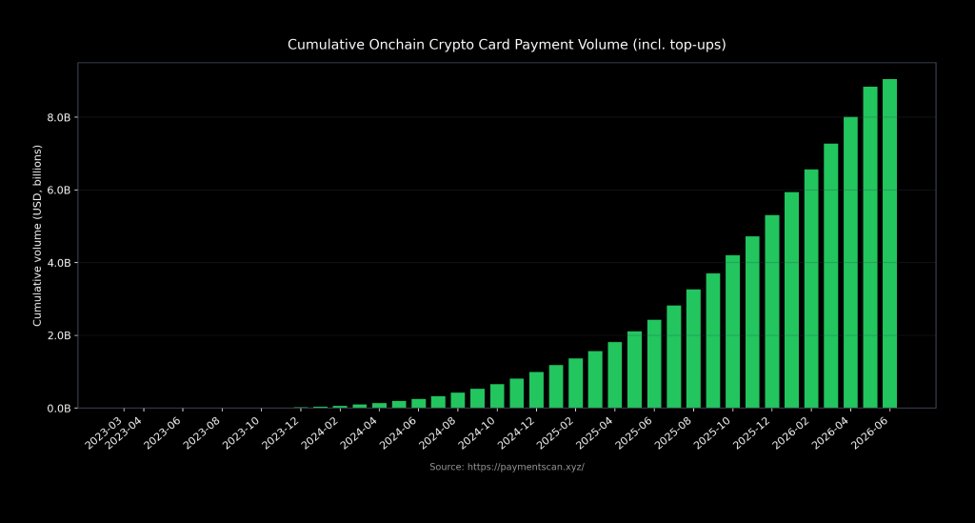
BREAKING: Total onchain crypto card payment volumes hit a record $833 million in May 2026, up +180% year-over-year.
High performance networks such as Optimism and Solana have benefited from the growth in payment related activity.
These networks have outperformed the broader market since 2025 while capturing a combined ~22% of market share.
Key onchain players are accelerating adoption, such as Jupiter Spend through localized payment options such as QR integration, which has seen 60%+ month-over-month payment volume growth.
As a result, cumulative onchain crypto card payment volumes have exceeded $9 billion for the first time in history.
Onchain adoption is seeing rapid growth.
Elixir v1.20 released! Now officially a gradually typed language: Elixir type checks every single line of code, finding bugs and dead code, without developer overhead (no typing signatures) and extremely low false positives rate. Plus a faster compiler! Links and reports below.
been a starlink fan since day one, prob one of the first to pre-order in brazil. using it right now on a super long international flight and it gives me that exact same "wow" feeling as when i first booted it up in the middle of nowhere back home.
Imagine a Brazil where you board a train in São Paulo and step off in Rio 105 minutes later.
Imagine every coastal capital linked, from Porto Alegre to Belém.
Imagine Brasília as the hub with 5 bullet train lines reaching across the country.
Even Manaus, the biggest city in the Amazon, on the grid.
That is the map I see.
16,600 km of track.
A real grid for a country of ~213 million people.
The São Paulo to Rio train has been on paper since the 1980s.
Almost 40 years of plans.
Zero track in the ground.
The drive between those two cities still takes 5 to 6 hours (depending on traffic).
50 million people live in that corridor.
About the size of South Korea.
China built 50,000 km of bullet trains in 17 years.
Brazil built 0 in 40.
At China's pace, the Brazilian network gets built in 20 years.
At Brazil's pace, 50.
The price tag is about $500 billion in today's dollars.
Closer to $1 trillion by the time the last track is laid.
Every dollar spent comes back as $2 to $3 in growth.
That is $2 to $3 trillion added to Brazil's GDP.
Land prices jump the moment the project becomes real.
Cities along the route gain value 20 years before the train arrives.
The corridor leads.
The train follows.
The biggest infrastructure project of the 21st century is not in China.
It is in Brazil.
It just has not been built yet.
SECURITY ADVISORY — TanStack npm packages
A supply-chain compromise affecting 42 @tanstack/* packages (84 versions total) was published to npm earlier today at approximately 19:20 and 19:26 UTC. Two malicious versions per package.
Status: ACTIVE — packages are deprecated, npm security engaged, publish path being shut down.
Severity: HIGH — payload exfiltrates AWS, GCP, Kubernetes, and Vault credentials, GitHub tokens, .npmrc contents, and SSH keys.
If you installed any @tanstack/* package between 19:20 and 19:30 UTC today, treat the host as potentially compromised:
• Rotate cloud, GitHub, and SSH credentials immediately
• Audit cloud audit logs for the last several hours
• Pin to a prior known-good version and reinstall from a clean lockfile
Detection — the malicious manifest contains:
"optionalDependencies": {
"@tanstack/setup": "github:tanstack/router#79ac49ee..."
}
Any version with this entry is compromised. The payload is delivered via a git-resolved optionalDependency whose prepare script runs router_init.js (~2.3 MB, smuggled into each tarball at the package root).
Unpublish is blocked by npm policy for most affected packages due to existing third-party dependents. All 84 versions are being deprecated with a SECURITY warning, and npm security has been engaged to pull tarballs at the registry level.
Full technical breakdown, complete package and version list, and rolling status updates:
https://t.co/Zy8qG7PA9f
Credit to the security researcher for responsible disclosure.
NEW: The CIA used a secret tool called "Ghost Murmur" that uses AI to find heartbeats to rescue the U.S. airman who was stranded in Iran, according to the New York Post.
The secret technology was allegedly used for the first time in the field, according to the Post.
"The secret technology uses long-range quantum magnetometry to find the electromagnetic fingerprint of a human heartbeat and pairs the data with artificial intelligence software to isolate the signature from background noise," the Post reported.
"It’s like hearing a voice in a stadium, except the stadium is a thousand square miles of desert," the source said.
"In the right conditions, if your heart is beating, we will find you."
"The name is deliberate. ‘Murmur’ is a clinical term for a heart rhythm. ‘Ghost’ refers to finding someone who, for all practical purposes, has disappeared..."
"Advances in a field known as quantum magnetometry, specifically sensors built around microscopic defects in synthetic diamonds, have apparently made it possible to detect these signals at dramatically greater distances."
CIA Director John Ratcliffe appeared to hint at this technology on Monday, saying the CIA possessed "unique capabilities" but said he couldn't "tell you everything that you want to know."
President Trump also revealed during the press conference that the CIA spotted the officer from about "40 miles away."
Insane.
Introducing Constellation: a multiple concurrent proposers protocol for Solana. With proposers operating on a 50ms cycle, Constellation gives Solana the fastest protocol enforced economic tick rate of any blockchain.🧵
WELCOME TO SUPERTEAM BRASIL 🇧🇷
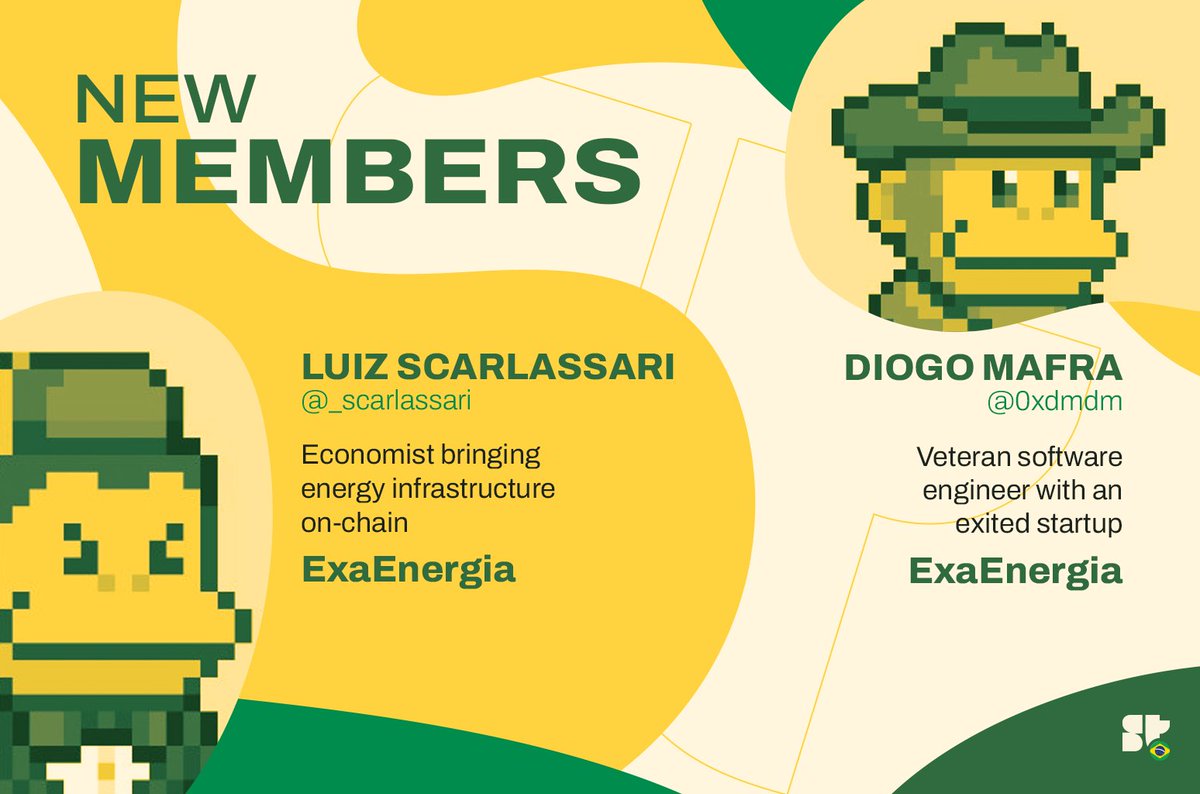
We’re excited to welcome Diogo @0xdmdm and Luiz @_scarlassari to the STBR members hub.
Diogo is a Software Engineer with 10 years of experience, a founder with one successful exit, and currently a Staff Software Engineer at a leading Web2 company. He’s also Co-Founder of @exaenergia, bringing strong technical leadership and entrepreneurial execution into the energy + crypto frontier.
Luiz is an Economist with 5 years of experience in Private Equity and a long-time crypto enthusiast. As Co-Founder of @exaexergia, he’s working to bring the kilowatt-hour onchain — bridging capital markets, energy infrastructure, and blockchain to unlock new models of value.
Energy meets crypto.
Finance meets infrastructure.
Only Possible on Solana.
i've always been pro making money, being money motivated
and if i tried hard to do something great then money would be a side effect
it feels like silicon valley lately is infected by a different version of this where the money is the entire point
very uninspiring
finally took some time to try out new 5.3-codex alongside the codex cli tool and my god, it's night and day compared to cc.
the tool itself is much better/faster, congrats to all involved.
still need to take some time to try out opencode with kimi k2.5.
Alibaba figured out how to get 90% of frontier coding performance from 1% of the active compute. That sentence should restructure how you think about AI development costs.
Qwen3-Coder-Next sits at 80B total parameters with 3B active. It scores 44.3% on SWE-Bench Pro. To its right on this chart: DeepSeek-V3.2 at 671B, Kimi K2.5 at 1000B+, Claude Opus 4.5 at “we don’t disclose.” They all score within a few points of each other.
At 46GB RAM, a single M4 MacBook Pro runs this model locally. A Thoughtworks developer reported that one coding task on Sonnet 4 costs $10 to $20 via API. The same task on Qwen3-Coder-Next costs electricity. MIT research from last month found that open model inference runs 87% cheaper than proprietary APIs, and the optimal reallocation could save the industry $25 billion annually.
The future architecture is becoming obvious: frontier models for planning, open-weight models for execution. You pay for intelligence at the top of the stack and run commodity inference everywhere else.
Alibaba gives the model away for free because adoption is the product. Every developer who builds muscle memory on Qwen’s architecture is a developer who defaults to Alibaba’s ecosystem. The switching costs accumulate silently while everyone celebrates the open weights.
We’re entering a new phase.
@cloak_xyz is no longer just a privacy protocol.
It’s the @solana Privacy Rail.
We are building infrastructure.
Enabling programs with privacy by default.
Excited to launch Pencil
INFINITE DESIGN CANVAS for Claude Code
> Superfast WebGL canvas, fully editable, running parallel design agents
> Runs locally with Claude Code → turn designs into code
> Design files live in your git repo → Open json-based .pen format