I had a blast being out until 4am with my family and friends at UNVRS in Ibiza for my 77th birthday and thought I’d pass it along to turn you onto it, in case you’re in the neighborhood.
Africa's largest crypto exchange will power their core perps offering directly using Hyperliquid's onchain liquidity. This is a major milestone that will redefine how the next generation of financial applications are built.
The breakthrough of cloud computing was that any startup could quickly test their idea, with the comfort that the infrastructure would scale with their business. As the most liquid global venue for assets such as BTC, Hyperliquid will play the same role in the global economy. By tapping into the deepest onchain liquidity, builders can instead focus on their product and users.
Huge congratulations to the VALR team. We are honored that they chose to build on Hyperliquid. Excited to scale together!
I spent the past few days in Washington with @hyperliquidpc meeting with policymakers during the historic advancement of the Clarity Act. We discussed Hyperliquid, the benefits that it offers to American consumers, and the regulatory path to bring onchain derivatives markets into the United States.
Some conversations were technical with an impressive baseline understanding of Hyperliquid. Discussions included how onchain trading is a financial innovation that has clear global user demand. Other conversations focused more on a first principles introduction to defi and the promise of onchain markets. It was encouraging to see bipartisan support for thoughtful regulation of crypto. I look forward to continuing discussions in DC and working hard to make American access to Hyperliquid a reality.
USDC is becoming a core part of @HyperliquidX’s evolving market structure.
USDC will become an Aligned Quote Asset on Hyperliquid and continue as the primary collateral asset across HIP-1, HIP-2, HIP-3, and now HIP-4 markets.
As Hyperliquid expands into new onchain markets, USDC enables:
→ Deep liquidity across trading pairs
→ Greater capital efficiency ecosystem-wide
→ Seamless crosschain access to digital dollars
Circle is also making a significant financial investment in the ecosystem through HYPE staking.
Hyperliquid.
https://t.co/bxFRXgYJLm
okay so the hyperliquid announcement is omega giga bullish and there are enough tldr's around for you to read the basics but here are my favourite parts:
- the core team clearly has high leverage even with the biggest players in the game as they secure a deal with extremely favourable terms
- one of the biggest friction points (bridging to HL) will soon be direct through circle's cross-chain protocol
- hard to describe how big of a win this is from a regulatory standpoint just before the clarity act is likely to pass. two of the most scrutinised and regulation-friendly teams just threw a massive amount of reputation and money at HL right before it goes through the senate. that timing isn't an accident
- this deal reaffirms the HL team remains extremely aligned with the growth of the token and redistributing the wealth created on chain back to users
- there are no 'leaks' in the HL team, in crypto it's very common to see tokens outperforming into unknown announcements, $HYPE has been bleeding coming into this announcement
- there is no other chain where increasing TVL feeds directly into token increase, $HYPE now does
this announcement really helps smooth over the bear cases and creates an even higher ceiling for the bull cases
hyperliquid will be the house of all finance and all others will be competing through builder codes
hyperliquid
Microsoft 365 connectors are now available on every Claude plan.
Connect Outlook, OneDrive, and SharePoint to bring your email, docs, and files into the conversation.
Get started here: https://t.co/EdoQeT8BBN
S&P Dow Jones Indices and trade[XYZ] have joined forces to launch the first official S&P 500 perpetual contract, available exclusively on Hyperliquid.
For 69 years, the S&P 500 has been a defining reference point for global finance. Until now, access to that benchmark has been shaped by market hours, intermediaries, and geography. Today, that changes.
The S&P 500 perp is now available 24/7/365, anchored by the official index data required for deep liquidity and institutional confidence at scale.
SPDJI helped define modern indexing. They are stewards of an iconic benchmark, the standard against which portfolios across the globe are measured. We are honored to bring that legacy on-chain.
Trade[XYZ] is bringing the world's most iconic assets towards a future of global, continuous markets — a future powered by Hyperliquid.
Some key takeaways from $PURR first earnings call
1. $HYPE Holdings and Cash
- Established a strong initial treasury with 12.5M HYPE tokens and $300M in cash contributed by investors.
- Deployed $10.5M to repurchase ~3.0M PURR shares, reducing the fully diluted share count to 150.6M.
- Deployed $129.5M to acquire ~5.0M additional HYPE tokens at ~$25.9, increasing total HYPE holdings to 17.6M.
- $125M in remaining deployable capital.
2. $PURR Views on $HYPE and Treasury Strategy
@dschamis and the team remain very impressed by $HYPE’s growth, especially with Builder Codes and HIP-3. They highlighted that at peak Silver volume, Hyperliquid processed around ~2% of total global Silver volume.
They also highlighted that BLP (Portfolio Margin) and HIP-4 are the two upcoming updates they are most excited about, as they believe these will further expand $HYPE’s TAM. He mentioned:
“Before HIP-4, for any startup trying to compete with Polymarket, it would have required significant capital, time, and execution capabilities. With HIP-4, these startups can focus on distribution, liquidity, and users without needing to build backend infrastructure.”
They also stated that they believe $HYPE is currently undervalued, citing valuation multiples such as P/E being significantly lower than traditional benchmarks like the S&P.
That said, they emphasized they will buy or sell both $HYPE and $PURR using a valuation-driven approach.
From my understanding:
- They will buy (sell) $PURR when mNAV is significantly below (above) NAV. "Not when mNAV is 0,9 - 1,1"
- They will sell (buy) $HYPE when price is significantly above (below) their perceived fair value.
This helps explain why they are currently accumulating more $HYPE. They believe $HYPE is undervalued.
3. $PURR’s Role Within the Ecosystem
Today, a large part of $PURR value comes from providing U.S. investors access to $HYPE. David mentioned an HFT firm that actively trades crypto but currently cannot access $HYPE directly.
Another key role is increasing $HYPE visibility/understanding, through direct investor meetings, TV appearances, and podcasts. David mentioned recognition has improved significantly but that a large audience still remains untapped.
That said, they also expressed interest in increasing their direct participation within the ecosystem and potentially generating operating income, for example by running a validator. They emphasized they are not a hedge fund, and will only expand operating activities if they remain within their risk framework.
4. $PURR Net Asset Value Framework
They also introduced their framework around $PURR mNAV and mentioned they would release a new dashboard tracking NAV in real time, adjusting dynamically based on both $PURR and $HYPE prices.
They also stated they plan to update the dashboard weekly around company cash, purchases , etc. rather than only reporting when required by the SEC every quarter.
We personally like this announcement a lot.
5. $HYPE Outstanding Supply
David also shared their framework for estimating $HYPE outstanding supply, which we believe is very interesting and broadly aligns with our own way of thinking about circulating supply.
Their framework suggests real supply is closer to ~47% of total supply.
I mostly agree with this framework, although I think real outstanding supply could be even lower.
AF buybacks are structurally deflationary, meaning effective circulating supply should continue decreasing over time. It may also make sense to factor in future AF buybacks and burns when thinking about forward supply.
Regarding team allocation, there is limited additional analysis possible today due to lack of data. However, the team is currently unstaking ~90% less than the maximum allowed.
I believe the majority of team supply will not hit the market for a very long time.
--
This is a brief summary, but I believe it captures most of the key points. I’d like to thank @dschamis, @rediamondjr and their team for the work they are doing for Hyperliquid and the broader industry. They have been a net positive for the ecosystem, and I believe they are just getting started.
Great job @dschamis for your first earnings call as CEO !!
Looking forward to future ones and to seeing @HypeStrat role within the ecosystem continue to expand from here.
Hyperliquid.
Funniest arc of this entire CZ crashout saga is him backing away slowly from the non functional chinese Hyperliquid after realizing they were retarded enough to washtrade $150B+ in volume a day (2x Binance's ADV).
The Death of Critical Thinking in Crypto
Trigger Warning: @binance
I’m not here to convert anyone from their chosen religion - whether that’s a blockchain, CEX, or DEX.
I’ve found the tools that work for me - tools that help me make money, that I enjoy using, that improve the quality of my life. I don’t need anyone’s approval for that.
What’s right for me might not be right for you, and that’s perfectly fine.
I’m not insecure enough to need validation, nor delusional enough to think my opinions could sway the hearts and minds of so many to make a difference. As I've always said: if your bags require you to constantly shill them, you have the wrong bags.
But in this era of crypto religion - where everyone defends their prophets, worships their chains, and shills their tokens - we’ve lost something essential: critical thinking. The ability to separate fact from fiction, to search for truth without bias or ego.
And that skill is non-negotiable for any serious investor.
The facts are painting a clear picture: Binance triggered the global cascade of liquidations just days ago.
Many brilliant researchers have laid it out in detail. This isn’t conspiracy or speculation - it simply is. I’ve shared some of that research here for anyone who values truth over tribalism.
I don’t care whether Binance succeeds or fails, or whether their tokens and “DEX” offshoots win or lose. I’ve never been a Binance customer, and it makes no difference to my life either way.
But if this industry wants to evolve, we have to face catastrophic failures with logic, not loyalty. Learn from them, adapt, and do what crypto was built to do: solve our own problems without waiting for regulators to “save” us.
Some have said I’m using these facts as an excuse for my own massive loss - that it’s easier to blame someone else.
Let me be vulnerable for a second: it’s not easier. It’s harder.
I told my wife earlier that I’ve been struggling emotionally. Because as investors, we understand risk. We accept it. We build systems to manage it. When those systems fail because of our error, we learn and grow stronger.
But when you realize your system didn’t fail - someone simply drove a tank through your house - it’s not liberating. It’s depressing. You followed your own battle-tested plan, and still got robbed. That feeling - helplessness, violation - I hate it.
But here’s the truth: victimhood doesn’t pay. Quitting doesn’t pay.
Adapting does. Pivoting does. Overcoming does. This is what both we as an industry as well as us as individual investors must do.
There will always be predators in the deep.
The key is learning how to stay safe from them.
🫡 From the depths —
The White Whale 🐋
Hyperliquid’s fully onchain liquidations cannot be compared with underreported CEX liquidations
Hyperliquid is a blockchain where every order, trade, and liquidation happens onchain. Anyone can permissionlessly verify the chain’s execution, including all liquidations and their fair execution for all users. Furthermore, anyone can verify the solvency of the entire system in real time. Transparency and neutrality are key reasons that fully onchain defi is the ideal infrastructure for global finance.
Some CEXs publicly document that they dramatically underreport user liquidations. For example on Binance, even if there are thousands of liquidation orders in the same second, only one is reported. Because liquidations happen in bursts, this could easily be 100x under-reporting under some conditions. Source below.
Hopefully the industry will see transparency and neutrality as important features of the new financial system, and others will follow.
A Post-Crash Pilot Debrief from The White Whale
$62M - gone in a flash. But as was repeatedly pounded into my head in pilot training: any landing you can walk away from is a good landing.
As I’ve been processing yesterday’s events, I want to share a few thoughts from a place of honesty, vulnerability, and accountability - as I always have.
Let’s start with why I faced such a large liquidation, and then I’ll share some observations from the last 18 hours.
First and foremost: I got too fixated on the goal.
At one point this year, my unrealized PnL sat at 98 out of 100 million. Counting profits from other platforms, I had actually surpassed that goal - but because some of those platforms lacked HyperLiquid’s transparency, it became a mental game of “proof, or it didn’t happen.”
Heading into late September, my thesis was that because everyone expected a dip, it wouldn’t happen - and I wanted to be positioned in case I was right. I wasn’t. But I remained calm; I’ve survived every “black swan” this year and turned each into profit before.
That 100M milestone meant more than numbers to me. Years ago, I built a real-world company with that same amount as my exit target goal. But I walked away - choosing peace over profit. Running it had made me miserable; I was a prisoner to my own creation. So being able to finish that prior goal, this time on my own terms, became a form of redemption. A personal validation that I’d found a better way.
I’ve always been stubbornly resilient. Knocked down, yes - but never out.
That same determination that helped me survive life’s earlier chapters also made me impatient to start the next one. I wanted to move beyond daily trading and begin shaping the future of this space - helping build what comes next, not just benefiting from it.
Crypto is wild, beautiful, and broken in equal measure. My background has always been consumer-first: if you do right by people, your reward eventually comes. That principle belongs here, too - and I intend to bring it here.
But I rushed. I let excitement override discipline. And that’s on me.
While the timeline was full of “crime season” posts (ironically including my own), I’ve always believed this: you can’t claim the victories if you won’t own the failures.
Yesterday, when someone asked how I was handling it, I admitted I cried in my wife’s arms. Some mocked it with “no crying in the casino.” But I shared that moment intentionally - because sometimes, it’s okay to not be okay.
Vulnerability, especially among men, needs more voices.
And for the record - I’m still up for the year. I’ll recover, rebuild, and rise again.
A few quick observations from the wreckage:
L2 failures, once again.
During peak activity, Arbitrum and Base failed me - transactions hung while I tried to move stables. Solana, meanwhile, stayed rock solid. It wouldn’t have saved the position (nothing could outrun that $3200 ETH / $138 SOL wick), but once again Solana proved it performs when it matters most and earns more of my loyalty by the day.
Leverage isn’t the villain.
Some rushed to say, “See, that’s why leverage kills you.” I reject that. Leverage is just a tool - like a knife, a car, or money itself. Tools aren’t evil. The hand that wields them determines the outcome.
The humanity in the aftermath.
Amid the trolls celebrating others’ losses - a dark side of this space I’ll never understand - I also witnessed incredible compassion. People offering comfort, solidarity…even five individuals offering to send me money to help rebuild. I refused, of course - but the gesture hit me hard. It reminded me that for all the toxicity, there’s still goodness here.
Most days I’m the one offering support, not receiving it. Yesterday reversed that dynamic - and it meant more than I can express.
This wasn’t my proudest moment. But every chapter - even the painful ones - has purpose. If this experience reminds even one person to stay humble, to manage risk, to remain human through the chaos, then it wasn’t wasted.
Losses teach what profits never can: where strength truly lives. And mine was never in the number - it’s in the will to rebuild.
🫡 From the depths —
The White Whale 🐋
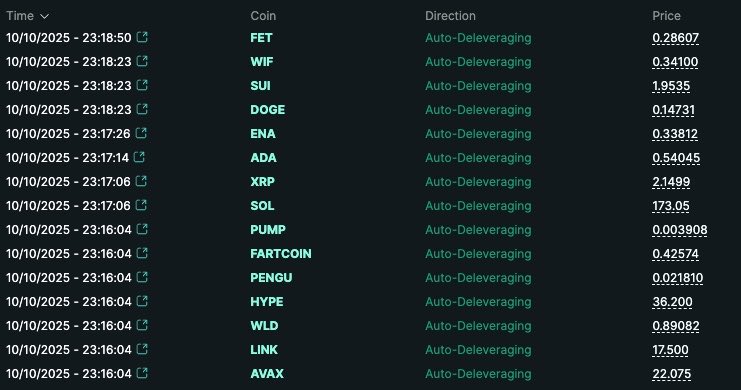
TLDR: During recent volatility, Hyperliquid had 100% uptime with zero bad debt. This was Hyperliquid’s first cross-margin ADL in more than 2 years of operation. ADL does not change the outcome for any liquidated users. While some specific ADL providing trades were unfavorable, the aggregate effect of ADL was that traders realized significant pnl by closing positions at favorable prices that were only briefly available.
--
It’s sad to see some people attack Hyperliquid to deflect from their own platforms’ issues. Solvency and uptime are the two most important properties of a financial system. These are table stakes for any trading system, and gaslighting to convince users otherwise is unethical and irresponsible.
Below is more analysis on how Hyperliquid’s margining system handled the extreme volatility.
Background on liquidations
For a perps system to be solvent, every position must be backed by a minimum amount of collateral. This is called the “maintenance margin.” When positions do not meet the maintenance margin requirement, they are taken over by the system to be liquidated. Earlier today, many altcoins dropped by more than 50% in a short period of time. When this happens, long positions at 2x or higher leverage must be liquidated, or else the system accrues bad debt.
There were billions of dollars worth of positions liquidated on Hyperliquid in a matter of minutes. In a permissionless system, each user chooses their own position sizing and collateralization. Any system that does not liquidate the necessary users is irresponsibly gambling with other users’ funds. On Hyperliquid, every order, trade, and liquidation is transparently verifiable onchain. Many other venues significantly under-report liquidation data. This cannot be compared apples-to-apples against the fully onchain picture of Hyperliquid.
Background on HLP
HLP is a protocol vault with permissionless deposits that 1) provides order book liquidity and 2) performs backstop liquidations. The first role is negligible, with HLP trading less than 1% market share. The focus of this post is liquidations.
Liquidations are first attempted against the order book, and any user can provide liquidity to these market liquidations. Backstop liquidations occur when the order book does not have enough liquidity to absorb an undercollateralized position. In this case, HLP takes over the position along with its collateral. For improved risk management, HLP is split into several child vaults, and each liquidation is only sent to one child vault.
Background on ADL
Auto-deleveraging (ADL) is the liquidation mechanism of last resort, when market and backstop liquidations do not work. See Doug’s thread (link in reply) for a thorough explanation on the details of ADL.
Every ADL event has two sides: the “triggered” side is undercollateralized, while the “providing” side is decided as a function of profitability and leverage used.
Similar to backstop liquidations, even though providers to ADL are profitable on average, there are no guarantees for any specific event. Some ADL providing trades were unfavorable, such as when only some components of long/short portfolio were closed. The system is designed to minimize ADLs because they are unpredictable even if ADL providing trades are profitable on average. Because HLP is a non-toxic backstop liquidator, ADL is a rare settlement of last resort. As far as I know, this was the first cross-margin ADL event on Hyperliquid mainnet (ADL is more common for isolated-only assets such as hyperps, which are not backstop liquidated by HLP).
Summary of events
Over the course of 20 minutes, HLP backstop liquidated billions of dollars worth of positions.
HLP's philosophy has always been to provide liquidity of last resort. Contrary to misconceptions, HLP is a non-toxic liquidator that does not pick profitable liquidations. Instead HLP is a public good for maintaining system solvency. In particular, Hyperliquid has no liquidation fees. HLP’s design, including its multi-component child vault system, is the product of countless simulations, and allows HLP to maximally serve the benefit of the protocol while managing its own risk.
In fact, the liquidator child vaults of HLP themselves became undercollateralized in the course of backstop liquidating as many user positions as possible. This is by design, where child vaults are isolated from the other components of the overall strategy. HLP is treated no differently from other users when participating in ADL. In aggregate, HLP's child vaults were the largest addresses on the triggered side of ADL by more than an order of magnitude. The addresses on the providing side of ADL against HLP’s child vaults realized hundreds of millions of dollars in additional profit relative to the prices shortly before and after the dislocation.
On other venues, the liquidation engine is not transparent and therefore may not be subject to the same strict margin requirements as for normal users. On these venues, the exchange could have backstop liquidated more positions, bearing increased solvency risk to extract hundreds of millions in business revenue. This is not an acceptable tradeoff for Hyperliquid.
Finally, I know that this is a difficult time for many traders, and I hope the community can continue to support each other and grow together. As a contributor to Hyperliquid, I’ll continue to work my hardest to build the best possible platform that can house all of finance. Times like this highlight the importance of transparency and fairness in the financial system.
During the recent market volatility, the Hyperliquid blockchain had zero downtime or latency issues despite record traffic and volumes. HyperBFT consensus and execution handled the spike in throughput gracefully.
This was an important stress test proving that Hyperliquid's decentralized and fully onchain financial system can be robust and scalable. The system's risk and margining implementation functioned as designed, ensuring platform solvency throughout the extreme volatility.
1/ Since a lot of people are waking up to see their perps positions closed and wondering what the hell “Auto-Deleveraging” means, here’s a quick and dirty primer.
What is ADL? How does it work? And why does it exist?