With the power outage in Spain and Portugal, we hope that all Q community members there are safe!
For those who are running a node in this area, here is a reminder of what happens:
Q has pioneered the concept of “constitutional slashing”.
This means that although uptime requirements for node operators (validators and root nodes) are mandatory, slashing of stake in case of downtime is not automatic. Slashing proposals are evaluated by Q’s root nodes, who can take into account circumstantial factors – like a nationwide power outage – when making slashing decisions. The process and their scope of discretion is clearly defined in the Q Constitution. And in case of disputes, Q’s dispute resolution mechanism is in place to resolve the situation.
This approach is unique to Q and protects node operators from unfair slashing of stake.
This approach is in stark contrast to slashing rules in other networks, where power outages – although entirely outside the control of node operators – can lead to serious slashing penalties (e.g. via correlation penalties).
The Q community believes that constitutional slashing is not only fairer, but also promotes a healthy and geographically diverse validator set.
Developers!
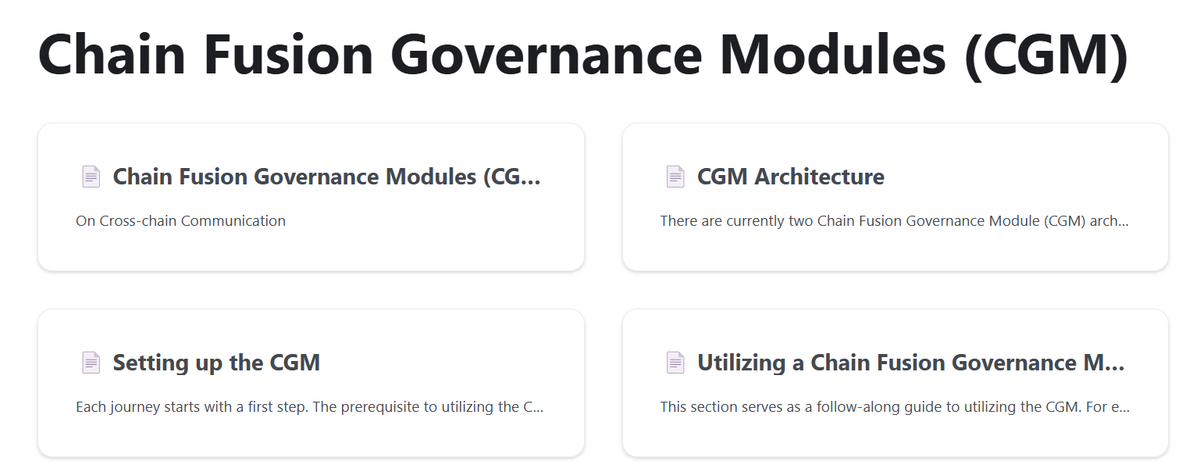
Want to find out how to integrate @QBlockchain with @dfinity via ICP Chain Fusion?
Check out the developer documentation (linked in reply):
DAO enjoyooors!
If you want to learn about the hottest topics in 2025, make sure to read @owocki 's article on trends in DAO design.
Subjective rule enforcement, as provided and pioneered by the Q Protocol, is featured under #43.
The list provides a fantastic starting point to dive deep into the DAO rabbit hole.
Proud to share the latest advancement: cross-chain treasuries on any EVM chain and on ICP, governed from a DAOs on Q.
Made possible via @dfinity's Chain Fusion.
Q Protocol 🤝 Internet Computer
2025 starts with a major integration: “ICP Chain Fusion Governance Modules” connect Q’s unique governance capabilities with the @dfinity ecosystem.
My friend @0xgerritbr wrote a blog post on the necessity for DeSci to have enforcement via governance. Quote from the article:
"Effective governance mechanisms are therefore crucial for DeSci projects and communities to function in a truly decentralized manner. These mechanisms must go beyond the deterministic “code-is-law” paradigm which is typically associated with blockchains, and provide nuance."
-> Enforcement via code alone will not work.
I agree that this is completely missing in the current batch of DeSci tokens.
Decentralization lies at the heart of the Q Protocol. To learn more about how Q International Foundation supports the Q community in decentralizing Q, check out the following blog post:
https://t.co/qRF3PtY7Tn
The Q community supports decentralized governance initiatives across ecosystems.
@Cardano is one of them - cast your vote here to support this effort:
https://t.co/MJJI3hBWH6
@Fidias0@Fidias0 therye is a lot we can learn from how projects are governed on the Blockchain. For the first time in history we are seeing rapid prototyping of democratic governance systems being built, failing, iterating and improving.
@colludingnode I think centralization can enter in multiple dimensions and even many projects that you could consider useful are more centralized than it seems at first look.
@colludingnode I agree in principle, but I believe that our systems realistically need to also account for a wider range of users. And clearer processes increase the accessibility to participate.
@colludingnode And this does not even touch the fact that a process of forking itself is heavily biased. Neglecting a systems inertia and barriers of entry to new forks like capital, brand, trust...
Seems like I should get twitter premium to wrap that all into one reply...
@colludingnode While Option 2) still requires a governance process. This can either involve the community and we are right were we started OR the project team uses the notion "you can fork at any time" to de-facto centralize operations. Which can be ok, but that's not decentralized.