What stuck out reading this (it kept me up last night too):
#1 proof of humanity will / should really grow in importance, like @harari_yuval insists. Ironic that sama’s @worldcoin is farthest along in this.
#2 how critical direct dialogue & verifiable trust in the US-China relationship is. Telling the last thing Kissinger worked on was AI arms control b/w both superpowers.
#3 if all else is FUBAR, the ASI from a frontier lab really putting safety first could be the white hat that saves our bacon. @AnthropicAI figuratively / actually doing god’s work
r/acc (accelerate responsibly)
@venturetwins I guess @odysseyml already going in this direction, but has to take next step to VR to be immersive worlds. Wonder who else is credibly working on this 🤔 apart from @theworldlabs
But something I’ve been thinking about is also what happens to democracy in a world of widespread powerful AGI (let alone ASI). Major influences for the rise and strengthening of democracy was to accommodate needed workers’ and soldiers’ demands. @LRudL_ touches on this in his AI through 2040 scenario, that government as much as business elites may come to realize the average worker-soldier citizen isn’t important anymore to secure and expand a state’s economic and security interests. Does democracy endure or dilute then? It’s like that realist maxim, there are no principles, only interests
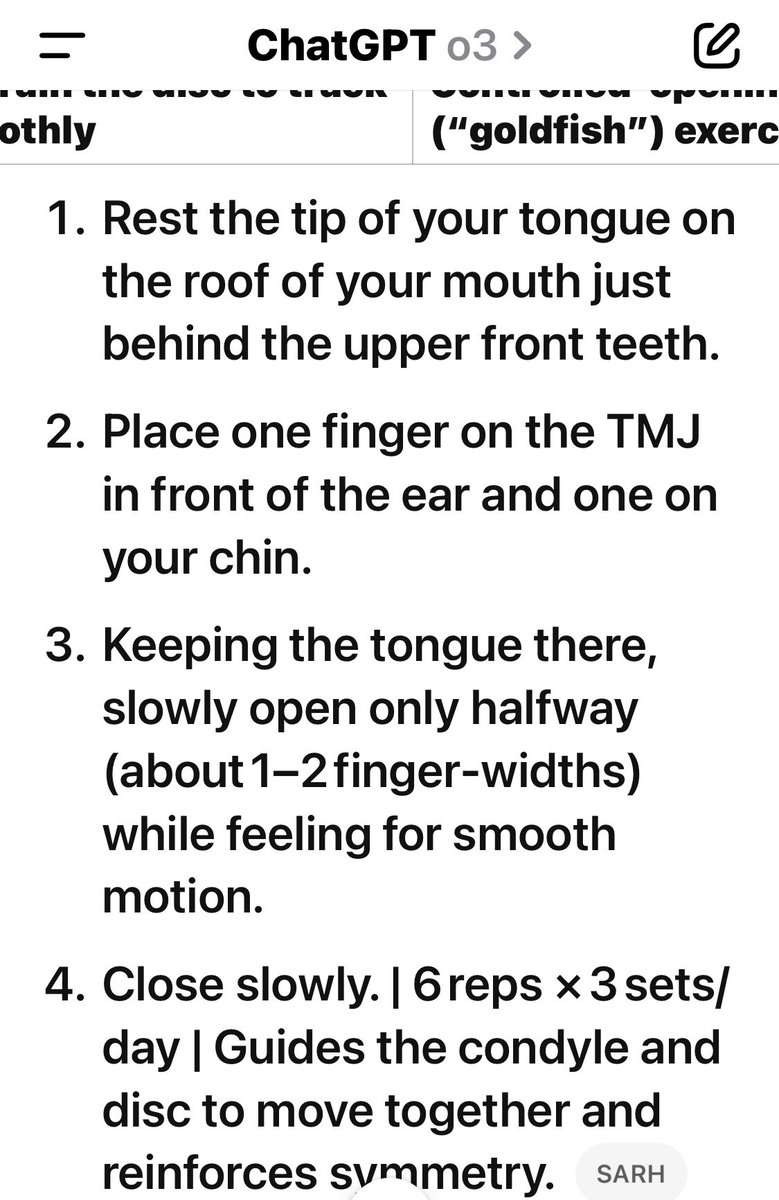
Wait, wtf. It worked. I've had TMJ for 17 years, have spent maybe $5,000 on various fucking "specialists" for it, and I just had to put my tongue on the roof of my mouth and open slowly? I'm honestly shocked
Right, ah I see, you mean that once researchers (whether human or AI) understand how AIs work / “think”, they can further increase their capabilities and that’s where the safety risk is exacerbated? I guess the way I thought of it before was more like a “lie detector”. I also wonder if AIs could learn how to avoid/game interpretability if that’s possible (like OAI’s recent report advising not to train for CoT optimization, which is like a “weak” interpretability atm, or AI’s will get better at “lying” / hiding their CoT)
@nickcammarata@__RickG__ Why do you think it is much more a capabilities technique instead of fully pro safety? Isn’t it basically a way to verify the model’s real process / “thinking”?
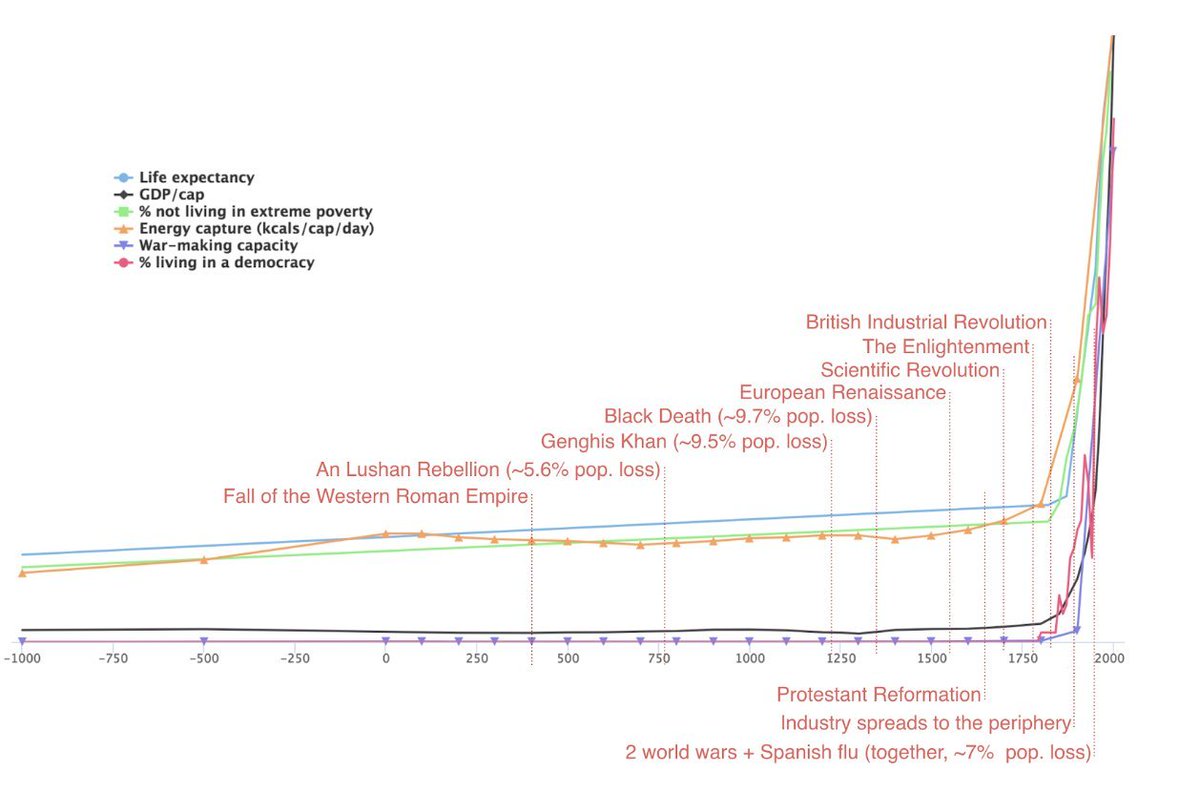
On a macro view, over the past 3000 years only the industrial revolution has really mattered
Rome's fall, events killing ~10% of humanity, massive social shifts... all insignificant blips on a flat line
until the Industrial Revolution hits and EVERYTHING explodes upward
Many of you have forgotten that the internet has been left unfinished.
We are meant to use wearable hardware to plug into a spatially incarnated internet that weaves together virtual worlds with a giant social graph of every human.
We have yet to fully realize the potential of the internet; to build the last and only true social network.
Instead of broadcast-only websites like X/Instagram, we are meant to build virtual cities, make friends with people on the other side of the globe, have an intimate evening with someone in your living room but they’re in Tokyo. To organize raves with a bunch of anonymous DJs living in Serbia for a Chinese crowd. To build new digital cathedrals for people lurking the internet to find kinship. Or simply to be with your family members who are living in a different country, and spend an evening talking with them face to face.
A complete internet is a physical and spatial portal to be with anyone, in worlds you can sculpt.
Introducing Claude 3.7 Sonnet: our most intelligent model to date. It's a hybrid reasoning model, producing near-instant responses or extended, step-by-step thinking.
One model, two ways to think.
We’re also releasing an agentic coding tool: Claude Code.
@JDVance Are you pretending to be stupid or are you just completely ignorant of history? America’s own experience in Vietnam and Afghanistan offer proof apparently a Yale Law degree doesn’t teach you how to argue