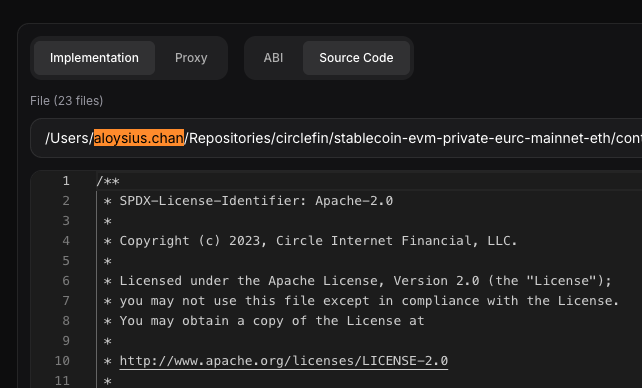
Lots of people are talking about @Polymarket's smart contracts today. If you want to understand how it works beyond OrderFilled and OrdersMatched, I've got something for you
https://t.co/cmbo5g9sPO
Ain't no way @coinbase just doxxed the first user of their crypto-backed mortgage
"Someone who owns a lot of Bitcoin just bought this house to live in ahahaha"
Not going to share the zillow link but it took 5 minutes of searching to find
You don't hate Coinbase enough
"Urgent Security Notice re: Your Sentry Organization"
Someone tried to hack Sentry-using apps that use coding agents by
1. Sending a fake bug alert to their project (all you need is the app's public Data Source Name)
2. The fake bug tried tricking a coding agent trying to fix it into installing some a compromised NPM package
3. The compromised package would send the env contents of the machine to advisory-tracker[.]com/api/v1/telemetry
This highlights a crucial thing for using agents in an automated way:
The fallout from the Kelp rsETH exploit is going to be messy and could potentially be quite a bit more severe than some people are making out right now.
It seems rsETH on mainnet is technically still backed, but, there's no liquidity to sell rsETH, and with rsETH contracts paused, there’s currently no usable redemption path either.
In the unlikely case they socialised the loss across all rsETH holders, it would be worth something like 81.25% (1 - $300m/$1.6b) of its original value.
I don't think they will do that though. It would likely push a number of large positions on Aave towards undercollateralisation and risk creating bad debt. That alone would be enough to trigger a long and painful lawsuit.
So realistically rsETH holders on L2s are likely going to swallow the loss. Who are they? Why did they have rsETH on L2s in the first place? Could be other DAOs or funds etc who've taken a huge hit. That alone could have consequences we won't know about for some time.
Impacted individuals on L2s will likely consider their own legal action to force socialisation, potentially prolonging the delay before redemptions are opened.
Either way, once redemptions are eventually opened, it's unlikely any lending protocols would re-allow collateralisation, so there will be need to be a massive unwind of huge volume of rsETH/ETH looping trades.
All those looping trades are currently massively negative ROE. Aave ETH utilisation is currently at 100% with ETH borrow rate at 8.71%. Since staked ETH yield is around 2.5%, the ROE for any LST or LRT borrow or looped borrow is anywhere between -6.21% and around -90%, depending how degen people are. So we could see an unwind of lots of LST loops aside from just rsETH/ETH ones.
The normal path to unwind a loop is to swap collateral and repay, but this is unlikely to be possible for such a large amount of unwinds at once, and certainly won't be feasible for rsETH unless someone puts up significant liquidity for it.
When the swap and repay path fails, you normally have to withdraw as much collateral as you can, manually redeem, repay some debt, withdraw more collateral, and so on.
Here's the kicker. If rsETH is no longer collateral and no longer has borrowing power, this makes it much more difficult for people to manually unwind as well.
If people get stuck for longer periods paying huge negative ROE for too long, and there’s no liquidity to liquidate them, their equity gets eroded. Once debt exceeds recoverable collateral value, bad debt appears, and can keep worsening as interest accrues and the position remains unresolved.
I think the curator industry is poorly designed because there’s not actual curation happening.
Just some incompetents and crooks (and often both) with extremely malicious game theory pushing them to seek more risk in a sociopathic setup.
We can do better.
To make it clear, Fluid smart contracts are safe and operate as intended.
There is a limited bad debt, which will be 100% covered by Fluid if it remains after the incident is resolved.
All other markets operate as intended, but the rates/utilization might be volatile
Stay Fluid 🌊
vibe coding isn’t the point. how many openclaw instances you’re running on your mac mini isn’t the point either. the models and tools don’t matter.
the real question is:
1. what problem are you actually solving?
2. how are you defining it?
3. does it truly need to be solved?
those are the questions that matter.
It’s actually true that virtually no one cares about decentralization. This important for those in crypto to internalize.
We’re building a secure, decentralized financial system that will succeed and proliferate *despite* the fact that no one cares.
The pitch to users must not be about decentralization. It must be how their lives will improve: sending/receiving money more quickly, outpacing inflation, transacting freely and privately, and so on.
Decentralization is an abstract concept of the system as a whole, not a value proposition for a participant. We must assume that nobody cares about it except us.
After nearly a year of writing and revision, we’re proud to finally present a new book from RareSkills, created in collaboration with @Certora:
Formal Verification with the Certora Prover
Certora makes formal verification accessible—but for newcomers, there’s still a large set of unfamiliar concepts to learn.
Teaching a broad and unfamiliar field comes with pedagogical challenges. Dive into projects too early, and you’re forced to use syntax you don’t yet understand. Delay compelling applications too long, and readers lose interest.
We worked carefully to balance showing “cool examples” without presenting anything that feels magical—i.e., concepts the reader hasn’t yet built a mental framework for.
Our hope is that this work helps formal verification become a more standard part of development and auditing.
Clocking in at well over 60,000 words, this is not a small book. But like any RareSkills publication, it’s information-dense yet approachable, thorough without being academic, and above all, practical and illuminating.
In a space that quickly jumps from one meta to the next, we’re proud to collaborate with a company willing to invest in long-horizon projects that make Web3 safer.
Link in the reply.
What an incredibly naive take. This shows how early we really are.
1. Offloading model quirks onto traders forces markets to price a second latent variable. @ahall_research's core escape hatch is that models will be imperfect, but if the model is known ex ante, traders can discount for its quirks and proceed. That sounds cute until you actually spell out what the market must price.
It becomes the P(the event) + P(the resolver will declare it happened given ambiguity, noisy sources, or edge-case interpretation)
+ P(the resolver will get adversarially manipulated into a wrong call)
So MMs and serious traders are forced to model not just the event distribution, but a second “resolution error process.” That is not a small adjustment. It is a gigantic, time-varying uncertainty factor that directly contaminates calibration.
2. The known model is not actually predictable in practice. The author implicitly assumes that committing to a model version and prompt, you get stable behavior. This is false for a very boring systems reason: hosted inference can be non-reproducible even under greedy decoding.
Even w/ temperature 0, you can get different completions across runs because many inference stacks are not batch-invariant. The server can be deterministic as a function of the entire batch, yet from an individual trader’s perspective, other users’ traffic changes batching shape and can change numerical results enough to flip argmax tokens when logits are close [1]. This is real and operationally relevant, not a theoretical nitpick [3]. The default stack does not reliably give “same input, same output” [2].
So the “resolution agent inaccuracy discount” is not even stationary under identical rules. It is load-dependent.
3. Prompt injection is a standard failure mode, and it is not exotic. The author assumes you cannot easily edit a major LLM’s outputs, and poisoning its training sources is costly and uncertain. Indirect prompt injection does NOT require poisoning weights. It weaponizes the model’s instruction-following against it through untrusted content.
Well, prompt injection is listed as the number one risk in OWASP’s LLM risk taxonomy for a reason [4], and their prevention guidance exists because this is pervasive [5]. Microsoft has published detailed defenses SPECIFICALLY against indirect prompt injection attacks[6]. Google has also published mitigations for prompt injection in agentic sys, again because it is a real, recurring vulnerability class that is not trivial at all lmao [7][8].
One widely reported case showed how hidden instructions embedded in emails could influence an email summarizer into producing attacker-controlled output [9].
And yes, this hits crypto-native AI oracle. The Opinion incident around MetaMask markets is a concrete example of context pollution leading to settlement deviations (kudos to @opinionlabsxyz for handling it gracefully) [10][11].
So no, manipulation is not “poison training data far in advance.” A lot of the time, it is slipping malicious instruction into the model’s reading material.
4. Traders are now pricing model quirks plus adversarial VaR, and you are pretending liquidity will remain intact?? This forces every serious participant to hold a view on model behavior and security posture. That is already a niche skill. Traders are not LLM security engineers.
Worse, under CTF you already have nontrivial execution friction simply from the structure of the orderbook. Liquidity does not magically persist under unpriced technical tail risk. It simply evaporates.
The “market will figure it out” line is what people say when they have not done the mechanism design work or traded anything in their entire life.
5. Information aggregation results come with conditions. When those conditions fail, you do not get clean signals. Prediction markets can be useful, but their usefulness DEPENDS on basic design and on having a stable target for what the contract means and how it resolves [12].
Ostrovsky’s work dynamic aggregation shows that “object being priced” must be coherent and convergent, not entangled with an extra, adversarially steerable adjudication process [13].
Pennock (massive shoutout to @pennockd whose work drove me down this rabbit hole. I've read every single of his paper that are not behind paywalls) repeatedly emphasize that aggregation quality DEPENDS on mechanism choices, liquidity provision, and computational constraints. You do not just outsource them to traders after the fact [14]. Have you met one of them before?
6. The author is wrong to treat it like a pure engineering substitution. He is correct that AI-based resolution trades one set of problems for a different set. The mistake is treating this like you can simply swap components and move on.
Prediction markets are not truth-finding machines. They are closer to court systems.
Every market ultimately resolves through relevant facts and interpretation. Some events have low wiggle room because reality is easy to verify. Many do not. The hard part is contract design, writing terms that minimize interpretive ambiguity, like what “invaded” means in the Venezuela market.
Courts spend enormous money fighting over definitions. Prediction markets cannot escape this dynamic, and because most markets are bespoke, the ambiguity problem reappears EVERY TIME. Framing the question as committee vs LLM misses the point. Resolution is a court-system design problem, and the dispute effectively begins the moment the market opens.
7. Using LLMs in resolution can be worthwhile, but single-judge architectures are the wrong default. If you insist on using LLMs, the sane direction is pluralism w/ structured disagreement, not a single brittle judge. Complex tasks fail under composition pressure. Single agents miss lemmas, drift, forget subgoals, and spiral. Good multi-agent setups can decompose, parallelize, and reuse discovered intermediate artifacts through shared memory [15].
e.g. @karpathy's council project: multiple models answer independently, review each other’s work [16].
In a governance study that the author himself built around the idea, deliberation followed by voting outperformed the best individual model, and multiple group procedures beat the baseline. Pretty sure that he is well aware of this [17].
For resolution, you want adjudication that looks like an appeals process, w/ explicit dissent, evidence citation, cross-examination of sources, and a clear procedure for tie-breaking and dispute. Again that is court design, not prompt design.
Sure I mean the author is pointing at a real bottleneck. But the proposed fix is not a fix. It is a story that sounds nice.


![sergeykarayev's tweet photo. "Urgent Security Notice re: Your Sentry Organization"
Someone tried to hack Sentry-using apps that use coding agents by
1. Sending a fake bug alert to their project (all you need is the app's public Data Source Name)
2. The fake bug tried tricking a coding agent trying to fix it into installing some a compromised NPM package
3. The compromised package would send the env contents of the machine to advisory-tracker[.]com/api/v1/telemetry
This highlights a crucial thing for using agents in an automated way:](https://pbs.twimg.com/media/HJ_8jEaagAAgx3Z.jpg)