some time ago I had fun building a *local* agent that:
> takes in sensitive prompts
> uses a fast LLM fine-tuned to infer personal data
> outputs a list of privacy-leaking terms
> allows you to replace those in-text
> (optionally feeds another LLM for complete rephrasing)
I was told this is a rather grotesque approach and I get why: it is highly impractical with an awful ux.
So what if I did the opposite and fed online AIs deliberately (fake) sensitive data to mess with their personal attribute inference?
@VitalikButerin outside of mixenet territory, we can indeed achieve a form of msg-by-msg unlinkability onchain. here we lay out the protocol idea https://t.co/wW6g9svt3k
@headinthebox I think the deeper link here may be this inverse relation between logical strength and reach, since weaker assumptions survive in more (computational) worlds
This is has been known for decades in neurolinguistics, from classic split-brain and aphasia studies onward. Also many standardised neuropsychological tests to assess IQ or cognitive impairments is based on the premise (think of Raven progressive matrices for example) that nonverbal reasoning can be assessed with minimal reliance on language, in both children and adults. Too often, engineers unfamiliar with this literature end up equating linguistic competence with intelligence when discussing llms
Some random things that still make me an @ethereum maximalist ♦︎
Every once in a while, after almost 9 years in this space, I ask myself: why do I still believe in it?
I’ve seen a lot of the good and the bad of this industry, especially after spending the past year at @ethereumfndn, which still feels like a dream chapter of my life.
-
1) Ethereum is scaling, while transaction costs keep falling
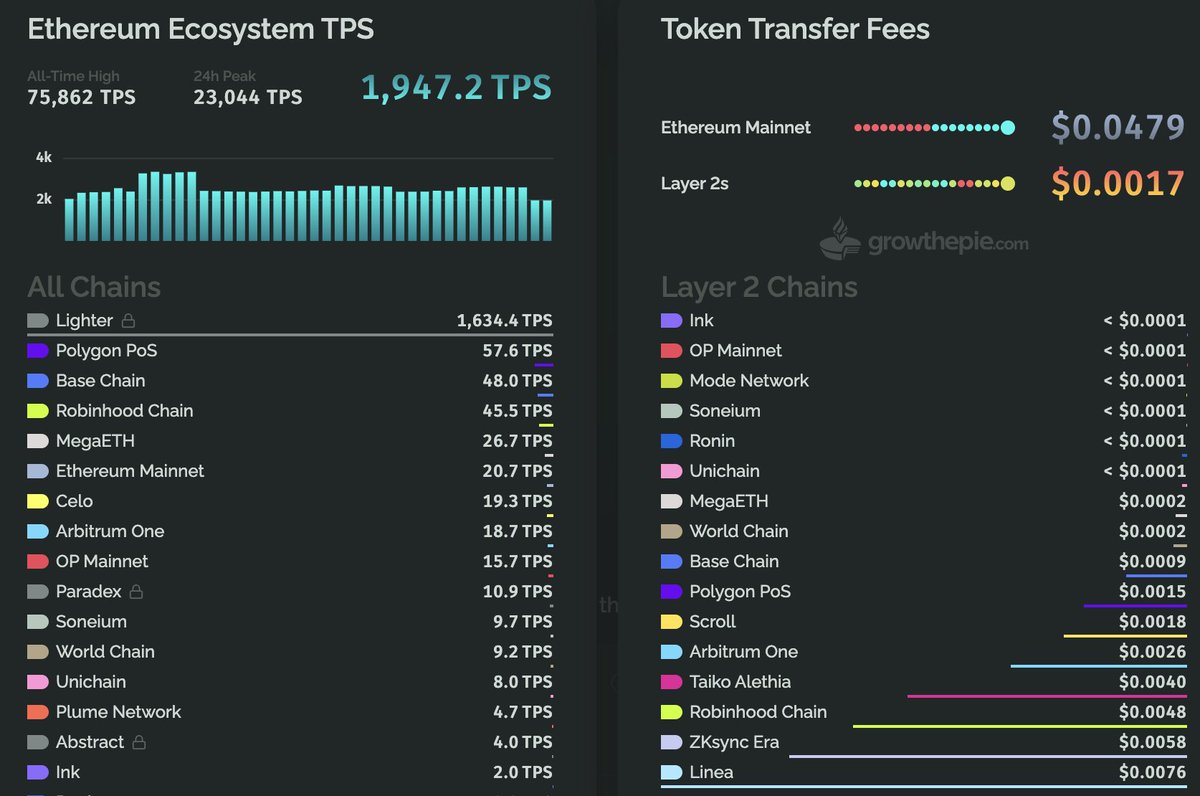
The Ethereum ecosystem can already handle thousands of TPS, with networks like @Lighter_xyz showing strong traction and consistently processing more than 2k TPS.
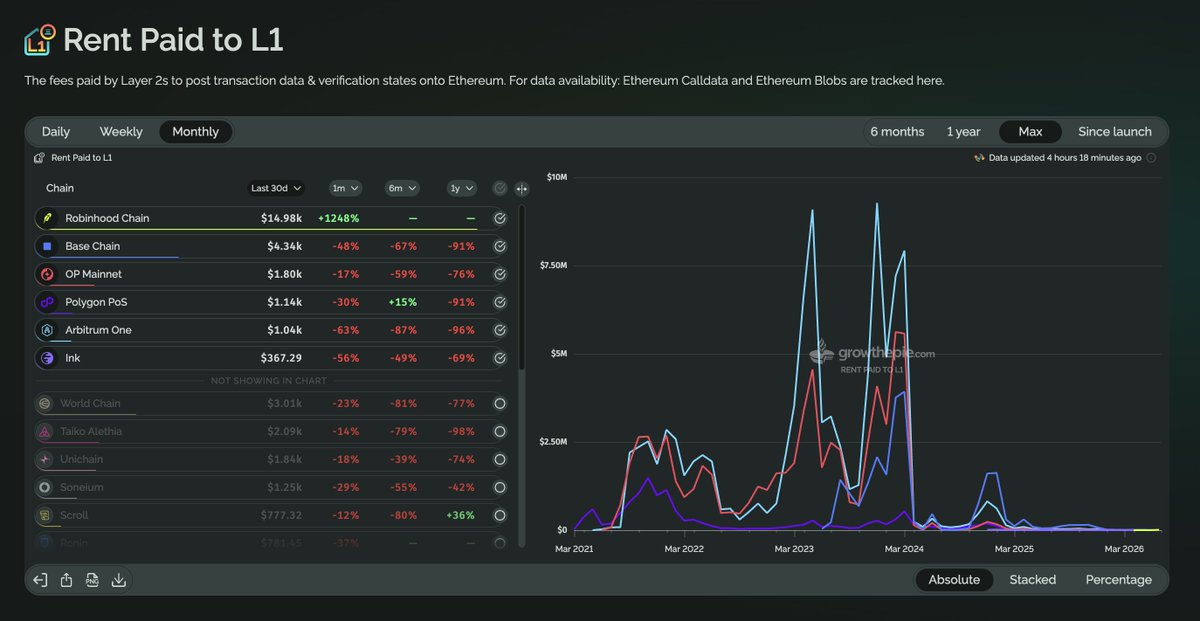
At the same time, transaction costs for users and the fees L2s pay to Ethereum have become ridiculously low.
The technology is here. The Ethereum scaling roadmap has worked.
Now the challenge is adoption.
We need 100x more Robinhood, Lighter, Base, Arbitrum, and applications capable of bringing millions of people onchain.
-
2) The Ethereum Strawmap, and especially the post-quantum plans
Ethereum Mainnet will keep scaling, potentially toward 10k TPS. But one of the most important long-term priorities is making Ethereum post-quantum secure.
That is one of the key priorities in the Strawmap that @drakefjustin shared a few months ago.
Scaling matters. But building infrastructure that can remain secure for decades matters even more.
-
3) The three new Ethereum-aligned organizations:
@ethlabs_org - the non-profit R&D lab for Ethereum
@ethereuminsti - the non-profit dedicated to accelerating the institutional adoption of Ethereum and its L2s.
@eth_systems - the company building confidential systems for institutional Ethereum.
Together with the Ethereum Foundation, these organizations can significantly strengthen Ethereum’s roadmap and GTM, especially with institutions.
And the timing matters: demand for stablecoins, tokenized assets, and onchain financial infrastructure is accelerating NOW.
4) RWAs - Stablecoins: Robinhood, Uniswap, AI agents, and regulation
I entered this ecosystem after writing my university thesis on equity tokenization 10 years ago.
At the time, I genuinely thought it could take 30 years before we saw compliant infrastructure for trading and managing tokenized real-world assets onchain.
Today, that future feels much closer.
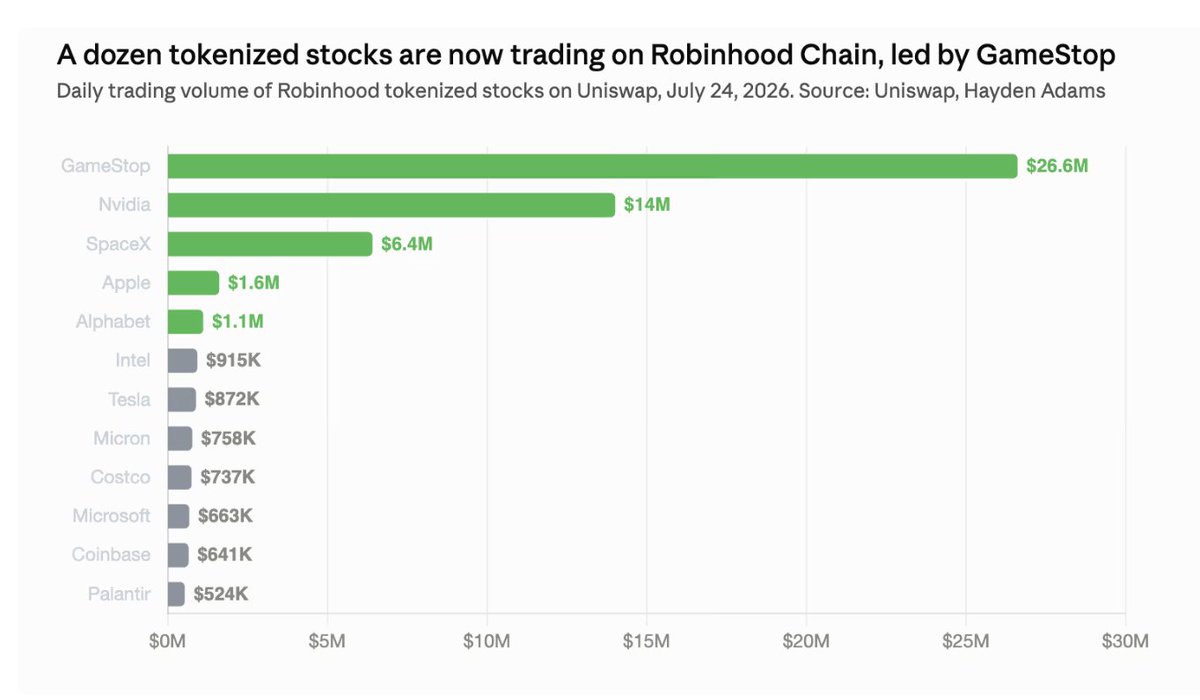
- Tokenized stock volumes on @RobinhoodApp are growing.
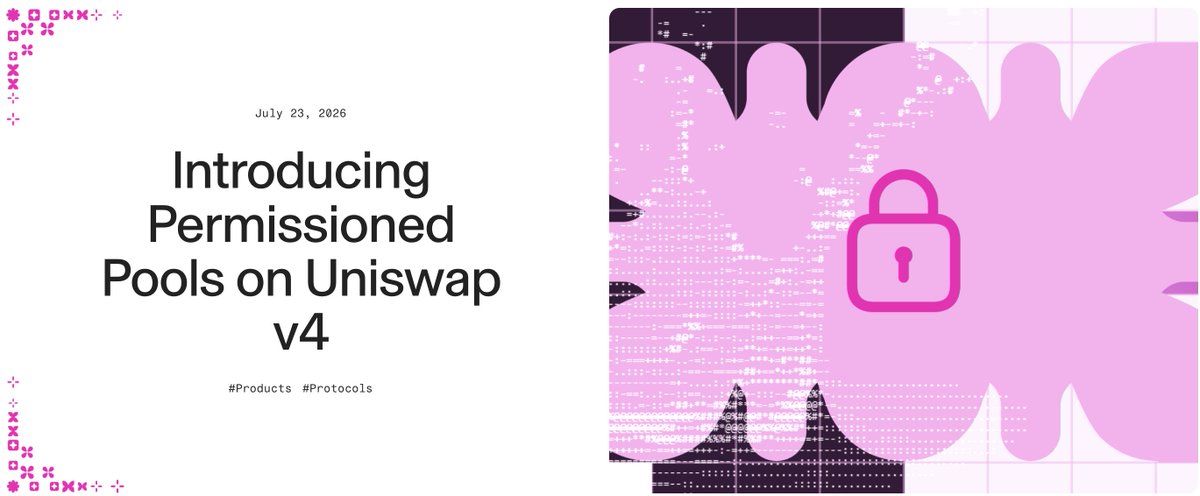
- @Uniswap is launching permissioned pools where compliance can be enforced directly onchain.
- AI agents are becoming capable of automatically managing strategies and portfolios built around tokenized real-world assets, not just memecoins.
And regulation (Clarity Act) is finally starting to catch up.
-
What I think many people underestimate is that for @ethereum to become the global settlement layer for stablecoins and RWAs, many different pieces need to come together.
It is not just a technology problem.
Completely subjective, but I would say we are roughly here:
🟢 Technology: 80%
🟡 Regulation: 30%
🔴 Market demand: 40%
The infrastructure is increasingly ready.
Now we need regulation, distribution, products, institutions, and users to catch up.
"And yet $ETH moves"
my idea and current testing is about using a powerful 2party computation protocol (the llm provider, and the user) and the Ligero commitment scheme.
So far I managed to achieve a linear-time prover with on both local 4-core cpu and on an A100 (here it's ~5 proved tokens/s), verification under half a second, with a communication cost of ~100MB per response plus a ~38MB one-time setup.
As most of the sota, I focused on gpt2, but I will soon move onto larger open weights models as I got surprisingly good results.
Since lately everyone has started shooting hard problems at frontier LLMs, I gave myself a chance too.
I think that some problems look far away but can be solved in a relatively short time horizon given enough "intellectual compute" and creativity. By that I don't mean some sort of heuristic or good enough optimization, but an actual architecture that combines other emerging components to enable a truly scalable and usable solution. This, after all, was the promise of general purpose zk proofs.
Here I try to explain how to address the problem of zk Machine Learning, and specifically with the transformer architecture (in the well known diagram below this would sit on top in the z axis, as the most prominent and timely primitive)
the problem with current sota prototypes for zk proofs of llm inference is the superlinear prover, with enormous constants: e.g. proving a single inference of a 13B model still takes ~15 min on a GPU, orders of magnitude slower than the inference itself. Also, almost none of them has demonstrated a full e2e proof of the autoregressive nature of token prediction, meaning they prove just one forward pass, or single predicted tokens, not the whole generated answer (except for a recent zkAgent publication).
This was such a fun and insightful research work. We think that machine learning on distributed data can be made verifiable without sacrificing confidentiality. Once your trust model is clear, this paper helps reason about the implementation choices needed to selectively verify specific claims.
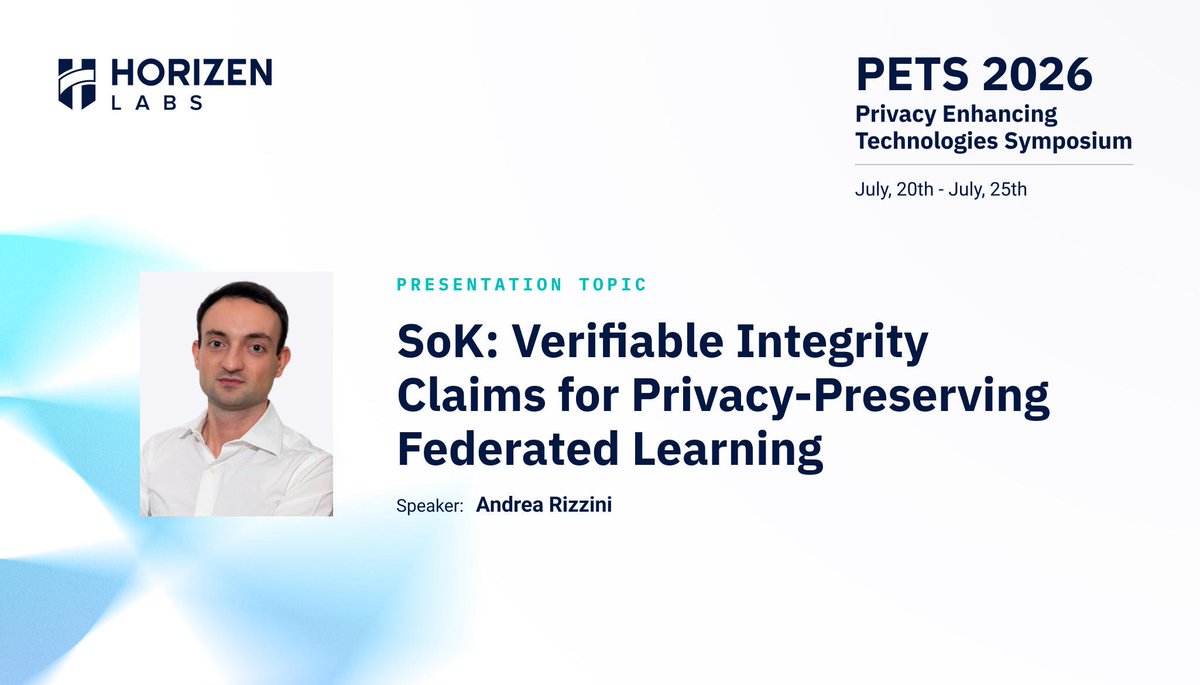
Next Tue at PET Symposium in Calgary, Canada, Andrea Rizzini from our cryptography research team presents the paper "SoK: Verifiable Integrity Claims for Privacy-Preserving Federated Learning", a systematization of knowledge authored with Horizen Labs' Head of Cryptography and Quantum Security, Tommaso Gagliardoni, together with Marco Esposito and Francesco Bruschi from Politecnico di Milano.
It surveys 13 verifiable federated learning systems spanning zero-knowledge proofs and trusted execution environments, and introduces a framework with a claim taxonomy for client-side and aggregator-side verifiability.
The practical finding: verifiable aggregation is deployable today. Verifiable training remains costly and rarely scales to realistic model sizes.
🚨 #ChatControl 1.0 HAS PASSED - despite a majority voting against it (314:276) 🚨
After the EU parliament has rejected #ChatControl TWICE in the past, it has been pushed as an urgent procedure for a new plenary vote. TODAY the EU parliament has voted YES for #ChatControl 1.0😡
The EU has simply continued to put the vote on the agenda to get the outcome they've wanted since the start. This is not democratic‼️
What does #ChatControl 1.0 mean for us now?
🚩 Every photo, every message, every file you send will be scanned by Big Tech automatically
🚩 Mass surveillance of 450 million EU citizen without warrants
🚩 Every citizen is put under general suspicion
Here's what you can do to stay private on the internet:
✅ Use end-to-end encrypted messengers & email (like Signal or Tuta Mail)
✅ Use Linux instead of Windows & Apple
✅ Switch to GraphenOS or LineageOS
It's a sad day for the privacy of EU citizens but we will not let this stop us from continuing to fight for what is right.
At Tuta, we will continue to provide end-to-end encrypted email to everyone, and we will continue to fight for everyone's right to communicate without surveillance.
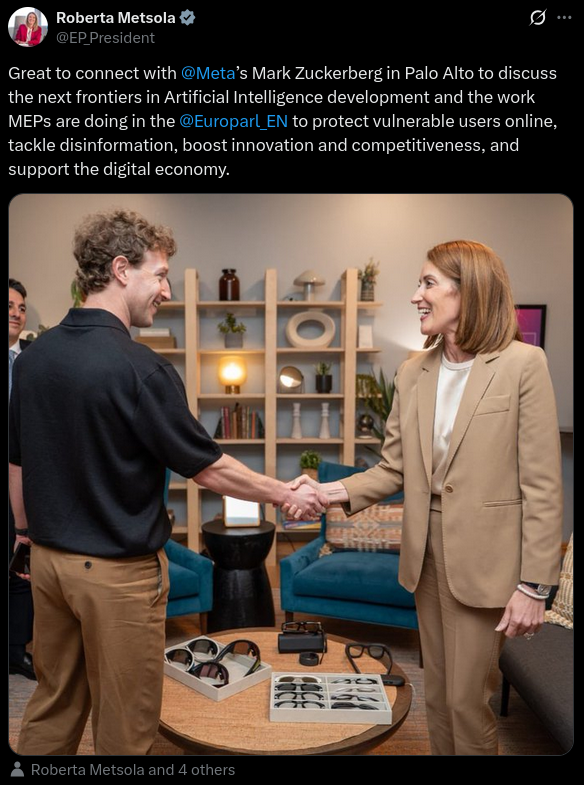
Pictured: Parliament President Roberta Metsola (EPP) who revived Chat Control 1.0 shaking hands with Mark Zuckerberg!
Taken from EP_President on Twitter/X.
@nero_eth@VitalikButerin Why not make UTXOs a programming unit too? each tx would declare exactly which state pieces it consumes, which makes validation more predictable and parallelizable
@AIatMeta@Nature great work but please do not oversell it as if it cures acquired language disorders! It’s much more likely to help when language is intact but motor output is impaired…like anarthria or disarthria
ok i was completely unaware of the context here. sure, if “compromised” means cryptographic material (via nonce misuse?) was leaked for the attacker to reconstruct the signing key, then a simple signature is not enough. That said, couldn’t the recovery flow use a stake-key signature instead (assuming it was not affected..)?
Crypto is better than Traditional Finance in the same way Democracy is better than Dictatorship.
Both Crypto and Democracy are less efficient, and move slower. But both lead to Freedom and Empowerment of humans.