@RinoTheBouncer Fahrenheit, Final act felt so rushed. Loved the sountrack though.... I remember the daaaaaaayyyy when you left to Santa Monicaaaaaaa!!!
Fantom to Sonic migration should be a case study for every L1 and L2 team.
$S is down 90%, from $1 to $0.12, and TVL followed the same destiny.
On paper, Sonic had a solid playbook:
- 200M S for airdrops to attract users
- $120M migration program to attract builders and liquidity
- 90% of gas and fee sharing to App devs
- 400k TPS, sub-400ms finality
Obviously, it failed (?)
I haven't seen anyone talking about S on my timeline. I have long bridged out of Sonic myself.
Personally, I was bullish on S but quickly realized there were not much to do on the chain besides farming airdrop and betting on $S price.
No unique Apps to play with.
Big FUD was Binance announcement to delist $FTM without specifying the migration to $S
Timing was also unfortunate, during memecoin mania where all alts failed to get bid.
Tech was there. Execution and timing were not.
What are other reasons it failed to get more traction?
I believe it has lessons for Monad and MegaETH teams as well as their investors.
Si estas en cripto para solo holdear stablecoin y buscarles rendimiento, dejame decirte que estas en el peor lugar de la faz de la tierra.
Porque estas expuesto a:
Perdida del colateral que lo respalda.
Depeg.
Hackeo de la stablecoin.
Hackeo del contrato del la stablecoin.
Hackeo del puente.
Black list.
Errores de contratos.
Hackeo del protocolo de staking/Lending.
Mala gestión de los curadores.
Mala gestión de los Auditores.
Cuando el mercado entra en Bear Market estos riesgos se multiplican, y cuando suceden escenarios de cisnes negros o grandes liquidaciones se vuelve a multiplicar. Y cuando cae un protocolo o una stablecoin comienza arrastrar a los demas tras el efecto colateral, porque todos se apalancan en las misma garantías y estan se colateralizan sobre sus mismas garantia.
Si estas en Stablecoin solo por un rendimiento del entre el 4% a 10% anual. ¿Esta poniendo el 100% en riesgo por por un 4 al 10%, vale la pena?
Cualquier incidente que pierdas todo te llevará en promedio 8 años recuperar el capital a una tasa del 10% anual, siempre y cuando no pase nada durante esos 8 años.
Ahora si tu enfoque es farmear Airdrop entonces ya no buscas el APR estándar si no más bien una mayor ganancia, que pueda justificar el riesgo asociado.
Realmente nunca le vi sentido poner gran capital de stablecoin en lending para ganar un 0.5% mensual, para eso tenes el sistema financiero regulado y bursátil que te da esos rendimientos con mayor protección jurídica.
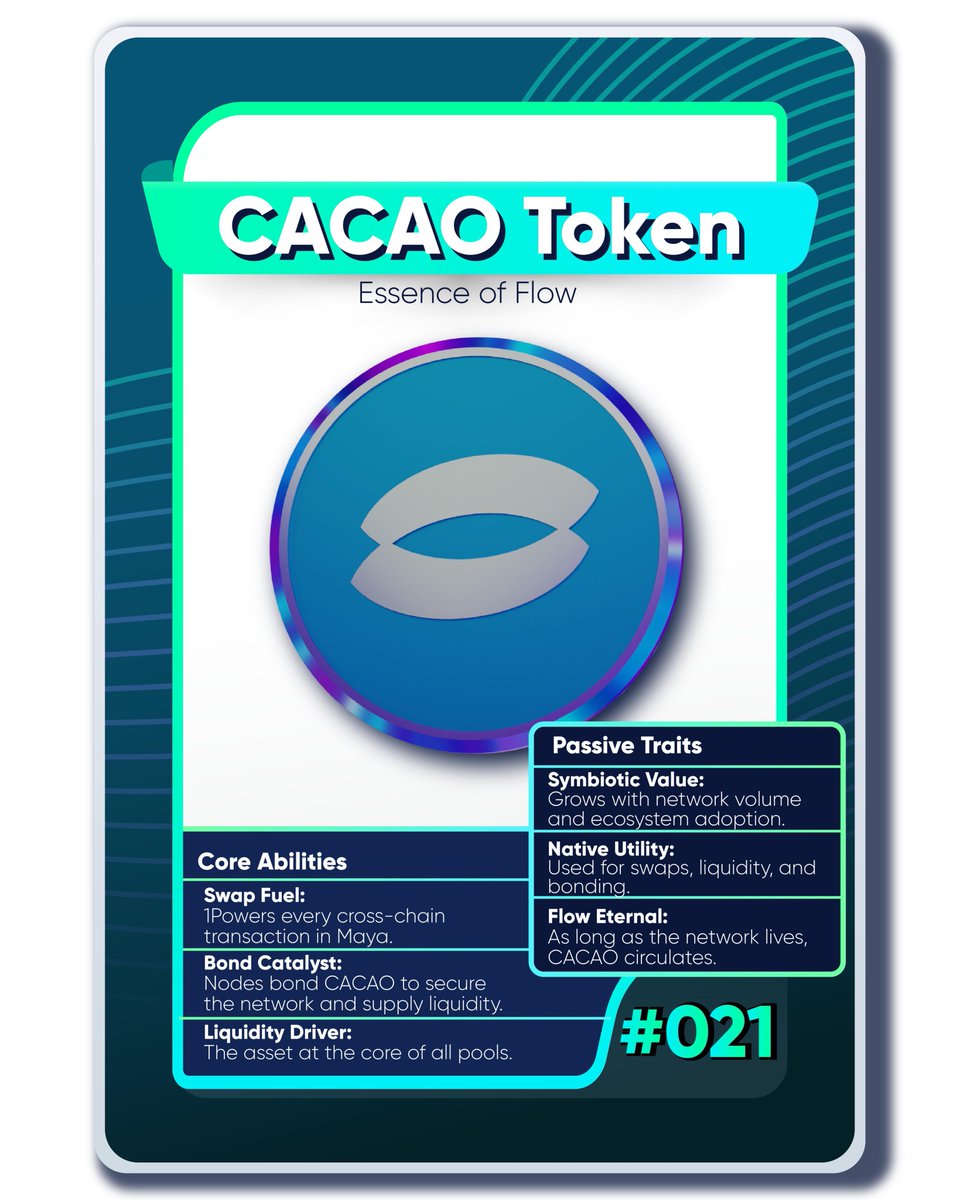
From the heart of the tribe comes
CACAO: the Essence of Flow. 🍫
The sacred energy that powers swaps, binds nodes, and keeps Maya alive.
As long as CACAO moves, the network breathes.
Heartbreaking story of $1.1M in crypto stolen...
Guy's lifesavings were broadcast on TV!
What happened, and whose fault is this?
Here is how a guy lost everything in a single moment🧵👇
What makes the Sunflower Land Chapter Model a success?
♻️ A seasonal based token - inflation is reset every 3 months
💰Exclusive + desirable NFTs
🏆Competitive aspects
🏃♂️Rapid delivery - no long drawn out periods. New mechanics & themes every 3 months
📚 Iteration - every chapter improves itself based on feedback.
Cómo ya comenté en el post citado, retiré toda mi liquidez de KittenSwap al identificar unas cuantas red flags 🚩
Hoy he entrado de nuevo en la dApp y he visto que han repartido un 'badge' para los OG
No tengo ni idea para que servirá ni tampoco lo han explicado en sus redes así que veremos...
Seguramente un boosteo para los puntos
Revisad si os lo han dado:
🔗 https://t.co/NgpRJ7AUuE
Cómo he dicho, no voy a exponerme a este protocolo, con los puntos que haya acumulado hasta ahora me conformaré de cara al Airdrop
¡Eso es todo!
🚨 ¿Qué es $LOUD de @stayloudio?
No es otro meme-token más.
Es un experimento SocialFi donde cada post, like o RT puede generarte recompensas en SOL.
🎯 Atención = Activo productivo
🎤 Hablas de $LOUD → 💰 Ganas por ello
No hay farming. No hay staking. Solo mindshare.
I didn’t expect the answers to be so divided!
With the “See results” option getting the most votes, it shows a clear lack of understanding about Uniswap liquidity!
It's time for a brief lesson on Uniswap liquidity. But first, the correct answer is:
~
~
~
~
C: Alice earns the SAME in each scenario
Why is that? Let's look at the two scenarios once again:
In A), Alice gets 100% of the fees generated by that swap.
First, we need to convert the 1 ETH of deposited tokens into "Liquidity". Here, the formula for converting tokens to UniV3 liquidity is given in the Uniswap whitepaper as:
∆x = L * (1/√Pa - 1/√Pb)
Where
Alice:
- ∆x = 1 ETH
- Pa = 1980
- Pb = 2000
Solving for L gives for each depositor yields:
L_Alice = 8,877
Next, we compute the amount of fees distributed to Alice when the price moved from 1980 to 2000.
Uniswap works by deducting the fee from the INPUT of a trade. So the amount of USDC spent to purchase 1 ETH is decreased by 0.3% to pay for that fee.
This means that the amount paid by swapper is ∆y, but only ∆y*(1-0.003) is used to purchase the 1 ETH.
Thus, the amount of money spent is:
= ∆y*(1-0.003)
= L_Alice * (√2000 - √1980)
= 1989.94 USDC
And the swapper paid:
-> ∆y = 1995.93 USDC
So the fee received by Alice is:
fees_A = ∆y*0.003 = 5.987 USDC
--
Now, in scenario B, Alice still earns 100% of the fees between 1980 and 1998, but she shares her fee with Bob between 1998 and 2000.
Is that fee share equitable? Let's do the math.
Like before, we compute the amount of fees distributed to Alice when the price moved from 1980 to 1998.
Amount paid by swapper is ∆y*(1-0.003)
= L_Alice * (√1998 - √1980)
= 1791.4 USDC
Hence, the swapper paid:
-> ∆y = 1796.82 USDC
So the fee received by Alice is :
fees_1 = ∆y*0.003 = 5.39 USDC
Next, we look at the trade from 1998 to 2000. Solving for L_Bob gives:
- ∆x = 10 ETH
- Pa = 1998
- Pb = 2000
- L_Bob = 893,756
We repeat the same calculation for the second part of the trade, where the price moves from 1998 to 2000:
Amount paid by swapper:
= ∆y*(1-0.003)
= (L_Alice+L_Bob) * (√2000 - √1998)
= 20,188.55 USDC
Hence, the swapper paid:
-> ∆y = 20,249.29
And the fees paid by the swapper is:
∆y*0.003 = 60.75 USDC
However, Alice only contributed L_Alice/(L_Alice + L_Bob) = 0.98% of that liquidity in that last swap, so she receives:
fees_2 = 60.75*0.98% = 0.597 USDC
Adding those two together, we get:
fees_B
= ∆y*0.003
= 5.39 + 0.602
= 5.987 USDC
--
Both amounts are the same whether Bob has added liquidity or not!
So even though the swapper paid a lot more to buy 11 ETH, and the bulk of that fee went to Bob between 1998 and 2000, Alice got the exact same amount of fees.
Why is this relevant? For one, that means that small liquidity providers aren’t diluted by later entrants, whether those are JIT LPs or other larger depositors. And if the pool is a heavily arbitraged one (eg. a ETH-USDC pair that closely tracks the price on Binance), then the liquidity could still be an order of magnitude larger and the arb trades will still happen, and Alice will get paid the same regardless.
It also means it is extremely easy to conduct backtests because each LP position earns fees independently of the other liquidity positions present, which means one can extract the fees received by any position by simply looking at block-by-block tick data, and only updating the fees when the tick's actually changing.
🧵 CBX Episodio 2 – Bitcoin, Silk Road y el futuro del dinero con Nelson Cardozo
🚀 Bienvenidos al segundo episodio de CBX, el podcast donde exploramos criptomonedas, tecnología y mercados financieros.
1/ Ethereum's next major upgrade, Pectra, is tentatively scheduled to go live in mid-March!
This will be Ethereum's largest upgrade in history (as measured by number of EIPs/features included).
Here's a breakdown of what's coming in Pectra 🧵👇
Turns out, 80% of LXP holders are Intract users...
all patiently waiting for the Linea airdrop 😁
While you wait, revisit your top moments from 2024 on Linea with Intract x Linea Rewind: https://t.co/KQa1iyL3mv
& catch Linea's Rewind below 👇