This is a really interesting take on interactive streaming.
It's great to see how digital payments are opening up new avenues for audience engagement and participation.
...............
Most livestreams are built around watching. This takes a different approach.
When viewers can send money that directly affects what the streamer can afford, they become part of the experience rather than just spectators.
It also shows how digital payments can create new forms of audience participation beyond simply sending tips.
This is a very insightful analysis.
The resilience of solana:2fUFhZyd47Mapv9wcfXh5gnQwFXtqcYu9xAN4THBpump in various market conditions is certainly noteworthy and warrants further observation regarding ecosystem activity.
......
One thing I find Mind-blowing about $RNT is how differently it has performed across these market conditions.
@rntprotocol token stayed flat over the last 7 days, while the broader crypto market dropped 11% and RWA tokens lost 5.4%.
The 30-day comparison makes that contrast even harder to ignore. $BTC is down 22.5%, $ETH is down 26.1%, while $RNT is up 5.4%.
Looking at the 12-month picture, $RNT is up 106%.
I wouldn't call this proof that $RNT is immune to market conditions. No token is. But holding up across these different timeframes is worth paying attention to.
Now the question is whether this relative strength can be supported by real demand and continued activity across the ecosystem.
This is a very informative breakdown.
It's excellent to highlight the importance of independent operators and the nuances of server control for true decentralization and privacy.
Tnx
Having more VPN servers doesn't automatically make a VPN decentralized.
What matters is who operates those servers.
With a traditional VPN, your traffic usually passes through infrastructure controlled by one provider.
Even when the connection is encrypted, you're still trusting that company with the routing of your internet traffic.
@nym approaches this differently.
Its network is powered by 800+ independently operated nodes across 70+ countries. Instead of relying on one provider-controlled server, it distributes traffic across independent operators.
But there's another detail worth understanding: having two servers doesn't automatically mean having two independent operators.
If the same entity controls both ends of a connection, the benefit of distributing trust becomes weaker.
That's why @nym introduced Server Families.
This feature helps identify servers operated by the same entity, so users can make more informed choices when selecting their entry and exit servers.
NymVPN also offers two different routing modes.
Fast Mode uses two independent hops and is designed for everyday browsing, streaming and downloads.
Anonymous Mode takes a different approach. It uses five hops, including three mix nodes that shuffle packets, introduce random delays and generate cover traffic to make communication patterns harder to analyze.
There is a trade-off: stronger mixing comes with additional latency.
For me, understanding the operators behind a VPN's infrastructure is just as important as knowing how many servers it has.
Privacy isn't only about encrypting traffic. It's also about how much trust you have to place in a single provider.
Want to explore NymVPN? Try it here:
https://t.co/hvseZaG1qA
Just tried bridging with @PheasantNetwork and the experience was seriously smooth.
Fast transactions, clean UI, and a seamless cross-chain experience that makes moving assets feel effortless.
#PheasantNetwork
Impressed by the approach. Building utility first creates lasting value and trust.
The TimeBox NFT model adds a thoughtful, gamified dynamic. DYOR and steady execution over hype.
Well done.
Most projects launch a token first and figure out the utility later.
@timesoulcom did the opposite.
The ecosystem came first, and now $TTS powers real use cases:
- Education & creator rewards
- NFT minting, renting & staking
- Mystery Cave mechanics
- Advertising
- Premium subscriptions
What I like most is that the token is tied to an existing product ecosystem instead of future promises.
The TimeBox NFT model is also interesting:
Train - earn XP - unlock chances for rarer NFTs.
To me, that's a much stronger foundation than pure speculation.
NFA. Always DYOR.
@BingXOfficial #BingXBlast
Impressive concept.
Canopy’s peer-to-peer app chains with native security and self-governance could broaden growth while sustaining safety.
Curious to see adoption hurdles and real-world interoperability progress.
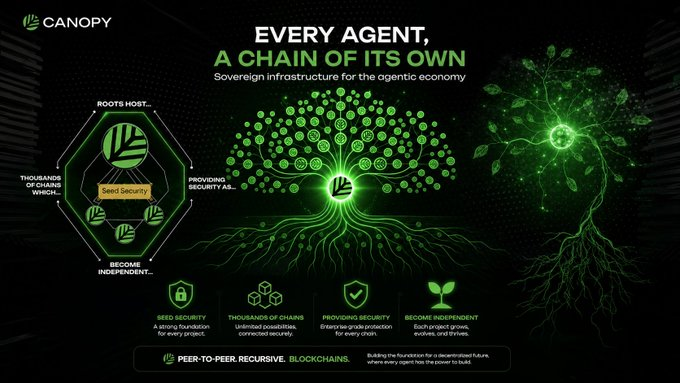
One thing I find interesting about @CNPYNetwork is that it rethinks how blockchain networks should grow.
Instead of relying on a single chain, Canopy envisions a peer-to-peer network where application-specific chains can launch, secure each other and eventually become independent.
What stands out to me:
- Independent scalability for every app chain
- Native security from day one
- Permissionless interoperability
- Self-governance without external dependencies
The idea of making blockchain deployment feel as simple as using familiar developer tools could lower the barrier for many builders.
Curious to see how this recursive architecture evolves as the ecosystem continues to grow. 🌱
Impressive approach.
The integration of mindfulness, education, and AI with measurable engagement shows real promise.
Looking forward to seeing how timesoul scales user value and community impact.
Most people try a meditation or learning app, use it for 10 days, then forget it exists.
@timesoulcom is trying to fix exactly that.
It mixes 4 things
- Mindfulness
- EdTech
- Web3
- AI
But the goal is simple:
Turn daily mental health and self-education into something fun, social and actually rewarding.
How it works:
You do short practices
- Breathing
- Walking
- Micro-lessons
- Reflections.
Behind the scenes, an AI mentor tracks your stress, energy and engagement, then adjusts tasks in real time. No more random content thrown at you.
What's different:
Most apps reward taps. @timesoulcom AI evaluates the quality of your effort. XP, chests, new levels .
All tied to how mindfully you actually complete tasks.
The NFT side:
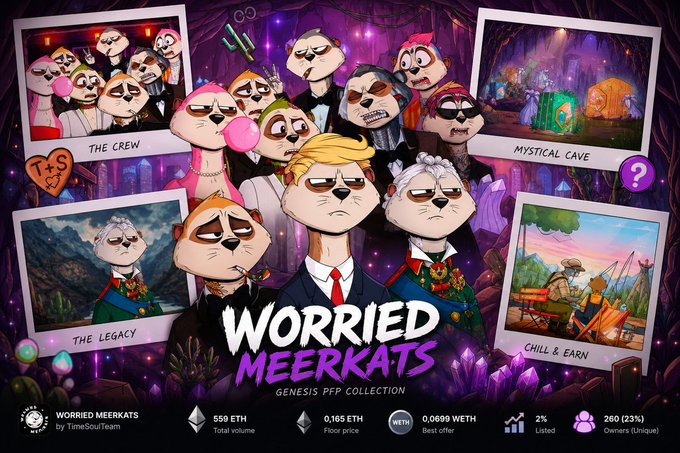
Meerkat NFTs aren't just collectibles. They unlock courses, content, events, community tools, staking, Mystery Cave mechanics and extra perks inside the ecosystem.
For Web2 users - feels like a normal wellness and learning app.
For Web3 users - a Learn / Play / Challenge-to-Earn world with tokens, NFTs and on-chain ownership.
Why I joined:
I like the idea. Fixing low engagement in learning with actual game design and AI feels like a real problem worth solving.
@BingXOfficial #BingXBlast
Impressive vision. If the barrier to launch is truly this low, it could accelerate practical AI-native ecosystems.
Curious to see real-world deployments and governance in action.
GOOD MORNING ☀️
Most people are still asking "how do I build a chain?"
With @CNPYNetwork that question is already answered before you finish your coffee .
Here is what actually got me thinking...
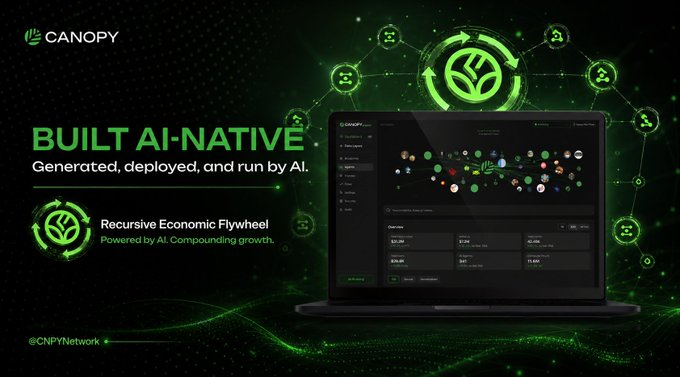
AI-native does not just mean using AI tools. It means infrastructure that was designed from the ground up to be generated by AI , deployed by AI and built to run AI-native applications natively.
Most chains fail on at least two of those three. Canopy was built for all three from day one 👀
And this is where it gets real for builders -
- Launch sovereign appchains in minutes
- Use Python TypeScript and languages you already know
- Full control over supply fees governance and execution
- Shared security through restaking without losing sovereignty
- No deep blockchain knowledge required
The old trade-offs are gone. Speed no longer costs you sovereignty. Shared security does not mean shared control.
$CNPY is not just infrastructure with AI. It is infrastructure built FOR AI and for the agentic economy that is already here.
The future belongs to chains that speak the same language as the builders on them 🔥
-
Would you launch your own chain if the barrier was this low? Drop it below 👇
It's impressive to see how @CNPYNetwork is simplifying blockchain development.
The integration of AI to facilitate building is a game-changer.
I'm looking forward to witnessing its evolution.
Blockchain development has always felt too complex for many builders.
That's why @CNPYNetwork stands out to me.
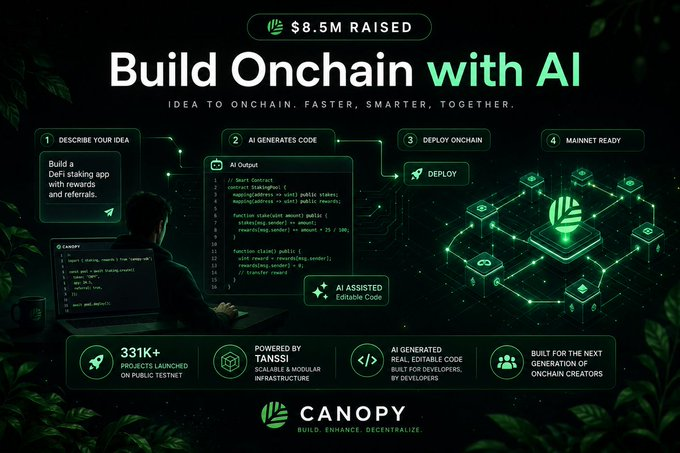
Instead of spending months building from scratch. The vision is to let founders describe an idea and use AI to generate real, editable code that developers can continue improving over time.
With $8.5M in fresh funding, the integration of Tanssi's infrastructure and 331K+ project launches on the public testnet. The momentum is definitely there.
If Canopy delivers on this vision, building onchain could become faster and far more accessible for the next generation of creators.
Excited to see how Canopy evolves toward mainnet. 🌱