DeFi is too complex for most people. I use first principles to identify unique yield opportunities and navigate complex risks by breaking down DeFi concepts into their fundamental components.
This approach was used by the philosopher Aristotle and is used now by Elon Musk and Charlie Munger. It allows them to cut through the fog of shoddy reasoning and inadequate analogies to see opportunities that others miss.
Thread 🧵👇
@Ikebillion_ So, if I understand correctly, every rating framework contains some degree of bias based on its assumptions, methodology, and underlying data?
Pendle MCP is getting a lot of attention. But should you actually use it?
Depends on who you are.
Here's what I found after testing all three Pendle interfaces.
In my last post I found 3 top stablecoin markets missing from MCP — AVLT (18.34% APY), apxUSD (14.31%), apyUSD (14.29%). Clearly visible in the UI. Invisible to the MCP.
I assumed the workaround was simple: grab the contract address and call get_market directly. It wasn't. Even with the exact address, MCP returned MARKET_NOT_FOUND.
I tested it with apxUSD (0x50dce...). Same result. The gap is bigger than just discovery.
==> Why it happens
Pendle API ──→ everything (full data, all markets)
↓
MCP layer ──→ whitelisted markets only
↓
MCP tools ──→ what you get in Claude Code
Pendle UI ──→ connects directly to the API, no filtering
Two separate registries inside MCP. The asset/price one picks up tokens the moment a contract is deployed. The market index only activates after explicit listing.
So for unlisted markets, here's what actually works:
✅ get_asset — token metadata, expiry
✅ get_prices — LP price
❌ get_market — APY, liquidity, TVL
❌ get_history — historical data
❌ buy_pt / sell_pt — trading
==> Who should use each Pendle interfaces
Pendle UI — for users
- Full market access, no code needed. You see everything. You do things manually.
- Use it if you're a yield farmer who just wants to buy PT or add LP.
Pendle REST API — for developers
- Same full access as the UI. Requires code. You handle signing and execution yourself.
- Use it if you're building a dashboard, a data pipeline, or a trading bot without AI.
Pendle MCP — for AI agent builders
- Natural language interface. AI handles research, routing, and calldata generation. You sign and broadcast.
- Use it if you're building an AI agent that needs to interact with Pendle or if you want to trade and analyze directly inside Claude Code.
The tradeoff: which markets make it into MCP is unclear. In my test, around half the top stablecoin markets were missing, including some with 14–18% APY. Always cross-check with the UI.
I spent a session stress-testing the Pendle MCP inside Claude Code. Here's what I found, including one bug.
Pendle Finance released an official 1.0.0 update to their MCP plugin on April 1. The biggest change: the local MCP server was completely removed (~16,000 lines of code deleted). Everything now runs through a remote Streamable HTTP endpoint.
That meant my local installation was broken. I updated it live — git pull + swap the config from stdio to HTTP and got back online in about 2 minutes.
==> What the MCP can actually do:
25 tools across 4 areas:
- Data queries (markets, APY, prices, portfolio)
- Trade execution — builds full transaction calldata for buying/selling PT/YT, adding/removing LP
- Limit orders with EIP-712 signing flow
- AI Trade Advisor agent (Opus model) that runs a 5-step market analysis before recommending anything
==> The bug:
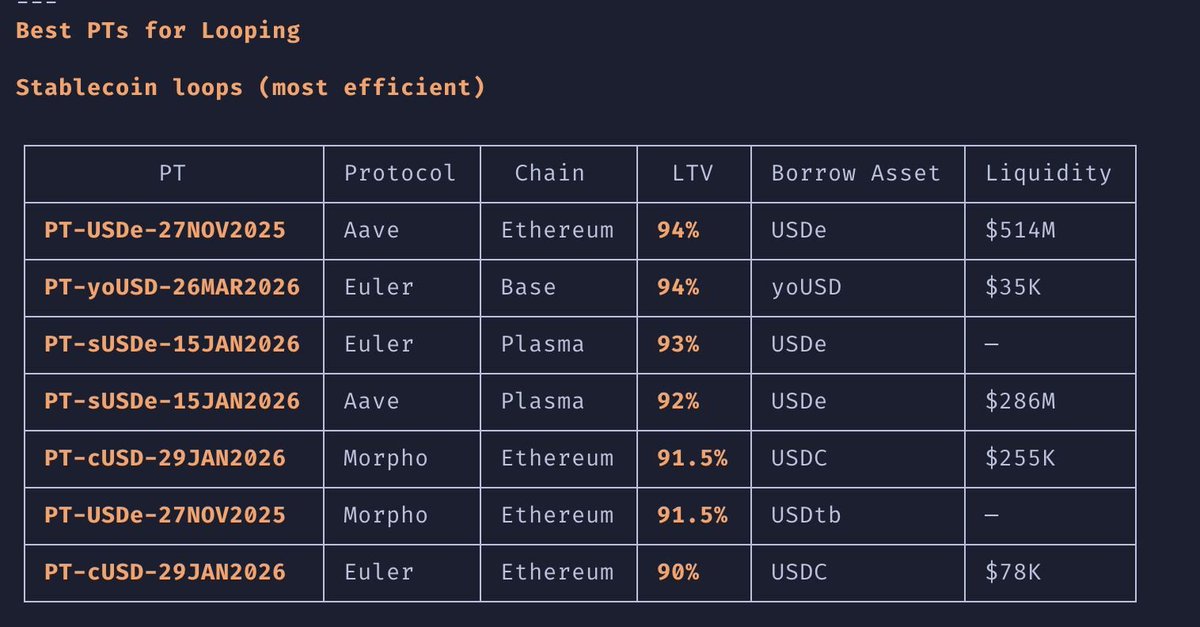
I queried for "PT tokens supported by lending protocols for looping strategies." Got a nice table. Presented it confidently.
Every single PT was expired. Today is April 2026. All those markets matured months ago.
The get_external_protocols API has no filter by market expiry — it just returns historical data without flagging it.
The fix: first query active markets (expiry > today), then cross-reference. Result: currently, zero active Pendle PT markets have lending integrations listed in the MCP database.
==> MCP vs raw Pendle API:
For interactive use inside Claude Code — MCP wins. Fewer tokens, transaction calldata built-in, no need to handle HTTP headers, routing, or error parsing manually.
Use the raw API only if you're building your own app or need data the MCP doesn't expose.
==> The real limitation I found:
The MCP database is incomplete. The Pendle UI showed AVLT (18.34% fixed APY), apxUSD (14.31%), and apyUSD (14.29%) as the top stablecoin markets. None of them appear in the MCP at all.
For market discovery: check the Pendle UI or API first. For everything after — MCP handles it.
Next up: I'll be testing the built-in Trade Advisor agent — it runs a full 5-step market analysis using the Opus model and recommends trades based on your capital, risk tolerance, and time horizon. Will share how it performs in practice.
I spent a session stress-testing the Pendle MCP inside Claude Code. Here's what I found, including one bug.
Pendle Finance released an official 1.0.0 update to their MCP plugin on April 1. The biggest change: the local MCP server was completely removed (~16,000 lines of code deleted). Everything now runs through a remote Streamable HTTP endpoint.
That meant my local installation was broken. I updated it live — git pull + swap the config from stdio to HTTP and got back online in about 2 minutes.
==> What the MCP can actually do:
25 tools across 4 areas:
- Data queries (markets, APY, prices, portfolio)
- Trade execution — builds full transaction calldata for buying/selling PT/YT, adding/removing LP
- Limit orders with EIP-712 signing flow
- AI Trade Advisor agent (Opus model) that runs a 5-step market analysis before recommending anything
==> The bug:
I queried for "PT tokens supported by lending protocols for looping strategies." Got a nice table. Presented it confidently.
Every single PT was expired. Today is April 2026. All those markets matured months ago.
The get_external_protocols API has no filter by market expiry — it just returns historical data without flagging it.
The fix: first query active markets (expiry > today), then cross-reference. Result: currently, zero active Pendle PT markets have lending integrations listed in the MCP database.
==> MCP vs raw Pendle API:
For interactive use inside Claude Code — MCP wins. Fewer tokens, transaction calldata built-in, no need to handle HTTP headers, routing, or error parsing manually.
Use the raw API only if you're building your own app or need data the MCP doesn't expose.
==> The real limitation I found:
The MCP database is incomplete. The Pendle UI showed AVLT (18.34% fixed APY), apxUSD (14.31%), and apyUSD (14.29%) as the top stablecoin markets. None of them appear in the MCP at all.
For market discovery: check the Pendle UI or API first. For everything after — MCP handles it.
Next up: I'll be testing the built-in Trade Advisor agent — it runs a full 5-step market analysis using the Opus model and recommends trades based on your capital, risk tolerance, and time horizon. Will share how it performs in practice.
Pendle is now 100% ready for AI agents!
Introducing Pendle Skills and MCP
✅ Ready to be plugged into @claudeai, @ChatGPTapp and more
✅ Hunt yields and execute autonomously with agents
DeFi’s best yields are now just a prompt away
USR depegged. Let me explain how to work with such risks.
The USR depeg affected 10+ pools on @Morpho , 3 pools on @pendle_fi , and pools on @upshift_fi , @yield , @0xfluid, @InverseFinance, @VenusProtocol, @lista_dao, @CurveFinance.
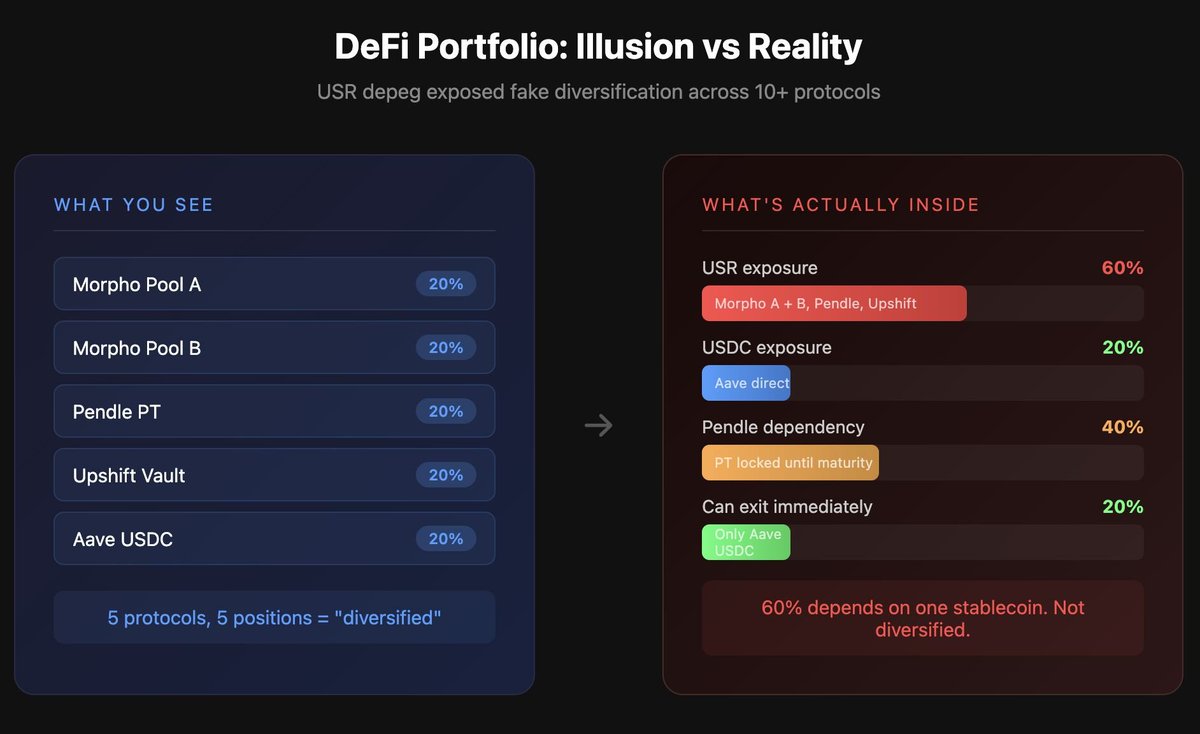
Just diversifying your portfolio between different DeFi strategies won't help you avoid losses.
Here's why.
=> The hidden problem: fake diversification
Imagine you have 5 positions across 5 different protocols. Looks diversified.
But look inside each strategy:
- Morpho Pool A → yield strategy built on $USR
- Morpho Pool B → Pendle PT-USR
- Morpho Pool C → Upshift vault holding USR
3 protocols, 3 pool names. One real dependency: USR. Depeg hits all three at once.
=> The matryoshka problem
Direct USDC on Aave = 1 layer of risk.
Morpho vault → strategy → Pendle PT → USR = 4 layers.
Each layer adds a new dependency. More layers ≠ free yield. More layers = more hidden risk.
And when things break, Pendle PT is locked until maturity, Upshift has withdrawal delays. You can't exit. You're frozen.
=> How to actually diversify
Stop looking at protocol names. Map your real dependencies:
- What asset is at the bottom of each strategy?
- Can I exit immediately if something breaks?
- Does the same asset appear across multiple positions?
Rules I follow:
1. Max 20-30% to any single underlying asset
2. Same protocol in 3+ strategies = concentration risk
3. Deeper the matryoshka = smaller the position
The question isn't "how many protocols am I in?" It's "how many independent risks do I actually have?"
UnstakeYield Beta is Live 🟢
We’re excited to open UnstakeYield in Beta, a clean, non-custodial vault designed to capture real on-chain yield from sUSDe / USDe arbitrage via @ethena.
What you get
• Competitive APY from a market-neutral yield source
• Safety first: immutable smart contracts audited by @Nethermind
• Simple flow: deposit → receive avUSDe → earn returns → withdraw anytime
• No complexity: built for a smooth, transparent vault experience
🎁 Genesis NFT Pass (for every $1k+ deposit)
• Airdrop eligibility
• Access to alpha products & OG chat
• Points multipliers and future perks
👉 Join now: https://t.co/VlikeXCnaf
Beta is open — early participants get early advantages.
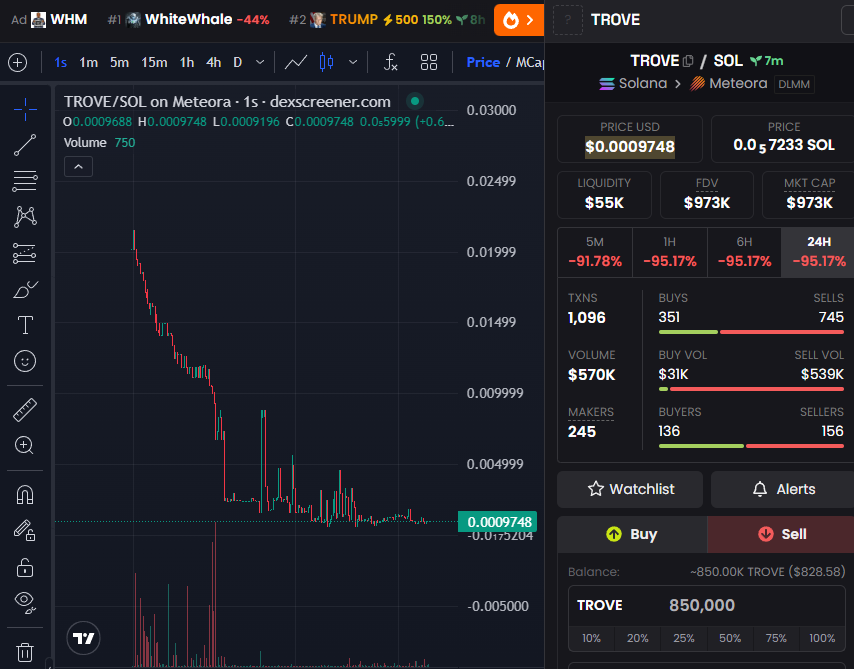
It's time for a class-action lawsuit against @TroveMarkets
My $20,000 investment with 9+ mil committed should have resulted in $14k USDC back and $6k in $TROVE
Due to the token GIGA nuking, they gave me in total....
$600 back