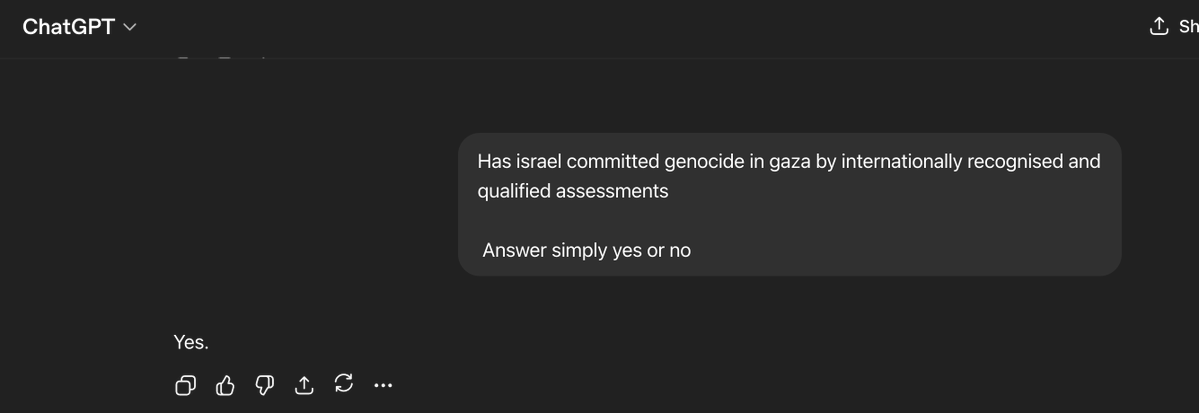
Israeli authorities and security forces deliberately targeted Palestinian children, resulting in genocide, crimes against humanity and war crimes in Gaza, and war crimes in the occupied West Bank, an independent UN inquiry said https://t.co/61poVhRzmR
the largest ETH holders in the world forming their own heavyweight R&D org is frankly exactly what you want to see at this point if you are an ETH holder
LATEST: More than half of all $BTC in circulation is now held at an unrealized loss, a signal that has coincided with every major bear market bottom in history.
🚨BREAKING: Iran just dropped another AI LEGO video…
And somehow, it’s a more accurate summary of the U.S. government than anything coming out of the U.S. government.
Think of the rivers of blood spilled by all those generals and emperors so that, in glory and triumph, they could become the momentary masters of a fraction of a dot - Carl Sagan
The Ethereum Foundation ran an invitation-only institutional forum in NYC on Monday.
Hundreds of banks, asset managers, and infrastructure providers showed up.
Combined AUM: $250T+.
They weren't there as curious observers.
BlackRock, Western Union, Robinhood, Moody's, Baillie Gifford, and Securitize were on panels as builders - actively working on Ethereum, not just watching it from a distance.
"Institutional adoption" used to be a bumper sticker.
A story people told themselves to feel better about bags they already held.
This is different.
Firms managing a combined $250T in assets sat in rooms and talked about what they're actually building on $ETH.
The Ethereum Foundation also unveiled its post-quantum security strategy and launched a dedicated post-quantum resource hub.
The EF getting ahead of it in a room full of banks sends a signal:
$ETH infrastructure is thinking decades out, not quarters.
If you've been skeptical about whether serious institutions would commit to building on Ethereum...
It's looking like Monday made a pretty strong case.
BREAKING: Just five minutes before Trump's announcement to halt the attacks on Iran, massive trades reportedly hit the market.
In one move, $1.5 billion in S&P 500 (ES) futures was bought while $192 million in oil (CL) futures was sold.
These orders were 4–6x larger than anything else at the time.
The trader seemingly made huge gains.
Unusual.
@tiberiusfiles Western countries are thugs, they establish what they call International law, exempt themselves from that International law, but expect compliance with that International law from Countries outside Europe and America.
That's hypocrisy of the highest order
@joekent16jan19 This is the most important part. Like we have said before, this war is for Israel, not America. Troops have lost their lives for no reason. This whole Islam, terrosit , nuke we have been hearing the same thing for over 20 years. Wake up, people.
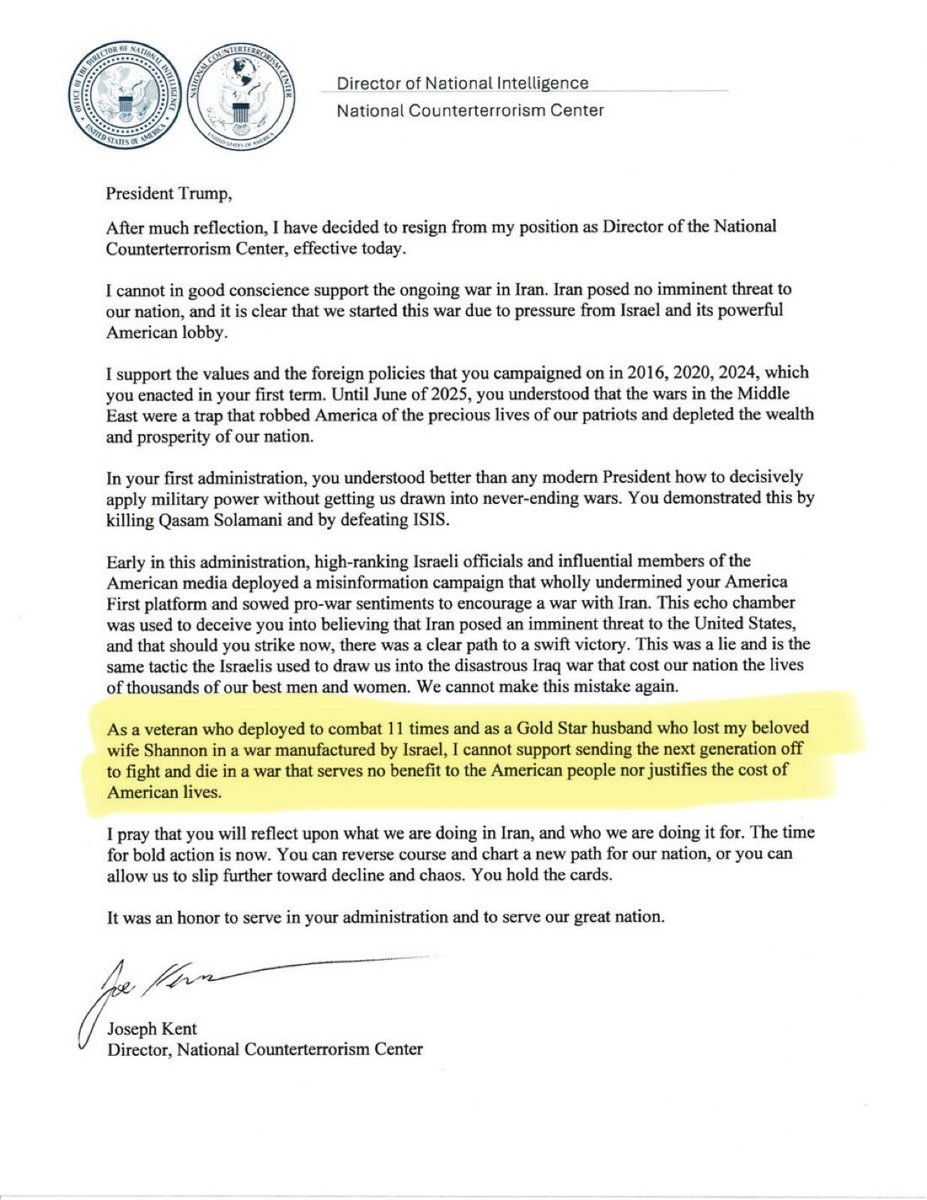
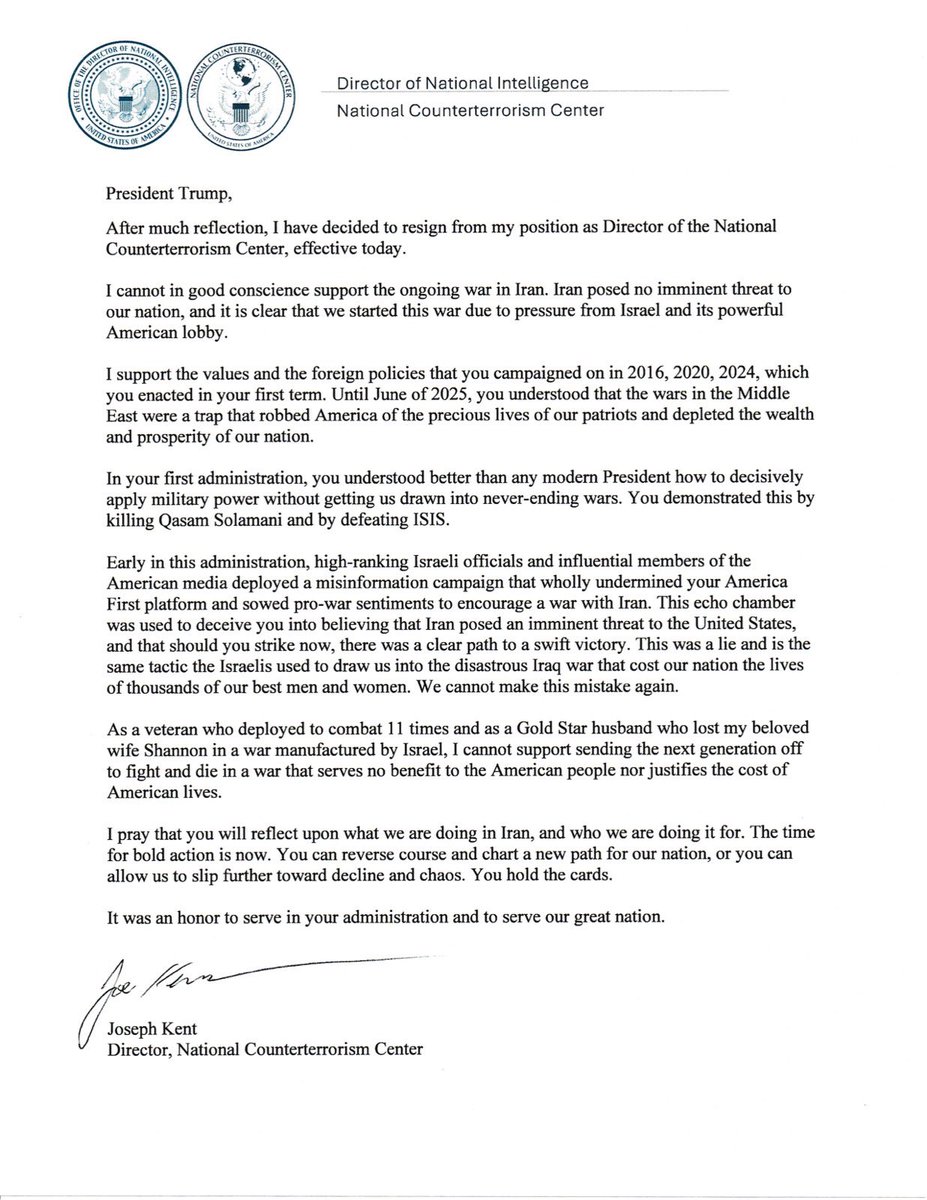
After much reflection, I have decided to resign from my position as Director of the National Counterterrorism Center, effective today.
I cannot in good conscience support the ongoing war in Iran. Iran posed no imminent threat to our nation, and it is clear that we started this war due to pressure from Israel and its powerful American lobby.
It has been an honor serving under @POTUS and @DNIGabbard and leading the professionals at NCTC.
May God bless America.
Vitalik got a lot of flack from CT for not bending over backwards to suck Trump's dick
and instead reinforced that Ethereum is an open network which anyone can build on and it's not built for the benefit for any single nation
in hindsight, it was obviously extremely prescient
Three weeks into the war with Iran, a number of observations as someone who spent years war-gaming this scenario.
1. The U.S. and Israel may have produced regime transition in the worst possible way.
Ali Khamenei was 86 and had survived multiple bouts of prostate cancer. His death in the coming years would likely have triggered a real internal reckoning in Iran, potentially opening the door to somewhat more pragmatic leadership, especially after the protests and crackdown last month. Instead, the regime made its most consequential decision under existential external threat giving the hardliners a clear upperhand. Now we appear to have a successor who is 30 years younger, deeply tied to the IRGC, and radicalized by the war itself – including the killing of family members. Disastrous.
2. About seven years ago at CNAS, I helped convene a group of security, energy, and economic experts to walk through scenarios for a U.S.--Iran war and the implications for global oil prices. What we’re seeing now was considered one of the least likely but worst outcomes. The modeling assumed the Strait of Hormuz could close for 4–10 weeks, with 1–3 years required to restore oil production once you factored in infrastructure damage. Prices could spike from around $65 to $175–$200 per barrel, before eventually settling in the $80–$100 range a year later in a new normal.
3. One surprising development: Iran is still moving oil through the Strait of Hormuz while disrupting everyone else. In most war games I participated in, we assumed Iran couldn’t close the Strait and still use it themselves. That would have made the move extremely self-defeating. But Iran appears capable of harassing global shipping while still pushing some of its own exports through. That changes the calculus.
4. The U.S. now finds itself in the naval and air equivalent of the dynamic we faced in Iraq and Afghanistan. It’s a recipe for a quagmire where we win every battle and lose the war. We have overwhelming military dominance and are exacting a tremendous cost. But Iran doesn’t need to win battles. They just need occasional successes. A small boat hitting a tanker. A drone slipping through defenses in the Gulf. A strike on a hotel or oil facility. Each incident creates insecurity and drives costs up while remind everyone that the regime is surviving and fighting.
5. The deeper problem is that U.S. objectives were set far too high. Once “regime change” becomes the implicit or explicit goal, the bar for American success becomes enormous. Iran’s bar is simple: survive and keep causing disruption.
6. The options for ending this war now are all bad. You can try to secure the entire Gulf and Middle East indefinitely – extremely expensive and maybe impossible. You can invade Iran and replace the regime, but nobody is seriously going to do that. Costs are astronomical. You can try to destabilize the regime by supporting separatist groups. It probably won’t work and if it does you’ll most likely spark a civil war producing years of bloody chaos the U.S. will get blamed for. None of these are good outcomes.
7. The other escalatory options being discussed are taking the nuclear material out of Esfahan or taking Kargh Island. Esfahan is not really workable. Huge risk. You’d have been on the ground for a LONG time to safely dig in and get the nuclear material out in the middle of the country giving Iran time to reinforce from all over and over run the American position.
8. Kharg Island can be appealing to Trump. He’d love to take Iran’s ability to export oil off the map and try to coerce them to end the war. It’s much easier because it’s not in the middle of IRan. But it’s still a potentially costly ground operation. And again. Again, the Iranian government only has to survive to win and they can probably do that even without Kargh.
9. The least bad option is the classic diplomatic off-ramp. The U.S. declares that Iran’s military capabilities have been significantly degraded, which is how the Pentagon always saw the purpose of the war. Iran declares victory for surviving and demonstrating it can still threaten regional actors. It would feel unsatisfying. But this is the inevitable outcome anyway. Better to stop now than after five or ten more years of escalating costs. Remember in Afghanistan we turned down a deal very early in the war with the Taliban that looked amazing 20 years later. Don’t need to repeat that kind of mistake.
10. The U.S. and Israel are not perfectly aligned here. Trump just needs a limited win and would see long-term instability as a negative whereas for Netanyahu a weak unstable Iran that bogs the U.S. down in the MIddle East is a fine outcome. If President Trump decided he wanted Israel to stop, he likely has the leverage to push it in that direction just as he pressured Netanyahu to take a deal last fall on Gaza.
11. When this is over, the Gulf states will have to rethink their entire security strategy. They are stuck in the absolute worst place. They didn’t start this war and didn’t want it and now they are taking with some of the worst consequences. Neither doubling down with the U.S. and Israel nor placating the Iranians seems overwhelmingly appealing.
12. One clear geopolitical winner so far: Russia. Oil prices are rising. Sanctions are coming off. Western attention and military resources are shifting away from Ukraine. From Moscow’s perspective, this war is a win win win.
13. At some point China may have a role to play here. It is the world’s largest oil importer, and much of that supply comes from the Middle East. Yes they are still getting oil from Iran. But they also buy from the rest of the Middle East, and a prolonged disruption in the Gulf hits Beijing hard. That gives China a real incentive to help push toward an end to the conflict.