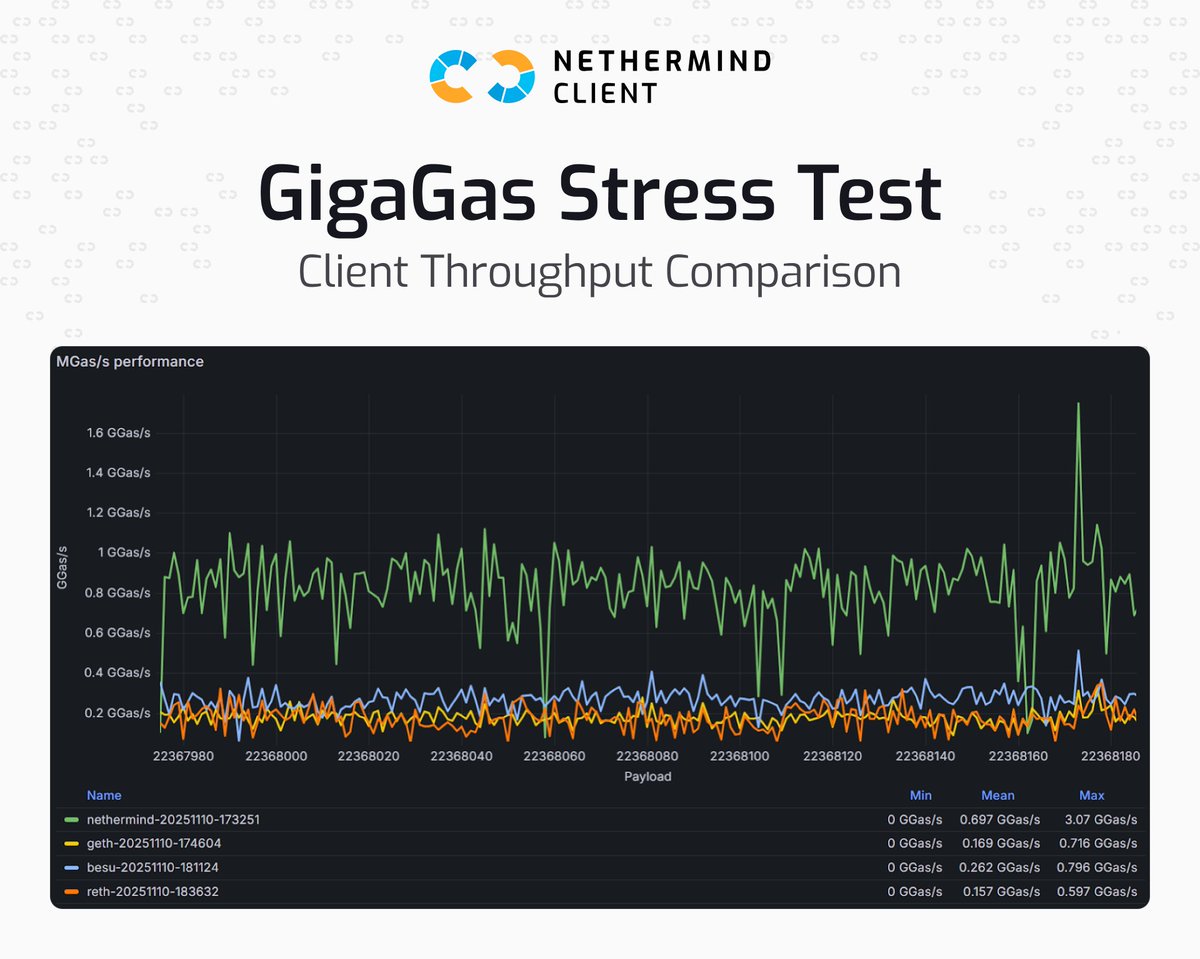
We're introducing a new benchmark for Ethereum clients.
It replays real mainnet blocks and merged super-blocks to measure real execution throughput.
Initial results show significant performance differences under heavy load, with 𝗡𝗲𝘁𝗵𝗲𝗿𝗺𝗶𝗻𝗱 𝗳𝗮𝘀𝘁𝗲𝘀𝘁 𝗮𝗺𝗼𝗻𝗴 𝗮𝗹𝗹.
🔗 https://t.co/ClMzawGH7H
GPT3: scale compute by 10x to get a good model
Grok-4: scale RL compute by 10x to get a good model
Llama-5: scale employee comp by 10x to get a good model.
GMX v1 Lost $42M Through AUM Manipulation
Yesterday GMX v1 suffered an attack that drained $42M through AUM manipulation. This was GMX's 2nd major hack of 2025 (lost $13M in March).
Disclaimer: This is not a full post-mortem, I've mainly looked into the AUM manipulation part.
The Attack Vector:
1. Exploited reentrancy in `executeDecreaseOrder` function
2. During callback, opened massive short positions at artificially low prices
3. Manipulated `globalShortAveragePrices`, inflating AUM calculation
4. System thought it had huge "unrealized profits" from shorts
5. Redeemed GLP tokens at inflated prices, extracting real assets
The Core Issue:
GMX's AUM = Physical Tokens + Stablecoins + Unrealized Trading Profits + Fees
When shorts lose money (current price > average price), the vault "profits" and AUM increases. The attacker exploited this to create artificial profits.
Simple Prevention:
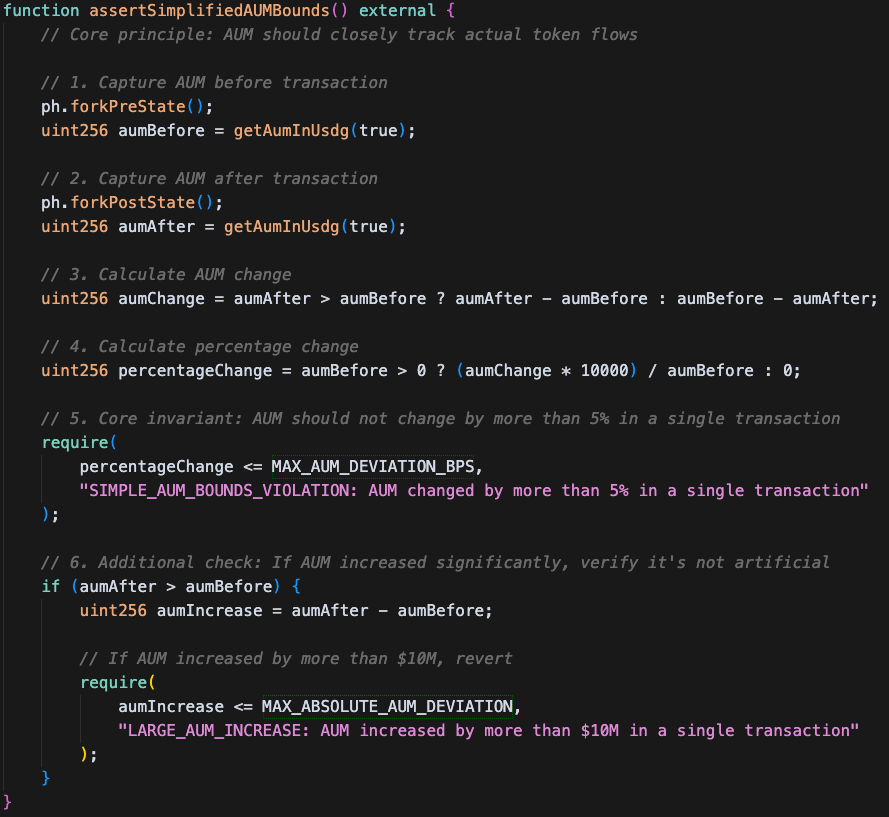
An AUM bounds invariant enforcing `AUM_change ≤ net_token_inflow + 5%` would have caught this immediately.
The attack created massive artificial value with minimal real deposits - exactly what economic sanity checks detect.
A simplified version of a @phylaxsystems assertion that could have detected and prevented the hack:
The Rust Language Cheat Sheet is another phenomenal resource discovered by way of @rektoff_xyz.
https://t.co/3pRtop12Gu
Go get yourself some Memory Layout learnings.
i know of a yield bearing stablecoin mintable on any EVM network (base, arbitrum, eth, hyperevm) currently generating net ~25% base yield exclusive of any incentives or timelocks, can CT notice this?
@LucidlyFinance
https://t.co/mrxJiOCuQX
🚨 It’s official: @CoWSwap is upgrading its core mechanism — moving from the current Batch Auction to the Fair Combinatorial Auction! 🐮⚙️ Exciting to see research make its way into the real world, and a big moment for on-chain trading infrastructure. 1/3
A quick guided tour for those looking to join the ranks of based rust devs.
Start with the book: https://t.co/d2EohiTnkw
Practice with: https://t.co/ChZWPIvEPh
Then, when you get through the basics of understanding the ownership model, generics, lifetimes, and broader use (and indeed all of it if just learning to code), write a fun project that does a thing.
Most likely by induction that will lead you to: https://t.co/MRALKZ6g3R
Then by proxy, the tokio/rayon ecosystem. As your code grows you'll want to leverage: https://t.co/9TYEGrOmxx
At which point if you want to push the envelope, this will be useful: https://t.co/uhcMYbNOce
On your inevitable journey to get closer to the metal you'll want to learn all about locks and atomic: https://t.co/QBR6d8JXlk
Eventually you'll write some unsafe rust: https://t.co/w9p9p87gD2
For worked real world examples you'll want to read: https://t.co/uh9K8t7szI
😅🫡
REVMC is surprisingly easy to integrate!
And, after compiling funky Curve and Balancer pools, our arbitrage bot can leverage opportunities in less than 30ms (6x faster!!).
Let me explain. Relays are responsible for delivering the highest value block to proposers. There are two ways of doing that...
1. If the builder's address is the fee recipient then measure the value of a direct payment tx to the proposer, which is the last tx in the block.
CoW Swap is excited to announce the launch of an entirely new class of orders. We call them Programmatic Orders. ✨
Programmatic Orders execute automatically, in perpetuity, according to the conditional parameters you set.
Let's dive in. 🤿
The WIP version of @vyperlang, which leverages the new Venom IR, has already demonstrated remarkable improvements in produced code. It currently generates up to 20% - 30% smaller EVM code compared to Solidity.
For example, the test contract presented below, when compiled with Vyper, results in a compact 515 bytes, whereas its equivalent in Solidity amounts to 651 bytes. This makes it ~26% more expensive to execute the Solidity version vs the Vyper one.
The reason I'm excited about these preliminary results, is because we haven't even started the optimization phase yet. These gains are purely a result of the initial architectural improvements. Exciting times lie ahead! 🚀🥳🐍
Finematics is back with another deep dive! 🚀
💰 What is MEV?
🏗️ Who are searchers and builders?
🤖 What's Flashbots mission?
⚖️ What's the future trajectory of MEV?
Discover this and more in our latest video: "Decoding MEV: Past, Present, Future" ➡️ https://t.co/jp3n2k1YXc