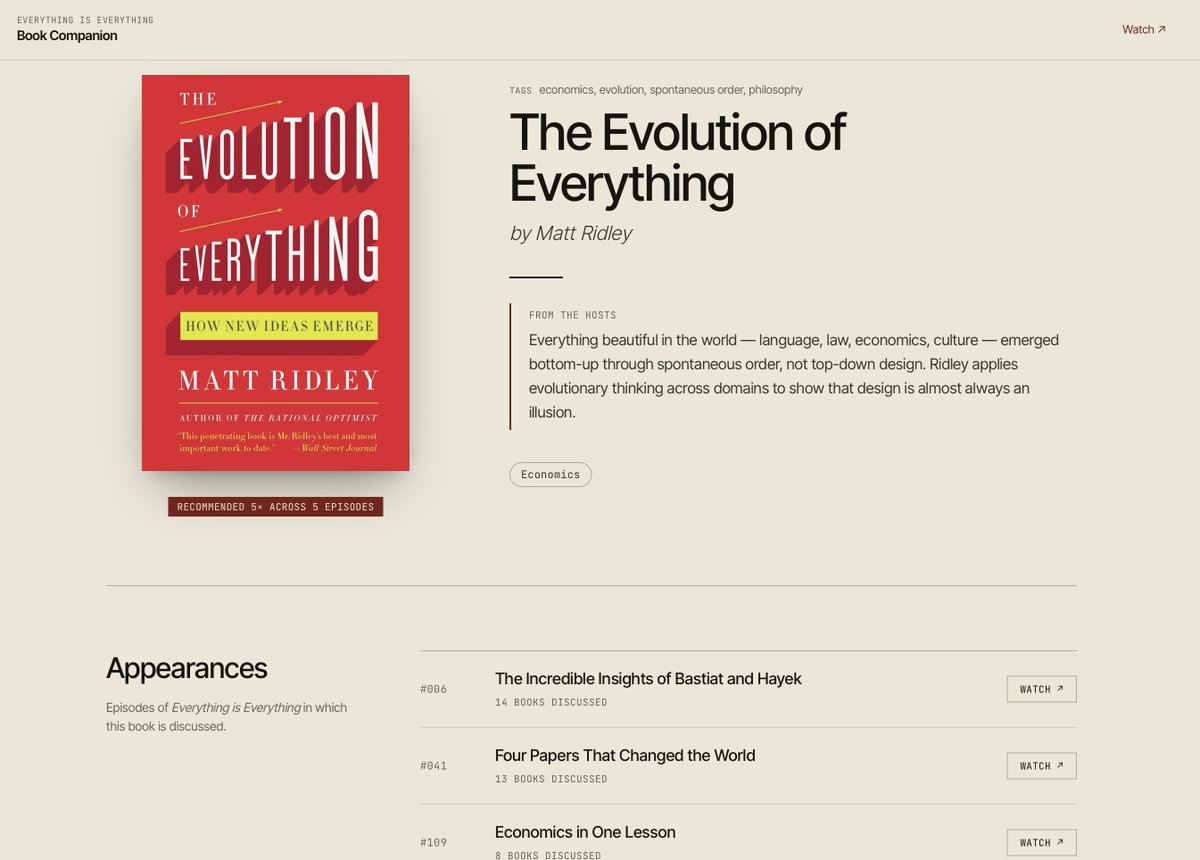
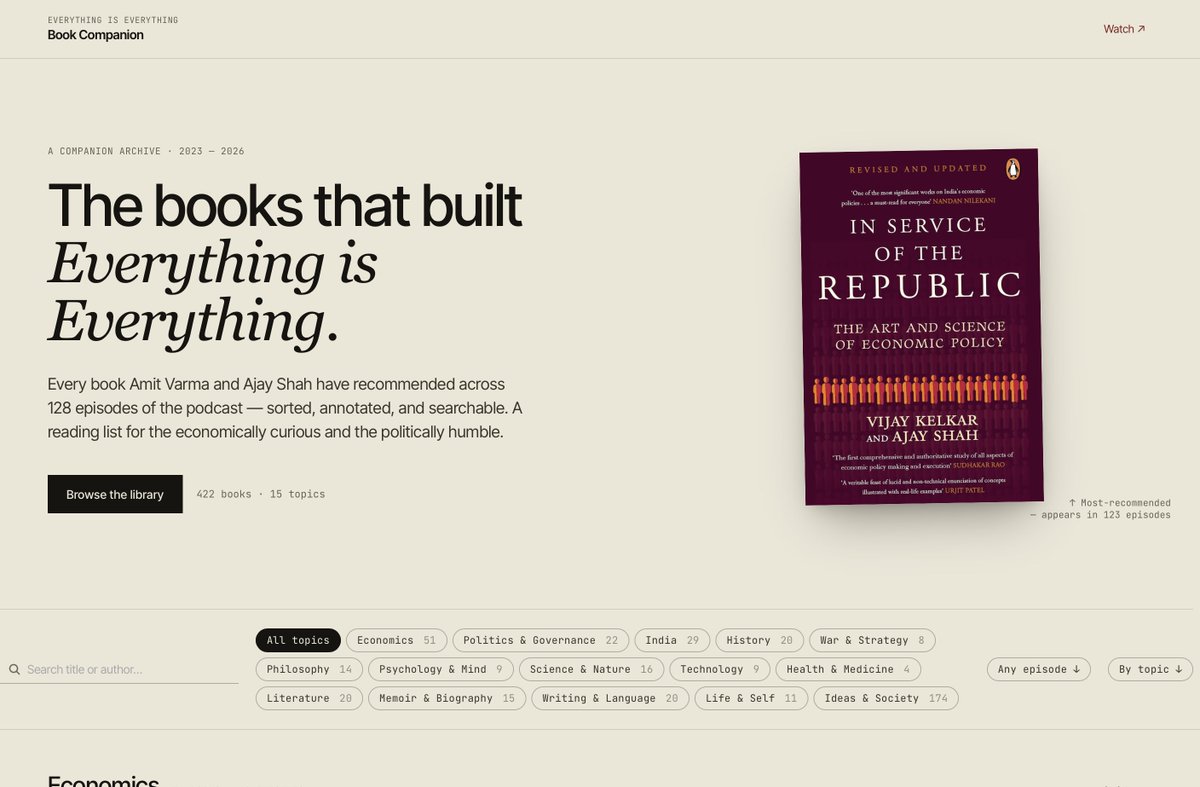
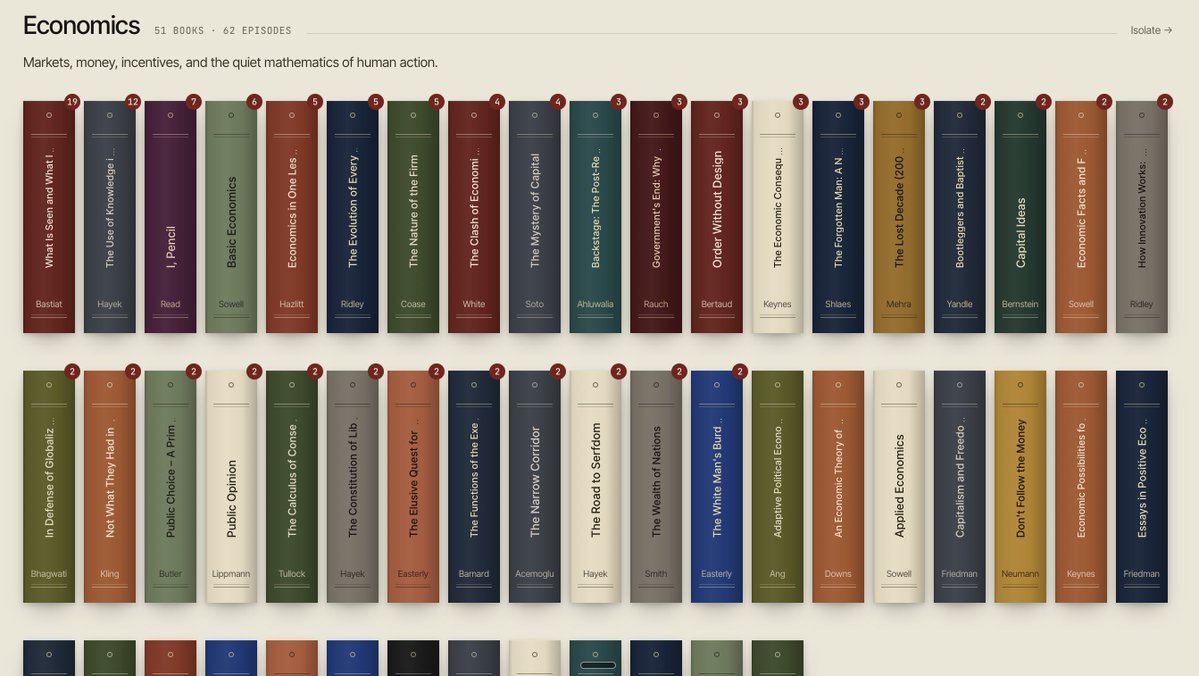
I recently discovered the “Everything Is Everything” podcast by @amitvarma & @ajay_shah and I loved it so much that I felt like we needed a book companion for all those incredible recommendations!
So here it is: https://t.co/3XgSyoAlaa
That'd be true if the trials were independent.
If these trials are conducted one after another and people learn from their mistakes, the real probability would be higher.
That chances of a 1/n event happening in n tries converges quickly on 63% (1-1/e to be exact) has been one of my favorite useful real world math shortcuts since high school.
while we must not leave what's important, we must shed what's weighing us down.
so, how to maximize memories stored while minimizing the space needed? compression.
a compression that has stored history before History was written, i.e. via Itihāsa.
Your phone knows something about you that you don't.
Every screenshot you refuse to delete is an anchor point. Your brain encodes memories spatially and temporally, so that random 2021 screenshot isn't storing the image. It's storing the entire emotional state of wherever you were when you took it. The lighting. The mood. Who was texting you.
Delete the screenshot and your brain loses the retrieval cue. The memory doesn't vanish, but the door to it gets harder to find. Your subconscious figured this out before your conscious mind did, which is why you feel physical resistance when your thumb hovers over "delete."
This is also why 128GB was never enough and 1TB still won't be. You're not collecting files. You're building an external memory palace, one screenshot at a time, and storage companies have priced their entire upgrade model around the fact that you will always choose memories over megabytes.
while it may lose minute details, it stores the lessons, mistakes, important events, and everything that matters.
siddhānta is preserved through dṛṣtānta.
these siddhānta-s are universal, and thus can be used as fractals to revisit many memories not just one.
File over app
File over app is a philosophy: if you want to create digital artifacts that last, they must be files you can control, in formats that are easy to retrieve and read. Use tools that give you this freedom.
File over app is an appeal to tool makers: accept that all software is ephemeral, and give people ownership over their data.
In the fullness of time, the files you create are more important than the tools you use to create them. Apps are ephemeral, but your files have a chance to last.
The pyramids of Egypt contain hieroglyphs that were chiseled in stone thousands of years ago. The ideas hieroglyphs convey are more important than the type of chisel that was used to carve them.
The world is filled with ideas from generations past, transmitted through many mediums, from clay tablets to manuscripts, paintings, sculptures, and tapestries. These artifacts are objects that you can touch, hold, own, store, preserve, and look at. To read something written on paper all you need is eyeballs.
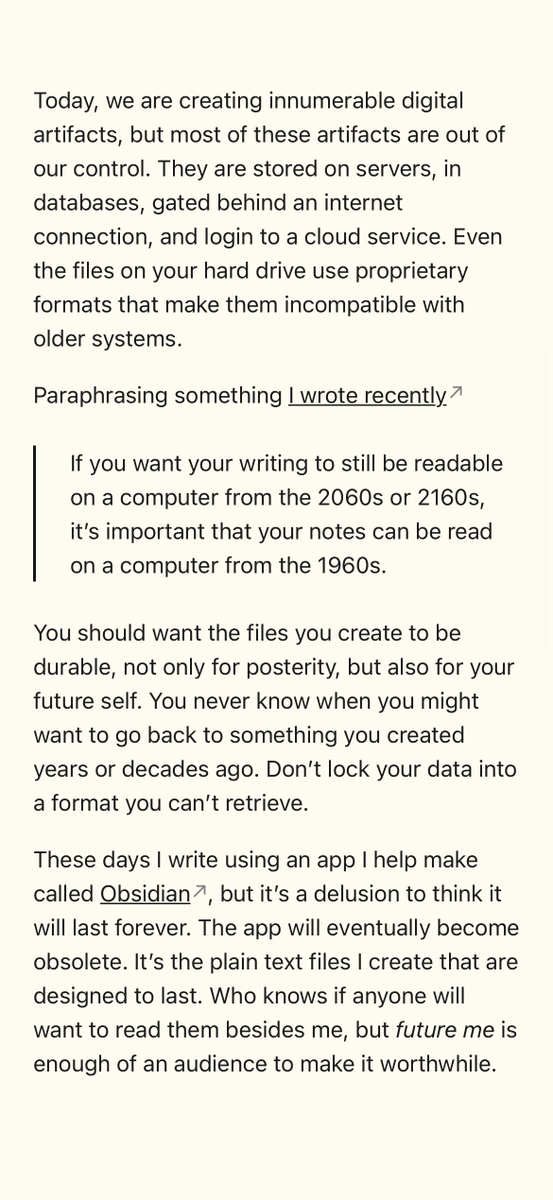
Today, we are creating innumerable digital artifacts, but most of these artifacts are out of our control. They are stored on servers, in databases, gated behind an internet connection, and login to a cloud service. Even the files on your hard drive use proprietary formats that make them incompatible with older systems.
Paraphrasing something I wrote recently:
> If you want your writing to still be readable on a computer from the 2060s or 2160s, it’s important that your notes can be read on a computer from the 1960s.
You should want the files you create to be durable, not only for posterity, but also for your future self. You never know when you might want to go back to something you created years or decades ago. Don’t lock your data into a format you can’t retrieve.
These days I write using an app I help make called Obsidian (@obsdmd), but it’s a delusion to think it will last forever. The app will eventually become obsolete. It’s the plain text files I create that are designed to last. Who knows if anyone will want to read them besides me, but future me is enough of an audience to make it worthwhile.
Your one-minute clock starts now.
Prompt 1 to Grok: "Review the video in the post. Create a detailed project requirements document to exactly recreate the app in the video" - about 15 seconds of typing
Prompt 2 to Claude Code: "Go into planning mode and create a detailed plan to implement the app described in the attached PRD" - about 15 seconds of typing. Although I did have to come back and type "1" to give it permission to execute the plan.
Prompt 3 to Claude Code: "Push this to a public repo." - about 5 seconds of typing
All coding about 60 seconds of my time. The longest part was trying to figure out how to screen capture a video with system audio. That flummoxed me for three to four minutes.
https://t.co/mahecc279O
We need a full 7-hour theatrical cut of Dhurandhar in select cinemas.
If there’s enough demand and pre-booking, make it happen.
Add 3 intervals and it would be an experience.
Personal wish, but I know many would show up.
Students who took notes by hand scored ~28% higher on conceptual questions than laptop note-takers.
Writing forces your brain to process and compress ideas instead of copying them.
Whenever I see us (fellow Indians) getting way-too-happy because a foreign leader touches our feet or calls us the emerging power, I remember this scene from rick & morty.
For centuries, mathematicians believed they could build a perfect logical machine: a system of rules that could prove every mathematical truth. Feed in the intuitive axioms already assumed to be true, turn the crank of logic, and out would come all of mathematics—complete, certain, and unbreakable.
Then in 1931, a quiet young logician named Kurt Gödel showed that this dream was impossible. His weapon to collapse this dream was astonishingly simple: he taught mathematics to talk about itself.
By encoding sentences and proofs with numbers, Gödel constructed a statement that effectively says:
“This sentence cannot be proven.”
If the logical system proves it, then the system is proving a lie (the sentence itself says it has no proof).
If it cannot prove it, then the statement is true ; but forever unprovable.
With one ingenious argument, Gödel revealed a profound limit on logic, proof, and even mechanical reasoning itself. The result changed mathematics, philosophy, and later computer science.
How did he do it?
This article walks step-by-step through the strange loops, hidden mirrors, and brilliant ideas behind Gödel’s Incompleteness Theorem - one of the deepest discoveries in human thought. (Link below)