With the launch of tokenized Coinbase stock ($wbCOIN) by Backed Finance on the Base blockchain, this round of SEC regulation seems to have fully opened the gates. This could mark the beginning of a transformative shift in the financial markets, potentially signaling that other U.S. stocks may soon enter the era of tokenization. For traders, this not only presents new market opportunities but also introduces unique possibilities for trading strategies. Below, I’ve outlined several potential arbitrage opportunities and strategies—feel free to add your thoughts and suggestions!
1. Trading Arbitrage Opportunities and Strategies
(1) Price Arbitrage
1️⃣Scenario: The U.S. stock market (traditional market) may experience sharp fluctuations due to news, macroeconomic data, or company events (e.g., earnings reports), while tokenized stocks on the blockchain (e.g., $wbCOIN) might not reflect these changes immediately due to insufficient liquidity or delays in price feeds.
2️⃣Strategy: Monitor price differences between the traditional market (e.g., Coinbase stock $COIN) and its tokenized counterpart (e.g., $wbCOIN). If $COIN drops (or surges) sharply in the traditional market while $wbCOIN lags behind in the crypto space, traders can buy (or sell) $COIN at a lower (or higher) price in the traditional market and simultaneously sell (or buy) $wbCOIN at a higher (or lower) price in the crypto market.
3️⃣Risks: Delays in price feeds, high transaction fees, blockchain network congestion, and legal risks between tokens and actual stock value (e.g., if the token doesn’t fully represent the stock).
Example: If $COIN falls to $200 in the traditional market but $wbCOIN remains at $205 due to liquidity issues, a trader could buy $COIN in the traditional market and sell $wbCOIN in the crypto market, locking in a $5 profit (after fees and slippage).
(2) Liquidity Spread Arbitrage
1️⃣Scenario: Tokenized stocks in the crypto market typically have lower liquidity than traditional U.S. stocks, especially during low trading volume, resulting in wide bid-ask spreads.
2️⃣Strategy: Buy stocks (e.g., $COIN) at near-market prices in the traditional market, convert them into tokens (e.g., $wbCOIN) via blockchain mechanisms (e.g., Base or other DeFi platforms), and sell them at a premium in the crypto market. Alternatively, exploit low-liquidity markets by providing liquidity (market making) and profiting from the bid-ask spread.
3️⃣Risks: Low liquidity may limit trade volume and hinder quick exits; blockchain Gas fees could also erode profits.
Example: If $wbCOIN has a bid price of $205 and an ask price of $210 on platforms like AerodromeFi or CoWSwap, a trader can provide liquidity by placing both buy and sell orders, earning a $5 spread.
(3) 24/7 Trading Time Arbitrage (Time Zone Arbitrage)
1️⃣Scenario: Traditional U.S. stock markets operate only on weekdays from 9:30 AM to 4:00 PM ET, while tokenized stocks on the blockchain trade 24/7. This creates opportunities to capitalize on global market movements during U.S. market off-hours.
2️⃣Strategy: After U.S. markets close, global markets (e.g., Asia or Europe) may influence Coinbase or other U.S. stock prices due to news or events, while $wbCOIN in the crypto market may not fully adjust. Traders can buy (or sell) $wbCOIN at a lower (or higher) price in the crypto market and wait for price convergence when U.S. markets reopen.
3️⃣Risks: Sharp price swings could lead to losses; tokenized prices may deviate from true value due to low participation.
Example: After U.S. markets close on Friday, an event in Asia boosts Coinbase’s outlook, but $wbCOIN hasn’t risen yet. A trader buys $wbCOIN at a low price in the crypto market and sells it after U.S. markets reopen on Monday.
(4) Cross-Market Arbitrage
1️⃣Scenario: Tokenized stocks may exhibit price discrepancies across multiple blockchain platforms (e.g., Base, Ethereum, Polygon) or between traditional exchanges (e.g., NYSE, Nasdaq) and DeFi platforms (e.g., Uniswap, SushiSwap).
2️⃣Strategy: Monitor $wbCOIN or other tokenized stocks’ prices across platforms. If the price on Base is lower than on Ethereum or the traditional market, use cross-chain bridges or traditional-to-blockchain tools to buy low on one platform and sell high on another.
3️⃣Risks: Cross-chain transaction delays, high Gas fees, and regulatory differences between platforms.
Example: If $wbCOIN is $200 on Base but $205 on Ethereum, a trader can buy on Base and sell on Ethereum, pocketing the difference (after cross-chain fees).
(5) Event-Driven Arbitrage
1️⃣Scenario: Major events (e.g., Coinbase earnings, regulatory news, or hacks) may cause asynchronous price movements between traditional stocks and tokenized versions.
2️⃣Strategy: Anticipate events that could impact Coinbase or other U.S. stocks (e.g., SEC policy shifts, mergers), predict price movements, and trade on the price divergence between traditional and tokenized stocks after the event.
3️⃣Risks: High uncertainty in event outcomes; prices may deviate further from expectations.
Example: If Coinbase releases positive earnings and $COIN rises 10% in the traditional market while $wbCOIN only increases 5% due to low liquidity, a trader can buy $wbCOIN cheaply in the crypto market and wait for convergence.
2. Key Factors to Watch
Sufficient Liquidity: Tokenized stocks currently suffer from low liquidity, limiting large-scale arbitrage. Web sources (e.g., McKinsey) suggest the tokenized market will only scale with greater user participation.
Fees and Slippage: Blockchain Gas fees, traditional market commissions, and swap costs in token trading can eat into profits.
3. Summary and Recommendations
The tokenization of other U.S. stocks, especially highly liquid and well-known names like Apple, Amazon, or Tesla, seems increasingly likely. For traders, the price, liquidity, and time disparities between tokenized and traditional stocks—along with cross-market and event-driven fluctuations—offer a range of arbitrage and trading opportunities. I recommend using real-time market data tools (e.g., TradingView, CoinGecko) and blockchain analytics platforms (e.g., Dune Analytics) to track prices and liquidity. Set strict stop-loss and take-profit levels, monitor Gas fees and slippage, and ensure profits outweigh costs.
If history is any indication, the market cycle low for Bitcoin will occur between October 3rd to October 11th of 2026, plus or minus a few days.
I'm sure plenty of rallies will occur between now and then.
In a rising market, the range of viable strategies is broad.
In the secondary market, traders can engage in swing trading and sector rotation.
In the primary market, opportunities include VC-backed projects, ICO launches, and high-beta assets such as airdrops memecoins.
In contrast, during a declining market, viable strategies narrow significantly.
These are mainly limited to shorting clearly overvalued altcoins,and executing short-term tactical longs on severely oversold or sharply declining assets—strictly under disciplined risk management.
The fundamental appeal of the crypto market lies in this: it consistently preserves opportunities for ordinary individuals to achieve upward mobility.
With the arrival of the AI era, structural inequalities in learning and information access are being progressively flattened. Increasingly, outcomes are determined by depth of understanding and execution capability rather than background or starting position.
Therefore, a bear market is not a dormant phase, but a period of preparation.
By systematically building knowledge, refining toolsets, and strengthening analytical and trading skills,one positions oneself to act decisively when the cycle turns and to win the one game that truly matters.
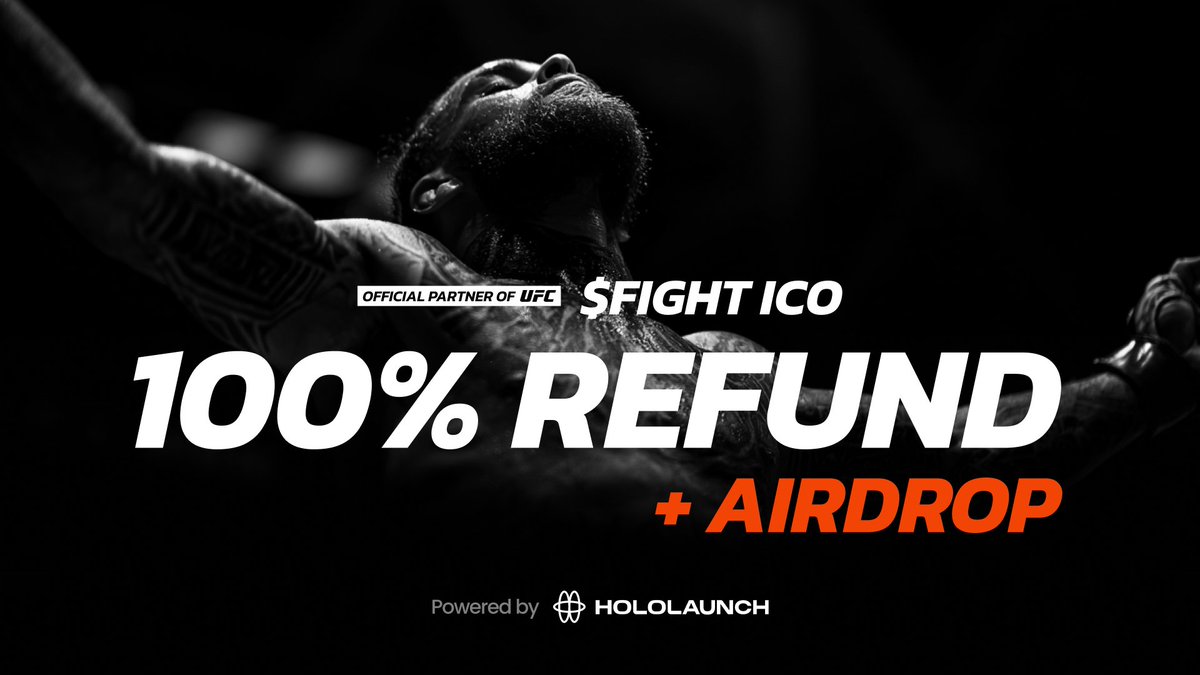
100% of $FIGHT ICO proceeds will be refunded to all participants.
As the flagship project on https://t.co/AXPWg1OgxW, $FIGHT is setting a new standard for putting the community first. The team has the financial strength and the grand vision to prioritize long term growth over short term funding. They are well capitalized and have chosen to give the total upside back to the believers.
With the 100% refund, tokens will be airdropped to:
- ICO participants on @BNBCHAIN
- ICO participants on @solana
- x402 Fight Pass holders
- Holler Campaign participants
- $HOLO stakers
Refunds and token distribution are automatic and will be sent directly to your contributing address on BSC and Solana. No action is required on your part.
- Total $FIGHT Supply: 10 billion
- 85 million tokens (0.85% of supply) will be airdropped
- For all ICO, x402, and Holler campaign participants: 0.2% of total supply unlock on TGE, 0.15% unlock on day 7, and 0.15% unlock on day 14
- For $HOLO stakers: 0.15% of total supply unlock on day 7, and 0.2% unlock after the first month
The focus is now entirely on the $FIGHT launch. We are ensuring the ecosystem has the strongest possible momentum for its secondary market debut.
Strength in execution. Grand vision. This is how we build the future through Holoworld.
$FIGHT
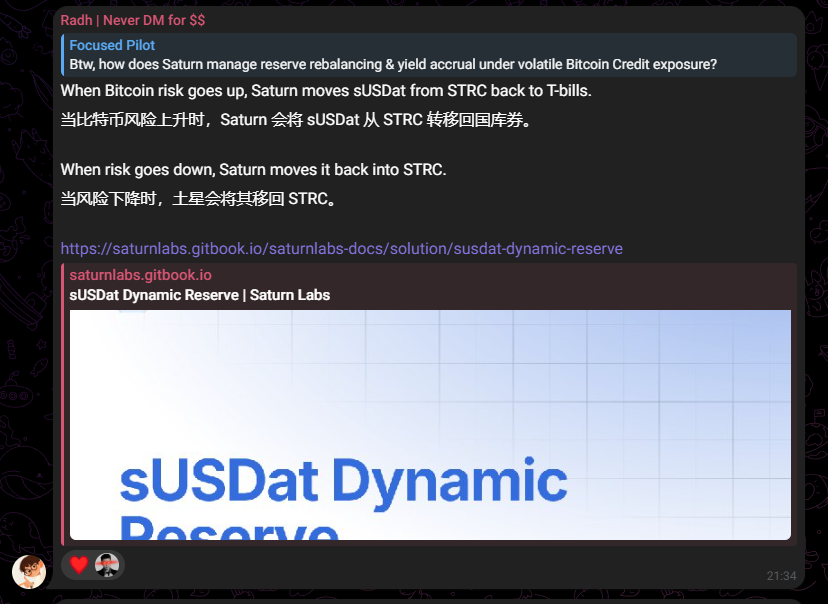
1/ We are excited to announce that Saturn raised $800K from @YZiLabs, @soraventures, and prominent crypto angels to build USDat, a stablecoin protocol delivering 11%+ yield backed by Bitcoin.
We generate yields through @Strategy’s $STRC, and unlock global, onchain access to digital credit.
The real endgame isn’t a SpaceX IPO.
It’s the day Tesla acquires SpaceX in a share-swap.
That won’t be news.
It will be the moment when, for the first time in human history, a planetary future is formally embedded into the capital markets.
It is not a portfolio of companies, but a sovereign economic organism:
X Holding
•Tesla → Cash flow, energy, manufacturing
•xAI → Intelligence and decision-making
•FSD / Optimus → Autonomous labor
•Starlink → Planetary-scale connectivity
•SpaceX → Interplanetary logistics and access to orbit
Once these are placed under a single holding structure, it stops being a company.
It becomes a civilization-grade capital system — one that can generate its own cash, its own intelligence, its own labor, its own infrastructure, and ultimately its own access to space.
At that point, it no longer depends on:
•Any single nation
•Any single currency
•Or even a single planet
This is why SpaceX doesn’t belong in a traditional IPO.
Quarterly earnings cannot govern a multi-planet future.Only a vertically integrated, cash-generating, self-controlled capital structure can.
Tesla is not meant to be the destination.
It is meant to be the financial engine that carries humanity beyond Earth.
WOAH: @chamath predicts @Soacex will not IPO but instead do a reverse merger with @Tesla.
Consolidating @elonmusk’s two biggest assets into a holding company has long been predicted in the Tesla community (notably by @heydave7 and @EmmetPeppers)