@Polymarket@100MBTC May be this is the day humans are waiting for. If AI can truly decode animal communication, it will completely change how we understand and interact with other species. This kind of breakthrough can help in wildlife conservation and better pet care.
A Temporary Flight Restriction has been posted for Masseys from June 4th to June 16th. It had been stated to be for ”ROCKET BOOSTER TESTING” so Booster 20 and possibly Ship 40 aswell.
We’re expanding Project Glasswing. We’ve extended access to Claude Mythos Preview to approximately 150 additional organizations, based in more than fifteen countries.
Read more about this expansion and our future plans for Project Glasswing: https://t.co/QrtHSBdRbh
$AVGO just reported:
"Q2 semiconductor revenue from AI of $10.8 billion grew 143% year-over-year, above our forecast, driven by increasing demand for custom AI accelerators and AI networking. The momentum continues and in Q3 we expect semiconductor revenue from AI to grow over 200 percent year-over-year to $16.0 billion."
So the whole AI story of AVGO is smaller than NVDA networking, and growing slower.
$AVGO is a $2.269T company at market close today, vs $5.201T of $NVDA, does it make sense ?
⚡️Owning SpaceX is owning a claim on the off-planet operating system.
That sounds insane under normal equity math.
It is not insane under empire math.
The market has already started doing this with Nvidia, AI data centers, and hyperscaler capex.
It is valuing bottlenecks, not just earnings.
Compute bottlenecks. Power bottlenecks. Chip bottlenecks. Cloud bottlenecks. Now SpaceX would add the orbital bottleneck.
This is the same regime signal again, but louder.
Nvidia controls the intelligence substrate.
Hyperscalers control the compute deployment layer.
SpaceX controls the orbital access layer.
Bitcoin controls the neutral monetary escape layer.
Gold controls ancient collateral memory.
Power and copper control the physical constraint layer.
The whole system is reorganizing around entities that control unavoidable constraints.
SpaceX is one of the rarest because the constraint is not just economic. It is geographic, military, communications-based, symbolic, and civilizational. There are only so many companies that can credibly say they may become the dominant logistics provider between Earth and orbit. SpaceX can.
The public-market danger is obvious though: the IPO may transfer the private-market upside to late buyers at empire pricing.
That is the brutal part. SpaceX can be one of the most important companies ever built and still be a bad buy at the wrong valuation. Those two things can both be true without contradiction. Great asset. Terrible entry if the future has already been capitalized too aggressively.
At $1.77T, the stock would need a path toward becoming a multi-trillion-dollar infrastructure monopoly. Not a successful launch company. Not a profitable satellite broadband company. A multi-layer strategic platform with durable pricing power across launch, Starlink, defense, government, direct-to-device, aviation/maritime connectivity, orbital logistics, and eventually deeper space infrastructure.
That is a massive burden.
But the market may accept it because SpaceX has what almost no company has: scarcity plus myth plus execution plus state necessity. The U.S. cannot afford to let SpaceX fail. Allies increasingly need it. Defense planners need it. Communications networks need it. NASA depends on it. Competitors lag. That puts a quasi-sovereign floor under the story.
The real implication is that public markets are about to be offered a crown jewel after the private market already understood the crown.
If it lists and holds anywhere near that valuation, it confirms the market has entered a new phase: private infrastructure empires can come public valued like nation-state organs. That would be a huge validation of the broader thesis that the next market leaders are not ordinary companies. They are operating layers.
The deepest truth:
SpaceX is probably worth an extraordinary valuation. $1.77T may still be too rich for new buyers.
But structurally, the number is not random. It is the market trying to price the first company that may own the highway to orbit.
That is the highest-level signal.
The future is no longer being valued as software alone.
It is being valued as compute, energy, collateral, and space.
@Crypto_ragdolls@dschamis@elonmusk@SpaceX@HyperliquidX People are railed up over data centers because it's turned into so stupid political stance to hate them for both left & right.
Issue isn't gonna be solved. More than build out, as more jobs are lost, more people will hate or even destroy them
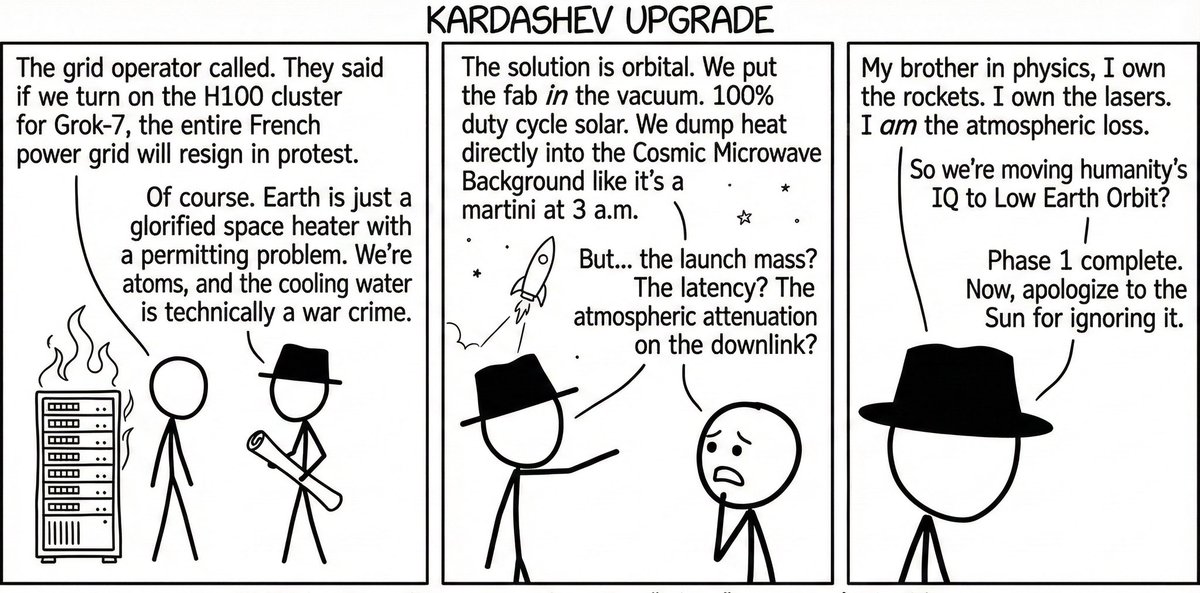
@johndeanl@skorusARK@Robotbeat First principle thinking for ODC is it's easier to build first data center on land and incrementally harder to build 100th. And visa versa for space
Fastest data center builder of Earth built few and came to that conclusion
Probably we need orders of magnitude more than 100
The conundrum was that neither LEO telecom constellations nor reusable rockets were economically viable when viewed separately.
But when viewed as a sequence of problems (let's reuse a rocket, then figure out how to make money with it), the solution is wildly profitable.
@Crypto_ragdolls@dschamis@elonmusk@SpaceX@HyperliquidX Well fastest data center builder on Earth thinks it might just works
He might know thing or two about rockets, satalities and data centers that even anthropic willing to pay 15B$ a year