Week 2 of Solana Fellowship
Covered this week Box, Deref, Rc & RefCell - really solid session, concepts are finally clicking.
Arc, Mutex & mpsc (self-learning grind on 💪)
Excited for this week’s assignment
Week 2 of Solana Fellowship
Covered this week Box, Deref, Rc & RefCell - really solid session, concepts are finally clicking.
Arc, Mutex & mpsc (self-learning grind on 💪)
Excited for this week’s assignment
This indie dev is making a third-person parkour runner game. If we can’t have Mirror’s Edge 2, then indies will.
- Play as Kaia
- Use parkour abilities to traverse the world
- Move in any way you see fit
It's called Tachyon Flow. Would you play this?
Week 1 - Rust basics, Solana India Fellowship
Completed Rust fundamentals and assignments
covering ownership, borrowing, error handling, generics & lifetimes.
Up next - AI interview 👀
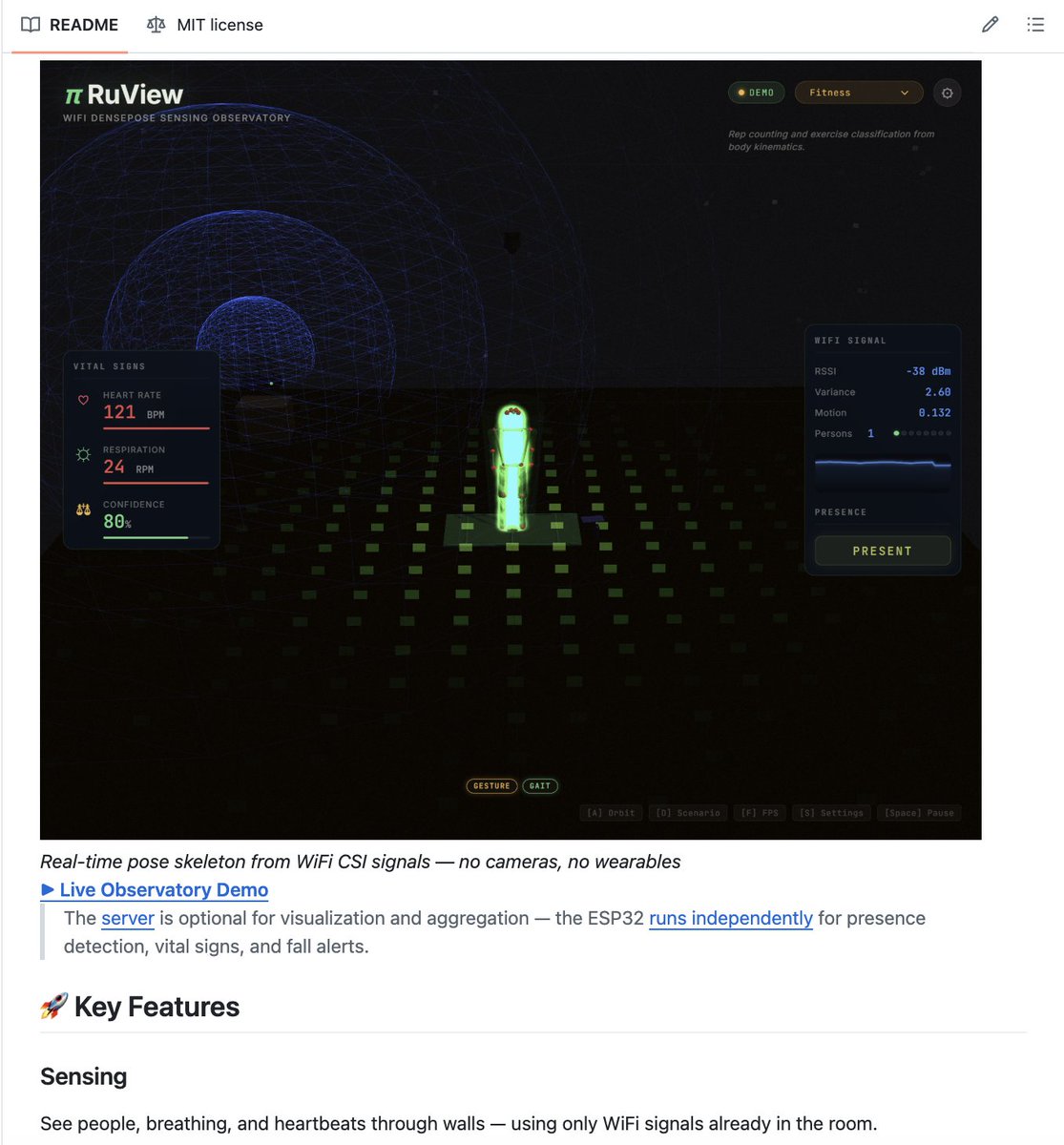
🚨BREAKING: A developer on GitHub just turned your WiFi router into a full-body surveillance system.
It's called RuView.
It uses the WiFi signals already in your room to detect human poses, track breathing, measure heart rate, and see through walls.
Not a concept. Not a research paper. Working code you can run right now.
Here's what this thing actually does:
→ Tracks full 17-point body pose using only WiFi signals
→ Detects breathing rate (6-30 BPM) without touching anyone
→ Measures heart rate (40-120 BPM) from across the room
→ Sees through walls, furniture, and debris up to 5 meters deep
→ Tracks multiple people simultaneously with zero identity swaps
→ Self-learns from raw WiFi data. No labeled datasets needed
Here's how it works:
WiFi signals pass through your room and hit the human body. The body scatters those signals differently based on position, breathing, even heartbeat. RuView reads that scattering pattern and reconstructs everything.
A mesh of 4 ESP32 nodes ($48 total) gives you 360-degree coverage with 12 measurement links, 20 Hz updates, and sub-30mm precision.
Here's the wildest part:
It has a disaster response mode called WiFi-Mat. It detects survivors trapped under rubble through concrete walls, classifies injury severity using START triage protocol, and estimates 3D position. The kind of tool that saves lives after earthquakes.
The Rust implementation processes 54,000 frames per second. That's 810x faster than the Python version. The entire Docker image is 132 MB.
The AI model fits in 55 KB of memory. Runs on an $8 ESP32 chip.
Train once, deploy in any room. No retraining. No recalibration.
1,100+ tests. 15 Rust crates on crates. io. SHA-256 verified capability audit.
100% Open Source.
AI can generate code in seconds, but it takes a developer with intuition to fix the mess it leaves behind. As @kirat_tw said, developer jobs aren't going away that easily when complex bugs still require a human brain.
Tired of paying for AI meeting assistants? I built my own open-source alternative.
Meet MeetingMind: an open-source tool that auto-joins your Google Meets, records the session, and transcribes everything perfectly.
What it does:
- Chrome extension to easily send the bot to any meeting
- Headless bot joins silently and records the video
- Synced transcripts with speaker labels and timestamps
- Built-in AI chat to instantly ask questions about the meeting
Code: https://t.co/0CNFFN9Tnu
Built for developers to self-host and customize. Check out the repo and drop a star if you find it useful!
@kirat_tw@SuperteamIN@100xSchool