@mattpocockuk Oh cmon now, enough with this bs. Software needs to be precise, this isn't magic that you cast spells. There's a place for each tool, LLMs (not AI) aren't it.
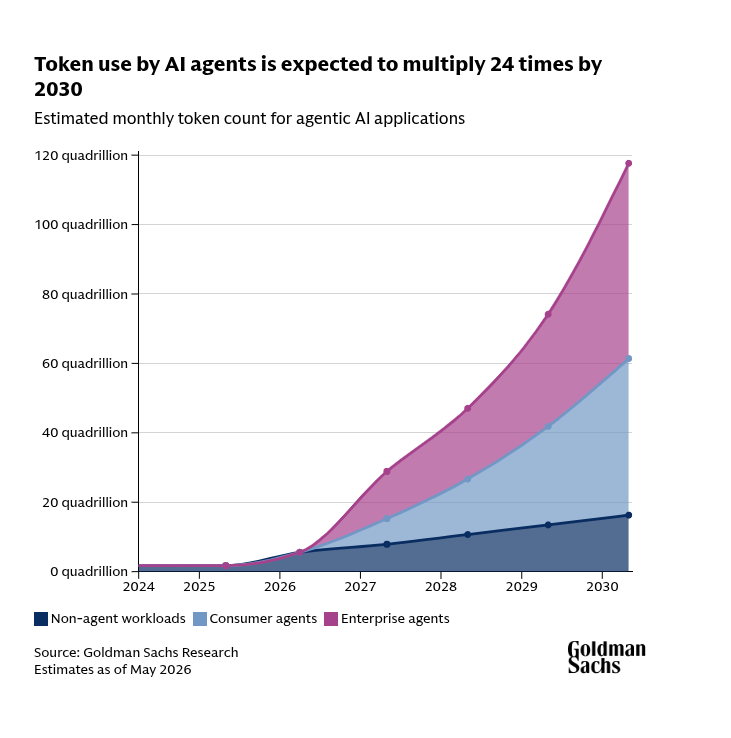
Goldman Sachs: "Token use by AI agents is expected to multiply 24 times by 2030"
AI agents are now creating the first serious cost test for the AI boom. As was reported this week, Uber and Microsoft are already rethinking expensive agent usage.
A chatbot may answer once, but an agent plans, calls tools, checks results, edits mistakes, and repeats the loop.
That loop can make one user request consume 10x, 50x, or even far more tokens than a normal answer.
Goldman’s bullish case is that monthly token use could reach 120 quadrillion by 2030, while inference cost per token keeps falling 60%-70% per year.
The fight is now between agent productivity and token waste.
Earlier this month, Microsoft began revoking developer access to Claude Code, with plans to move them to its in-house Copilot Command Line Interface tool by June 30. The company has framed this as consolidating teams around its own tools, but the timing at the fiscal year’s end hints it may also be about lowering costs.
I got so fed up of seeing bullshit about "I sacked my SEO agency and replaced $5000 a month with a $20 claude subscription" that I've been testing AI SEO Agents.
So, to shut this crap down quickly I decided to test lots of AI SEO automations from programmatic content experiments with OpenClaw through to SEO Skills in Claude Code.
Here's my first post on Claude SEO the AI powered SEO audit skill for claude code:
https://t.co/GcU4L9sGEJ
Here's the summary:
👀 AI SEO Agents do NOT WORK
No IFS, no BUTS, they DO NOT WORK.
They don't work for auditing and they do not work for creation.
Why?
❌ SEO auditing is a large job where the variables for priority and rank are changing and are often website / niche dependent. Most AI auditing tools for SEO just use the "same" checklist approach whilst placing over-emphasis on the things that don't matter vs things that do
❌ Recommendations are often wrong, over-exagerated or just use a lateral rule book i.e. something MUST be present or its a critical issue! like a sitemap
❌ It's not viable for AI to properly audit content at scale at this point, even with strong models that burn tokens - content requirements are highly varied and thus a standardised checklist of checks isn't always very effective
❌ AI for content creation stands out like a sore thumb Google is PROACTIVELY indexing LESS and LESS content now - why? because, due in part to Google not needing it and, if you are creating what already exists out there where is there any value in Google indexing it let alone serving it?
❌ Google is no doubt actively working to stamp out scaled content abuse - one easy way to do that is simply look at the growth rate of a site, spot clear AI content patterns as well as relying on things like domain weight/authority and brand trust which is SIGNIFICANTLY harder to game
❌ AI loses context on large audits - even content audits, 1m context window, it becomes quick and easy to lose context so audits need segmentation before running such as E-E-A-T/YMYL and then segment by content type
I have been testing the following and over the coming weeks I am going to do long-form posts and videos showing you the REALITY of using AI within SEO vs handing off to automations as well as risks, time wasting and fallacies.
☑️ I tested PURE AI content generation on domains with no links
☑️ I tested PURE AI content generation on domains with links
☑️ I tested AI content sites with domain consolidation
☑️ I tested OpenClaw automations - I built a research agent to research SERPS and then to create article frameworks, I created a content creation agent that wrote the content based on the first agent, then an agent to automate deployment
☑️ I tested Hermes Agent with a programmatic content strategy
☑️ I tested an agent set up with AntiGravity to perform complex SEO audits
☑️ I tested various SEO automations from Github repos
#seo
Mark (@thetafferboy) created a fake standard called cats.txt and now LLMs are crawling it, it’s being indexed, and ChatGPT even says it works for ranking in search and LLMs 😂😂👏🏽👏🏽
@athenseo
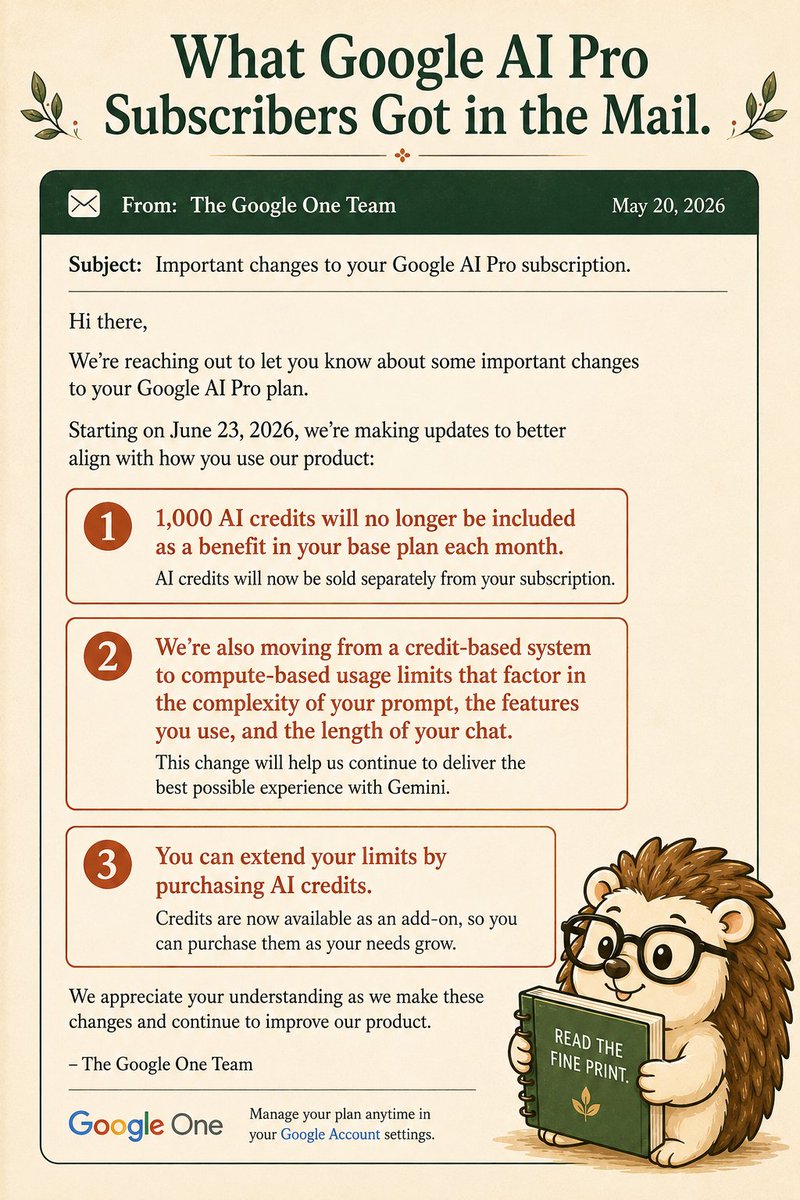
🦔Google AI Pro subscribers got an email yesterday telling them the 1,000 AI credits included in their base plan are gone, replaced by a "compute-based usage limit" that varies based on prompt complexity, features used, and chat length. The new limit refreshes every 5 hours until a weekly cap is hit, after which extra access has to be purchased separately. Annual subscribers who paid upfront are seeing the change mid-contract. The Gemini app, Flow, and Antigravity products are all on the new model. No price reduction was offered.
My Take
Google told paying customers the included benefit is gone and replaced it with a metering system the customer cannot calculate in advance. "Compute-based usage limit that factors in complexity, features, and length of your chat" is a polite way of saying token-based billing where the user has no idea what each prompt costs until after they send it. Annual subscribers paid for a year of credits they no longer get, which would be a contract breach in any other industry but reads as routine in AI subscription land.
This is the same token cost story I just wrote about in the Fortune post playing out one layer down. The labs face IPO-driven pressure to fix their unit economics, the hyperscalers running the infrastructure pass that pressure to enterprise customers, and now consumer subscribers are getting the same treatment. Headline price stays flat, included usage shrinks, and the difference gets sold back as a metered upsell. Anyone subscribed to an AI service should expect the pattern to keep repeating. The bill is moving down the stack from labs to enterprises to households.
Hedgie🤗
Scraping websites and having AI summarize them, so that no one visits the websites, is theft.
Training AI on videos, so that it can make new videos that compete with them, is theft.
We are witnessing the largest theft of creative work in history.
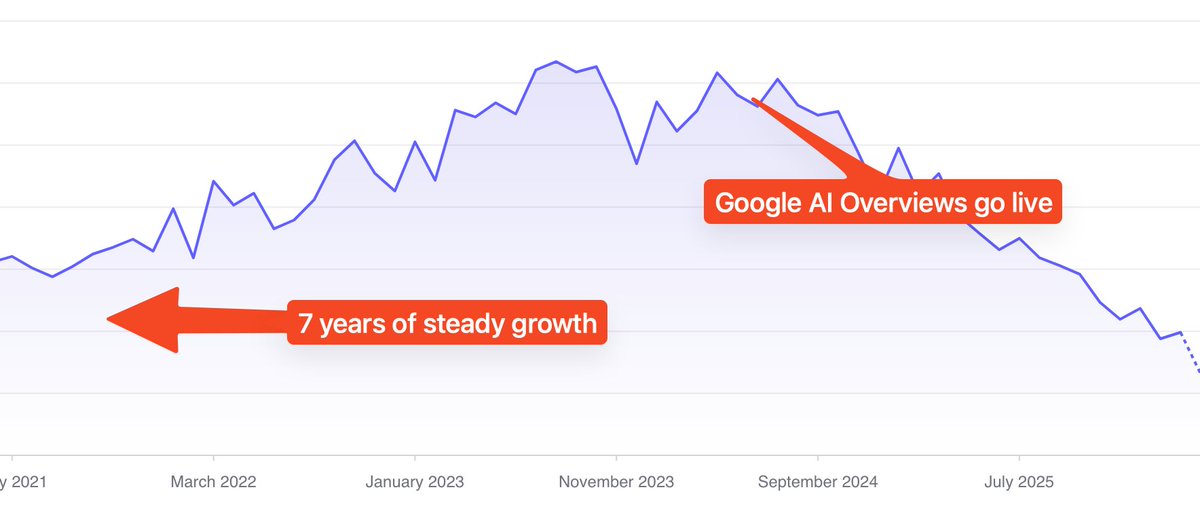
AI is killing All About Berlin. When you Google something, you used to get a link to my website, but now you get an AI-generated answer trained on my work. This has a devastating impact on traffic.
@aka_yaswanth@RyanJones Nope, not gonna happen. What already exists is personas: run checks via them. Better than generic... still awful way to spend money llm trackers.
🚨 Google just announced what it calls the biggest upgrade to the Search box in more than 25 years 👇
A new AI-powered Search box is designed to go beyond keywords and autocomplete. According to Google, it will:
✅ Dynamically expand so users can describe what they need in more detail
✅ Suggest better ways to formulate questions, beyond traditional autocomplete
✅ Support multimodal inputs, including text, images, files, videos, and Chrome tabs
✅ Let users continue from AI Overviews into AI Mode with follow-up questions
✅ Preserve context as users explore more deeply
✅ Still provide a range of Search results, according to Google
This is starting to roll out today in countries and languages where AI Mode is available.
Google also announced that AI Mode is now using Gemini 3.5 Flash globally as its default model.
Let's see how this impacts users search behavior, journey and ultimately, outcome towards sites.
Read announcement:
https://t.co/sGioSL84A8
Google has published official WebMCP documentation on https://t.co/VwJhTvnRSb and confirmed an origin trial in Chrome 149. This is Google getting serious about shipping it. You can either live in denial or start learning this stuff quickly. The choice is of course yours.
Here is my guide: https://t.co/qEpvEnC6Oc