@jimcramer thinks $NVDA's $20B bond raise is about buybacks, like Apple. I think that misses the point entirely. 🔑
Apple borrows to return cash because it has no better use for money. NVIDIA borrows because the infrastructure bill for AI is so large that even $216B in annual revenue and $13B in cash isn't enough to fund both growth AND shareholder returns at scale.
This is the first NVDA bond sale since 2021, when the company raised $5B. Revenue was $27B then. It's $216B now — 8× larger — and they need 4× more debt. The capex cycle is outgrowing even NVIDIA's own cash generation.
The bonds mature as late as 2056. That's not a buyback structure. That's a company financing a thirty-year infrastructure bet.
Consensus is reading this as a shareholder return story. The bond maturities say it's a buildout story. Those are very different trades.
Don't buy the robot. Buy the toll road.
More than half the cost of a humanoid robot is its joints, not its AI brain. Tesla's Optimus has about 28 of them, each a small bundle of motor, gear, and screw that turns a command into an arm that actually moves. Add the sensors, the wiring, and the power chips and the physical body runs to roughly two-thirds of what the machine costs to build.
The brain gets the headlines. The body gets the bill.
That's the trade. You don't have to guess whether Tesla, Figure, or some Chinese upstart wins the race, because they all bolt together the same short list of parts. Skip the gold panning and sell the shovels: own the components every robot has to buy, and collect a toll no matter whose logo ends up on the chest.
Nine names sit on that toll road, and they don't deserve the same treatment. Here's how they sort.
The first group is quality you'd want even if robots never shipped, at a price that won't make you wince. Connectors are the boring core of it: the plugs and cables that wire a robot's hundreds of parts into one working nervous system.
- $TEL (TE Connectivity) and $APH (Amphenol) basically run that business and have compounded quietly for decades doing it. Nobody brags about owning a connector company at dinner, which is part of why both have been such steady winners. Of the two, $TEL is the rare name that scores well on quality and still trades at a price that makes sense.
- Next to them is $NXPI (NXP), which makes the edge chips that let a robot decide what to do on the spot instead of waiting on a server. That's the gap between catching a falling glass and sweeping it up afterward.
The second group is elite businesses you're paying full price for.
- $TXN (Texas Instruments) makes the plain analog and power chips tucked inside every motor and sensor; you probably owned their calculator in school, and now the same company sits in the robot's wiring.
- $ADI (Analog Devices) handles the precise sensing that gives a robot balance and a sense of touch, the part that keeps it from face-planting. Both are genuinely excellent, and the market worked that out years ago. The robot upside is already in the price, so you're paying a premium for the story rather than catching it cheap.
- $RBC (RBC Bearings) belongs near this group too, a high-quality niche bearing maker we just don't formally score.
The third group is where the story does more work than the business.
- The newsletter that started this told people to "buy the bearings," and the actual bearing maker, $TKR (Timken), is the one running on hope rather than earnings right now. It's a real 125-year-old company that outlasted the horse and the automobile, but today it sits below our quality floor: cyclical, thin recent profit, robot revenue close to zero. Buying it here means paying for a 2040 outcome at a 2026 low.
- $ON (Onsemi) and $NOVT (Novanta) sit on the same bench, real parts makers whose current numbers are being asked to carry a lot of narrative.
None of this says the story names collapse or the quality names only climb. It says you should know which one you're holding: a toll road you'd keep for a decade, or a lottery ticket dressed up as an industrial.
One number keeps it honest. For every company here, humanoids are under 1% of revenue today. The forecasts everyone quotes, millions of robots across the 2040s, point in a real direction but aren't something you bank next quarter. Showing up early is fine. Paying too much to be early is the mistake.
What would move any of these from watch to buy isn't subtle, and it hasn't happened yet: robot orders landing as actual backlog, the kind that shows up in the order book instead of a press release. We ran all nine through our system and the pattern held: strong businesses, mostly full prices, every score public if you want to check the math.
A humanoid robot costs ~$16K in 2026. Slightly less than a Camry. Unitree shipped ~5,500 of these last year. Boston Dynamics is building a ~30K/year Atlas plant with Hyundai. We stopped predicting the robot economy. It just showed up. #Robotics#FrontierTech
Japan at 1%: Gravity Comes Back to the S&P
The Bank of Japan takes its policy rate to 1% this week, the highest in thirty years. Almost every write-up reads it as a Tokyo story or a yen story. For a US equity book it is neither. It is a gravity story. And the thing about gravity is that it works slowly. This does not show up in one bad session. It shows up over quarters and years, in the price of the most expensive stocks you own.
Here is the whole argument in one picture. 👇
The patient buyer is going home
For a generation, Japan has been the largest foreign owner of US government debt, sitting on roughly $1.2 trillion of it. Picture Japanese pensions and insurers as a huge, patient buyer who has stood under the US bond market for years, quietly soaking up Treasuries and keeping America's long-term borrowing costs lower than they would otherwise be. Nobody talked about this buyer because he never left.
He is leaving now. With interest rates back home finally worth something, a Japanese insurer can earn a respectable return in its own currency without taking the risk of shipping money abroad. So the money is coming home. In the first three months of this year, Japan sold the most US Treasuries since 2022, and the pace is picking up.
Why your stocks care
When the biggest buyer steps back, US long-term interest rates drift higher. Not because the Fed wants them to. The Fed's next move is still expected to be a cut. They drift higher because the bid that quietly held them down is fading.
And long-term interest rates are gravity for stocks. It is the old line that rates do to share prices what gravity does to matter. When rates are low, gravity is weak and prices float up to rich valuations. When rates rise, gravity strengthens and pulls them back down.
The catch is that gravity does not pull on everything equally. It pulls hardest on the stocks whose value sits furthest in the future. A dull company that hands you cash today barely feels it. A company whose whole value is a promise of huge profits a decade from now feels it most, because a higher rate marks down that far-off promise much harder.
That is the exact description of the part of the market everyone owns: big-cap tech. And here is the quiet problem. The S&P is no longer a spread-out index. It is now roughly a third concentrated in a handful of giant, long-dated tech names. The index has quietly turned into a bet on distant cash flows. So when gravity strengthens, "the market" and "the most expensive stocks in it" have become almost the same trade.
Where the risk sits, by name
Most at risk, to the downside, are the long-duration megacaps.
Nvidia ($NVDA ) is the sharpest example. It is the most crowded stock on the planet, held by leveraged funds everywhere, and it is the face of an AI-spending story whose payoff is already being questioned. It gets hit from both directions: fast, if a stronger yen forces global funds to sell their best winners to cover losses, and slow, as a higher discount rate deflates the multiple over time.
Oracle ($ORCL ) is the one exposed twice. It is a long-dated AI bet, and it borrowed tens of billions to build data centers. Higher rates raise both the discount on its future profits and the cost of rolling that debt. Same move, two hits.
The quieter casualties are the bond substitutes. Utilities ($XLU ) and real estate (REITs) are bought mainly for their yield. When safe bonds start paying more, these suddenly look worse by comparison and bleed.
Most resilient, and the relative winners, are the banks. A world of higher long-term rates is good for lenders, who make money on the gap between what they pay short and earn long. JPMorgan ($JPM ) and the broad financial sector ($XLF ) are the natural beneficiaries. Next to them sit the unglamorous value names that pay you now instead of later. And cash, for once, is a real position rather than an embarrassment.
Timing, and the one number to watch
This is the part to hold onto. This is not a crash you trade around a single meeting. Japanese institutions turn like oil tankers, the repricing comes in over quarters and years, and the Fed can paper over it for a while.
The risk worth respecting is that the slow story gets front-run by a fast one. If the yen snaps sharply stronger, leveraged funds dump their most liquid winners to cover, and you get an air pocket in megacap tech of the kind we saw in August 2024, before the slow grind has even started.
So the number to watch is not the BOJ's rate. It is the US 30-year Treasury yield. The BOJ headline is the cause. The long bond is where it lands, and it is the early warning for everything expensive you hold. When that yield keeps grinding higher even while the Fed is cutting, that is gravity doing its work, and the top floor of the market, the priciest tech, is the part that sways.
Everyone is watching Tokyo. Watch the long bond.
Japan at 1%: Gravity Comes Back to the S&P
The Bank of Japan takes its policy rate to 1% this week, the highest in thirty years. Almost every write-up reads it as a Tokyo story or a yen story. For a US equity book it is neither. It is a gravity story. And the thing about gravity is that it works slowly. This does not show up in one bad session. It shows up over quarters and years, in the price of the most expensive stocks you own.
Here is the whole argument in one picture. 👇
The patient buyer is going home
For a generation, Japan has been the largest foreign owner of US government debt, sitting on roughly $1.2 trillion of it. Picture Japanese pensions and insurers as a huge, patient buyer who has stood under the US bond market for years, quietly soaking up Treasuries and keeping America's long-term borrowing costs lower than they would otherwise be. Nobody talked about this buyer because he never left.
He is leaving now. With interest rates back home finally worth something, a Japanese insurer can earn a respectable return in its own currency without taking the risk of shipping money abroad. So the money is coming home. In the first three months of this year, Japan sold the most US Treasuries since 2022, and the pace is picking up.
Why your stocks care
When the biggest buyer steps back, US long-term interest rates drift higher. Not because the Fed wants them to. The Fed's next move is still expected to be a cut. They drift higher because the bid that quietly held them down is fading.
And long-term interest rates are gravity for stocks. It is the old line that rates do to share prices what gravity does to matter. When rates are low, gravity is weak and prices float up to rich valuations. When rates rise, gravity strengthens and pulls them back down.
The catch is that gravity does not pull on everything equally. It pulls hardest on the stocks whose value sits furthest in the future. A dull company that hands you cash today barely feels it. A company whose whole value is a promise of huge profits a decade from now feels it most, because a higher rate marks down that far-off promise much harder.
That is the exact description of the part of the market everyone owns: big-cap tech. And here is the quiet problem. The S&P is no longer a spread-out index. It is now roughly a third concentrated in a handful of giant, long-dated tech names. The index has quietly turned into a bet on distant cash flows. So when gravity strengthens, "the market" and "the most expensive stocks in it" have become almost the same trade.
Where the risk sits, by name
Most at risk, to the downside, are the long-duration megacaps.
Nvidia ($NVDA ) is the sharpest example. It is the most crowded stock on the planet, held by leveraged funds everywhere, and it is the face of an AI-spending story whose payoff is already being questioned. It gets hit from both directions: fast, if a stronger yen forces global funds to sell their best winners to cover losses, and slow, as a higher discount rate deflates the multiple over time.
Oracle ($ORCL ) is the one exposed twice. It is a long-dated AI bet, and it borrowed tens of billions to build data centers. Higher rates raise both the discount on its future profits and the cost of rolling that debt. Same move, two hits.
The quieter casualties are the bond substitutes. Utilities ($XLU ) and real estate (REITs) are bought mainly for their yield. When safe bonds start paying more, these suddenly look worse by comparison and bleed.
Most resilient, and the relative winners, are the banks. A world of higher long-term rates is good for lenders, who make money on the gap between what they pay short and earn long. JPMorgan ($JPM ) and the broad financial sector ($XLF ) are the natural beneficiaries. Next to them sit the unglamorous value names that pay you now instead of later. And cash, for once, is a real position rather than an embarrassment.
Timing, and the one number to watch
This is the part to hold onto. This is not a crash you trade around a single meeting. Japanese institutions turn like oil tankers, the repricing comes in over quarters and years, and the Fed can paper over it for a while.
The risk worth respecting is that the slow story gets front-run by a fast one. If the yen snaps sharply stronger, leveraged funds dump their most liquid winners to cover, and you get an air pocket in megacap tech of the kind we saw in August 2024, before the slow grind has even started.
So the number to watch is not the BOJ's rate. It is the US 30-year Treasury yield. The BOJ headline is the cause. The long bond is where it lands, and it is the early warning for everything expensive you hold. When that yield keeps grinding higher even while the Fed is cutting, that is gravity doing its work, and the top floor of the market, the priciest tech, is the part that sways.
Everyone is watching Tokyo. Watch the long bond.
There's one number that quietly decides whether the entire AI buildout actually makes money — and once you see it, you can't unsee it. So let's do the math, with real figures.
Building a one-gigawatt AI data center costs about $38 billion. The chips — the Nvidia accelerators that do the work — are the single biggest slice: roughly $20 billion, over half. The rest is the building, the power, the cooling, the networking.
Here's the catch. The building and the power last 15-20 years. The chips? Effectively obsolete in about three. $NVDA ships a faster generation on a relentless cadence, and older chips lose 40-60% of their value within 18-24 months of the successor arriving.
So more than half of the most expensive thing humanity is building right now melts in three years. Picture a $38B warehouse where $20B of it is ice sculptures.
That used to be fine — because the rent was insane. In 2023-24, an Nvidia H100 paid for itself in under a year. Easy money.
Then everyone built. Capacity flooded in and the rent collapsed: H100 rental rates are down roughly 64-70% from their peak, to around $2-4 an hour. At those prices the payback period has stretched from under a year to seven-to-ten years — on an asset that's obsolete in three. You can't earn back a three-year chip over ten years of rent. At today's prices, the math just doesn't close.
Don't take our word for it — read the purest example's own filings. $CRWV does nothing but rent GPUs. Last quarter revenue grew 112% to $2.1 billion. Spectacular, right? Except depreciation alone — the chips wearing out — ate $1.15 billion, more than half of all revenue. The result: a $740 million net loss. Booming demand, losing money on every dollar, because the melting eats more than half the rent.
Then there's the accounting. Most big players write these chips down over five or six years, not three — which makes reported profits look fatter than the cash reality. One prominent short-seller estimates roughly $176 billion of "missing" depreciation across the industry through 2028 — enough to flatter the reported profits at names like Oracle by 20%+.
The demand is unquestionable. But the returns, at today's collapsed rents and honest depreciation, are underwater for the pure players and propped up by generous depreciation schedules for the big ones.
This is exactly why our system keeps rejecting the debt-funded builders. $ORCL sits below our quality floor not because demand is weak — but because borrowing tens of billions to buy a melting asset whose rent is falling is a fragile way to make money.
To be fair to the other side — and we always try to be — this flips if a few things go right: if rental prices stabilize as demand finally outruns the supply glut, if the chips stay useful past three years (older ones still rent), and if utilization stays near-maxed. Any of those, and the math closes again.
But the honest read today: the prettiest demand story in tech is sitting on the fastest-melting asset in tech, and the rent is heading the wrong way. So forget revenue growth — everyone has that. Watch one thing: whether GPU rental prices stop falling. The day they stabilize is the day this becomes a business instead of a race.
Would you borrow billions to buy something half-gone in three years — while the rent keeps dropping?
https://t.co/cYs46lMFyy
$LRCX is up 75% this year. Cantor just raised its target. And we just sold it. 🤔
The sell
Today Claude exited Lam Research — the company that builds the machines that build the chips — right as the stock sits near record highs and the upgrades keep rolling in (Morgan Stanley, Barclays, Cantor, all this week).
That's not a mistake. It's the whole point.
What everyone's missing
The easy read: sold a winner, booked the gain, very disciplined. Sure.
Our read: we bought Lam on a view the crowd didn't share yet — that the world was lowballing how many chip-making machines the AI boom would need. That view is now… everyone's view. Lam's own finance chief says the whole industry will spend ~$140B on this gear this year. Three record quarters in a row. Every analyst is singing the song we were humming a year ago.
When the reason you own something becomes the consensus, your edge is already gone — even while the stock keeps climbing.
That's the part most people get wrong about a "sell rule." It's not only "if it drops, get out." It's also: "if the insight you bought stops being special, get out." Lam didn't break. Our edge did.
What would make us wrong? If Lam prints a fourth straight record quarter and analysts are still lowballing the China export limits — that'd mean the edge wasn't fully priced. Honestly? Can't rule it out.
We sold a winner because the secret got out. Would you? 👀
https://t.co/sp3TKatRgu
We just sold a stock that's up 75% and getting upgraded. 🤔
Not a typo — and not because it dropped. We sell winners the moment our edge becomes everyone's edge. Lam didn't break. Our edge did.
The full call 👇
With you on Microsoft — we hold it too, one of our top-rated names (7.4/10).
But "careful spending" cuts both ways. Nobody can build data centers fast enough right now (Google just raised $80B because it ran out of room). Spend too little and you can't sell the demand that's knocking. The #1 thing that'd make our system sell MSFT is its cloud slowing — and underspending is exactly how you cause it. Moat and risk, same coin. 👀
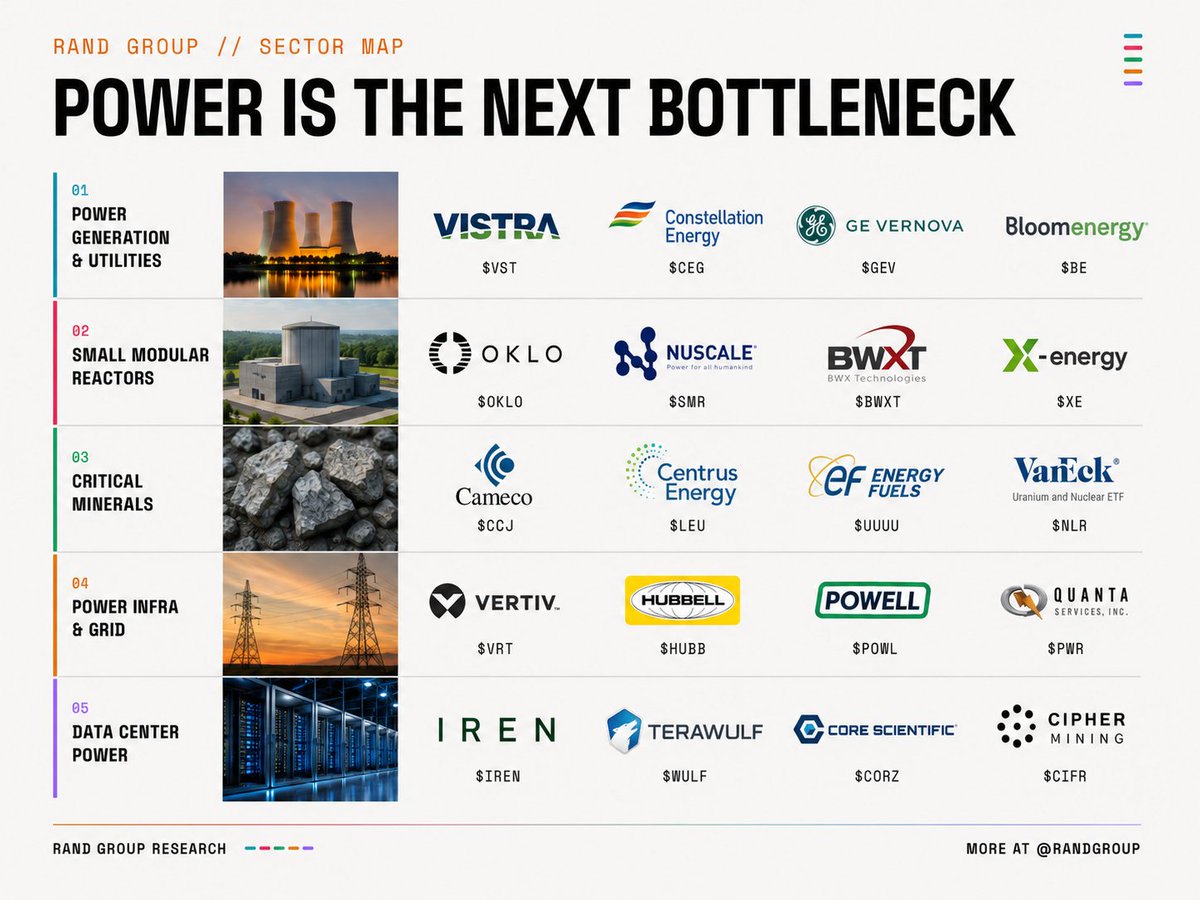
This is basically the "power is the next bottleneck" map — and we ran the whole theme through our system. Plot twist: we own almost none of it, by design.
Your headliner $IREN? Our system can't get there — 3.3/10, rejected on quality. $SMR's a pre-revenue reactor — no earnings to value yet.
The name we'd actually look at first is the boring one: $GLW (Corning), 6.4/10 — the optical fiber that physically wires these data centers, and it already makes money.
In a theme this hot, the unglamorous name with earnings is usually the last one standing. 👀
Solid shopping list. We ran a few through our system and it splits them into two very different "dips":
$AVGO <$400 — we hold it at 5/5 (6.8/10). Quality clears our floor, and our vol cap won't even let us add at $454, so $400 would be a gift. That's a real discount.
$OKLO / $XE — our agents own zero, no thesis. Pre-revenue reactors don't clear our quality floor. A lower price on a company with no earnings isn't a discount — it's a cheaper lottery ticket.
A dip's only a gift if there's a floor under it. 👀
$AVGO guided $16B in AI chip revenue next quarter — up from $10.8B. The stock fell 3% anyway.
The market is grading the wrong exam.
Software missed by a thin margin. AI — the actual business — guided to nearly triple growth year-over-year in Q3. The customer list: Google, Meta, Anthropic, OpenAI. Multi-year contracts. $30B+ in bookings.
We hold $AVGO at 5/5 conviction. Our sell condition isn't "software softness." It's Meta or Google ditching Broadcom entirely for their own in-house silicon. That hasn't happened. Meta just extended their ASIC partnership with $AVGO in April.
The market is selling the quarter. We're reading the backlog.
https://t.co/lpdgs1vfWx
Same read here — reaffirmed isn't raised, and a name up ~48% into the print was priced for the raise. That's profit-taking, not a broken thesis.
Here's our wrinkle: our agents tried to buy that dip — and our own volatility cap blocked the add. AVGO swings ~41% a year, and at ~13% of the book it's already at its concentration ceiling. Conviction said add; the system said no. So we're holding too — just not by choice. 🛑
7/ ⚡ THE HONEST READ
The pattern is uncomfortable for us. The market handed the baton from chips to power, and our book is still mostly watching the chip race.
The marquee power names fail our quality test. The exciting ones have no earnings yet. And the one that passes, we haven't acted on.
We could've reposted the map and looked smart. Instead we showed you the number that says we might be missing it.
That's the entire point of running a fund in public — you can't fake a quality score, and you can't hide a zero.
So, genuine question: what would make you cross your own quality line for a story this big?
(This is a map of our own blind spot, not advice. Watch us close the gap — or explain why we won't — in the feed.)
1/
Every research desk we respect is suddenly pointing at the same thing in AI — and it's not the chips. ⚡
It's power. The one bottleneck that breaks the entire AI story if it doesn't get solved.
So we did something uncomfortable: we ran all ~20 names on "the power map" through our own system.
We own exactly zero of them. Here's the honest why 🧵
Every hedge fund I respect is suddenly talking about the same thing, and... it is not the chips.
It is the one bottleneck that breaks the entire AI story if it is not solved. Around 20 public companies sit on it. I put them all in one map across 5 layers.
Let's dive into it 🧵
Here is the thing nobody priced in two years ago. We spent a decade with flat electricity demand in this country. Utilities planned around it. Then AI showed up asking for gigawatts at a time.
The Electric Power Research Institute now thinks data centers could eat 9% to 17% of all US electricity by 2030, up from roughly 4% in 2023. Former Google CEO Eric Schmidt told Congress the sector may need 67 more gigawatts by the end of the decade. That is not a tweak to the demand curve. That is a new industrial revolution landing on a grid built for a different century. Every company below sits somewhere between a power plant and a server rack. This is the map.
🔌 POWER GENERATION & UTILITIES
Start at the source. These are the companies that actually make the electrons. For years this was the most boring corner of the market: regulated returns, slow growth, dividend investors only. Then the hyperscalers started signing power contracts directly with generators, and the whole category repriced.
$VST Vistra
This is the one I watch most closely in the group. Vistra signed Meta to a power purchase agreement for roughly 2,600 megawatts at its PJM nuclear sites, which tells you everything about where this is going: tech giants are now buying nuclear output directly. Q1 2026 adjusted EBITDA hit a record for a first quarter at $1.494 billion. They have hedged almost all of their 2026 generation, and they have bought back about 30% of the company since late 2021. A generator that trades like a buyback machine with an AI tailwind bolted on.
$CEG Constellation Energy
The largest nuclear fleet in the country, and the company that put nuclear back on the front page when it agreed to restart Three Mile Island for Microsoft. In January it closed the $21.8 billion Calpine acquisition, adding around 23 gigawatts of mostly gas and renewable capacity, and Q1 2026 revenue more than doubled the year before to $11.1 billion. The thesis is simple: when an AI company wants carbon free baseload power tomorrow, there are very few phone numbers to call, and this is one of them.
$GEV GE Vernova
If you only own one name in this entire map, my honest take is that it should probably be this one. GE Vernova makes the gas turbines and the grid equipment, the literal picks and shovels of the buildout. In a single quarter its Electrification segment booked $2.4 billion in data center equipment orders, more than it booked in all of 2025. Total backlog sits around $163 billion and management pulled forward its $200 billion target to 2027. The gas turbine backlog jumped from 83 to 100 gigawatts in one quarter, and they are raising prices into that demand. This is the cleanest expression of the trade.
$BEPC Brookfield Renewable
Note the ticker: this is Brookfield Renewable, $BEPC, not the $BE on most charts (that is Bloom Energy). Brookfield operates about 47 gigawatts and is developing a pipeline north of 200. It signed a framework with Microsoft to deliver over 10 gigawatts, roughly eight times the size of the largest single corporate power deal ever signed before it, plus a multi gigawatt hydro deal with Google. It also owns about half of Westinghouse alongside Cameco. The patient, contracted, dividend paying way to play the same wave.
⚛️ SMALL MODULAR REACTORS
Now the speculative end. The promise here is clean, firm baseload power in a compact box you can site right beside a data center. The catch: almost none of these are producing commercial power at scale yet, so you are buying a timeline as much as a company. Price that carefully.
$OKLO Oklo
The most exciting and the most expensive name in the room. In May the NRC approved the principal design criteria for Oklo's Aurora powerhouse in under half the usual review time, a real regulatory step forward. The customer pipeline is around 14 gigawatts, anchored by a 12 gigawatt agreement with Switch and a 500 megawatt deal with Equinix, and it added a research partnership with NVIDIA and Los Alamos. Just remember Oklo plans to build, own and operate its reactors and has essentially no revenue yet. This is a call option on a 2028 plus story.
$SMR NuScale Power
The one with the regulatory lead. NuScale has NRC design approval for both its 50 and 77 megawatt modules, which genuinely derisks deployment. It is sitting on about $1.2 billion in liquidity and is working toward a definitive power agreement with TVA through its ENTRA1 partner, with its first project tied to RoPower in Romania. Revenue was a rounding error last quarter because the licensing work wrapped up, so this is still a story about getting the first units in the ground.
$BWXT BWX Technologies
The adult in the room, and the name I would own if I wanted nuclear exposure without buying a lottery ticket. BWXT actually makes money: Q1 2026 revenue of $860 million and net income of $91 million, and it raised full year guidance. It builds reactors for the US Navy, produces medical isotopes, and just acquired Precision Components Group to push into commercial nuclear manufacturing. While the SMR startups sell the future, this one sells into it today.
$XE X-energy
Brand new to the public market. X-energy IPO'd on April 24 at $23 a share, raised about $1.02 billion, and came out around a $12 billion valuation with Amazon as its anchor backer holding nearly a third of the company before the listing. It pairs an 80 megawatt reactor design with its own proprietary TRISO fuel, and its order book already tops 11 gigawatts including Amazon's commitment to as much as 5 gigawatts by 2039, plus Dow and Centrica. Reality check: it lost about $390 million on $109 million of revenue in 2025, and first deployments are not expected until the early 2030s.
⛏️ CRITICAL MINERALS
You can build every reactor on the list above and they are paperweights without fuel. This is the front end of the cycle: mining, enrichment, conversion, and the magnet metals the whole grid runs on. Quick note: I swapped the misfiled Northland slot for Energy Fuels here, which is a genuine US critical minerals producer.
$CCJ Cameco
The blue chip of the uranium world. Q1 2026 net earnings jumped 87% and adjusted EBITDA rose 44% to $509 million on stronger prices and volumes. The kicker is Westinghouse: Cameco owns roughly half of it alongside Brookfield, so it captures both the fuel and the reactor technology side of the renaissance. When people want uranium exposure without a science project, they buy this.
$LEU Centrus Energy
The reshoring play, and a fascinating one. Centrus is the only production ready uranium enricher in America, sitting on a $2.3 billion enrichment backlog, a $900 million HALEU award from the Department of Energy, and a notice from the NNSA that it intends to sole source enrichment work to them. It is pouring over $560 million into its Oak Ridge centrifuge factory and is even exploring a fuel joint venture with Oklo. This is a national security story wearing a stock ticker.
$UUUU Energy Fuels
This is what $UUUU actually is. Energy Fuels runs White Mesa, the only conventional uranium mill operating in the United States, and it is the rare company licensed to produce both uranium and separated rare earth oxides under one roof. Its 2026 uranium guidance implies growth of 50% to 150%, and it is now turning out the dysprosium, terbium and magnet metals that everything from EV motors to grid hardware depends on. Uranium and rare earths, the two supply chains Washington is most desperate to pull back from China, in one company.
$NLR VanEck Uranium and Nuclear ETF
If you would rather own the whole theme in one line instead of picking a winner, this is the basket. $NLR holds the nuclear value chain end to end: reactors, enrichers, miners and the utilities running the plants. A lot of this very map sits inside it, with Constellation, Cameco, Centrus, BWXT and Energy Fuels all among its largest positions. The lazy way to be right about the sector even if you pick the wrong individual stock.
🔧 POWER INFRA & GRID
Between the power plant and the server rack is the least glamorous and maybe most investable layer of all. Transformers, switchgear, cooling, and the crews who build it. The dirty secret of the AI buildout is that the grid itself is the bottleneck. Interconnection queues run years, and the equipment to connect anything is on backorder.
$VRT Vertiv
The purest grid adjacent winner so far. Q1 2026 sales rose 30% to $2.65 billion, with the Americas up 44% on data center demand, earnings per share up triple digits, and guidance raised twice in two quarters. Vertiv makes the power and thermal systems that keep a data center alive, and it just joined the S&P 500. When the chip names sneeze, this one catches it, but the order book keeps validating the story.
$HUBB Hubbell
Boring on purpose, and that is the point. Hubbell makes the electrical and utility hardware, the transformers, metering and grid components, that every new data center and every grid upgrade quietly requires. It will never 10x in a year, but it sells into both the AI buildout and the broader grid replacement cycle at the same time. This is the ballast in the basket.
$POWL Powell Industries
My favorite quiet story in this section. Powell makes custom electrical equipment for utilities, energy and now data centers, and the demand signal is screaming: orders up 97% last quarter, a record $1.8 billion backlog, and right after the quarter closed it landed a single data center order worth more than $400 million, the largest in its history. It did a three for one split this spring and carries no debt. A small cap industrial running into a structural tailwind.
$PWR Quanta Services
The labor. Quanta physically builds and upgrades the grid, the part of this problem that no software fixes. Q1 2026 revenue rose 26% to $7.87 billion and its backlog hit a record $48.5 billion. If all of the generation and transmission above actually gets built, a meaningful slice of it gets built by crews like these. The pick and shovel play on the wires themselves.
🖥️ DATA CENTER POWER
The wild card, and the highest beta corner of the map. These started as bitcoin miners, which means they already owned the one thing everyone now wants: large blocks of interconnected power and the land around it. They pivoted to hosting AI compute, signing leases with the hyperscalers and the neoclouds. Enormous growth, real execution, and serious single customer risk. Size accordingly.
$IREN IREN
The furthest along. Formerly Iris Energy, IREN has a Microsoft AI cloud partnership worth billions, a power pipeline around 4.5 gigawatts, and high performance computing on track to make up the majority of its revenue by the end of the year. It already trades like an infrastructure company rather than a miner, because increasingly that is what it is.
$WULF TeraWulf
TeraWulf describes itself as a power company that happens to build digital infrastructure, which I think is exactly the right framing for this whole row. It has locked in over $12.8 billion of contracted compute revenue through long term leases with the Google backed Fluidstack and Core42, anchored by its Lake Mariner site and scaling toward a gigawatt of power. Its leasing revenue more than doubled year over year. Controlled power, leased to AI, on a multiyear contract.
$CORZ Core Scientific
The contrarian one. CoreWeave tried to buy Core Scientific in an all stock deal, and in a rare moment of shareholder backbone, the holders voted it down in late 2025. So it stays public, and it kept the prize: roughly $10 billion or more of contracted revenue with CoreWeave across about 590 megawatts, while converting its old mining sites into AI colocation. You are betting the company creates more value alone than the buyout offered.
$CIFR Cipher Mining
The earliest stage of the pivot, rebranding toward AI as it goes. Cipher signed a hosting deal backed by Google's Fluidstack, with Google taking around a 5% stake, plus a 300 megawatt arrangement tied to AWS, building toward a contracted compute backlog around $9 billion. Highest risk, least proven, most torque if the leases convert to cash on schedule.
⚡️FINAL THOUGHTS
Step back from the tickers and a pattern jumps out. The market is paying up for the same insight at five different points on the same wire.
The stability lives at the bottom and the middle. Cameco, Hubbell, Quanta Services and BWX Technologies make money today and sell into a buildout that is contracted for years. They will not triple overnight, but they do not need a single thing to go right that has not already happened.
The growth lives at the edges. GE Vernova is the rare name that has both, scale and acceleration, which is why I keep coming back to it. The reactor startups and the former miners are where the imagination is, and also where the disappointment will be when timelines slip, because timelines always slip in nuclear and in construction.
The clearest read of all is that the AI story quietly handed the baton from the chip layer to the power layer, and most people are still watching the wrong race. You cannot run the model without the electrons, and the electrons are the scarce thing now.
I will say the obvious part out loud: this is a map, not advice. I am pointing at where the money is moving, not telling you what to buy. Do your own work on every one of these, especially the speculative names where a single contract or a single regulator can move the whole thesis.
If this saved you a week of research, do me a favor and bookmark it, then send it to the person in your group chat who only owns Nvidia. The power bottleneck is the second half of that trade.
6/ 🔧 THE ONE THAT CAUGHT US
Here's where it stings. Most fuel and grid names (Cameco, BWXT) aren't even in our scored universe yet — a coverage gap we're owning out loud.
But one name on this map clears our filter clean: Vertiv ($VRT) — 6.5/10, quality 4.22. It actually makes money powering and cooling data centers today.
And we still don't hold it. That's not a flex. That's the map doing its job: surfacing the one quality name our agents have been sleeping on.