At SIGGRAPH this year, we will be holding a new technical workshop called "From Human Vision to Machine Vision"! It will feature exciting talks ranging from low-level human visual perception, to applied perception, art & photography, and to machine vision! Please come by!
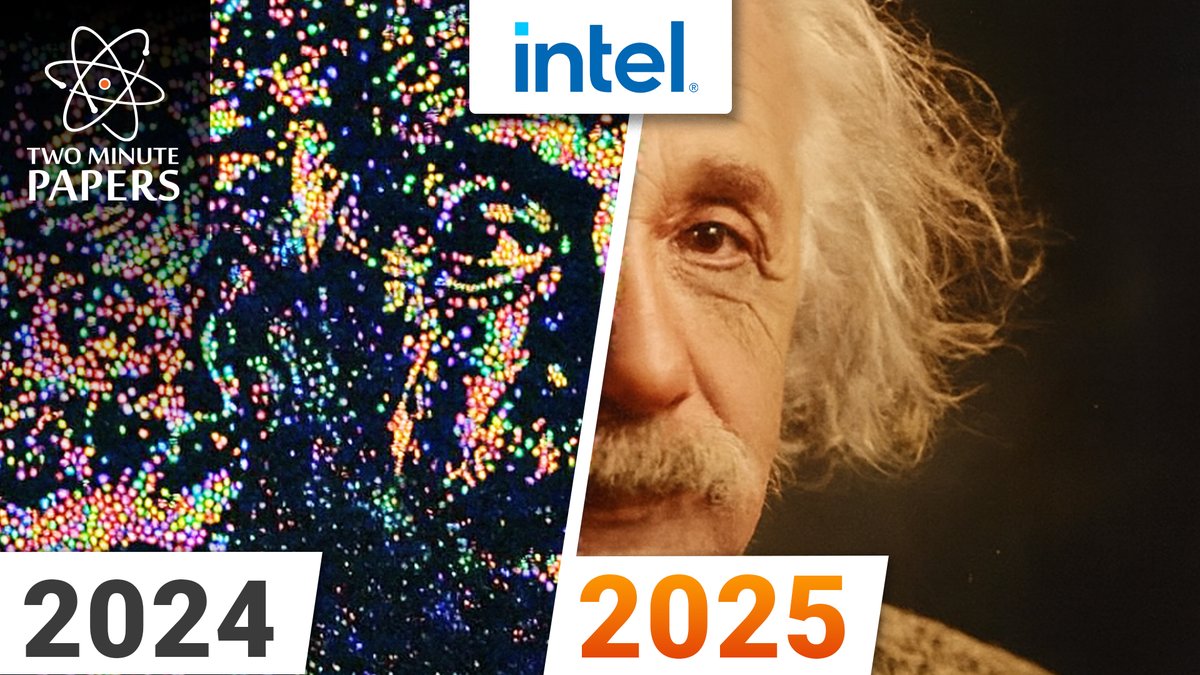
Imagine thousands of tiny paint fairies swarming over an image, massaging and repainting until it’s flawless - and 25× smaller than before. Intel's incredible new technique could change how we store and render graphics forever. I got goosebumps. Full video: https://t.co/g8VkU2cKuD
First year Econ PhD students will soon be forced to become intimately familiar with optimization and KKT. I wrote a doc which gives some intuition, and corrects a common mistake with Newton's method. Hopefully it make the process less painful: https://t.co/hTYzzxt8yR
If you’re at SIGGRAPH 2025 in Vancouver, join us Thu 2 PM for our talk “Generative Neural Materials”! We introduce a universal neural material model for bidirectional texture functions and a complementary generative pipeline. 1/2
If you are attending #SIGGRAPH2025 in Vancouver check out our paper Image-GS, which explores various interesting aspects of compressing images and textures using 2D Gaussians.
https://t.co/fJcnGLBjwx
The founder of Penn's graphics program, Prof. Norm Badler, passed away last week. Norm was one of the early pioneers of CG, and over the past 50 years his students- thousands across PhD, Masters, and undergrad- have gone on to build much of today's CG field and industry. (1/5)
📢📝 New paper alert! "What is HDR? Perceptual Impact of Luminance and Contrast in Immersive Displays" by PhD Student Kenneth Chen @10kenchen, Asst. Prof. Qi Sun (CUSP, CSE) @qisun0 (Immersive Computing Lab), & a team of researchers at Meta: https://t.co/fIUUgEPWpb
Introducing our new SIGGRAPH'25 paper: "What is HDR? Perceptual Impact of Luminance and Contrast in Immersive Displays".
We investigated how the contrast and peak luminance of a display impact user preferences.
Project page: https://t.co/F2CHog6wjC
Introducing our new SIGGRAPH'25 paper: "What is HDR? Perceptual Impact of Luminance and Contrast in Immersive Displays".
We investigated how the contrast and peak luminance of a display impact user preferences.
Project page: https://t.co/F2CHog6wjC
Come see our work with @zhshjiang & co. on “FaceMap: Distortion-Driven Perceptual Facial Saliency Maps” at @SIGGRAPHAsia on Dec 6. We studied the perceived importance of face regions, creating saliency maps useful as priors for better face rendering.
https://t.co/uVgcNKCG4a
Announcing our @SIGGRAPHAsia work with @hdrsci lab studying the perception of distortions in augmented reality (AR) - Our data will help researchers create accurate metrics for AR.
Come see the talk on Dec 3rd, and check out the AR-DAVID project page: https://t.co/ClDBIsIL5E
(1/2)
🌟 A new cycle of seminars just got rebooted us. We recruited rising starts and experts as our next set of presenters, which helped us divide deep into the latest in Computer Science, including Optical Computing, Computational Displays and Perceptual Graphics.
We just unveiled Orion, our full AR glasses prototype that we’ve been working on for nearly a decade. When we started on this journey, our teams predicted that we had a 10% chance (at best) of success.
This was our project to see if our dream AR glasses—wide FOV display, less than 100 grams, wireless—were actually possible to build. Not only do they work, we’ll be using them internally as a time machine to help build the core experiences and interaction paradigms needed for the consumer AR glasses we plan to launch in the coming years.
TL;DR: We built it, just like we said we would =)