🚨🚨 THE ILLEGITIMACY PLAYBOOK / THE DEMOCRACY FILES: A PRIMER 🚨
I will be using this thread to track all drops, so bookmark it.
I spent most of yesterday backing everything (now 312 gigabytes) up in various sources and getting the materials out to others. I also produced an AI video (below) to explain the whole thing to others are not on 𝕏 - feel free to distribute.
Here's the primer:
USAID, the foreign aid agency, had a democracy office. Inside the agency, it was called DRG.
Officially, DRG administered "democracy assistance." They'd go inside countries they thought were sliding into authoritarianism and help the opposition there. That assistance included election monitoring, judicary support, independent media, and civil society building.
You may have heard the term "color revolution." The model comes from Serbia in 2000, where trained student activists brought down Milosevic with the help of Western governments, after sustained protests. With the help of USAID's democracy office, this model was implemented in many other countries to topple governments: Georgia's "Rose Revolution" in 2003, Ukraine's "Orange Revolution" in 2004, and many more.
Then last year, DOGE shut down USAID. But the USAID democracy office didn't stop. They formed a group called the Democracy Renewal Group, the same initials as their office (USAID Democracy, Human Rights, Governance). Their goal: apply their own playbook to the United States itself.
This goal became a plan, called Renew American Democracy (RAD). It invoked the "4 B's" framework. Block - use lawfare and protests to make life harder for the Trump administration. Bridge & Belong - control dialogue and win people over. The final and most important B is Build. Build means redesigning the American government itself, and the crisis is the opening.
In their own words:
"We can take that breakdown moment and leverage it for a big structural reform, you know, refounding moment." - Danielle Reiff, DRG lead.
Calls show DRG working alongside DSA on ideas of creating a different government, one that does away with the Constitution itself.
DRG does not run the Block operations. They hand it to UDA, the United Democracy Alliance. One organizer calls it a "huge galaxy": lawsuits, street protests, non-cooperation. They list No Kings, Indivisible, MoveOn, 50501, and many other mega-activist NGOs among their members.
Another organizer calls UDA Erica Chenoweth's project. Chenoweth is the Harvard professor behind the three-and-half-percent rule of regime change: get that share of a country's populace onto the streets, and historically, the movement wins.
The UDA is very "hush-hush." They have no website, no roster, no filings.
Then come the red lines: things the Trump administration could do, such as calling the Insurrection Act on protesters, that would mean that the federal government, in their words, "crosses the threshold into illegitimacy." Nobody voted on those lines. There was no public debate. These red lines were developed within secretive working groups, and in a paper addressed to governors and staff.
In the words of Reiff/DRG:
"So that if there is a red line crossed in terms of a Constitutional crisis, like everyone's already pre-organized. And so Mike Smith actually said, he goes, oh, you guys have the day after tomorrow plan."
Cross a line, and the paper's options include states refusing to lend their resources to federal officials, and governors convening what it calls a "Third Continential Congress."
Running the UDA's Insurrection Act working group: Rear Admiral Mike Smith (RET) of National Security Leaders of America (NSL4A). NSL4A is also credited with operationalizing UDA, the blocking operations. NSL4A consists of about 1,600 ex-officers, spies, diplomats. They're turning red lines into indicators and running a situation room to monitor them throughout the midterms and beyond.
The NSL4A's lawyers told them to stop recording meetings in case of subpoenas. But the rest of the network continued to record. DRG works in conjunction with Renew to Thrive (R2T), which ended up accidentally publishing 400+ calls and thousands of documents. These calls and documents were never meant for our eyes, but it's them, on tape.
Thousands of NGOs and billions of dollars are involved in this endeavor. Most of them believe they're saving democracy. The problem is that people who spent their careers deciding when other countries' governments had lost their legitimacy wrote that test for ours, in private, and planned for what comes after.
Who decides when your government is legitimate?
From the USAID files: The purpose of fact-checkers is to "debunk information in a way that aligns with the objectives of government partners."
Wow. Just wow.
We were all living inside an epistemic bubble.
This guy HAS to be a former drill sergeant. And if he’s not, he missed his damn calling! I laughed so fucking hard watching this. Those poor damn cows probably think they just got drafted into the Army!
In 2016, inside a darkened analysis room at the Pentagon in Washington, battle hardened special operations veterans stared at a single infrared drone video that had been enhanced with the latest technology. They broke down in silent tears.
Fourteen years earlier, on a snowy mountain 10,000 feet above sea level, an Air Force airman had been declared killed instantly after charging an enemy position. His unit had no choice but to withdraw, leaving his body behind.
For 14 years, his wife and two young daughters had been told that he died the moment he was shot, without suffering.
But the footage captured by a drone flying overhead revealed an unbelievable truth about what happened after everyone believed he was dead.
His name was John A. Chapman.
Before dawn on March 4, 2002, Chapman, a 36 year old U.S. Air Force combat controller, landed on the summit of Takur Ghar in Afghanistan to rescue a fellow Navy SEAL who had fallen from a helicopter.
The night before his deployment, he had carefully glued his little daughter’s broken musical snow globe back together and quietly tucked spare parts into his gear bag. He was a loving father who cherished his little girls.
Through waist deep snow, Chapman charged an enemy bunker alone to protect his teammates, successfully clearing it before being struck by gunfire as he approached a second enemy position.
After his teammates withdrew, there should have been no one left alive on that freezing mountain summit.
But in the drone footage, Chapman could be seen regaining consciousness, completely alone in the darkness and snow.
Unable to call for help and surrounded on three sides by al Qaeda fighters, he continued fighting alone for more than an hour in the bitter cold, even repelling an enemy fighter who approached at close range in hand to hand combat.
Then, just before dawn, the roar of helicopter rotors echoed across the mountain as an American rescue helicopter carrying nearly 20 young American troops flew straight toward an enemy ambush position armed with rocket propelled grenades.
If Chapman had remained hidden behind his rock, he might still have survived.
But despite suffering nine wounds across his body and devastating injuries to his chest, Chapman deliberately stepped out from behind his cover and stood defiantly in the open.
He drew the machine gun fire that had been aimed at the rescue helicopter onto his own body, continuing to fire back at the enemy.
At the cost of his own life, he gave countless brothers in arms the chance to return home alive to their families.
Sixteen years after his death, on August 22, 2018, his wife Valerie and their two daughters, Madison and Brianna, who had been only toddlers when they lost their father, stood at the White House to receive his Medal of Honor.
Chapman became the first Air Force service member to receive the Medal of Honor since the Vietnam War. It was also the first Medal of Honor in American history awarded for an act of heroism whose entire course had been captured on video.
Two days later, his two daughters, now grown into young women, gently ran their fingers over their father’s name engraved at the Air Force Memorial overlooking Arlington and laid a wreath in his honor.
Once, he had repaired a little broken snow globe before leaving for a snowy mountain on the other side of the world.
And today, the courage of a father who protected his brothers in the darkness, when he believed no one was watching, has been forever etched into his nation’s history.
His legacy lives on with pride in the hearts of the daughters he loved so dearly.
I had to stop going over to MacDill during that entire fiasco. It pissed me off that our entire fucking military chain of command ORDERED a humiliation ritual.
That’s what it was. Those same bastards trained every last military member what MOPP gear was and how to use it. Big ass rubber suits to protect you from bio/chem attack and then turned around and told all of those same ppl a paper mask could do the same thing. Every single airman knew it was a lie and their commanding officer was perpetuating a lie. It undermined the entire profession in one single act. No military member could trust their commanding officer after that nor should they. This did more to destroy the military than anyone could imagine. That distrust is still there today. Improving but still there and they depend on those same officers for leadership when their life is on the line.
This left an indelible mark on the profession of arms.
In the fall of 1862, Union soldiers mounted the heads of Jack Hinson’s two sons on the gateposts of his Tennessee plantation.
Hinson had stayed out of the war. He was 57, a prosperous planter near Dover. But his sons George, 22, and John, 17, went deer hunting near home and ran into a Federal patrol. The soldiers took them for bushwhackers and executed them.
Hinson buried his boys. Then he had a gunsmith build him a custom .50 caliber rifle.
His first target was the lieutenant who ordered the killings. Hinson shot him from ambush as he rode at the head of his column. Later he killed the soldier who put the heads on the posts.
For the rest of the war, “Old Jack” hunted Union troops from the hills along the Tennessee and Cumberland rivers, picking off men on land and on the decks of passing boats.
He cut 36 circles into his rifle barrel, one for each officer. His total is believed to be over 100.
Amen! And we treat our Veterans like shit! Why do I have to go through hell proving everything again and agin regarding my military career, when someone can come across the border and receive more support than what I have earned?
"The willingness with which our young people are likely to serve in any war shall be directly proportional to how they perceive the Veterans of earlier wars were treated."
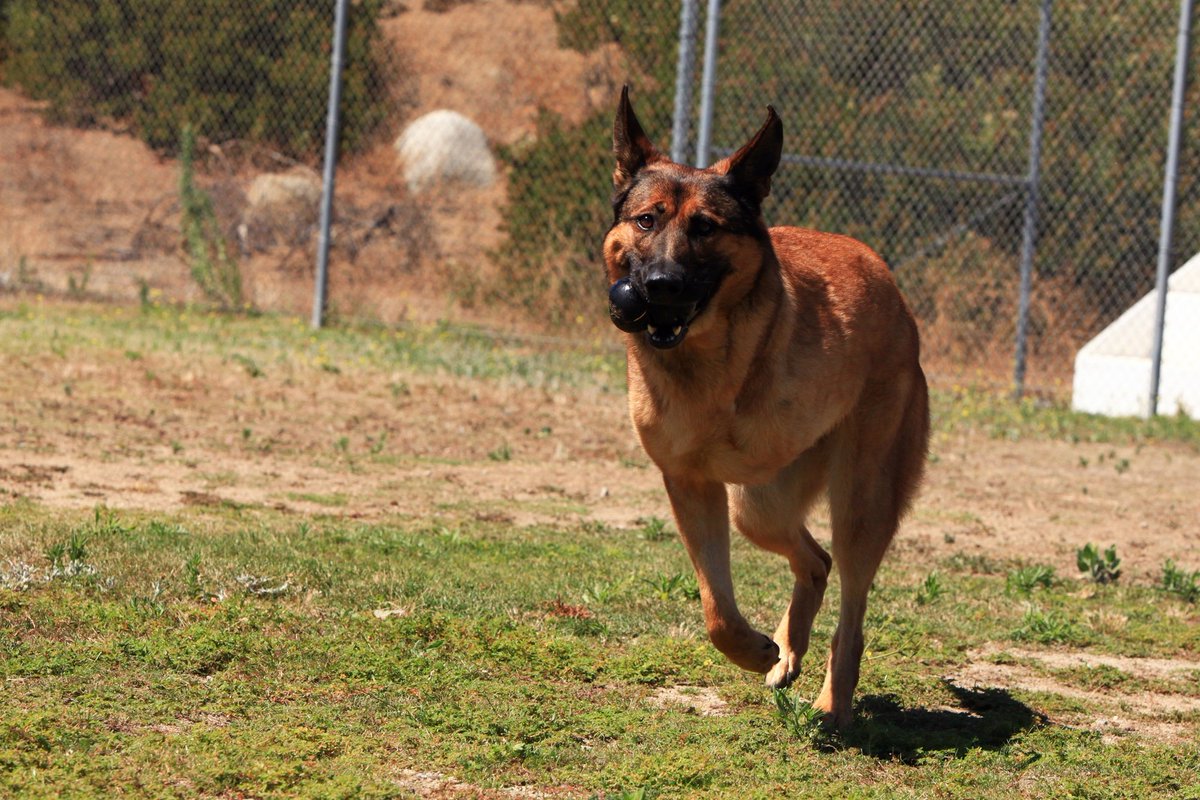
"This was filmed last Wednesday afternoon at Riverside Veterinary Clinic in Indianapolis, Indiana. The officer is Sergeant Paul Greer. He's 41 years old. Fourteen-year veteran of the Indianapolis Metropolitan Police Department. The dog is Bruno. A ten-year-old German Shepherd who served eight years as Paul's K9 partner before a joint condition ended his working career two years ago. When Bruno retired from active duty, Paul adopted him immediately. Brought him home. Bruno spent his retirement on Paul's couch, on Paul's bed, in the passenger seat of Paul's personal truck. The transition from working partner to household companion was seamless. Bruno had always been Paul's dog. The badge and the vest were just part of the job. Over the past several months, Bruno's condition had declined steadily. The joint condition spread. He had difficulty getting up. Stopped eating regularly. Paul had been managing Bruno's comfort with guidance from Dr. Angela Reese at Riverside for months. Last Tuesday evening, Bruno stopped getting up entirely. Paul called Dr. Reese that night. Wednesday afternoon, Paul drove Bruno to Riverside. He carried Bruno in from the truck himself. Wouldn't let the techs take him. Paul's partner, Officer Dana Choi, came with him. She filmed quietly on her phone from the corner of the room. She told us afterward that she asked Paul's permission before she started recording. He nodded. Paul sat on the exam table with Bruno cradled across his lap and chest. Bruno's head rested against Paul's shoulder. His eyes were half-open. His breathing was slow and easy. Paul bowed his head and pressed his face into Bruno's fur. Bruno lay still for a long moment. Then slowly — carefully — he raised both front paws. One at a time. And wrapped them around Paul's shoulders. And held on. Paul made a sound that Dana said she will never forget. Dr. Reese, who was standing nearby preparing, went completely still. Her assistant took a step back. Nobody moved. Dana told us: 'Bruno could barely lift his head that morning. But he lifted his paws and he held Paul. In that moment, with everything he had left, he held him. I think he was saying thank you. I think he was saying goodb"
🚨 BOOM: Medal of Honor recipient Dakota Meyer is RIPPING THE MOLD OUT OF MILITARY BARRACKS.
Pete Hegseth gave bases 24 hours to fix problems like no hot water, mold and broken doors, or else move the troops out.
Meyer didn't wait around. He relocated at least a dozen service members and shut down a building.
HIS RULE: "IF THE ROOM CANNOT BE FIXED, MOVE THE SERVICE MEMBER."
For years our warriors lived in conditions most landlords would get sued over.
Not anymore. Troops come first again, and that's what leadership looks like.
In 1979, a quiet former naval officer died in Japan without ever telling his family what he did on March 2, 1942.
At his small funeral, his relatives knew only that he had served on destroyers in World War Two and disliked talking about the war.
None of them knew that 422 families across the ocean existed only because of a single order he gave at sea.
His name was Shunsaku Kudo.
Thirty-seven years earlier, Kudo commanded the Imperial Japanese Navy destroyer Ikazuchi in the Java Sea.
The day before, a fierce battle had sent the British warship HMS Encounter to the bottom, leaving hundreds of Allied sailors adrift in thick black fuel oil.
Blinded by toxic sludge and burning with thirst under a blazing sun, exhausted men clung to wreckage and waited to die.
When a gray Japanese destroyer cut through the haze toward them, men in the oil closed their eyes and braced for machine-gun fire.
Mines drifted in those waters, and Allied submarines were hunting nearby.
Stopping dead in the water meant gambling the lives of Kudo's entire crew for men who had been firing at his fleet the day before.
Kudo stopped anyway.
He cut his engines, raised a rescue flag, and ordered ropes and cargo nets thrown over the side.
Many of the young British sailors were too weak and slick with black oil to hold the lines.
So Kudo's sailors climbed down into the sea themselves, tied ropes around the chests of their enemies, and hauled them aboard one by one.
For hours they refused to quit until 422 half-dead strangers crowded a small deck built for roughly half that number.
Japanese seamen knelt beside shivering prisoners, gently wiped burning oil from their eyes, gave them dry uniforms, and shared hot rations and fresh water.
Kudo then stepped onto the deck, saluted the captured officers as fellow sailors, and addressed them in English, praising their courage and welcoming them as honored guests.
The next day, he delivered every man safely to a hospital ship and sailed back into the war.
Here's where it gets strange.
Two years after Kudo was reassigned, Ikazuchi was sunk in combat with all hands lost.
When peace came, Kudo went home, mourned his lost crew in silence, and never once mentioned the rescue at the dinner table.
Not to his wife, not to his family, not to anyone.
Meanwhile, a rescued British officer named Samuel Falle became a diplomat, raised a family that almost never existed, and spent decades searching Japan for his savior.
By the time Falle finally learned his rescuer's name, it was too late.
Kudo was already gone.
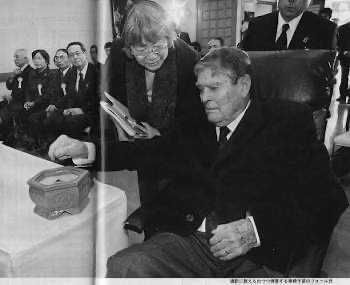
Still, in 2008, an elderly Sir Samuel Falle flew to Japan, sixty-six years after that afternoon in the Java Sea.
Standing before Kudo's gravestone, the old survivor bowed his head to deliver the thank-you Kudo never lived to hear, for 422 men and every child and grandchild born because one enemy chose mercy.
Real honor never asks to be remembered, which is why the lives it saves never let it die.
At 5:40 in the morning, the skinny brown stray was sitting by pump 7 again. For two years a trucker named Wendell fueled at that pump twice a week. The truck stop sits off the interstate near Cookeville, Tennessee. Every time, he split his sausage biscuit with the stray. The night cashier, Tammy, started calling the dog Pump. Wendell turned 67 in September and retired. Nobody told the dog. The lot camera shows Pump trotting in from the tree line at 5:40 every morning after that and sitting down by the same pump. On the ninth morning Tammy posted the clip online and asked if anybody knew a trucker named Wendell who drove a red truck with a dented front bumper. Drivers passed it around for two days. Somebody's cousin knew him. Wendell was home in southern Illinois, about 400 miles away. He got in his pickup that afternoon. The camera caught him at 5:38 the next morning. He was down on one knee by pump 7 with a sausage biscuit in his hand, and Pump came in from the trees at a dead run. By 6 the two of them were headed north on the interstate, and the dog was sitting up front.
On March 23, 2012, in Helmand Province, Afghanistan, a U.S. Marine Corps dog named Lucca found a hidden bomb and kept searching for more. The next one went off underneath her.
Her handler, Cpl. Juan Rodriguez, saw it happen.
"I saw a cloud of dust, and there was an explosion."
There could have been more bombs in that ground. He ran to her anyway.
"I ran in, put a tourniquet on to stop the bleeding."
"I picked her up and we ran to a nearby tree line to get some cover."
Lucca lost her left front leg. She had burns on her chest, neck and head.
By then she had served about six years and more than 400 missions: two tours in Iraq, one in Afghanistan. She was a specialized search dog, trained to work off leash, out in front of the patrol, alone, exactly where the danger was. The British animal charity that later decorated her said that on the patrols she led, there were no human casualties.
Rodriguez stayed with her through surgery and recovery.
"I was always with her, never left her side."
About ten days later, she was walking again. On three legs.
That summer she retired from the Marine Corps and went home to live with her first handler, Chris Willingham, who had partnered with her since 2006 and taken her through Iraq twice.
"She is the only reason I made it home to my family," Willingham said.
In 2016, in London, Lucca received the PDSA Dickin Medal, often called the animal Victoria Cross. She was the first U.S. Marine Corps dog ever to receive it.
She died in January 2018, almost 14 years old. Her ashes were later buried with military honors at a war dog memorial in Michigan.
"She's a legend of a dog to me," Rodriguez said.
Tomorrow is Veterans Day.
She walked in front so the troops behind her would not have to.
She came home on three legs.
A lot of Marines and soldiers came home on two because of her.
In 2017, six inmates in Georgia were presented with the perfect opportunity to escape when their guard lost consciousness, leaving his gun within reach and the van ready for their getaway.
Far from taking advantage of the situation to escape, the inmates removed the officer’s bulletproof vest, called 911, and stayed by his side to protect him until help arrived.
In recognition of this heroic act of humanity, the local sheriff recommended that their respective sentences be reduced by about a quarter.
Cpl Ryan L. Ice was the kind of guy who made an impression on everyone he met. He served five years in the Marine Corps, spending time deployed in Okinawa, Japan.
Ryan was famous for his great sense of humor. He always had a joke ready, bringing warmth and laughter to the Marines who served beside him. He was loved by everyone who crossed his path-and mostly by his wife, Joy.
Just ten days after Ryan and Joy got married, Ryan was diagnosed with stage 4 colon cancer. What came next showed the strength Ryan carried inside him. He always said he wouldn't have survived as long as he did without Joy by his side. Even in the hardest moments, his main focus was making sure his family was taken care of.
On November 3, 2026, Ryan's long battle came to an end. Ryan leaves behind a legacy of pure strength, deep devotion, and a spirit that will never be forgotten.
Marshawn is perfect.
"Is there a man here with you?"
Sons need fathers. We men speak to each other, and learn, differently. Not bad or good, just is.
More Marshawn. Well done.
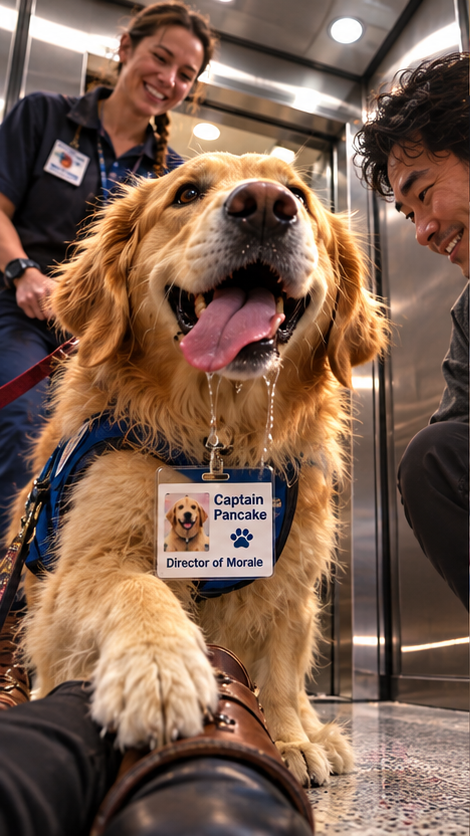
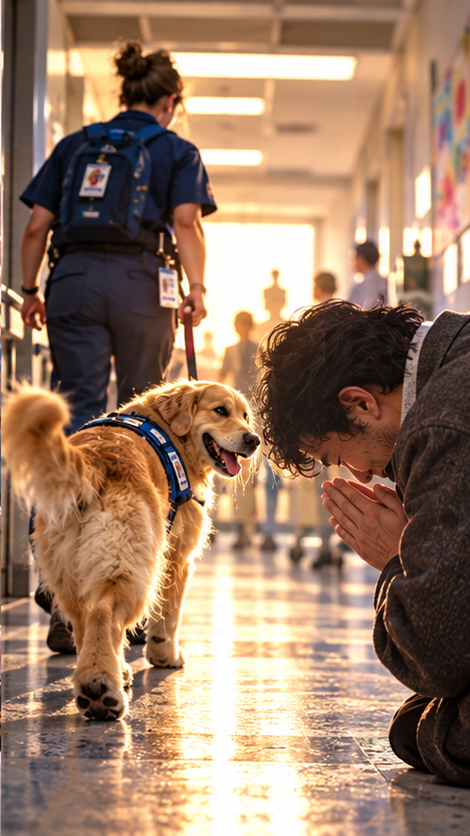
In a children's hospital in Boston, I shared an elevator with an officer wearing an official photo badge on his chest.
His badge read Captain Pancake. Director of Morale.
Captain Pancake was a ninety pound Golden Retriever who was currently trying to eat his own leash.
In my land, elite guards do not drool on the sandals of strangers.
Captain Pancake drooled on both of mine and then sat directly on my left foot so I could not escape.
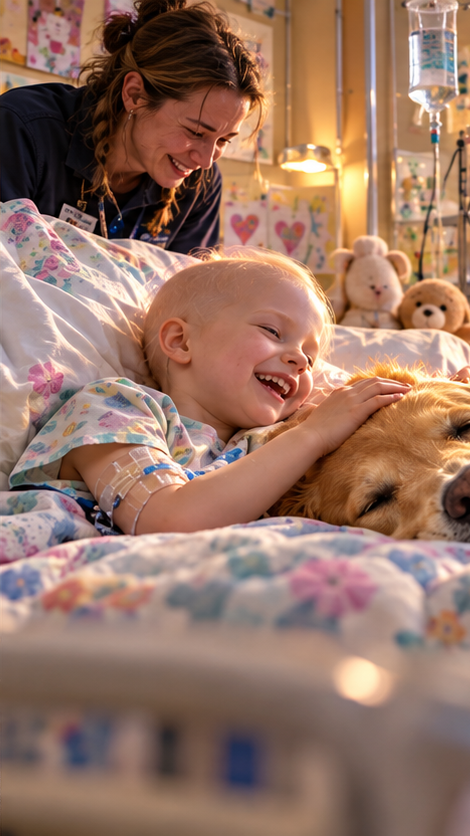
On the fourth floor, his handler led him into the room of a six year old girl with a bald head and clear tubes taped to her small arm.
Her mother stood by the window with dark circles under her eyes.
"She hasn't spoken or smiled in five days," the mother whispered. "She won't let any of the nurses touch her."
The instant Captain Pancake stepped across the threshold, the clumsy dog vanished.
He walked across the cold floor without making a sound.
He did not bark. He laid his heavy golden chin gently on the edge of the mattress, two inches from the little girl's fingers, and looked up at her with warm brown eyes.
Slowly, the girl reached out and buried her hand in his long furry ear.
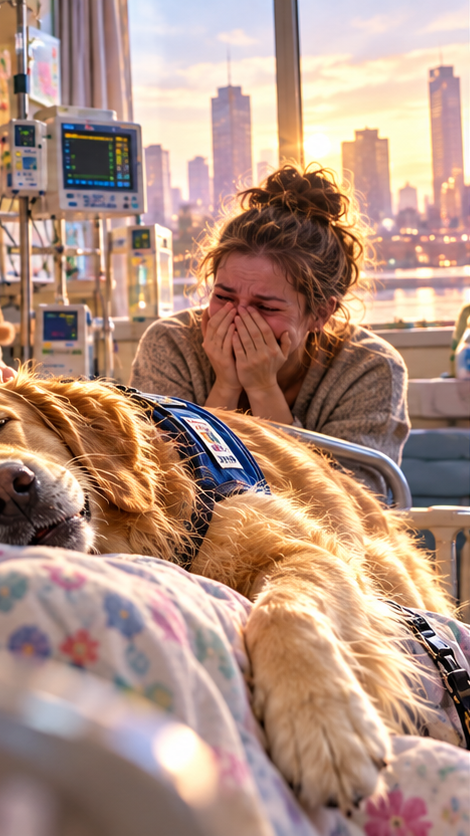
Captain Pancake closed his eyes, let out a long breath, and immediately produced a loud, ridiculous snore that sounded like an old farm tractor starting in winter.
The little girl burst out laughing.
Her mother dropped into the bedside chair and wept into her hands.
For forty minutes, ninety pounds of golden fur did what ten doctors and a million dollars of machines could not do.
When Captain Pancake left the room, I bowed deeply in the corridor. He tried to eat my sleeve. I let him.