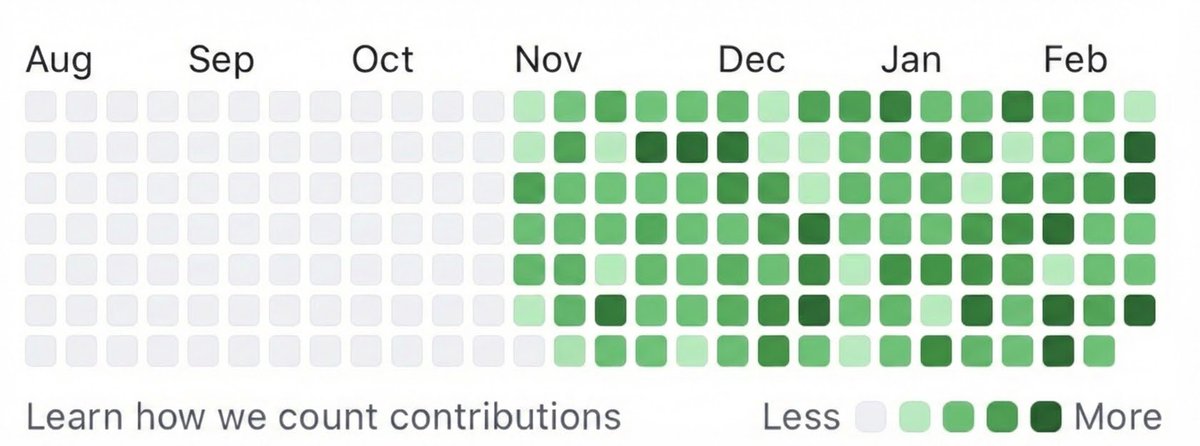
Last week, my role as a software engineering manager at Optum was eliminated.
Instead of sending out resumes, I'm going all-in on something I've been building.
Here's what I'm doing and why 🧵
A deep dive into modern data security risks would be a fun discussion.
It means different things to different people and the risks vary on such a wide spectrum by company. How often are companies misinterpreting risk? What’s at risk with data retention that’s not already at risk through other vendors?
Information in general is increasingly more accessible and available, which feels like will only continue. The risk of not adopting AI could be outweighing information security risk.
Introducing Claude Fable 5: a Mythos-class model that we’ve made safe for general use.
Its capabilities exceed those of any model we’ve ever made generally available.
A key to SWE leadership is to build solutions to problems that your business is exclusively positioned to solve for.
When I was at Optum, I had VPs who were begging their engineers to build this exact system for them. They actively sunk millions into trying to do so. They wanted the flashy delivery on their resume.
Do you know how many more executives, startups, etc. decided the same thing? Hundreds of millions spent on something that the market leader would inevitable solve for.
While the value proposition is impressive, it’s something that everyone is trying to build. By time you build something half decent, someone more capable will build something more superior. Now here we are.
Decisions like this are what separate the talented leaders from the snake oil salesmen. For the vast majority of engineering teams, it’s not time to build the tech that everyone needs built. Build solutions to problems that your business is best positioned to solve. Anything else is a waste of time and resource.
Introducing Claude Managed Agents: everything you need to build and deploy agents at scale.
It pairs an agent harness tuned for performance with production infrastructure, so you can go from prototype to launch in days.
Now in public beta on the Claude Platform.
While 90% of the population are using LLMs to do things that “any can do, but don’t want to” the top 10% are using LLMs to replicate skills and knowledge that most people don’t even understand.
The bell curve of expertise will never be as narrow as it is today and will look monstrous by the end of the year.
Three days ago I left autoresearch tuning nanochat for ~2 days on depth=12 model. It found ~20 changes that improved the validation loss. I tested these changes yesterday and all of them were additive and transferred to larger (depth=24) models. Stacking up all of these changes, today I measured that the leaderboard's "Time to GPT-2" drops from 2.02 hours to 1.80 hours (~11% improvement), this will be the new leaderboard entry. So yes, these are real improvements and they make an actual difference. I am mildly surprised that my very first naive attempt already worked this well on top of what I thought was already a fairly manually well-tuned project.
This is a first for me because I am very used to doing the iterative optimization of neural network training manually. You come up with ideas, you implement them, you check if they work (better validation loss), you come up with new ideas based on that, you read some papers for inspiration, etc etc. This is the bread and butter of what I do daily for 2 decades. Seeing the agent do this entire workflow end-to-end and all by itself as it worked through approx. 700 changes autonomously is wild. It really looked at the sequence of results of experiments and used that to plan the next ones. It's not novel, ground-breaking "research" (yet), but all the adjustments are "real", I didn't find them manually previously, and they stack up and actually improved nanochat. Among the bigger things e.g.:
- It noticed an oversight that my parameterless QKnorm didn't have a scaler multiplier attached, so my attention was too diffuse. The agent found multipliers to sharpen it, pointing to future work.
- It found that the Value Embeddings really like regularization and I wasn't applying any (oops).
- It found that my banded attention was too conservative (i forgot to tune it).
- It found that AdamW betas were all messed up.
- It tuned the weight decay schedule.
- It tuned the network initialization.
This is on top of all the tuning I've already done over a good amount of time. The exact commit is here, from this "round 1" of autoresearch. I am going to kick off "round 2", and in parallel I am looking at how multiple agents can collaborate to unlock parallelism.
https://t.co/WAz8aIztKT
All LLM frontier labs will do this. It's the final boss battle. It's a lot more complex at scale of course - you don't just have a single train. py file to tune. But doing it is "just engineering" and it's going to work. You spin up a swarm of agents, you have them collaborate to tune smaller models, you promote the most promising ideas to increasingly larger scales, and humans (optionally) contribute on the edges.
And more generally, *any* metric you care about that is reasonably efficient to evaluate (or that has more efficient proxy metrics such as training a smaller network) can be autoresearched by an agent swarm. It's worth thinking about whether your problem falls into this bucket too.
Three days ago I left autoresearch tuning nanochat for ~2 days on depth=12 model. It found ~20 changes that improved the validation loss. I tested these changes yesterday and all of them were additive and transferred to larger (depth=24) models. Stacking up all of these changes, today I measured that the leaderboard's "Time to GPT-2" drops from 2.02 hours to 1.80 hours (~11% improvement), this will be the new leaderboard entry. So yes, these are real improvements and they make an actual difference. I am mildly surprised that my very first naive attempt already worked this well on top of what I thought was already a fairly manually well-tuned project.
This is a first for me because I am very used to doing the iterative optimization of neural network training manually. You come up with ideas, you implement them, you check if they work (better validation loss), you come up with new ideas based on that, you read some papers for inspiration, etc etc. This is the bread and butter of what I do daily for 2 decades. Seeing the agent do this entire workflow end-to-end and all by itself as it worked through approx. 700 changes autonomously is wild. It really looked at the sequence of results of experiments and used that to plan the next ones. It's not novel, ground-breaking "research" (yet), but all the adjustments are "real", I didn't find them manually previously, and they stack up and actually improved nanochat. Among the bigger things e.g.:
- It noticed an oversight that my parameterless QKnorm didn't have a scaler multiplier attached, so my attention was too diffuse. The agent found multipliers to sharpen it, pointing to future work.
- It found that the Value Embeddings really like regularization and I wasn't applying any (oops).
- It found that my banded attention was too conservative (i forgot to tune it).
- It found that AdamW betas were all messed up.
- It tuned the weight decay schedule.
- It tuned the network initialization.
This is on top of all the tuning I've already done over a good amount of time. The exact commit is here, from this "round 1" of autoresearch. I am going to kick off "round 2", and in parallel I am looking at how multiple agents can collaborate to unlock parallelism.
https://t.co/WAz8aIztKT
All LLM frontier labs will do this. It's the final boss battle. It's a lot more complex at scale of course - you don't just have a single train. py file to tune. But doing it is "just engineering" and it's going to work. You spin up a swarm of agents, you have them collaborate to tune smaller models, you promote the most promising ideas to increasingly larger scales, and humans (optionally) contribute on the edges.
And more generally, *any* metric you care about that is reasonably efficient to evaluate (or that has more efficient proxy metrics such as training a smaller network) can be autoresearched by an agent swarm. It's worth thinking about whether your problem falls into this bucket too.
The biggest gap in AI right now isn't the technology.
It's that everyone is selling you the How instead of solving for the Why.
Most businesses don't need another AI tool. They need someone who can look at their actual workflows and say "here's specifically the outcome we're solving for" — then build the simplest thing that gets them there.
That's the work.
Most businesses don't need a custom AI model.
They need someone who asks "what outcome do you actually want?" before writing a single line of code.
I've watched an automation feature sit in limbo for 18 months because everyone debated the How (aka what AI solution to use. Everyone wanted the credit for coming up with the AI solution also 🤦🏽)
The moment we shifted the conversation to the Why instead, it shipped in a week.
AI gets over-engineered fast.
The right architect keeps it simple, ships it quick, and iterates from there.
If you're a business owner wondering where to start with AI — DM me.
If you know someone in that position — a RT means more than you know.
Let's build. 🌿
https://t.co/axM10zspV2
Last week, my role as a software engineering manager at Optum was eliminated.
Instead of sending out resumes, I'm going all-in on something I've been building.
Here's what I'm doing and why 🧵
That's why I built Pando.
We help small and mid-sized businesses figure out where AI fits — and then we build it with them.
No hype. No buzzwords. Enterprise-grade engineering for businesses that actually need it.
This is quite literally the blueprint to building any good web product ever.
The moment a product leader starts influencing building for edge cases, your product starts its dying phase.
If you have teams dedicated to just building for edge cases, be very wary.
This is simply a human limitation, not an AI wall. It’s the same reason why many businesses grind to a halt. Maintaining *alignment* on workers is hard. I think it’s somewhat human to not be good at it.
Before AI, companies have hired layers and layers of orchestrators that they think can solve the problem, but often fail. Management and leadership is nothing more than orchestration and it’s probably the biggest economic limiter in business.
Some will try to solve this with thick layers of orchestration, some will try to solve it with somewhat flat layers of orchestration. Think of Meta’s Year of Efficiency in 2023 (flattening the hierarchy) and how it may play out in Agent orchestration.
We’ve been iterating on organizing workers for thousands of years really. AI will just iterate faster and I suspect the “wall” will not look too big in retrospect.
Salesforce firing 10% of staff, then having two truly standout quarters, then going on a hiring spree, then freezing hiring (easy to guess how Q4 2023 went!) is such a good example of QDC.
Quarterly-result Driven Company.
It's the curse of many publicly traded companies.
The AI/healthcare discourse has reached new levels of insane this week
A close friend, a MD at a prestigious medical center, recently shared the following memo with me. He asked me to share this anonymously.
"What we don't talk about when we talk about AI/medicine"
healthcare is having its top deck of the titanic moment
what happens in the next year will define the next century of american healthcare, and basically everyone is ignoring it.
here's the real story: