What is a Conference on #Precession and #AncientKnowledge without considering whether the Book of Revelation preserves knowledge of the Precession of the Equinoxes?
With the Great White Thone representing the North Celestial Pole and Polaris, the first and last Pole star in the precession cycle...
Something to consider and explore👇
____________
It’s the year 2026 CE and there’s very little time left on the celestial clock, so you will need to commit the story you’re about to hear to memory. Put it somewhere safe in your subconscious mind for recall at any time and for the collective consciousness to access. Mark the story with a cross, like X marks the spot.
“BEEP! BEEP! BEEP!...
That’s the alarm on the celestial clock, so I’ll hit snooze and cut to the chase before it goes off again.
In 1963 the author Chan Thomas warned “a cataclysm is due sometime between two and seven hundred years from now”. This is a message that our ancestors have been trying to tell us for at least 11,600 years since the time of Gobeki Tepe. So, it is here that this story and the rough sketch of the pioneering pen begins. But before commencing, there must be an acknowledgement that telling this story has only been possible by standing on the shoulders of all those that have come before.
Put simply, the story has always been about its main character the Sun and its cyclical death, resurrection and re-birth. A solar mythology that has been passed down through the Ages, orally, in pictures and encoded within sacred texts.
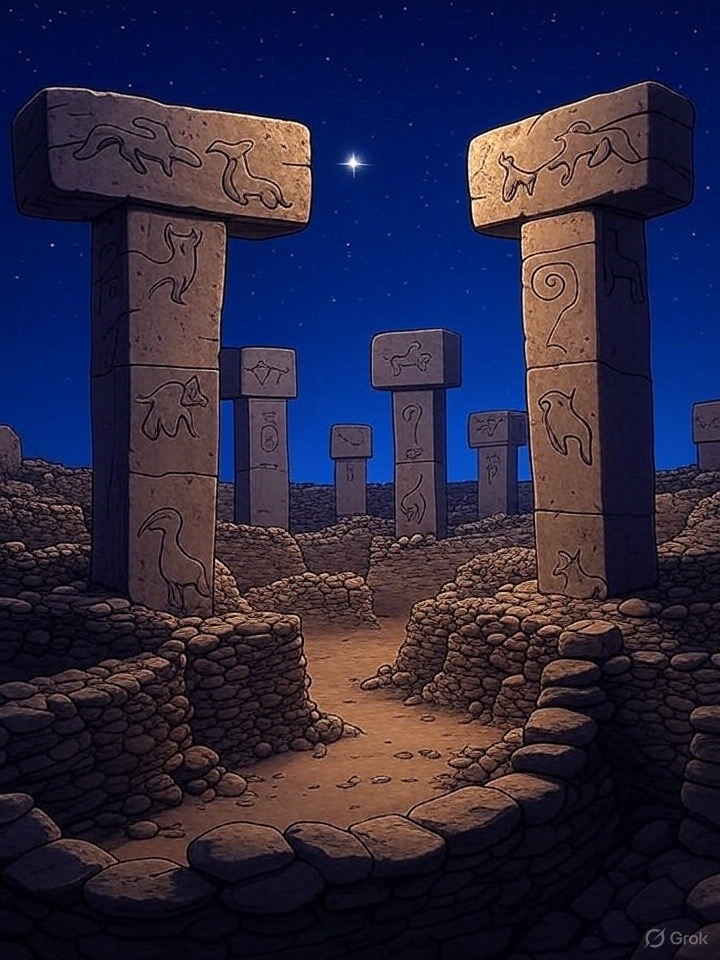
Gobeki Tepe was used as a temple and an astronomical observatory aligning massive T-shaped stone pillars to the Sun and to the stars, like Sirius. Thousands of years later other stone monuments followed throughout different cultures, like the pyramids, in reverence to the Sun and to the heavens. These monuments also acted as celestial clocks measuring time on a grand scale, slowly etching the oldest known cross symbol, the solar cross, into the human psyche. This symbol, a circle with a cross dividing it into four equal parts is associated with the Sun, the seasons, cardinal directions, time and cosmic balance.
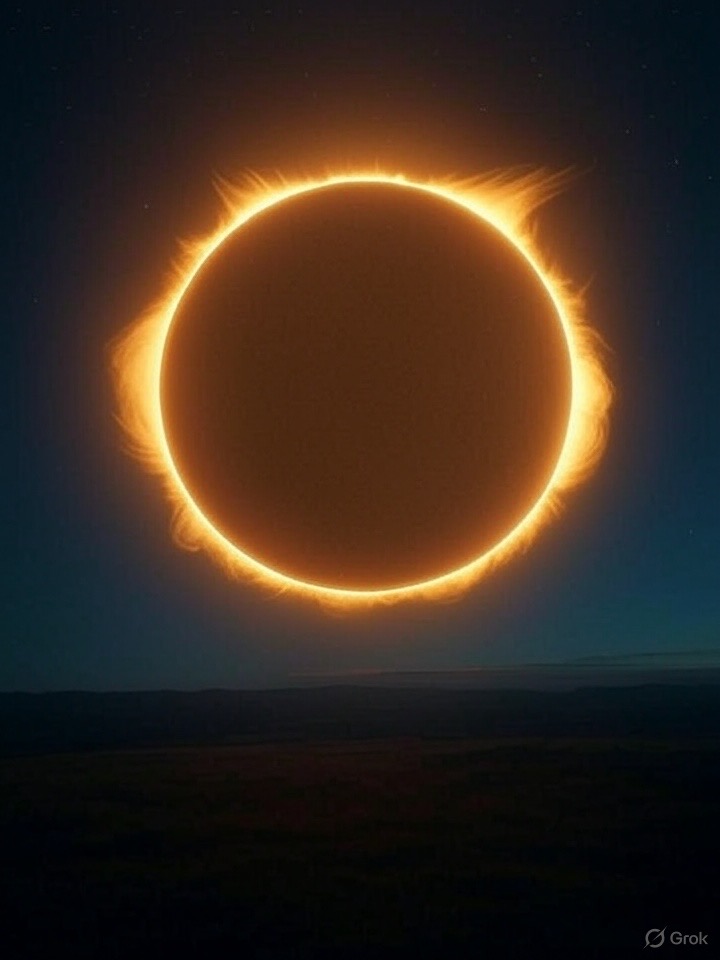
The solar cross has been ritualised ever since and as solar worship evolved different cultures devised their own Sun god and mythology, like Ra in Egypt or Sol in Rome. The Sun’s most outer layer, called the corona, has also been used in the various mythologies to describe different aspects of its character. As a crown it is associated with the Sun’s regal status, a halo speaks of transcendence and divine radiance whereas a crown of thorns is illustrative of its destructive power. A crown of thorns is now better known as coronal mass ejections or CMEs. These are massive bursts of plasma and electromagnetic energy.
The cross has taken many forms since the solar cross, like the Ankh or Tau cross, yet despite its different appearances the cross has always symbolised the intersection of the heavens and Earth - the meeting place of the spiritual and material worlds. In astronomical terms the solar cross refers to the intersection of the ecliptic plane and the celestial equator. These planes cross at two points known as equinoxes when the Sun appears directly above the equator to mark the beginning of spring and autumn. These two points when joined together form what can be described as the Pisces-Virgo axis.
Over a period of 25,776 years and due to Earth’s axial motion around the North Celestial Pole, or Pole for short, the position of the equinoxes slowly drift clockwise causing a shift in the Sun’s position relative to the constellations. The Sun is currently over the spring equinox in the constellation Pisces and the complete journey around the Pole is called the Precession of the Equinoxes, or simply Precession.
Now imagine that the 25,776 years is represented as a clock and divided into 12 equal segments. Each segment represents an Age of 2,148 years and 30 degrees with 1 degree of Precession representing around 72 years. To journey half-way around Precession would be 180 degrees and take 12,888 years, so you can start to get the picture. This is the celestial clock that will be used to help tell this story and it has been used many times throughout history as the backdrop for the celestial drama to unfold.
Before proceeding further, the other characters in this story need a brief introduction. These are Polaris - the Great White Throne, Vega - the Falling Vulture, Venus - the Morning Star, Sirius - the Blazing Star and Halley’s Comet – the Bearded Star.
The drama begins at the Pole as it traces its circular path in the heavens, passing near or through 7 constellations on its journey. The most reliable Pole stars during Precession are Polaris and Vega, so much so that you can set your watch by these.
Polaris resides in the constellation Ursa Minor and is the current Pole star. It is now moving towards the Pole until its closest approach around 2100 CE before it starts its journey away. Lock in this pivotal date as the jewel in the celestial clock from which all other dates can be derived. Now Polaris spends 1,800 years within 5 degrees of the Pole and for around 300 years it sits suspended within 1 degree of the Pole, with that period being from around 1950 to 2250 CE. You can travel back and forth the year 2100 CE by 25,776 years to find Polaris sitting on the throne, so to speak. For example, the last time would have been around 23,676 BCE and the next time will be around 27,876 CE.
The year 2100 CE can also be used to pencil in the transition from the current Age of Pisces to the Age of Aquarius, albeit this transition doesn’t just happen overnight. The shift between Ages can occur over 1-2 degrees of the celestial clock, meaning this shift is underway now. Working back from 2100 CE along the Pisces-Virgo axis marks the transition from the Age of Virgo to the Age of Leo, with that date last being around 10,788 BCE. That’s where you will find Vega in the constellation Lyra.
Now the last time that Vega was closest to the Pole was around 12,000 BCE in the Age of Virgo. Its journey takes it within 3 or 4 degrees of the Pole and it was the prominent Pole star in the northern skies for around 4,000 years, meaning it would have been the Pole star between 14,000 and 10,000 BCE. Its next closest approach is around 13,776 CE.
Next onto the stage is Venus, who plays an extremely reliable part in the celestial clock. Every 584 days Venus returns to the same position relative to the Earth and the Sun. This is known as a synodic period and every 8 years Venus weaves 5 synodic periods into the shape of a Venus pentagram. Venus also passes directly between Earth and the Sun as part of a much larger 243- year cycle. This rare transit occurs in pairs that are spaced eight years apart with the next transits occurring in 2117 and 2125 CE. An Age and Precession can therefore be measured by Venus like a celestial metronome, with an Age corresponding to around 269 Venus pentagrams and Precession corresponding to around 106 Venus transit cycles, give or take.
The star Sirius performs the role of a supporting actor that helps to mark time on the celestial clock over the course of Precession. Sirius’s current declination, that’s its distance north or south of the celestial equator is -16.7 degrees, which is midway its declination range of +6.8 to -40.2 degrees during Precession. It will pause here briefly before heading south and reaching its minimum declination of -40.2 degrees in around 6,444 years before heading north again. It will then take around 12,888 years to reach its maximum declination of +6.8 degrees before the cycle repeats. So, both Polaris and Vega act as Pole stars when Sirius appears in the heavens midway on its Precession journey.
Take a minute for all of that to sink in and to realise just how big a moment now is on the celestial clock. Finally, it is important to remember that the period until 2100 CE will see Polaris act in the role of the last Pole star in the current Precession cycle. Whereas after 2100 CE it will act as the first Pole star in the next cycle of Precession, meaning Polaris performs the role of both the first and the last in Precession.
You will need to safeguard all of these details for future generations.
Against this celestial backdrop the plot thickens. As the Pole stars shift at Polaris and Vega this also corresponds to a time on the celestial clock when Earth’s magnetic field can undergo change and experience a transfer of electromagnetic energy from the Sun. Imagine the symbol representing yin and yang to help grasp the idea - two opposing yet complementary energies in constant motion arising from one undivided source. When the interchange of energy is ready to occur, the Sun is centre stage to play out its different roles in the celestial drama.
Crossing the Pisces-Virgo axis is therefore an extremely significant and dangerous journey for Earth’s inhabitants. Records indicate that the last time Vega was the Pole star there was an extreme solar event in 12,350 BCE, geomagnetic anomalies spanning around 11,500 to 10,500 BCE and a possible geomagnetic excursion. This type of event is a temporary and significant disruption to Earth’s magnetic field. The last crossing also overlapped with the Younger Dryas climate period which spanned from around 10,900 to 9,700 BCE and witnessed a sudden return to glacial conditions.
Now at the time Vega was the Pole star prior to its last outing there was a geomagnetic excursion called Laschamps and the time before this there was another one called the Norwegian-Greenland Sea excursion. That takes the story back to around 63,500 BCE. Looking even further back into the distance and two precession cycles earlier there was the Blake geomagnetic excursion dated around 110,000 to 114,000 BCE.
Are you starting to see the full picture and feel the rhythmical nature of the celestial drama now? Earth’s inhabitants at the time of Gobeki Tepe did and they encoded a message for their future selves cast into the stone. It is said in ancient sky lore that Vega is associated with a “falling vulture”, representing its journey away from the Pole, and such a picture is depicted on Pillar 43 - the Vulture Stone. This pillar represents a picture of the heavens as they had appeared and the message was sent as a warning. With this in mind there will be the same need to warn future generations of what is to come when Vega next approaches the Pole, if humanity can survive until then. But that’s a different story for a later date given that there is a much more imminent threat.
Looking back to 23,676 BCE and when Polaris was last sitting on the throne can give an indication of what can be expected in the final Act of the current celestial drama. This date range corresponds to the time of the Taupo super-eruption, leading to what is known as a volcanic winter. This is a period of temporary global cooling caused by massive amounts of sulphur dioxide and ash being injected into the stratosphere.
Now fast forward to Polaris’s current approach to the Pole. Over the last 200 years Earth’s magnetic field has weakened around 10% and the magnetic north pole has been accelerating away from the Canadian Arctic. If this trend continues or worsens then another geomagnetic excursion may occur and the future will prove the past. However, the solar mythology and the celestial clock foreshadow a catastrophic ending sooner and it is this warning that should not be ignored.
It has been long written that before the curtains come down on the celestial drama the Sun will turn black and don its crown of thorns and the Earth will quake before a New Heaven and a New Earth emerges. Quickly sketching out how these final scenes could unfold.
The Sun’s gradual death starts in scene one alongside Earth’s weakening magnetic field. The Sun’s death is an electromagnetic one so look to the upcoming solar cycles for a decrease in sunspots to dim the Sun’s output and an increase in volcanic activity to turn the moon blood red. As the Sun’s internal dynamo tries to rebound the risk of a direct CME hit to Earth’s magnetic field also increases but such an event would be unlikely to be catastrophic at this point in the drama. However, should it occur, the captivated audience should heed it as a warning. It would cause significant damage and widespread disruption, especially if underprepared. To complete the opening scene, expect to see an increase in the frequency and the intensity of earthquakes, wildfires and tsunamis as Earth undergoes its habitual changes.
A cameo appearance from Halley’s Comet in 2061 CE marks a brief interlude in proceedings and as Earth’s magnetic field continues to weaken more cosmic rays are allowed to enter the atmosphere. Do not despair as more auroras and auroras at lower latitudes appear. Instead, take great comfort in the outpouring of love that will fill the aether as the spiritual and material worlds collide.
Scene two ushers in a grand solar minimum and this symbolises the Sun’s final death on the cross. This is a more sombre scene that extends for longer and depicts a prolonged period of low solar activity and cooling. The emotion persists until Halley’s Comet makes its return to the stage in 2136 CE. Thereafter, the tension continues to build until a rare outer planet alignment of Jupiter, Saturn, Neptune and Uranus occurs. Their combined gravitational pull shifts the Solar System’s centre of gravity, modulating the Sun’s internal dynamo. This period marks the onset of a deeper suppression in solar activity and sets the scene for a volcanic winter and a more severe cooling period.
Scene three is dominated by Earth’s magnetic field and the resurrection of the Sun’s internal dynamo. This chaotic scene sees a sharp increase in CME activity and with Earth’s magnetic field in a much weaker condition it lies vulnerable to the Sun’s destructive forces. The suspense levels rise until the transformative moment occurs and the Sun’s full halo radiates out into a great flash. The interchange of electromagnetic energy is now complete and a new energy begins to resonate. It is done and the celestial drama ends with a tremendous seismic upheaval that leaves the audience on their knees in complete awe.
Finally, as Polaris can be seen abdicating its position on the Great White Throne around 2250 CE a New Heaven and New Earth emerges with a new cycle of Precession. The Sun is re-born as a new light of the world and the human spirit has been transformed, rising like a Phoenix from the ashes.
Now this is where this particular story ends and all that remains is for humanity to choose how it wants to write its next chapter?
BEEP! BEEP! BEEP!...
That’s the final wakeup call and my cue to leave. You have the gist of the story and can fill in the rest by yourself. But don’t dwell on this for too long, the final Act of the celestial drama has already begun.
____________
@CPAK_Conference@WalterCrut@randallwcarlson@hughevans711@Valja46Zhark5