On the @theallinpod this week, @chamath asked @nvidia CEO Jensen Huang about decentralized AI training, calling our Covenant-72B run "a pretty crazy technical accomplishment."
One correction: it's 72 billion parameters, not four. Trained permissionlessly across 70+ contributors on commodity internet. The largest model ever pre-trained on fully decentralized infrastructure.
Jensen's answer is worth hearing too.
@im_perseverance A very interesting read. I'm definitely going to use the Validator Section Framework. Would've been great to demonstrate this with an example - but still mighty helpful. You should consider posting this on Substack - there's not much Bittensor analysis out there
⏰ THIS IS INSANE.
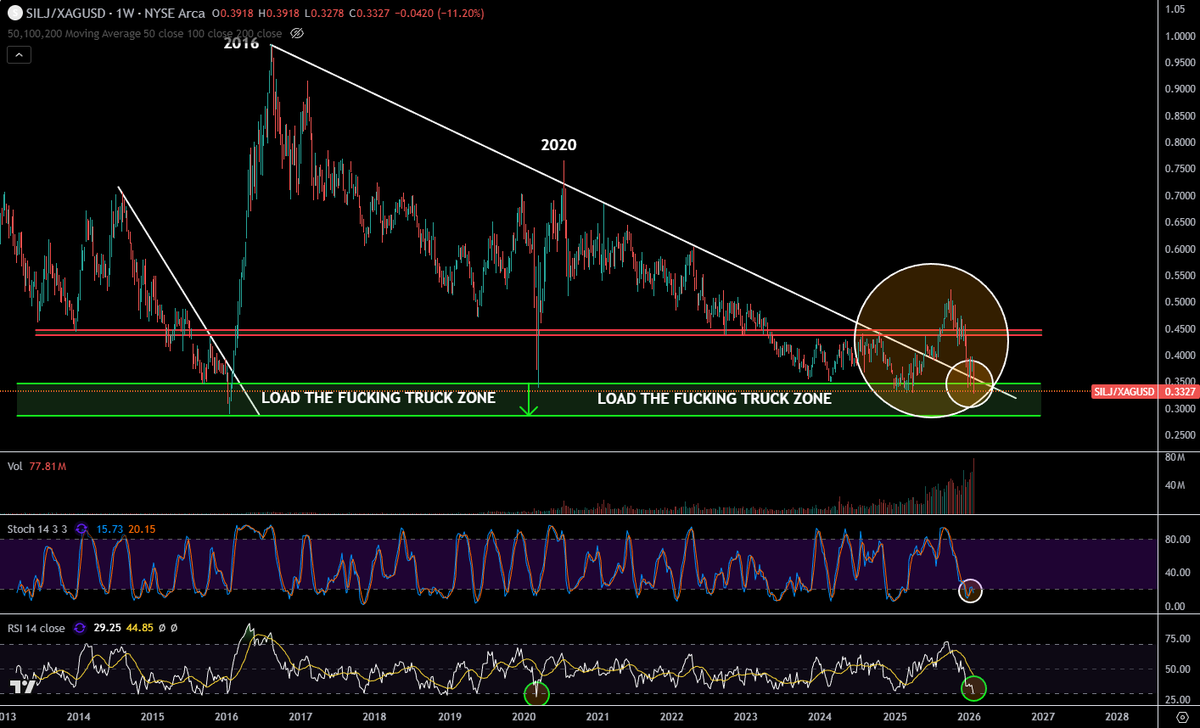
#SILVER#MINERS are at an all-time bottom relative to #Silver.
We are at the same relative levels as:
• The 2016 bottom
• The COVID crash bottom in 2020
• Even lower than the weakest point of 2025
#RSI is also at its lowest level since the 2020 COVID bottom.
Since #SILJ started trading 13 years ago, buying #SILJ (silver junior miners) in this zone has historically delivered life-changing gains.
I never thought we would revisit the “LOAD THE FUCKING TRUCK ZONE”, but here we are.
Right now, #SILJ is cheaper today than it was before it ran +276% over the last 12 months, relative to #Silver.
What are investors waiting for?
This is the window.
THE window.
Possibly the last window for anyone still not exposed to the sector to get in.
RT and get the word out.
People - if there is no use for a utility token, no users of the utility an access token provides access to, or no delivery on the promises of a security token, it will dump. Obviously. What did you think?
Its 2025 we are beyond speculation. Blockchain tokens have use cases, adoption, regulation, categorization, fundementals and the cream will rise.
The underlying business, utility or value must be there or the token will depreciate as users leave, as quality of delivery deteriorates. This is not rocket science.
Build good stuff and wrap it in a token. Build shit stuff or nothing and the token will be worthless. Like MEMEs. Worthless junk. Obviously.
The coming years will be the regulatory definition of many token types. All are different. All will have guidelines and market structure will be policed.
Welcome to the beginning of crypto. The speculative era is ending in 2026.
Builders, start building. No excuses. Investors, invest in quality teams and quality software. Stop chasing candles and become a value investor with a multi year time horizon.
The game is changing. We growing up.
How many blockchains will survive Market Structure?
IMO-less than 5 blockchains will survive and appreciate exponentially while 98% of unadopted chains will depreciate exponentially.
Many speculative or low-usage chains could fade due to higher compliance costs, reduced hype funding, or inability to achieve "maturity" certification (e.g., no single entity controls >20% of tokens, functional decentralization).
The upcoming Us Market Structure Bill (the Digital Asset Market Clarity Act of 2025 (CLARITY Act, H.R. 3633), which passed the House in July 2025 with bipartisan support but remains stalled in the Senate as of late December 2025 (delayed to early 2026 due to ongoing negotiations).
This bill aims to clarify regulatory jurisdiction between the SEC (for securities) and CFTC (for commodities), define "digital commodities" tied to mature/decentralized blockchains, and provide pathways for compliant operation.
Impact on Blockchains
Clear rules would likely benefit the industry overall by reducing uncertainty, encouraging institutional adoption, and fostering innovation in the U.S. (similar to how prior regulatory ambiguity drove some activity offshore). However, it could pressure less mature or centralized projects to decentralize faster or face stricter SEC oversight as securities.
Predictions on Surviving Blockchains
No exact number exists in analyses of the bill as it's speculative until final draft is released. Industry views often compare crypto to the early internet: thousands of dotcoms existed, but only a handful (e.g., Amazon, Google) dominated long-term.
Strong survivors
Established, highly decentralized networks with real utility, large ecosystems, and compliance readiness (e.g., Bitcoin, Ethereum, Solana) would thrive under lighter CFTC rules for "mature" blockchains.
Consolidation expected
Ultimately, survival depends more on real-world adoption, technology, and economics than regulation alone. Clear U.S. rules could help more blockchains flourish domestically compared to the current enforcement-heavy environment. If the bill fails or weakens, uncertainty persists, potentially harming the ecosystem further.