@abuatiyyah_ If he heard the kalām but didn’t understand all of it, that means he understood part of it. That’s all I needed.
You having a tantrum and talking about the taʿalluqāt of the maʿlūmāt didn’t help you escape the problem.
@abuatiyyah_ The question still remains did Mūsā عليه السلام understand everything the kalām nafsī signifies or only part of it.
This is not a third option.
There’s a reason why Al Āmidī says this objection is too difficult to answer in Abkār al Afkār.
The Shīʿah and the Māturīdiyyah have adopted the position of their predecessors, the Jahmiyyah, concerning Mūsā عليه السلام hearing created speech.
The Shīʿah hold the same belief as the Jahmiyyah on kalām. Technically they also believe Allah's speech is created, but the Shīʿī scholars preferred the term muḥdath (originated) over makhlūq (created).
Al Ṭūsī (d. 460AH) the Shīʿī says: "Allah's speech is an act of His, and it is originated. Our scholars refrained from describing it as created because this expression could give the impression that it is fabricated." – https://t.co/FnrXWLydSD (Al Khilāf, Al Ṭūsī, 6/119)
Whereas the Māturīdiyyah differ when it comes to affirming that Allah possesses eternal inner speech (kalām nafsī), which consists of neither words, letters, nor sounds. Which the Jahmiyyah do not.
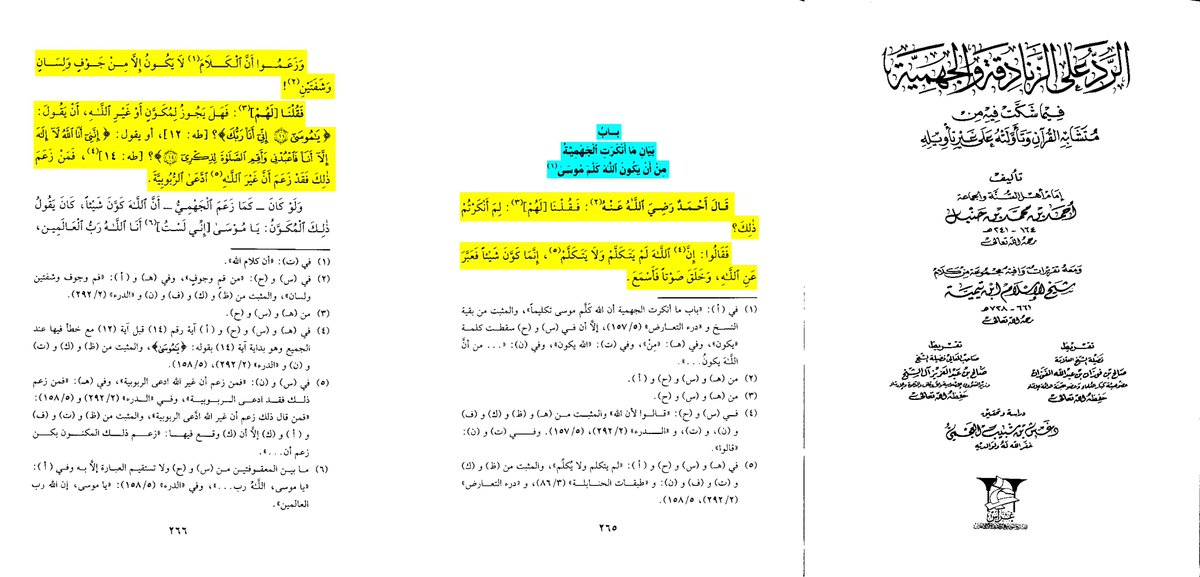
Imām Aḥmad ibn Ḥanbal (d. 241AH) said: "We asked the Jahmiyyah: 'Why do you deny that Allah spoke to Musa?'"
The Jahmiyyah replied: "Allah has never spoken, nor does He speak. Rather, He brought something into existence which expressed speech on His behalf, and He created a sound and caused it to be heard."
They also claimed: "Speech can only come from within a cavity, through a tongue and two lips!"
Imam Ahmad said: "We then asked them: 'Is it permissible for something brought into existence, or anyone other than Allah, to say:
"O Musa! Indeed, I am your Lord." (Ta Ha 11–12)
Or to say:
"Indeed, I am Allah. There is no deity worthy of worship except Me, so worship Me and establish prayer for My remembrance." (Ta Ha 14)
Whoever claims that has thereby claimed that someone other than Allah asserted Lordship for himself." (Al Radd ʿalā al Zanādiqah wa al Jahmiyyah, Aḥmad ibn Ḥanbal, p. 265–266)
(Also See Abū al Ḥasan al Ashʿarī attribute this view to the Jahmiyyah in Al Ibānah ʿan Uṣūl al Diyānah, p. 68–69) https://t.co/kVhOaieDTV
Muhammad ibn Muqatil (d. 226AH) said: "I heard ʿAbdullāh ibn al Mubārak (d. 181AH) say: 'Whoever claims that the words of Allah: "Indeed, I am Allah. There is no deity worthy of worship except Me." (Ta Ha 14) are created is a disbeliever.
It is not permissible for any created being to make such a statement.' (Khalq Afʿāl al ʿIbād, by Imam al Bukhārī, p. 8)
Abū Manṣūr al Māturīdī (d. 333AH) said: Concerning the statement of Allah, the Mighty and Majestic: "And Allah spoke directly to Musa." (an Nisa 164)
There was disagreement concerning its meaning.
Some said: "Allah created speech and a sound, and caused Musa عليه السلام to hear them."
Others said: "Allah wrote a Book for him and spoke to him through it. This is the meaning of His statement: 'And Allah spoke directly to Musa.' (an Nisa 164)
It does not mean that Allah spoke to him with His own Speech.
We do not know how this occurred, except that we know Allah brought into existence a sound that had not previously existed and caused Musa عليه السلام to hear it, however He willed, whatever He willed, and from whomever He willed.
This is because Allah's Speech, which is an eternal attribute of His, cannot be described in terms of huruf (letters), hija' (spelling), sawt (sound), or anything else by which the speech of created beings is described.
When something is described as 'the Speech of Allah', this is only said by way of muwafaqah (correspondence) and majaz (figurative expression).
An example is the statement of Allah: 'So that he may hear the Speech of Allah.' (at Tawbah 6)
However, there is no way for such a person to hear the Speech of Allah which is His eternal attribute. Rather, the expression is used by way of muwafaqah (correspondence) and majaz (figurative expression)." (Taʾwīlāt Ahl al Sunnah, Abū Manṣūr al Māturīdī, 3/420).
The voice coming from the tree itself is evidence that the voice was not Allah's own but a muhdas voice which Allah brought into existence not in his essence.
In his commentary on verse 52 of Sūrat Maryam, Imam Mujāhid (d. 104 AH) said:
❝Between the seventh heaven and the Throne are seventy thousand veils. Mūsā continued to draw nearer [to Allah ﷻ] until there remained only one veil between him and Him. When he saw His place (i.e., the place of Allah ﷻ) and heard the creaking of the Pen, he said: ‘My Lord, show me [Yourself] that I may look at You.’❞
Imam al-Dhahabi commented: “This is authentically reported from Mujāhid, the great Imam of Tafsīr.”
Ibn Taymiyyah makes this argument against the Ashʿarīs concerning whether Mūsā عليه السلام heard all or part of Allah's Speech, and NONE of them have an answer for it.
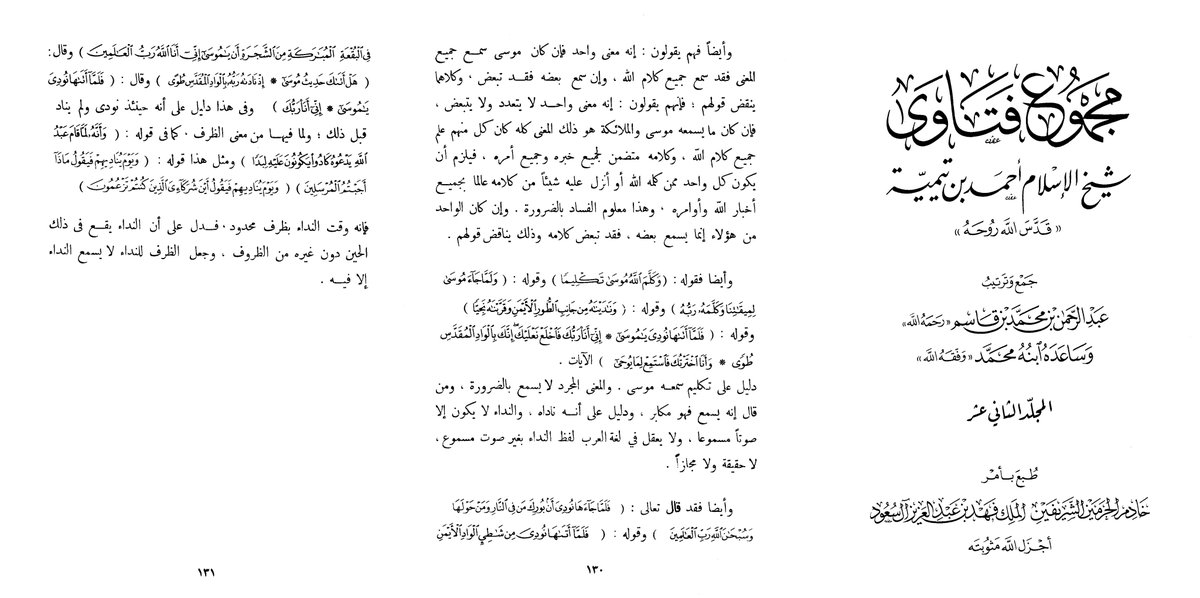
Ibn Taymiyyah (d. 728AH) said if Mūsā عليه السلام heard the entire meaning, then he necessarily heard all of Allah's Speech, including every one of His akhbār (reports and information) and awāmir (commands). Consequently, Mūsā عليه السلام, the angels, and everyone who received any revelation from Allah would possess complete knowledge of everything Allah has said. This conclusion is false.
However, if Mūsā عليه السلام heard only some of Allah's Speech, then the supposed single meaning would admit tabʿīḍ (division into parts), contradicting their claim that it is one meaning which cannot undergo taʿaddud (multiplicity) or division.
Therefore, either the recipients of revelation heard all of Allah's Speech and knew all His reports and commands, or they head only some of it, thereby contradicting the claim that His Speech is indivisible.
Ibn Taymiyyah said that a maʿnā mujarrad (abstract meaning) cannot itself be heard, and whoever claims otherwise denies something plainly evident.
Allah says: "And Allah spoke directly to Moses." (al Nisāʾ 4:164).
Allah also says: "And when Moses came at Our appointed time, and his Lord spoke to him." (al Aʿrāf 7:143).
And Allah says: "And We called him from the right side of the Mount and brought him near for private conversation." (Maryam 19:52).
Likewise, Allah says: "When he reached it, he was called, 'O Moses! Indeed, I am your Lord, so remove your sandals. You are in the sacred valley of Tuwa. And I have chosen you, so listen to what is revealed.'" (Ṭā Hā 20:11–13).
These verses establish that Allah called Mūsā عليه السلام. The term nidāʾ (calling) necessarily involves a ṣawt masmūʿ (audible voice). In the Arabic language, calling cannot occur without an audible voice, whether understood according to its ḥaqīqah (literal meaning) or majāz (figurative meaning).
Thus, Allah's Speech to Mūsā عليه السلام was truly heard and cannot be reduced to an inaudible, abstract meaning.
Allah's Calling Occurs at a Particular Time
Ibn Taymiyyah further explained that the Qur'an describes Allah's calling as occurring on specific occasions.
Allah says concerning Mūsā عليه السلام: "When he reached it, he was called, 'Blessed is whoever is at the fire and whoever is around it, and glory be to Allah, Lord of all worlds.'" (al Naml 27:8).
Allah also describes calling Mūsā عليه السلام from the right side of the valley, in the blessed place, from the tree, and calling him in the sacred valley of Ṭuwā. (al Qaṣaṣ 28:30; al Nāziʿāt 79:15–16).
Likewise, Allah mentions His calling to Ādam عليه السلام and his wife concerning the forbidden tree, His calling on the Day of Resurrection concerning people's response to the Messengers, and His questioning concerning the partners falsely attributed to Him. (al Aʿrāf 7:22; al Qaṣaṣ 28:65, 28:74).
Ibn Taymiyyah also referred to the statement concerning the servant standing in supplication, in which the expression lammā (when) connects the event to the occasion on which it occurred. (al Jinn 72:19).
These expressions establish that Allah's nidāʾ (calling) occurs at a particular waqt (time) or ẓarf (occasion or circumstance). The word lammā (when) shows that the calling took place when the specified event occurred.
Therefore, Allah's calling occurs at the appointed time, and whoever hears that calling hears it when it takes place, not before or after that occasion, which also refutes their claim that Allah is outside of time. (Majmūʿ al Fatāwā, Ibn Taymiyyah, 12/130–131).
Why Did Incorrect Readings of the Qur'an Occur, and How Were They Corrected?
Imām Ibn Mujāhid (d. 324AH) explained that differences in the qirāʾāt (Qur'an recitations) existed among the early Muslims, just as differences existed concerning certain matters of Sharia. Many of these differences were transmitted from the Ṣaḥābah (Companions) and Tābiʿīn (Successors), reflecting the recognised ways of reciting the Qur'an.
However, not every reading attributed to the Qur'an was authentic. Some differences arose from mistakes in memorisation, weaknesses in understanding Arabic, or readings introduced without any established transmission.
The correct qirāʾāt were those preserved through reliable transmission from earlier reciters, rather than readings invented through personal reasoning or linguistic preference. (Kitāb al Sabʿah fī al Qirāʾāt, Ibn Mujāhid, pp. 45–46).
Why Incorrect Readings of the Qur'an Occurred
Ibn Mujāhid explained that incorrect readings arose because some reciters lacked the knowledge or precision necessary to preserve what they had learned.
Some memorised the Qur'an but lacked sufficient knowledge of iʿrāb (Arabic grammatical inflection). Consequently, they confused the vowels of words, particularly the fatḥah (a vowel producing an 'a' sound), ḍammah (a vowel producing a 'u' sound), and kasrah (a vowel producing an 'i' sound). Such mistakes could alter the correct pronunciation and grammatical meaning.
Others possessed knowledge of Arabic but relied too heavily on their memory. Over time, they forgot what they had originally heard, confused similar letters, or recited words incorrectly. Some then mistakenly attributed these readings to earlier teachers because they believed their recollection was correct.
Ibn Mujāhid also identified those who understood Arabic grammar and vocabulary but lacked knowledge of the transmitted qirāʾāt. Such individuals sometimes introduced readings that were grammatically permissible in Arabic but had never been recited by the earlier generations.
Therefore, a reading could be grammatically correct in Arabic while still being unacceptable as a recitation of the Qur'an, because grammatical possibility alone could not establish an authentic qirāʾah (reading). (Kitāb al Sabʿah fī al Qirāʾāt, Ibn Mujāhid, pp. 45–46).
Why Personal Reasoning Was Not Sufficient
The Salaf rejected the practice of introducing Qur'an readings merely because they appeared linguistically correct.
ʿAbd Allāh ibn Masʿūd رضي الله عنه (d. 32AH) stated: "Follow and do not introduce innovations, for you have been given enough." (Kitāb al Sabʿah fī al Qirāʾāt, Ibn Mujāhid, p. 46).
Similarly, ʿAlī ibn Abī Ṭālib رضي الله عنه (d. 40AH) reported that the Messenger of Allah ﷺ instructed people to recite the Qur'an as they had been taught. (Kitāb al Sabʿah fī al Qirāʾāt, Ibn Mujāhid, p. 47).
Ibn Masʿūd also warned against excessive difficulty and unnecessary disagreement in recitation, explaining that the readings he had heard were close to one another and instructing people to recite as they had learned. (Kitāb al Sabʿah fī al Qirāʾāt, Ibn Mujāhid, p. 47).
Imām Abū ʿAmr ibn al ʿAlāʾ (d. 154AH), despite being a leading authority in the Arabic language, affirmed that he could not recite according to his personal linguistic preference. He explained that, were recitation not restricted to what had already been transmitted, he could have selected other linguistically possible readings.
When questioned concerning a particular Qur'an reading, Abū ʿAmr explained that its correct form could only be established by hearing it from the earlier scholars.
Thus, even the greatest knowledge of Arabic did not give someone the authority to introduce a Qur'an reading without established transmission. (Kitāb al Sabʿah fī al Qirāʾāt, Ibn Mujāhid, p. 48).
How Incorrect Readings Were Identified and Corrected
The early scholars distinguished authentic qirāʾāt from mistaken recitations through riwāyah (transmission) and talaqqī (direct learning from qualified teachers).
Some readings were widely known and reliably transmitted, while others were abandoned because of weaknesses in their transmission. A narrator could also forget the original reading after many years and mistakenly report something different.
When such reports were presented to knowledgeable scholars, the mistakes were recognised and corrected. In some cases, an unreliable narration was rejected altogether.
Ibn Mujāhid explained that this required specialists who understood the transmitted reports, the differences between narrators, and the established methods of recitation. Those without knowledge of riwāyah and the differences between transmitted readings were not qualified to determine their authenticity.
He also distinguished between well known Arabic expressions, less common linguistic usages, rare dialects, difficult grammatical constructions, and readings affected by mistakes. An unusual reading was not automatically incorrect, but its authenticity had to be established through reliable transmission rather than linguistic possibility alone. (Kitāb al Sabʿah fī al Qirāʾāt, Ibn Mujāhid, p. 49).
How the Correct Readings Were Preserved
The authentic qirāʾāt were preserved through continuous teaching and transmission across the major centres of Islamic learning, including Madīnah, Makkah, Kūfah, Baṣrah and al Shām.
Students received their readings directly from qualified teachers, who had themselves learned from earlier authorities. This established a continuous tradition through which readings could be examined, preserved and distinguished from errors.
Zayd ibn Thābit رضي الله عنه (d. 45AH) affirmed: "Recitation is a Sunnah, so recite it as you find it." (Kitāb al Sabʿah fī al Qirāʾāt, Ibn Mujāhid, p. 50).
The same principle was transmitted through other early authorities, including ʿĀmir al Shaʿbī (d. 103AH), who affirmed that recitation is a Sunnah and must be received as it was taught.
Other reports similarly explained that Qur'an recitation is passed from one generation to another, with later reciters learning from those who preceded them. The transmission of these statements was itself examined, and mistaken attributions were identified.
Consequently, the preservation of the qirāʾāt depended upon faithfully receiving and transmitting what had been taught, rather than independently constructing readings through grammar, memory or personal preference. (Kitāb al Sabʿah fī al Qirāʾāt, Ibn Mujāhid, pp. 49–52).
The Correct Understanding of How Mistaken Readings Were Prevented
Incorrect Qur'an readings arose when individuals forgot what they had learned, confused letters or grammatical vowels, misunderstood Arabic expressions, or introduced readings that lacked established transmission.
The early scholars addressed these errors by examining the reliability of narrators, comparing transmitted readings, correcting mistaken recollections, and requiring reciters to learn directly from qualified teachers.
The fundamental principle was that an authentic qirāʾah (reading) must be established through reliable transmission from the earlier generations. Neither grammatical correctness nor personal reasoning was sufficient to introduce a new reading.
Accordingly, the recognised differences among the qirāʾāt were preserved, while mistaken and unsupported readings were identified and rejected. This ensured that recitation remained dependent upon what had been faithfully transmitted, rather than the independent preferences of individual readers. (Kitāb al Sabʿah fī al Qirāʾāt, Ibn Mujāhid, pp. 45–52).
The Meaning of Taking the Apparent Meaning of Allāh's Attributes
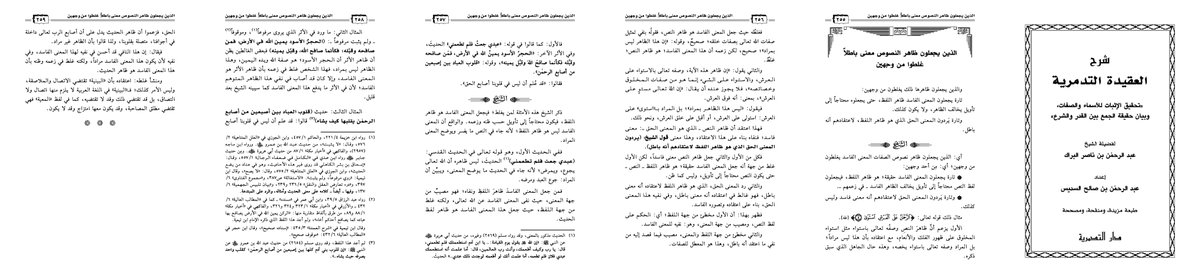
Ibn Taymiyyah (d. 728AH) explained that the expression ẓāhir (apparent meaning) is ambiguous because it can refer to more than one meaning. Consequently, when someone claims that the apparent meaning of the texts concerning Allāh's attributes is either intended or not intended, the meaning of the expression must first be established.
The apparent meaning of speech is the meaning that naturally comes to the mind of someone who possesses sound understanding and knowledge of the language.
According to the Salaf, the apparent meaning of the texts concerning Allāh's attributes is the meaning that befits Allāh, not a meaning that resembles the attributes of creation.
Therefore, if someone understands the apparent meaning to be tamthīl (likening Allāh to His creation), such a meaning is certainly not intended.
However, the Salaf never regarded this false understanding as the apparent meaning of the Qurʾān and Sunnah. Nor did they accept that the Speech of Allāh apparently conveys kufr (disbelief) or ḍalāl (misguidance). (Sharḥ al Risālah al Tadmuriyyah, al Barrāk, pp. 251–252).
The Different Understandings of the Apparent Meaning
Shaykh ʿAbd al Raḥmān al Barrāk explained that the disagreement arises because people understand ẓāhir (apparent meaning) differently. There are four positions concerning the texts of Allāh's attributes.
The first position is to affirm that the apparent meaning is intended, understanding it as the affirmation of Allāh's attributes in a manner befitting His Majesty and Perfection. This is the correct position in both wording and meaning, and it is the way of Ahl al Sunnah.
The second position is to affirm that the apparent meaning is intended while understanding it as resemblance between Allāh and His creation. This is the position of the Mushabbihah (those who liken Allāh to creation), and it is false in both wording and meaning.
The third position is to reject the apparent meaning because of the belief that affirming Allāh's attributes necessarily entails tashbīh (likening Allāh to creation). Although rejecting resemblance is correct, denying the attributes themselves is false. This position arises from mistakenly believing that resemblance is the apparent meaning.
The fourth position is to reject the apparent meaning because it is understood to mean resemblance, while nevertheless affirming the attributes in a manner befitting Allāh. This position is correct in rejecting resemblance and affirming the attributes, but incorrect in describing resemblance as their apparent meaning.
Thus, the fundamental error is assuming that the apparent meaning of Allāh's attributes is resemblance to creation. The true apparent meaning is the affirmation of the attributes in a manner befitting Allāh, without tamthīl (likening Him to creation). (Sharḥ al Risālah al Tadmuriyyah, al Barrāk, pp. 252–253).
Why the Apparent Meaning Cannot Be Disbelief or Falsehood
Ibn Taymiyyah rejected the claim that the apparent meaning of the Qurʾān and Sunnah is kufr (disbelief) or ḍalāl (misguidance).
Such a claim would imply that Allāh addressed His servants with words whose apparent meaning is false, while intending something contrary to what they naturally understood. This contradicts the Wisdom of Allāh, the clarity of His Speech, and the fact that He revealed the best speech.
Allāh says:
اللَّهُ نَزَّلَ أَحْسَنَ الْحَدِيثِ
"Allāh has sent down the best statement." (al Zumar 39:23).
It would also imply that Allāh was unable to explain His intended meaning, was unaware of how His words would be understood, or deliberately concealed His intended meaning. Allāh and His Messenger ﷺ are free from all such deficiencies, for Allāh possesses perfect Knowledge and Wisdom, and the Messenger ﷺ conveyed the revelation with complete clarity.
Therefore, it is not permissible to claim that the apparent meaning of Allāh's Speech is false simply because someone has mistakenly understood it to imply resemblance to creation. (Sharḥ al Risālah al Tadmuriyyah, al Barrāk, pp. 253–254; Darʾ Taʿāruḍ al ʿAql wa al Naql, Ibn Taymiyyah, 1/22).
The Two Errors of Those Who Reject the Apparent Meaning
Ibn Taymiyyah explained that those who regard the apparent meaning of the texts concerning Allāh's attributes as false have fallen into two errors.
The first is to assume that a false meaning is the apparent meaning of the wording, and then to claim that the wording requires taʾwīl (interpretation away from that supposed meaning). In reality, the false meaning was never the correct apparent meaning.
The second is to reject the true meaning indicated by the wording because of the mistaken belief that this meaning is false.
Shaykh al Barrāk showed these errors through the statement of Allāh:
الرَّحْمَٰنُ عَلَى الْعَرْشِ اسْتَوَىٰ
"The Most Merciful rose above the Throne." (Ṭā Hā 20:5).
The first person assumes that istiwāʾ (rising above the Throne) means rising in the manner of creation. Such a person correctly rejects resemblance but wrongly assumes that this resemblance is the apparent meaning of the verse.
The second person rejects Allāh's real istiwāʾ above the Throne because of the belief that rising above something is only possible for creation. Consequently, the verse is interpreted to mean that Allāh conquered the Throne or turned towards creating it.
Both positions are incorrect. The first wrongly attributes a false meaning to the wording, while the second rejects the true meaning because of a false understanding.
The correct meaning is that Allāh truly rose above His Throne in a manner befitting Him, without resembling His creation and without interpreting His istiwāʾ as something other than its true meaning. (Sharḥ al Risālah al Tadmuriyyah, al Barrāk, pp. 255–256).
Why Certain Aḥādīth Do Not Justify Rejecting the Apparent Meaning
Ibn Taymiyyah addressed three reports used by those who claimed that the apparent meanings of texts cannot always be accepted.
The Ḥadīth Concerning Allāh's Hunger and Illness
Among the examples was the Ḥadīth Qudsī (a sacred narration from Allāh) concerning Allāh saying, "My servant, I was hungry, and you did not feed Me."
Some claimed that the apparent meaning suggests that Allāh experiences hunger, and therefore the apparent meaning must be rejected.
However, the authentic ḥadīth itself explains the intended meaning. Allāh mentions a servant who was hungry and was not fed, and another servant who was ill and was not visited.
The hunger and illness belong to the servants, not to Allāh. The wording of the ḥadīth itself makes this clear.
Shaykh al Barrāk further explained that the expression concerning the sick servant indicates a special relationship of ʿubūdiyyah (servitude to Allāh). Visiting the sick servant is also connected to Allāh's special qurb (closeness) and maʿiyyah (being with His servant).
Every special closeness entails special maʿiyyah, although special maʿiyyah does not necessarily entail special closeness.
Therefore, the correct meaning is established by the ḥadīth itself, without needing to reject its apparent meaning or introduce an interpretation contrary to its wording. (Ṣaḥīḥ Muslim, 2569; Sharḥ al Risālah al Tadmuriyyah, al Barrāk, pp. 257–258, 260–261).
The Report Concerning the Black Stone
Another example was the report describing the Black Stone as the right hand of Allāh on earth, stating that whoever touches and kisses it is as though he has shaken hands with Allāh and kissed His right hand.
Some mistakenly understood this to mean that the Black Stone is literally an attribute of Allāh. Consequently, they claimed that the apparent meaning must be rejected.
However, the wording itself distinguishes between the Black Stone and Allāh. It describes the Stone as being on earth and uses a comparison, saying that touching and kissing it is as though someone has shaken hands with Allāh.
A comparison does not establish that the two things are identical. Therefore, the report does not mean that the Black Stone is literally Allāh's right hand or that touching it, constitutes touching Allāh.
Shaykh al Barrāk also clarified that this report is known from Ibn ʿAbbās رضي الله عنه, rather than being reliably established as a statement of the Prophet ﷺ.
Thus, the supposed false meaning arises from misunderstanding the wording, rather than from its true apparent meaning. (Sharḥ al Risālah al Tadmuriyyah, al Barrāk, pp. 257–258, 260–261).
The Ḥadīth Concerning the Hearts Between the Fingers of Allāh
The third example was the statement of the Prophet ﷺ that the hearts of the servants are between two fingers of al Raḥmān (the Most Merciful), and that He turns them however He wills.
Some assumed that the apparent meaning requires Allāh's fingers to be inside the bodies of His servants, touching their hearts. Consequently, they rejected this supposed apparent meaning.
Shaykh al Barrāk explained that the expression bayna (between) does not necessarily entail contact or attachment. In Arabic, something may be described as being between other things without touching them, just as the expression maʿa (with) does not always entail contact.
Therefore, the ḥadīth does not indicate that Allāh's fingers are inside the bodies of His servants or physically attached to their hearts.
The false understanding must be rejected, but this does not require rejecting the real attribute affirmed in the ḥadīth.
The correct position is to affirm the attribute of Allāh's Fingers in a manner befitting Him, while rejecting the false assumption that this necessarily entails contact with the hearts of His creation. (Ṣaḥīḥ Muslim, 2654; Sharḥ al Risālah al Tadmuriyyah, al Barrāk, pp. 257–259).
The Correct Principle Concerning the Apparent Meaning
The Salaf affirmed the true meanings of the Qurʾān and Sunnah concerning Allāh's Names and Attributes, without tashbīh (likening Allāh to creation), tamthīl (making Allāh comparable to creation), or taʿṭīl (denying His attributes).
The apparent meaning must be understood according to the Arabic language, the complete wording, its context, and what befits Allāh.
Where the wording itself provides an explanation, that explanation forms part of the apparent meaning. It is therefore incorrect to isolate part of a statement, impose a false meaning upon it, and then claim that the apparent meaning must be rejected.
The source of his error is his belief that al bayniyyah (being between) necessarily involves ittiṣāl (contact) and mulāṣaqah (touching). However, this is not the case. In the Arabic language, al bayniyyah (being between) does not necessarily involve contact or touching.
It may involve these things, or it may not. Similarly, the term maʿiyyah (being with) indicates muṣāḥabah (companionship) in a general sense, which may involve contact or it may occur without it. (Sharḥ al ʿAqīdah al Tadmuriyyah, Shaykh ʿAbd al Raḥmān al Barrāk, p. 259.)
Accordingly, the true apparent meanings of the texts concerning Allāh's attributes are intended, while all meanings involving resemblance to His creation are rejected. This preserves both the reality of Allāh's attributes and His absolute distinction from everything He created
Affirming two distinct attributes while maintaining they are unlike creation is somehow not contradictory to reducing those two distinct attributes into one attribute…
You cannot be serious.
@Hanbali2024@1athariarchive Imam al-Baqillani does not contradict al-Tahawi; rather, he provides the linguistic and theological explanation (ta'wil) for why these attributes do not resemble creation.
Tahawi clearly says whoever gives Allah a human meaning has committed kufr,
You’re such a jahil.
Imām al-Ṭaḥāwī (d. 321AH) vs. the Ashāʿirah
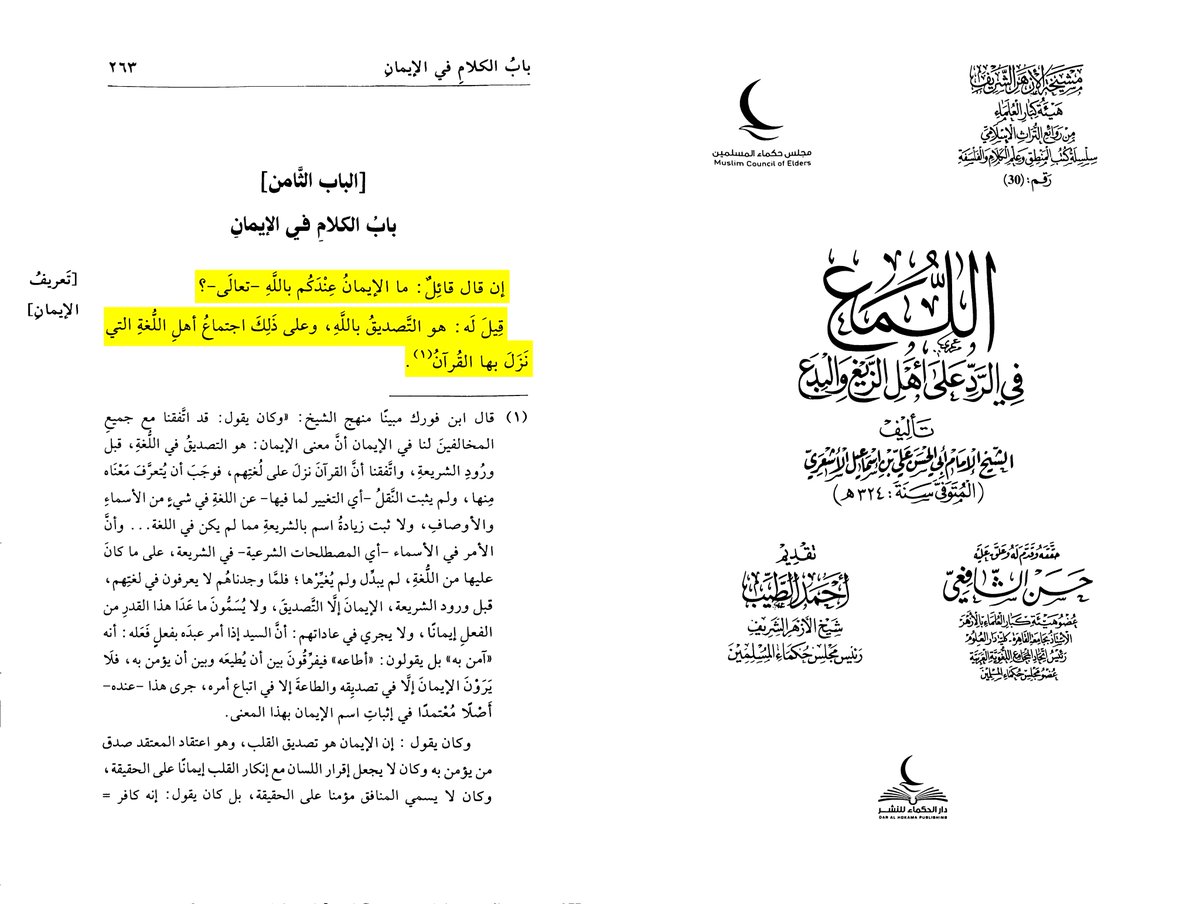
Al Ṭaḥāwī defined īmān (faith) as iqrār bi al lisān (affirmation with the tongue) and taṣdīq bi al janān (belief in the heart), whereas Abū al Ḥasan al Ashʿarī defined faith in Allah as taṣdīq (belief) alone.
Also, Al Ṭaḥāwī affirmed Allah’s ghaḍab (anger) and riḍā (pleasure) are unlike creation, whereas al Bāqillānī interpreted these attributes, alongside maḥabbah (love) and bughḍ (hatred), as His irādah (will) to reward or punish.
See quotations below ↓
Al-Ṭaḥāwī said: "Īmān (faith) is affirmation with the tongue and belief in the heart." (al ʿAqīdah al Ṭaḥāwiyyah p. 21)
Abū al Ḥasan al Ashʿarī (d. 324AH) said: If someone asks, 'What is faith in Allah according to you?'
The answer is: 'It is belief in Allah. This is the understanding unanimously agreed upon by the people of the language in which the Qur'an was revealed.' (al Lumaʿ fī al Radd ʿalā Ahl al Zaygh wa al Bidaʿ, by Abū al Ḥasan al Ashʿarī p. 263)
Al-Ṭaḥāwī said: "Allah becomes angry and is pleased, unlike anyone among creation." (al ʿAqīdah al Ṭaḥāwiyyah p. 28)
Abū Bakr al Bāqillānī (d. 403AH) said: "If it is asked, 'You have established that Allah is Living, Knowing, Powerful, Hearing, Seeing and Speaking. Do you also affirm that He becomes angry and is pleased, loves and hates, shows loyalty and enmity, and that He is described with these attributes?'
"The answer is: 'Yes. However, what is meant by His anger towards those with whom He is angry, His pleasure towards those with whom He is pleased, His love towards those whom He loves, His hatred towards those whom He hates, His loyalty towards those whom He supports, and His enmity towards those whom He opposes, is nothing other than His will to reward those with whom He is pleased, whom He loves and supports, and His will to punish those with whom He is angry, whom He hates and opposes.'" (al Inṣāf, Abū Bakr al Bāqillānī, p. 38).
May Allah guide you kid.
@Hanbali2024@1athariarchive , this mujassim fraud thinks we disagree with Tahawi on creed.
LOL 😂 . I did know you were this stupid.
Your people calling Tahawi him a jahmi.
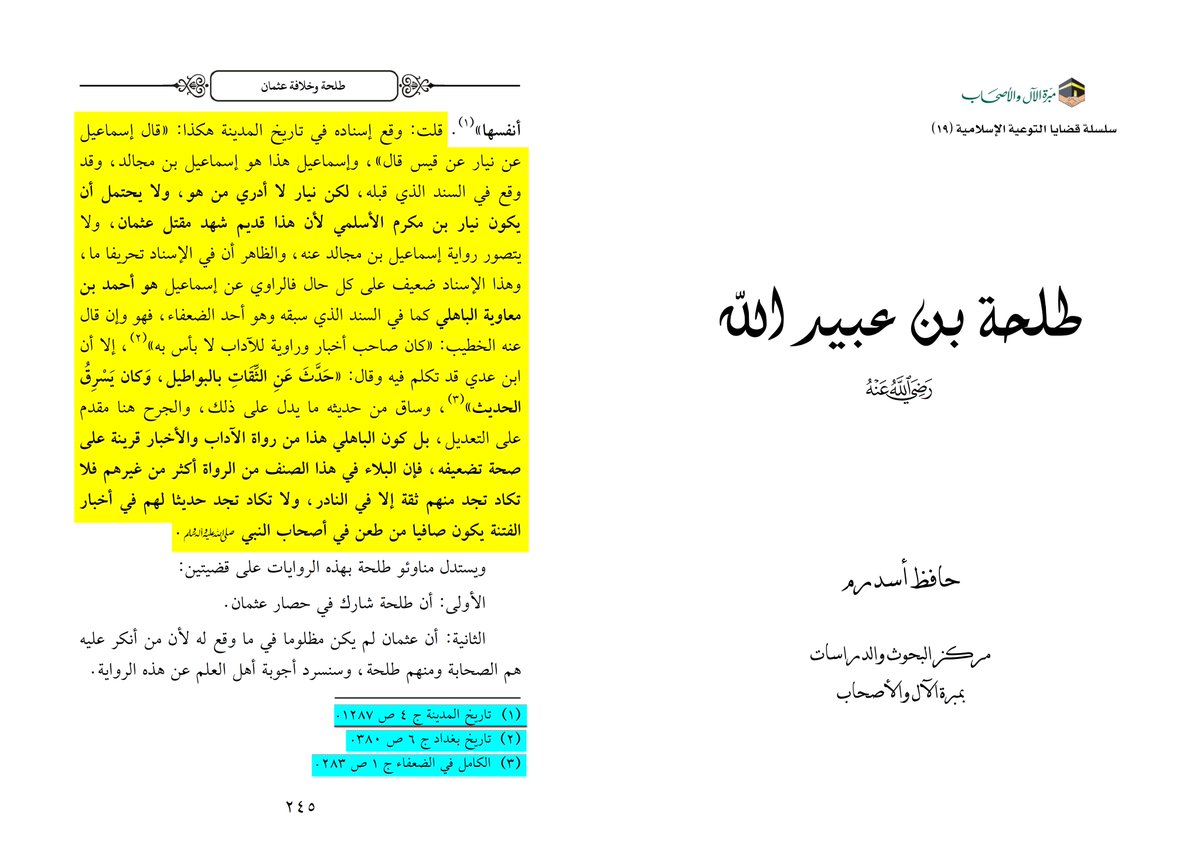
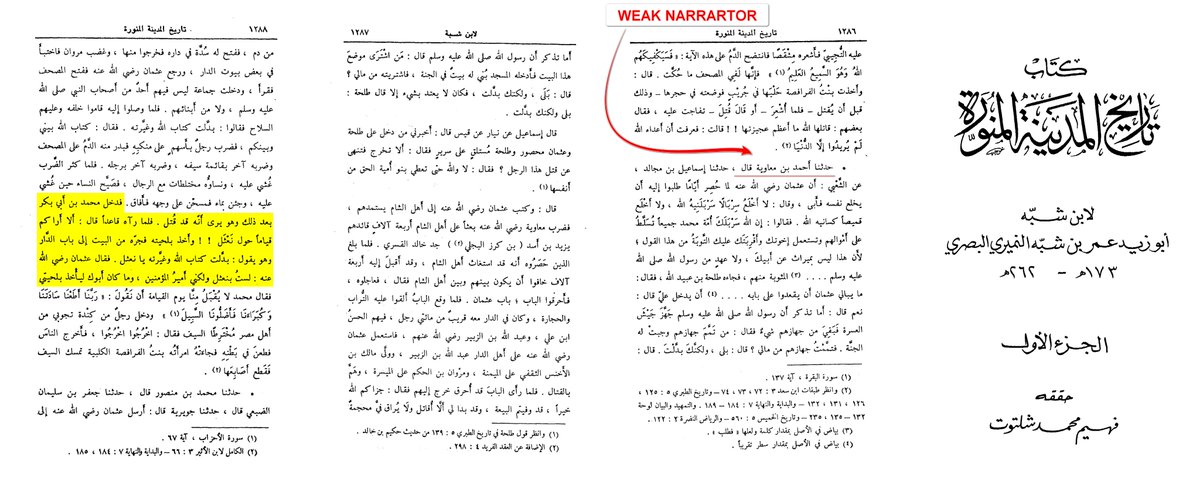
Christian Apologist diverges from @TaymiApologia's point, where he brings a report from Muṣʿab ibn Saʿd ibn Abī Waqqāṣ (d. 103AH) رحمه الله saying that none of the Ṣaḥābah رضي الله عنهم criticised what ʿUthmān رضي الله عنه had done concerning the copies of the Qur'an, by bringing a weak report in which ʿUthmān رضي الله عنه is accused of changing the Qur'an...
Ḥāfiẓ Asad Rustum said that: "The chain of narration in Tarikh al Madinah appears as follows: "Isma'il narrated from Niyar, from Qays, who said..."
This Isma'il is Isma'il ibn Mujalid, who appears in the preceding chain of narration.
As for Niyar, I do not know who he is. It is not possible for him to be Niyar ibn Makram al Aslami, because he belonged to an earlier generation and witnessed the killing of Uthman رضي الله عنه (d. 35AH). It is inconceivable that Isma'il ibn Mujalid could have narrated from him.
It therefore appears that some corruption has occurred in the chain of narration.
In any case, this chain of narration is weak. The narrator who transmitted from Isma'il is Ahmad ibn Mu'awiyah al Bahili, as established in the preceding chain. He is among the weak narrators.
Although al Khatib al Baghdadi (d. 463AH) said concerning him, "He was a narrator of historical reports and literary accounts, and there was nothing objectionable about him." (Tarikh Baghdad, al Khatib al Baghdadi, 6/380).
Ibn Adi (d. 365AH), however, criticised him, saying: "He narrated false reports from trustworthy narrators and used to steal Hadith." (Al Kamil fi al Duafa, Ibn Adi, 1/283).
The context of his narrations also provides evidence supporting this criticism.
Therefore, the jarh (criticism of a narrator) takes precedence here over the ta'dil (declaration of a narrator's reliability).
Furthermore, the fact that al Bahili was a narrator of literary accounts and historical reports lends further support to the criticism of his reliability.
This is because serious weaknesses are more common among narrators of this category than among others. It is rare to find a trustworthy narrator among them, and equally rare to find their narrations concerning the events of the Fitnah (civil strife) entirely free from attacks against the Companions of the Prophet ﷺ." (Ṭalḥah ibn ʿUbayd Allāh, by Ḥāfiẓ Asad Rustum, p. 245)
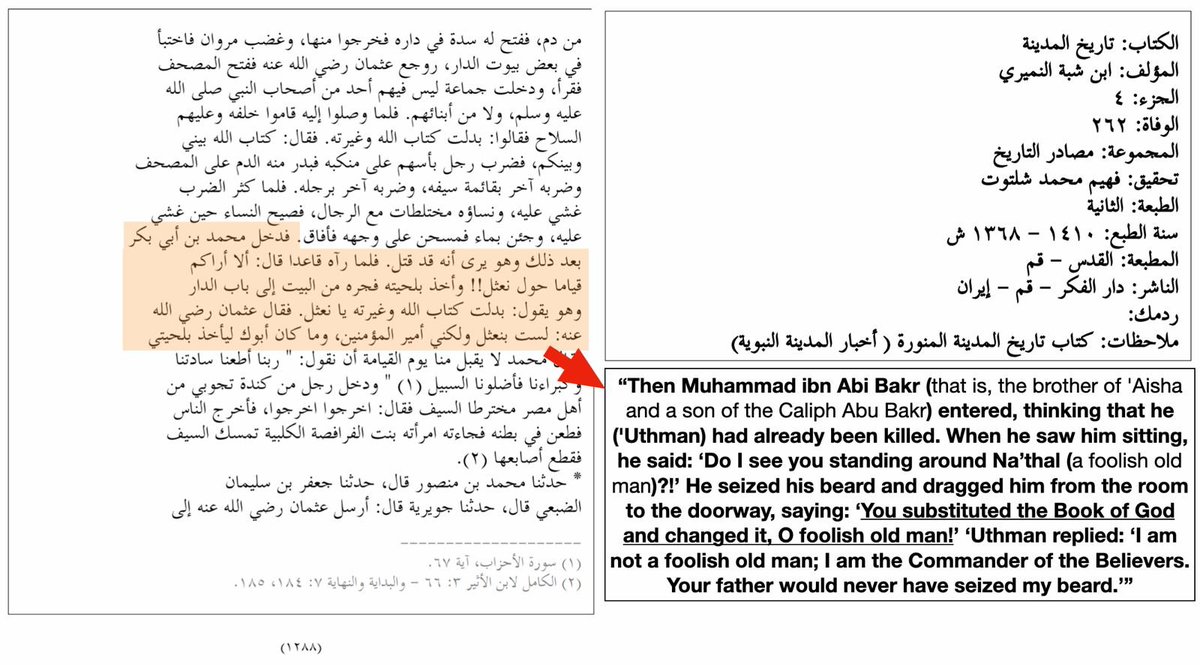
What the Muslim Apeelogetic (see replies for how he earned this name, the NASTY!) isn’t telling you is that the VERY same author, in the VERY same book, reports that 'Uthman was accused by Muhammad ibn Abi Bakr (the son of Abu Bakr) of substituting and changing the Book of God!
How come he omitted this detail?
Abū Ḥayyān ʿAlī ibn Muḥammad ibn al ʿAbbās al Tawḥīdī al Baghdādī (d. approximately 414AH) who was known for his knowledge of philosophy, Taṣawwuf (Sufism), and ʿIlm al Kalām, and who was also associated with Muʿtazila, says that:
Foolishness is widespread among the mutakallimūn. Bad manners are among their finest weapons, and stubbornly refusing to concede the truth is among their greatest means of defence. For this reason, they gather together, yet Allah grants no benefit through their gatherings, their disputes, or their desires." (al Baṣāʾir wa al Dhakhāʾir, Abū Ḥayyān al Tawḥīdī, 3/46)
This is not a response to your scholars being ignorant of the beliefs of the Salaf, but I’ll address it nonetheless. Afterwards, I’d also like you to acknowledge that the belief that the Qurʾān is created was not the belief of the Salaf. Rather, this belief originated with the Jahmiyyah.
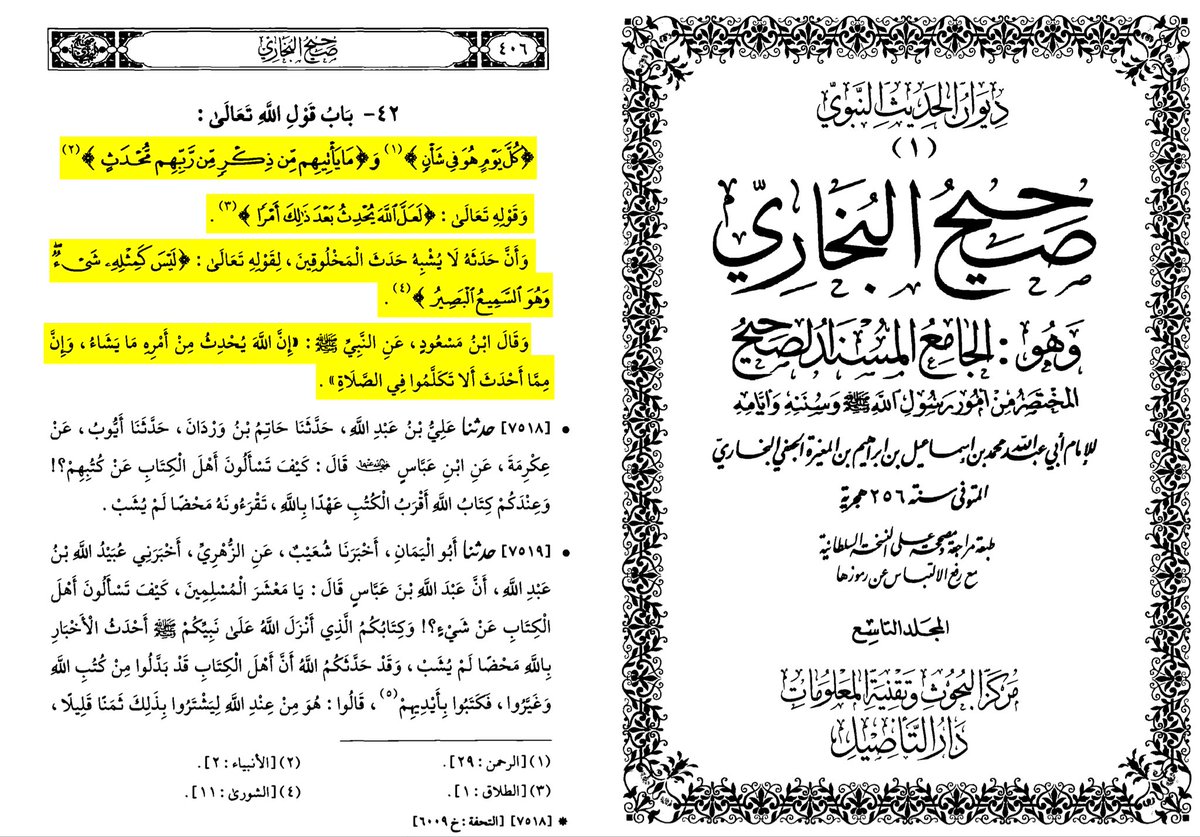
Ibn Taymiyyah mentions two opinions. The first is that the Qur’an should not be called muḥdath, but rather ḥadīth, because muḥdath means something created and separate from Allah.
As for ḥadīth, Allah Himself has described His Speech using this term. This is the position of the Karrāmiyyah and most scholars of ḥadīth and the Ḥanbalīs.
The second position is that it may be called muḥdath, as in His statement:
ما يأتيهم من ذكر من ربهم محدث
“No new reminder comes to them from their Lord.” (al-Anbiyāʾ 21:2)
Although it is not created. This is the position of many fuqahāʾ, scholars of ḥadīth, and scholars of theology, including Dāwūd ibn ʿAlī al-Aṣbahānī, the founder of the school of fiqh.
He also says that those who ordinarily used the term muḥdath only meant something created and separate from Allah. This was the commonly accepted meaning among those who debated the Qur’an during the trial of Imām Aḥmad, may Allah have mercy upon him. They understood muḥdath to mean nothing other than something created and separate from Allah.
According to this terminology, it is not permissible for Ahl al-Sunnah to say that the Qur’an is muḥdath. Rather, whoever says that it is muḥdath has effectively said that it is created.
When it comes to the Qur’an/ the rest of his speech being muhdath, if a person means that Allah spoke particular words by His will after He had not previously spoken those exact words, while He had spoken other words before them and has always been One who speaks whenever He wills, then this meaning is correct, and this has precedence.
Masrūq narrated from Ibn Masʿūd رضي الله عنه: "WHEN Allah speaks with revelation, the inhabitants of the heavens hear something. THEN, when fear is removed from their hearts and the sound subsides, they recognise that it is the truth and call out, 'What did your Lord say?' They reply, 'The truth.'" (Ṣaḥīḥ al Bukhārī, al Bukhārī, chapter concerning Sabaʾ 34:23, preceding 7481.)
The Salaf did not explicitly say the Quran is muhdath.
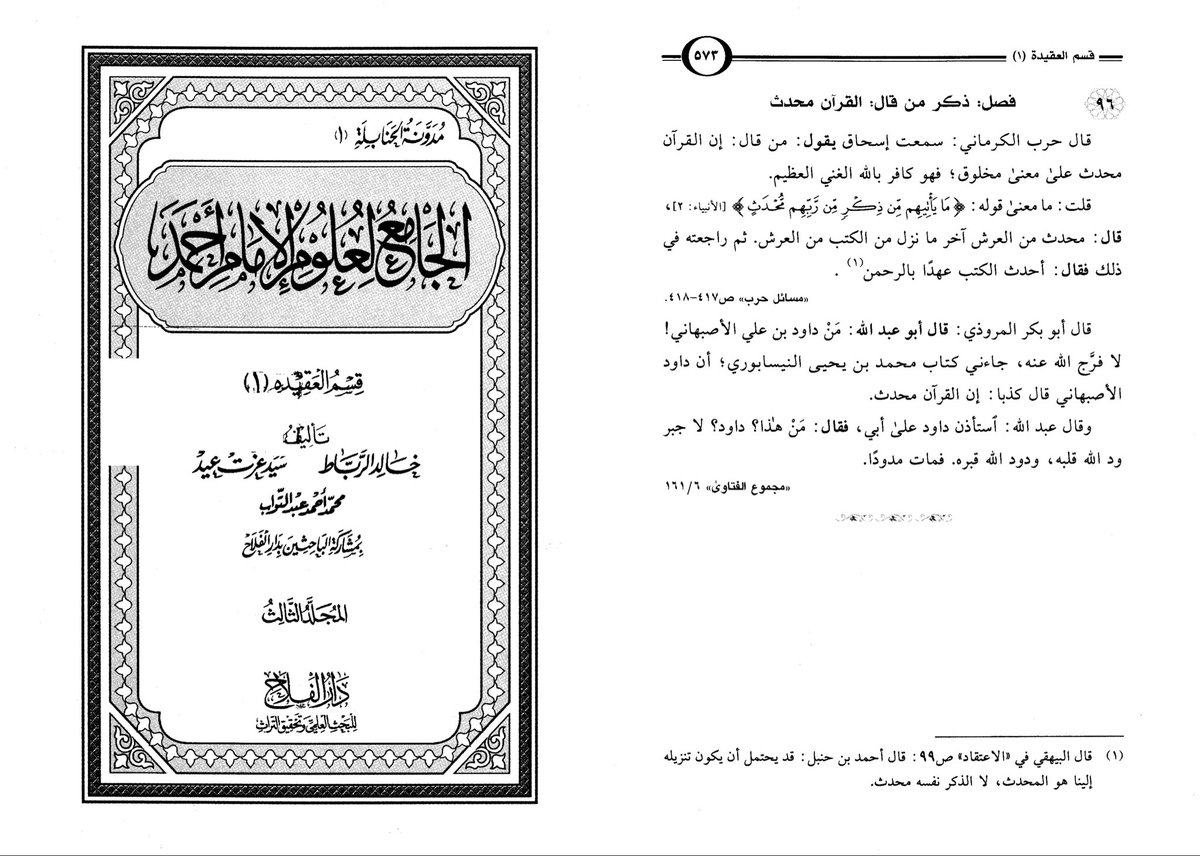
However, Imām al-Bukhārī, Imām Ibn Qutaybah, and Isḥāq ibn Rāhawayh (d. 238AH) differentiated between muḥdath and makhlūq.
Isḥāq ibn Rāhawayh (d. 238AH) said: “Whoever says that the Qur’an is muḥdath (newly originated), على معنى مخلوق (meaning that it is created), has disbelieved in Allah, the Self-Sufficient, the Magnificent.” (Al-Jāmiʿ li-ʿUlūm al-Imām Aḥmad 3/573, Also See Masāʾil Ḥarb al-Kirmānī, Ḥarb al-Kirmānī, 417).
Imām al-Bukhārī (d. 256AH) indicates that the Qur’an can be described as muḥdath (newly occurring) without being makhlūq (created).
He says that Allah brings about new matters as He wills, including revelation, but His actions and speech are unlike those of created beings. (Ṣaḥīḥ al-Bukhārī, al-Bukhārī, 9/406).
Ibn Baṭṭāl (d. 449AH), the Ashʿarī, said: “Al-Bukhārī’s intention was to distinguish between describing the Speech of Allah, the Most High, as makhlūq (created) and describing it as muḥdath (newly occurring). He rejected describing it as makhlūq but considered it permissible to describe it as muḥdath, relying upon the Qur’an verse as evidence.” (Fatḥ al-Bārī by Ibn Ḥajar 24/511 Also See Sharḥ Ṣaḥīḥ al-Bukhārī, Ibn Baṭṭāl, 10/525).
Ibn Qutaybah (d. 276AH) denies the claim that the Qur’an is created simply because Allah describes the revelation as muḥdath (newly occurring), and says that muḥdath does not necessarily mean makhlūq (created). (al-Ikhtilāf fī al-Lafẓ wa al-Radd ʿalā al-Jahmiyyah wa al-Mushabbihah, Ibn Qutaybah, 39).
See these two articles for more depth — https://t.co/PplbmIOJbY
https://t.co/ROJuho0yOu
Did Imām al Ṭaḥāwī Practise Tafwīḍ al Maʿnā? — https://t.co/HMgMIDrml7
This article is a detailed refutation of the claim that Imām al Ṭaḥāwī (d. 321AH) practised Tafwīḍ al Maʿnā, using the explanations of Shaykh ʿAbd al Raḥmān al Barrāk and Shaykh Yūsuf al Ghafees. Al Ṭaḥāwī affirmed the intended meanings of revelation, particularly the believers’ really seeing Allah in the Hereafter, which is the apparent meaning of the Hadith “You will certainly see your Lord” (Ṣaḥīḥ al Bukhārī 7434).
The Early Imāms Took the Apparent Meaning — https://t.co/P73dKg9pBu
An extensive collection of statements from the Salaf and major scholars of Ahl al Sunnah taking the apparent meaning of Allah’s attributes, taken from the Book Al Ashāʿirah fī Mīzān Ahl al Sunnah (The Ash'aris in the Scale of Ahl al-Sunnah) by Fayṣal al Jāsim.




![RaadIbnDawood's tweet photo. In his commentary on verse 52 of Sūrat Maryam, Imam Mujāhid (d. 104 AH) said:
❝Between the seventh heaven and the Throne are seventy thousand veils. Mūsā continued to draw nearer [to Allah ﷻ] until there remained only one veil between him and Him. When he saw His place (i.e., the place of Allah ﷻ) and heard the creaking of the Pen, he said: ‘My Lord, show me [Yourself] that I may look at You.’❞
Imam al-Dhahabi commented: “This is authentically reported from Mujāhid, the great Imam of Tafsīr.”](https://pbs.twimg.com/media/HUNtbv5WMAAGSNm.jpg)










![RaadIbnDawood's tweet photo. In his commentary on verse 52 of Sūrat Maryam, Imam Mujāhid (d. 104 AH) said:
❝Between the seventh heaven and the Throne are seventy thousand veils. Mūsā continued to draw nearer [to Allah ﷻ] until there remained only one veil between him and Him. When he saw His place (i.e., the place of Allah ﷻ) and heard the creaking of the Pen, he said: ‘My Lord, show me [Yourself] that I may look at You.’❞
Imam al-Dhahabi commented: “This is authentically reported from Mujāhid, the great Imam of Tafsīr.”](https://pbs.twimg.com/media/HUNtbv-W8AAIT5C.jpg)