Anatomy is now available on paper.
You can now generate printable PDFs of any figure, making it easier to bring anatomy to life at home, in the classroom, or for homework and learning.
Try this prompt with Hermes:
Explore all memory files, notes, conversations, and knowledge sources you can access. Extract topics, projects, people, and ideas. Identify relationships and form clusters of related items. Research the best free local tools for interactive network or force-directed graph visualizations. Then build and host a browser-based interactive knowledge graph where nodes represent memories or documents and edges show connections, so I can explore everything visually.
Introducing Anatomy
Describe a machine in one line. Claude brings it to life.
- Interactive isometric wireframes you can rotate, inspect and explore
- WebGL shaders for fire, water, plasma and more
- Real 3D motion, with individual parts that rotate and move
Install it as an agent skill. Fully open source.
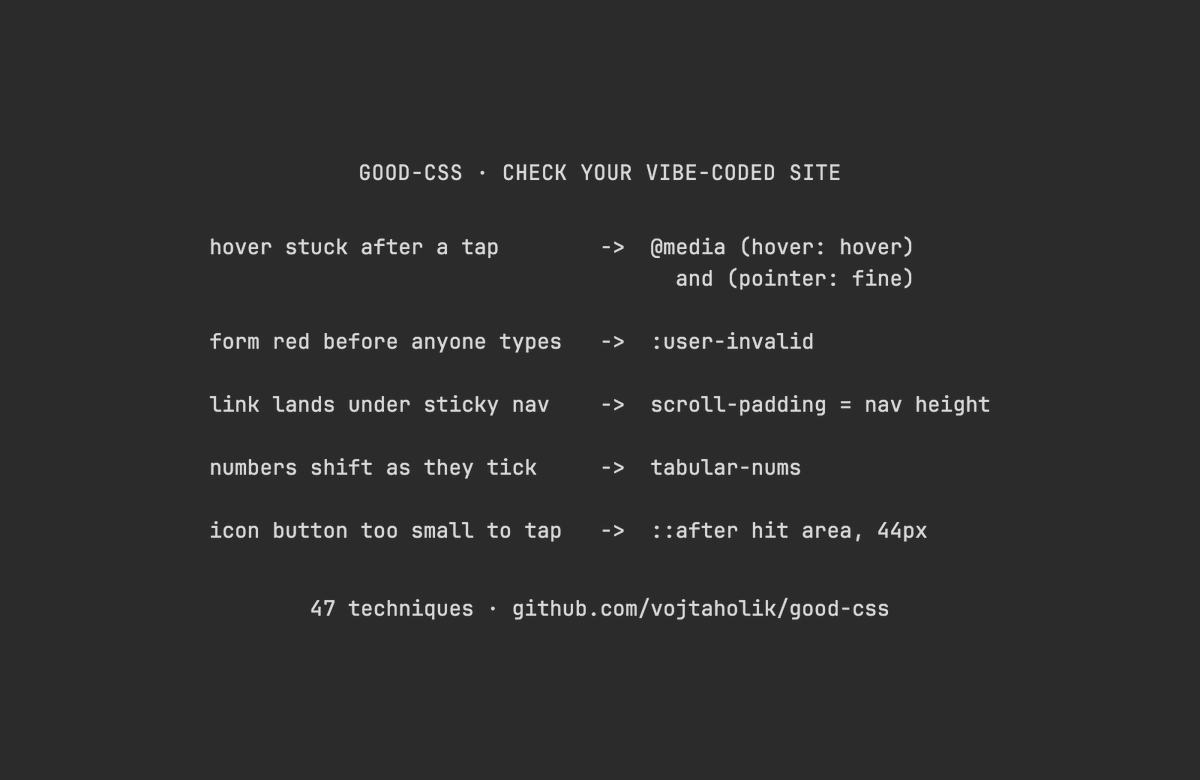
Highly recommend installing 𝗴𝗼𝗼𝗱-𝗰𝘀𝘀 in Claude Code or Codex, then having Opus 5.5 use it to 𝗰𝗵𝗲𝗰𝗸 𝘁𝗵𝗲 𝘀𝗶𝘁𝗲 𝘆𝗼𝘂 𝘃𝗶𝗯𝗲-𝗰𝗼𝗱𝗲𝗱. It holds 47 modern CSS techniques, and with it installed, your agent tries them first whenever it writes styles.
A few on the list you can check right away:
→ Tap a button on your phone and 𝘁𝗵𝗲 𝗵𝗼𝘃𝗲𝗿 𝗲𝗳𝗳𝗲𝗰𝘁 𝗴𝗲𝘁𝘀 𝘀𝘁𝘂𝗰𝗸. Put hover styles inside (hover: hover) and (pointer: fine) so only devices with a mouse get them
→ Open a form and every required field is already red. Switch to :user-invalid so a field turns red only after someone edits it or hits submit
→ Click an in-page link and the heading lands under your sticky nav. Give html a scroll-padding as tall as the nav, and the jump lands just below it
→ A price or timer ticks and the text next to it shifts. Add tabular-nums so every digit is the same width
→ An icon button is too small to tap. Use a pseudo-element to grow the tap area to 44px without changing how it looks
Send this prompt to Opus 5.5 👇
"Install good-css following the README at https://t.co/dXWbMbn7eF, then read its SKILL.md and the reference files you need.
Then use it to check this project's existing styles (CSS files and Tailwind classes in components both count) for three kinds of problems:
1. Things that break on phones: hover states that stick after a tap, and tap areas smaller than 44px.
2. Things CSS can do that were built with scripts or a pile of breakpoints: dropdown menus, popovers, accordions, and layouts stitched together from several breakpoints.
3. Details: in-page links that land under the sticky nav, forms that open already full of red borders, ticking numbers that shift the text next to them, and focus rings that were removed.
Report only these three kinds and skip any the project doesn't have. Components that come from a component library don't count. For each issue, quote the original code, explain what goes wrong on which device, and suggest the smallest change, ranked by impact. Also note which browsers don't support a technique you use yet.
Show me the list of issues first. Don't change any code."
@mattpocockuk's skills repo has more stars than React, and the most installed skill is one line long.
I animated how his whole workflow works, from /grill-me to /retro
Claude Code users, change this setting if you use subagents.
Claude has prompt caching with a 1-hour TTL, but that’s only for the main agent. Subagents get just 5 minutes by default.
If you use long-running subagents, I recommend increasing their cache TTL to 1 hour.
Just add this to ~/.claude/settings.json:
"subagentPromptCacheTtl": "1h"
Not sure why this isn’t the default.
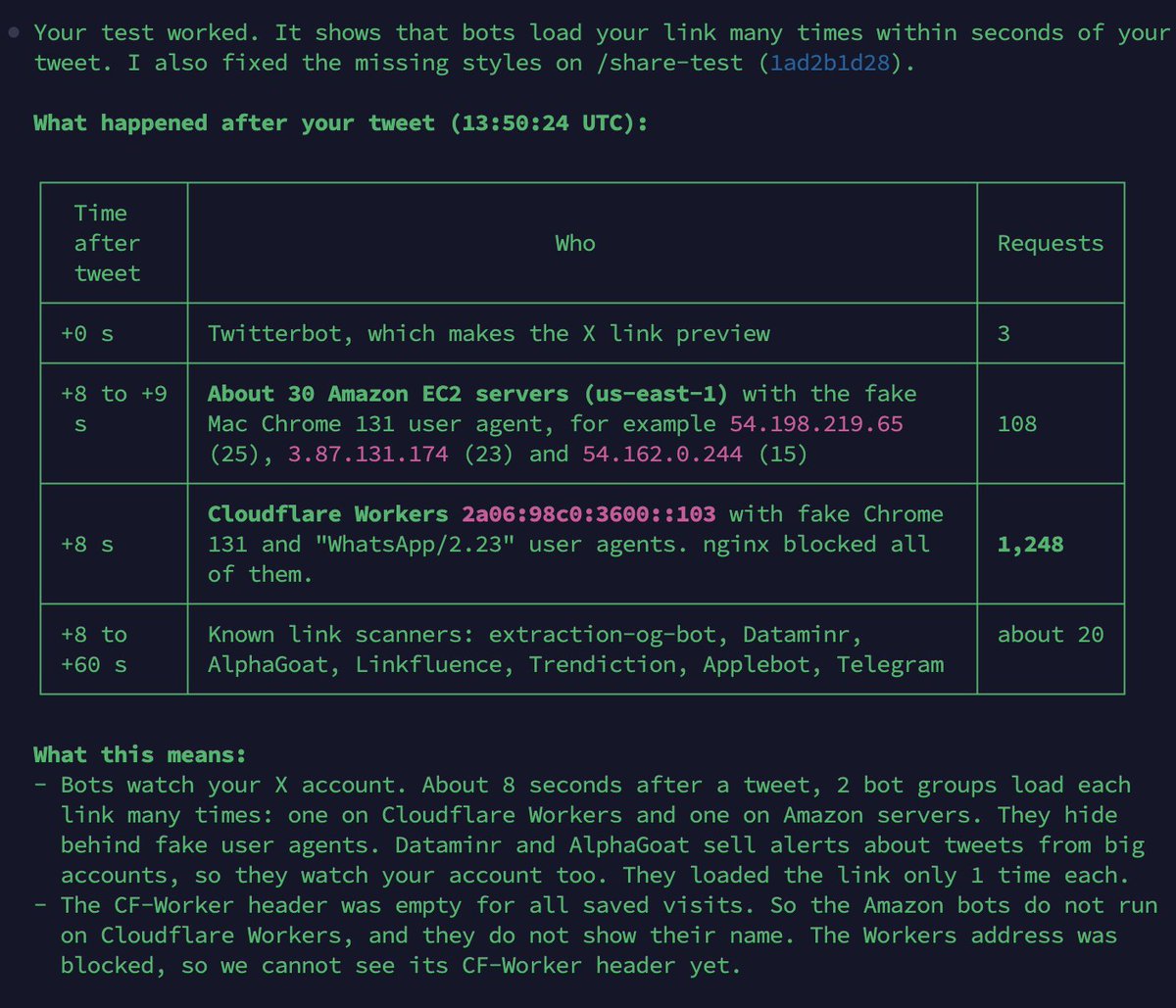
I discovered that 1000s of bots are actively monitoring X for new links posted, probably not just on my account
I noticed when everytime I'd share one of my sites new features or pages, the page would get a bit slower just after posting, then I asked Claude to analyze it
I tweeted a test URL as a reply somewhere deeply hidden in a thread (so not even a main post)
And within 8 seconds there's thousands of crawlers opening the page!
One is a military intelligence firm, that scans social media for breaking news and sells alerts to newsrooms, banks, companies and government, it specifically follows accounts with many followers
Another one is a social media monitoring company that tracks what people say online
I knew of course high frequency trading firms use online news to trade fast on things, but interesting to see it in real life
Twitterbot (X) of course is first, within 0 seconds of sharing, it opens it (probably when I wrote the tweet)
The first non-X bot arrives just 8.40s later, which I think is pretty fast considering it's a reply by me deeply hidden in a thread somewhere
TL;DR they're watching you!
holy sh*t. Official Anthropic tip for Claude Code: stop burning Opus 5.5 context on tasks Haiku 5.5 can swarm, while Sonnet 5.5 builds
put the architect on call with /advisor
claude --advisor opus --subagents haiku
Sonnet 5.5 drives the primary session on high effort, writing diffs and running test suites
Haiku 5.5 subagents swarm the repo in parallel at 340 tok/s, handling file discovery and spec docs lookup
Opus 5.5 stays on call in the background as the advisor, only stepping in at three critical moments:
→ before a plan locks: does the implementation plan miss auth invariants or schema contracts?
→ when a test breaks twice: are we fixing the root cause or falling into a recursive rabbit hole?
→ before calling done: did the full diff introduce hidden regressions or break pre-flight rules?
Opus 5.5 reviews. Sonnet 5.5 builds. Haiku 5.5 swarms
Jev engineering runs the identical pattern one layer down: mechanical decisions that need no reasoning (which file to open, which tool to invoke, retry or abort) execute in 16ms, so the frontier models only wake up when execution paths actually diverge
Plan on high. Delegate on medium. Keep Opus on call.
- the full advisor setup
> Opus 5.5 on call reads full session history and catches deep architectural traps
> Sonnet 5.5 lead drives edits, writes core logic, and executes test harnesses
> Haiku 5.5 subagents swarm AST parsing, grep scans, and API docs in parallel
> JEV micro-fork layer resolves 1,500+ mechanical routing branches in under 16ms
> advisor stays completely silent on routine bash execution to protect context
paste the setup and this prompt into Claude Code below:
"Configure my Claude Code workspace for hierarchical advisor orchestration:
1. Audit ~/.claude/settings.json and project config for model roles fitting lead, subagents, and advisor:
> Pin main session model: sonnet with effortLevel: high for primary execution
> Pin subagents model: haiku with effortLevel: medium for parallel file discovery and docs retrieval
> Pin advisor model: opus on call for strategic review
2. Enable the advisor tool in ~/.claude/settings.json:
> Set advisorModel to claude-opus-5-5
> Enable subagent parallel dispatcher pool (3x workers)
3. Configure automatic advisor consultation checkpoints in ~/.claude/CLAUDE.md:
> Consult /advisor opus before finalizing multi-file architecture plans
> Automatically summon /advisor opus when the same test or compiler error fails twice
> Enforce advisor diff contract audit before declaring tasks complete or staging git commits
4. Constrain subagent scopes:
> Haiku subagents return structured AST summaries and docs snippets only without modifying main session context
Show every configuration diff first. Do not apply edits until confirmed"
↳
https://t.co/gvAWk6KbDn