Introduction to Modern Statistics: https://t.co/COq0CLz1Ds
📊📈
Choose:
1️⃣Read it FREE online.
2️⃣Or name-your-own-price for the PDF.
3️⃣Or buy the book here: https://t.co/wiF6qwHL09
————
#Mathematics#DataScience#DataScientist
A University of Colorado Boulder professor built one of the best AI-learning resources I’ve seen for people who are tired of learning about models through diagrams and code alone.
Prof. Tom Yeh makes students calculate modern AI architectures by hand.
Transformer. Self-attention. Multi-head attention. MoE. Switch Transformer. Mamba S6. CLIP. U-Net. Sparse Autoencoders. BitNet. RLHF. Even Diffusion Transformers.
The idea is simple => shrink the architecture until the full forward calculation fits on a page, then work through every number with a pen. Yeh describes the project as reducing each model to an example small enough to calculate end-to-end by hand.
Learn here: https://t.co/DXfVjhdGkl
In C, `array[i]` does not add i to the address. It adds i times the size of one element. Assembly has to do that multiply. C hides it.
Stanford CS107, lecture 9.
most programmers learn math backwards.
theory first. application somewhere later.
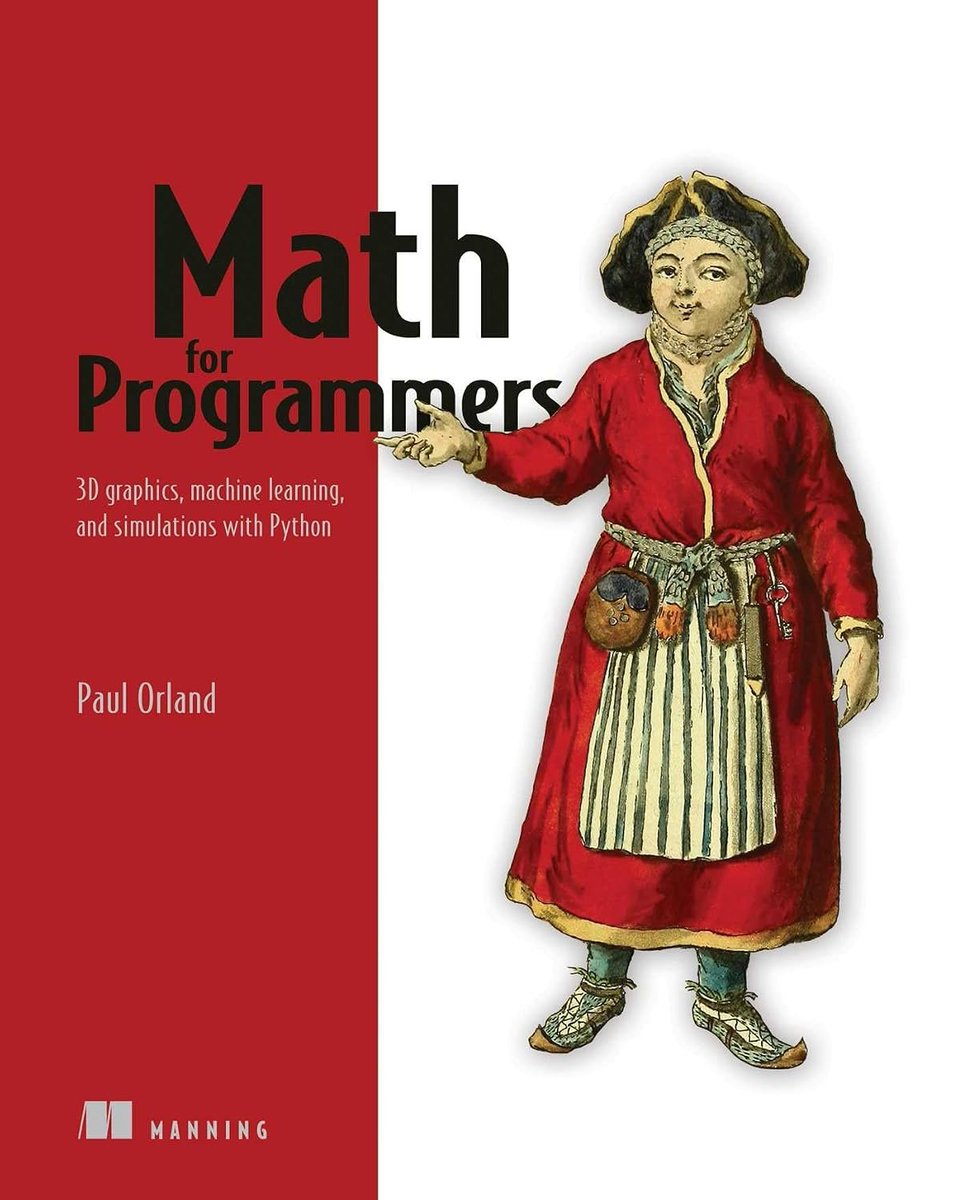
math for programmers by Paul orland does the opposite.
→ vectors become movement in 3d space
→ matrices become transformations
→ calculus becomes motion and optimization
→ probability becomes reasoning under uncertainty
→ linear algebra becomes the machinery behind machine learning
then you implement the ideas in python.
this is how math should be learned for engineering:
concept → intuition → code → experiment
you stop seeing equations as symbols to manipulate.
you start seeing them as executable descriptions of reality.
"Fundamentals of Linear Algebra" is an excellent 400-page textbook on linear algebra, freely available from the University of British Columbia.
It covers linear systems, matrices, vector spaces, linear transformations, determinants, eigenvalues and eigenvectors, inner product spaces, diagonalization, and much more. It also includes some interesting applications, including linear coding theory and many exercises.
I think it is a very useful resource if you are studying linear algebra and want a substantial reference to keep at hand.
https://t.co/oWytdLxTaN
My little essay on "Learning Mathematics" has received a lot of attention, and I'm really happy with all the feedback I've received. If you missed it, I'm sharing it again here. I'm already working on the second instalment.
Agency > Intelligence
I had this intuitively wrong for decades, I think due to a pervasive cultural veneration of intelligence, various entertainment/media, obsession with IQ etc. Agency is significantly more powerful and significantly more scarce. Are you hiring for agency? Are we educating for agency? Are you acting as if you had 10X agency?
Grok explanation is ~close:
“Agency, as a personality trait, refers to an individual's capacity to take initiative, make decisions, and exert control over their actions and environment. It’s about being proactive rather than reactive—someone with high agency doesn’t just let life happen to them; they shape it. Think of it as a blend of self-efficacy, determination, and a sense of ownership over one’s path.
People with strong agency tend to set goals and pursue them with confidence, even in the face of obstacles. They’re the type to say, “I’ll figure it out,” and then actually do it. On the flip side, someone low in agency might feel more like a passenger in their own life, waiting for external forces—like luck, other people, or circumstances—to dictate what happens next.
It’s not quite the same as assertiveness or ambition, though it can overlap. Agency is quieter, more internal—it’s the belief that you *can* act, paired with the will to follow through. Psychologists often tie it to concepts like locus of control: high-agency folks lean toward an internal locus, feeling they steer their fate, while low-agency folks might lean external, seeing life as something that happens *to* them.”
A dead MIT professor watched generations of engineers fall in love with the wrong thing. Neural nets. Genetic algorithms. Bayesian probability. Every year, a new method. Every year, the same blind spot.
Patrick Winston ran the MIT AI Lab for twenty-five years. He died in 2019. He gave it a name: mechanism envy.
Falling in love with a tool before asking what the problem is.
He taught the fix for fifty years. Start with the competence you want to understand. Find a representation that exposes the constraints. Only then pick a method. Without the right representation, you are guessing with expensive machinery.
Wall Street has the same disease. A trader buys a Bloomberg terminal before learning expected value. A founder hires a data team before understanding base rates. A retail investor opens a brokerage app before knowing that the number on the fund brochure is not the number that hits their account.
Quant firms do not pay half a million for methods. They pay for five representations: expected value, base rates, ergodicity, conditional probability, signal versus noise. Five ways of seeing that change every bet before you touch the machinery.
The lecture is free. The five models fit in one article. Almost nobody installs the representations before reaching for the tools.
The representations are free. Installing them is the entire edge.
HARVARD FILMED A PROFESSOR EXPLAIN IN 48 MINUTES WHAT TOOK MATHEMATICIANS 200 YEARS TO FIGURE OUT - AND SHOWS WHY THE SMARTEST MAN WHO EVER LIVED GOT THE INTUITION COMPLETELY WRONG
This is Joe Blitzstein, Harvard Statistics 110, lecture 4. He has won Harvard's Excellence in Teaching award multiple times, his textbook is used in over 200 universities worldwide, and his course has been taken by over 2 million people across 190 countries. He opens with one claim - conditioning is the soul of statistics. Everything else in the course follows from that.
He starts with De Montmort's matching problem. A deck of n cards labeled 1 through n, flipped one by one. What is the probability at least one card lands in its own position? The exact answer collapses into 1 minus 1 plus 1 over 2 factorial minus 1 over 3 factorial, continuing to n terms - which is exactly the Taylor series for e to the x at minus 1. The probability of no match converges to 1 over e, which is 0.37, no matter how large the deck gets.
Then the Newton-Pepys problem, 1693. At least one six from six dice, at least two sixes from twelve dice, or at least three sixes from eighteen dice - which is most likely? Pepys bet on the third. Wrote to Newton. Newton calculated correctly and showed it was the first, probability 0.665. Then the real punch - Newton's intuitive argument was wrong, and a statistician named Stigler proved it without even understanding what Newton wrote. Newton's argument never used the fact that the dice were fair. So it could not possibly be correct.
Then conditional probability. The definition is a single fraction - probability of A given B equals probability of A and B divided by probability of B. Blitzstein explains it two ways. First, pebble world - learning B occurred simply erases every outcome outside B and renormalizes what remains to sum to 1. Second, frequentist world - repeat the experiment many times, circle every run where B occurred, ask what fraction of those also had A.
Watch the moment he derives Bayes' rule in 10 seconds - divide both sides by P of B, end of proof. Then says controversies about this one line have raged for centuries and an entire field of statistics was built on top of it.
A data scientist I know rewatched this before switching careers into statistics. Said it was the first time probability felt like a system with rules rather than a collection of tricks.
Free on YouTube, Harvard, over 2 million views.
bookmark this and watch later - after this lecture every time you learn something new you will feel yourself updating a probability rather than changing your mind


![KirkDBorne's tweet photo. Free Mathematics PDF — MIT guide to the mathematical foundations of computer science: https://t.co/XCLY3DAs9w [1048 pages] https://t.co/Rv0MR4Nz7Q](https://pbs.twimg.com/media/HP5laTHXwAAWwD4.jpg)