An adult female elephant is called a cow
An adult male elephant is referred to as a bull.
A baby elephant is known as a calf.
The oldest and largest female elephant who leads the entire herd is called the matriarch. ✨️🐘
A fun table that puts everyday radiation risks into perspective. ☢️🍌
Radioactive materials are naturally present all around us - in our food, air, and water. In fact, our normal diet gives us an annual dose of less than 0.3 mSv, proving that low-level radiation is simply a normal part of daily life on Earth
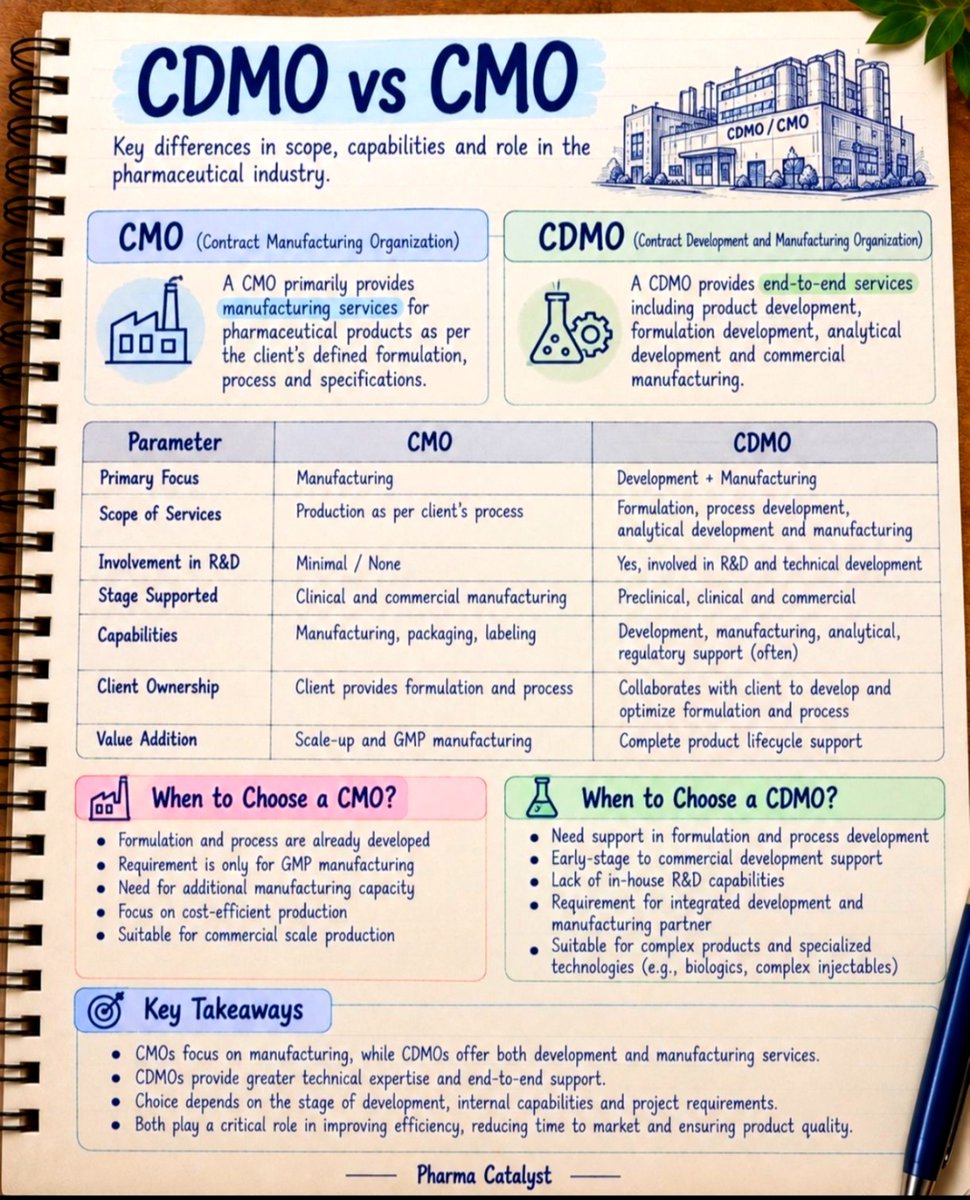
The main difference between a CMO (Contract Manufacturing) and a CDMO (Contract Development & Manufacturing) comes down to whether you need just a factory or a full drug-development partner. 🧪🏭
• Shifting a drug from a separate development lab to a CMO factory is notorious for costly errors. CDMOs keep everything under one roof to kill that risk.
• Over 70% of new drug pipelines are driven by small biotech startups. Because they lack physical factories, the CDMO market is absolutely exploding.
Choose a CMO if you want to cut costs on an established drug. Choose a CDMO if you are bringing a brand-new molecule to life.
Just read about this place in Japan and it looks so cool! Personally I don't drink, but for those who do and are science lovers it's worth a visit. It's a unique bar in Shinjuku, Tokyo called Science Bar INCUBATOR. They offer interactive demonstration cocktails, highly visual and bite-sized food to manipulate with laboratory tools, a fresh lab coat on arrival to look the part, and a relaxed vibe with authentic scientific decor. They hold a maximum of 16 guests and feature a multi-lingual smartphone ordering system so it's highly accessible for international travellers. 🇯🇵🥼🧪✨️
This! 👏 People don't realise how much time and effort goes into bringing life-changing medication to market. It's a massive group effort. Collectively our goal is to save lives, yet we have to listen to nonsense from others who have no understanding questioning our work.
Yes I completely agree with this. Many pursue research because they are passionate about a subject and want to build their skills and knowledge. You don't need one necessarily, and it doesn't make you any less than one who doesn't have one. I know many who went straight to industry after undergrad and they're incredible scientists. Not everyone ends up in academia, but it's a great starting point to pursue other avenues. It all depends on each individuals journey, not everyone is going to be ready to jump into a start-up.
Also many start-ups looking to hire want the best scientists or engineers. Naturally they will favour the ones who have done a PhD because they've got evidence to show their research over a specific period, especially if its on a topic of interest.
I don't know anyone who's done a PhD who looks down on others who haven't done one or acts superior in any way. Not sure where this is coming from. People see one random example online and think it's the same for everyone. If anything most PhDs love to talk with others that are passionate about their work, regardless of their credentials and background! That's what science is all about.
We’ve lost an icon. Margaret Hamilton, a computer science pioneer best known for her work at MIT leading development of the flight software for the Apollo missions to the moon, has died at 90. Read about her legacy via MIT News: https://t.co/ODkbdIsoHw
Homochirality is where molecules exist purely as one "handedness" instead of a mix of mirror images.
In medicine, many drugs are chiral. They exist as a pair of enantiomers (non-superimposable mirror-image molecules). Often, the right-handed enantiomer cures a disease, while the left-handed version does nothing or is highly toxic.
Historically, manufacturing just one specific enantiomer without using tedious biological extraction was incredibly difficult.
Kagan and Soai completely changed the game:
Henri Kagan discovered nonlinear effects, proving a tiny molecular imbalance could drastically tip a reaction to favor one enantiomer.
Kensō Soai developed an elegant reaction using autocatalysis, where the desired drug molecule acts as its own catalyst, replicating itself while completely shutting out the undesired enantiomer.
Thanks to their work in asymmetric organic synthesis, pharmaceutical scientists can now cleanly mass-produce the exact, safe enantiomers needed for modern medicines.
Thoughtful and, if possible, handmade or personalised gifts are the best. I love getting my loved ones gifts that are useful and something they can remember me by.