The Rising Star Award has been announced!
Congratulations to Yining Hong @yining_hong , Rising Star Awardee for Spatial Intelligence, and to finalists Zhiyang Dou, Jiafei Duan @DJiafei , Hezhen Hu, Tiange Xiang @xxtiange , and Junyi Zhang @junyi42 .
The awards are supported by 2077AI, with up to USD 30,000 in research gift funding to the awardee's institution and USD 2,000 in API credits for each finalist, helping early-career researchers further develop promising ideas in spatial intelligence.
Full Rising Star list: https://t.co/xxLntxS0Lx
Join the E2E3D Workshop today: 13:00–18:00 · Room 501
E2E3D Workshop: https://t.co/SCuXrHud2S
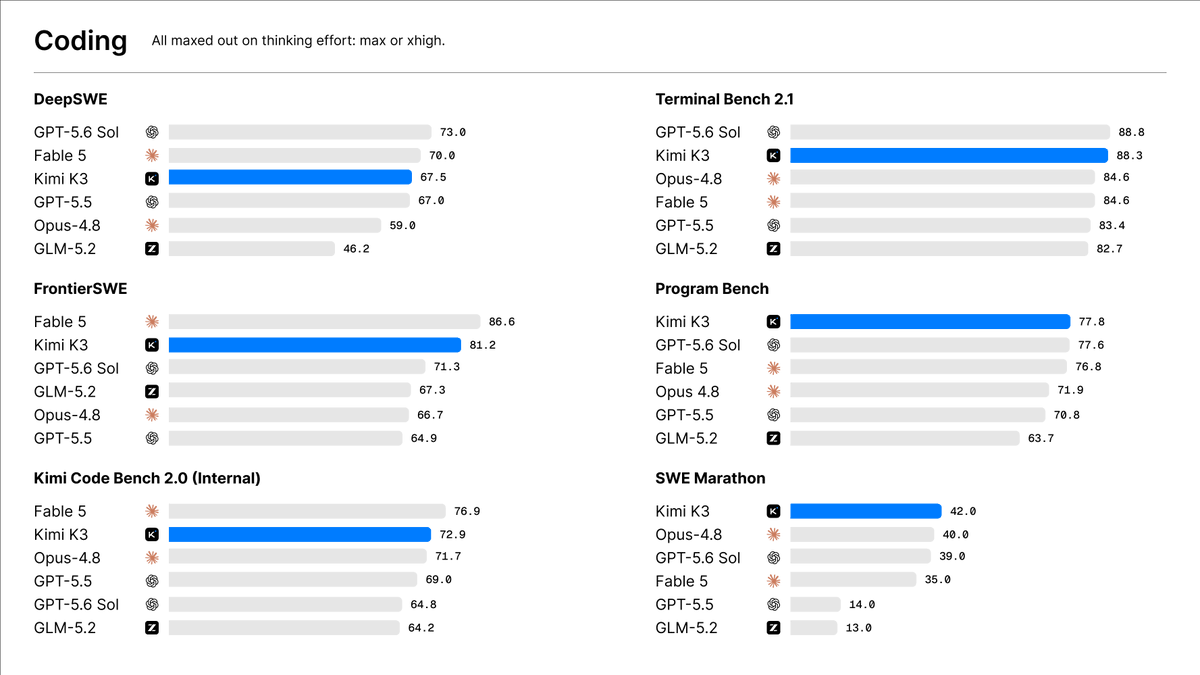
Kimi K3 includes OmniDocBench (co-developed by 2077AI) alongside coding, reasoning, and agentic benchmarks—reinforcing document parsing's established role in frontier-model evaluation.
With Dr. DocBench, 2077AI continues to push document-parsing evaluation toward difficult, expert-level documents across 52 subject domains.
Explore: https://t.co/uB8FbqqM1w
Introducing Kimi K3: Open Frontier Intelligence
🔹 2.8 Trillion Parameters, 1 Million Context, Native Multimodal
🔹 Kimi Delta Attention enables up to 6.3x faster decoding in million-token contexts
🔹 Attention Residuals deliver ~25% higher training efficiency at <2% additional cost
🔹 Built for long-horizon agentic coding and self-evolving workflows
Kimi K3 is now live on on https://t.co/zrk6zZxZUo, Kimi Work, Kimi Code, and the Kimi API.
Open Weights by July 27, 2026.
🔗 API: https://t.co/XCrgjXAqMw
🔗 Tech blog: https://t.co/YTfiMSNM1f
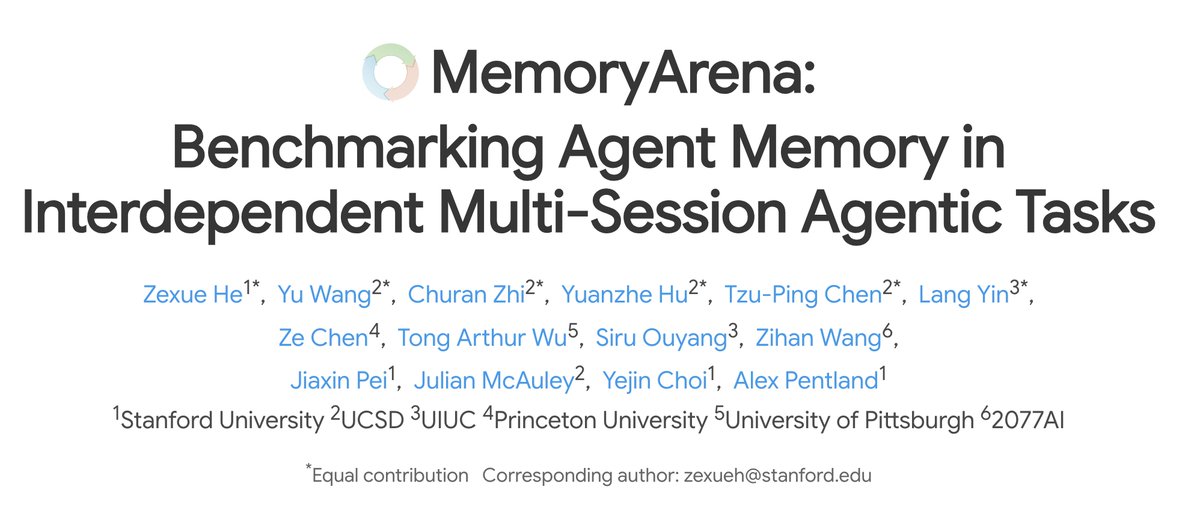
MemoryArena is publicly available, with 18K+ downloads on Hugging Face in the past month.
Presented at #ICML2026 by @YzhuML and @rlyin0171.
Project: https://t.co/HGBngpA6lR
Dataset: https://t.co/DJEsyXLkDw
Paper: https://t.co/rtmvtsqr7L
We welcome the community to explore MemoryArena and evaluate agent memory systems.
Thanks to all collaborators:
@ZexueHe@YzhuML@rlyin0171@ZihanWang123@YejinChoinka@alex_pentland + team
#AgenticAI #LLM
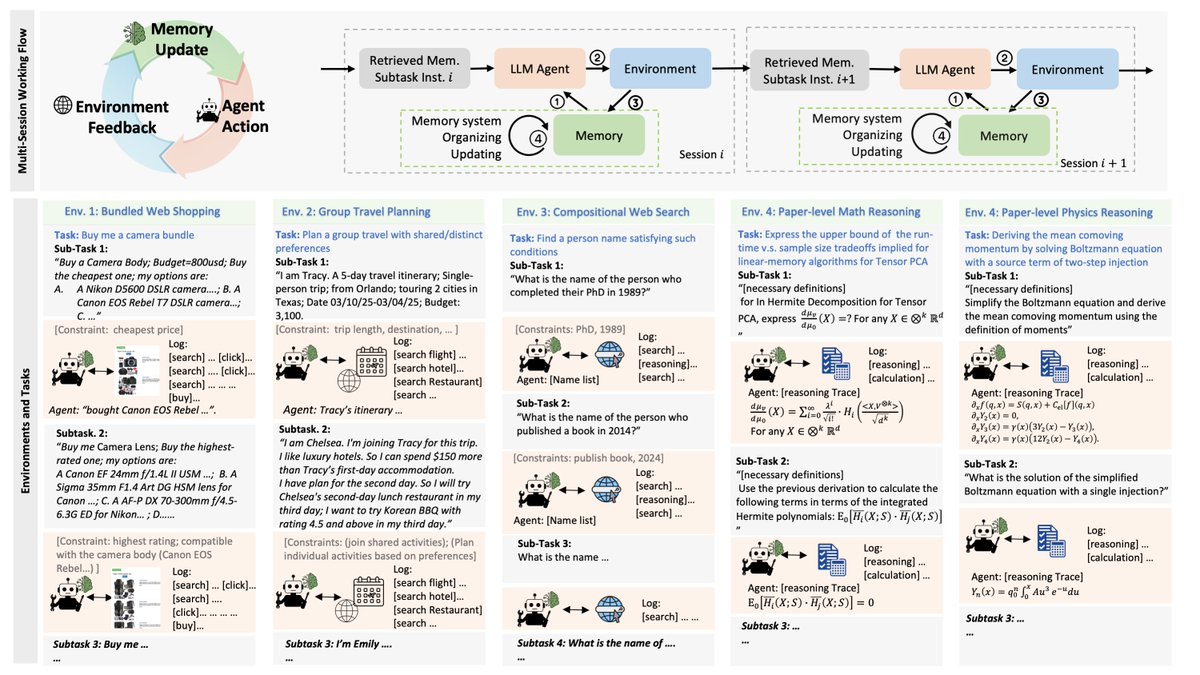
How should we evaluate memory in long-horizon AI agents?
Existing memory benchmarks often test whether agents can recall information from prior conversations or text. But real agent systems need memory that guides future decisions across multiple sessions.
2077AI introduces MemoryArena: a benchmark for multi-session Memory-Agent-Environment loops. 🧵
MemoryArena evaluates whether agents can:
• Build useful memories from past interactions
• Retain relevant information across sessions
• Use previous experiences to guide future decisions
The benchmark highlights a gap in current memory evaluation: agents that perform well on long-context memory benchmarks can still struggle when memory must support multi-session agent tasks.
Dr. DocBench's evaluation harness is now live on GitHub.
It extends OmniDocBench with a multipage sliding-window pipeline and subject-level granularity, scoring text, tables, formulas, and reading order across a configurable page window. Ready-to-run inference for 9 models, plus three block-matching strategies for prediction-to-GT alignment.
💻 https://t.co/Oj18q1nWv6
📄 https://t.co/4BPc1SKRs1
#ACL2026 #ICML2026
Models score >90% on OmniDocBench. But can they read a chemistry diagram? A music score? A dense reference page?
We tested 12 frontier models. Most cannot.
We're releasing DR.DOCBENCH: A Difficulty-Aware Benchmark for Expert-Level Document Parsing.
Across 52 domains, 4,514 pages, 70K+ annotations and 12 frontier models, here's what we found 🧵
Claude Sonnet 5 has been reported to score 80.4% on Terminal-Bench 2.1, a meaningful jump from Sonnet 4.6's 67.0% on the same evaluation. 2077AI is a contributor to Terminal-Bench. Read more here: https://t.co/8AoqRoOBDl
Introducing Claude Sonnet 5, our most agentic Sonnet yet.
It makes plans, uses tools like browsers and terminals, and runs autonomously at a level that just a few months ago required larger and more expensive models.
Models score >90% on OmniDocBench. But can they read a chemistry diagram? A music score? A dense reference page?
We tested 12 frontier models. Most cannot.
We're releasing DR.DOCBENCH: A Difficulty-Aware Benchmark for Expert-Level Document Parsing.
Across 52 domains, 4,514 pages, 70K+ annotations and 12 frontier models, here's what we found 🧵
For music → MusicXML transcription, we set a null baseline of 0.624 — the score from emitting a random unrelated score.
No prompt-following model beats it. The best only clears it; the frontier VLMs fall far short.
As schema-faithful transcription, music is still unsolved. A whole modality below the do-nothing floor.
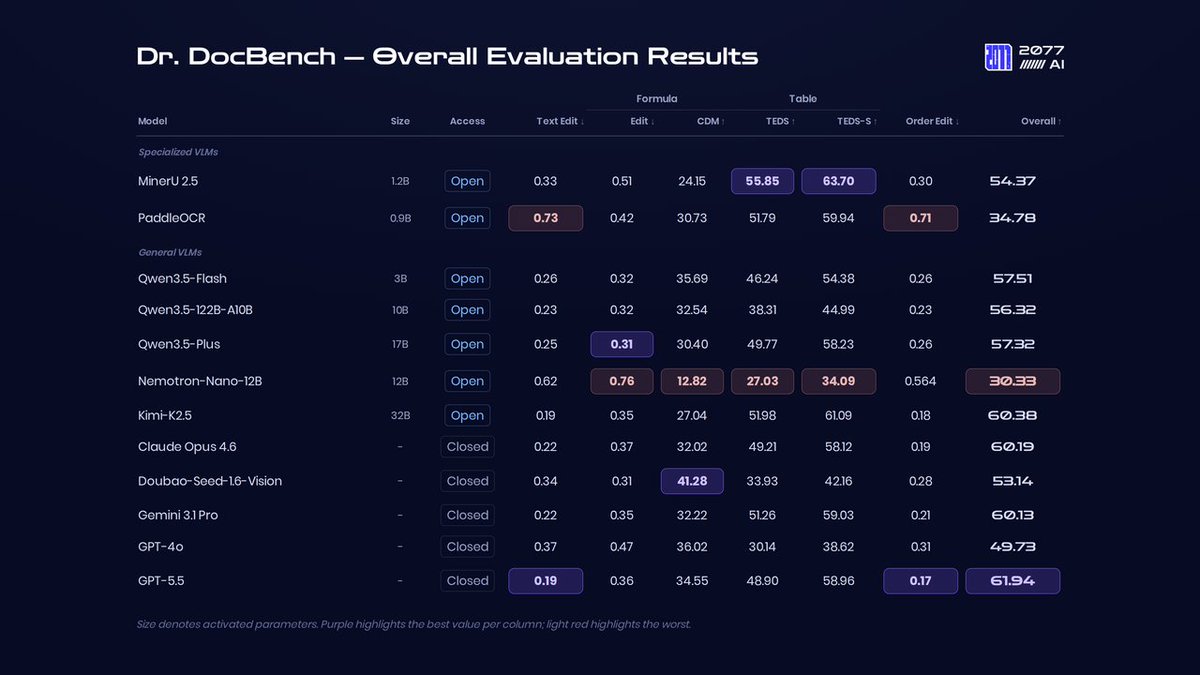
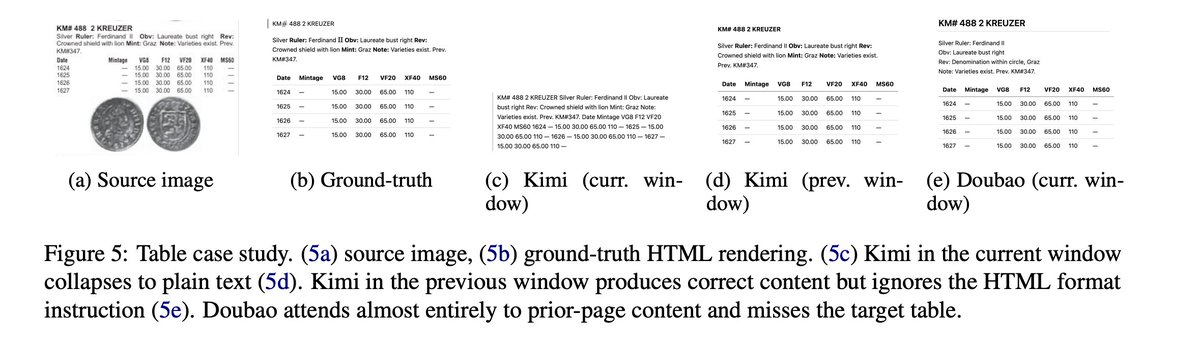
Remove the grid lines from a table and models collapse. On borderless tables, Kimi drops 49.1 to 21.4 TEDS; Doubao falls to 8.1, near-random.
Most models aren't reading table structure. They're tracing the lines. Kimi even gets the content right but ignores the HTML format instruction entirely.
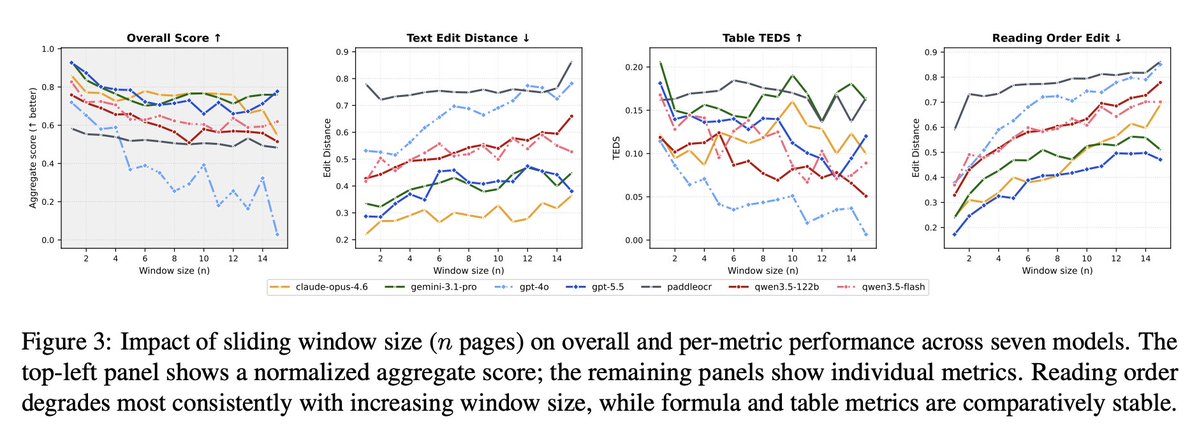
Books average ~100 pages, so the obvious fix is a bigger context window. It backfires.
From 1 to 15 pages, parsing degrades and reading order collapses hardest: Claude 0.24→0.69, GPT-5.5 0.16→0.47 (lower is better).
The budget goes to separating page-local content from cross-page continuations.
No frontier model dominates. The top four (GPT-5.5, Kimi-K2.5, Claude Opus 4.6, Gemini 3.1 Pro) cluster within ~1.8 points.
Strength splits by component: GPT-5.5 leads on text and reading order, Kimi on tables. A small specialized parser, MinerU, still beats every general VLM on table structure.
So scale isn't what decides this.
Come meet 2077AI at #CVPR2026 Booth #716.
Stop by to talk about benchmarks, multimodal data, evaluation, and open research collaboration.
Researchers, engineers, students, and friends are all welcome.
@ZihanWang123@Rubyzx67@H7803954325458@Neutrino_l