Which G7 country goes bankrupt first?
Not Japan - they owe 204% debt to GDP but its all debt owned by Japanese institutions not foreign institutions so its safe.
Who do you owe is important.
Not the USA - they owe 126% debt to GDP and $1.4t in annual interest but they owe dollars and print dollars so they safe. The only way the US defaults is if they choose to.
What currency you owe is important.
Germany - half its debt is held by Germany but they use Euro and cant print however they have the highest EU bond rating and are a EU flight to safety.
Canada - 111% debt to GDP, but lowest government debt - safe. Best books of the 7.
UK - 5.4% to borrow highest of the G7 but clear.
Italy - on the ropes - 138% debt to GDP
Credit rating lower than France.
Owe little to foreigners compared to France. Cant print Euros.
France - the biggest risk of default of the G7 - 118% debt to GDP - owes 50% of debt to foreigners. Deficit is 5.4% of GDP. Pay 1.9% on old debt but 4.9% on new debts with massive refinancing due in 2026. Cant print Euros.
High probability France will default.
Now do you understand why there are “riots” in France?
All societal issues are based on economic issues.
WHO DESTROYED FRANCE? 🇫🇷
Yes. EVERYONE did.
1. Emmanuel Macron, a man who thinks he's Jupiter but governs like a McKinsey intern who accidentally became emperor. He promised a French Renaissance and delivered a complete disaster. His solution to every catastrophe is another speech about the future of Europe.
2. The ENA Elite, Sciences Po, and the Grandes Écoles, the world's most sophisticated factories for producing highly educated incompetence. They can explain the collapse of French industry in seventeen PowerPoint presentations without ever having entered a factory. They invented a system where the same people run the state, destroy it, and then get promoted to investigate what went wrong.
3. François Hollande, the socialist who declared war on finance and then appointed Emmanuel Macron economy minister. His presidency was so spectacularly mediocre that even his own party eventually pretended not to know him. He managed to make political paralysis look like an exhausting full-time occupation.
4. Jacques Chirac, who promised reform, encountered a demonstration, and immediately discovered the virtues of doing absolutely nothing. He spent twelve years as president shaking hands with farmers while the national debt continued its agricultural expansion. His greatest political achievement was making immobility look presidential.
5. François Mitterrand, who tried socialism in 1981, and discovered economic reality in 1983. He nationalized companies, reversed course, and built a pyramid at the Louvre. Appropriate architecture for a president who occasionally treated the French economy like a pharaoh's burial chamber.
6. The Socialist Left, which believes money grows on government decrees. Their economic model consists of taxing the rich, subsidizing the poor, employing the middle class in public administration, and borrowing whatever remains. When the money runs out, they accuse arithmetic of being fascist.
7. The French Trade Unions, which defend public services by making sure nobody can use them. They stop trains to save the railways, close schools to defend education, and block refineries to protect purchasing power. Their greatest contribution to French productivity is ensuring that nobody produces anything without their permission.
8. The French Right, which has spent forty years promising to reduce public expenditure, reform the state, restore authority, and liberate the economy. Then it wins an election, appoints seventeen ministers, creates four administrative agencies, and discovers that cutting public expenditure might upset somebody. French conservatives defend free enterprise in speeches and administrative regulation in practice. They want a smaller state, provided nobody removes their subsidies, pensions, privileges, public contracts, or favorite government department. Their economic program was essentially socialism with better tailoring.
9. The French Boomers, who inherited affordable housing, expanding industries, and economic growth, then converted everything into pensions and real estate. They bought apartments for the price of a used Peugeot and now explain to young people that homeownership requires sacrifice. They spent their youth demanding revolution and their retirement demanding that absolutely nothing change.
10. Pétain and Vichy, who responded to the greatest military humiliation in modern French history by deciding that collaboration with the occupier was an excellent national recovery strategy. France had already lost the war. Pétain somehow found a way to make losing considerably more embarrassing.
11. The French Generals of 1940, who built the Maginot Line and apparently forgot to tell the Germans they were supposed to attack it. They prepared brilliantly for the First World War, only to discover that the enemy had inconveniently arrived in the Second.
12. The Republican Idealists, who believe France isn't a country but a philosophical concept. Other nations build institutions. France proclaims Values. When schools fail, they organize republican ceremonies. When public order collapses, they deliver speeches about citizenship. When reality contradicts their principles, reality is clearly insufficiently republican.
13. Saint-Simon, Fourier, Cabet, and the French Utopian Socialists, who looked at humanity and decided the problem was insufficient central planning. Fourier imagined communities organized around human passions. Saint-Simon dreamed of society directed by enlightened productive elites. Their descendants now occupy French ministries, designing national happiness through administrative circulars. Two centuries later, the happiness is still missing, but the paperwork is magnificent.
14. The French Revolution, which promised Liberty, Equality, and Fraternity, then introduced mass executions, revolutionary tribunals, civil war, and political terror. The revolutionaries liberated France from monarchy, discovered that citizens disagreed about liberty, and began executing one another. France has spent two centuries celebrating this as the birth of political enlightenment. Apparently, mass killing becomes progressive when accompanied by the correct slogans.
15. The Enlightenment, Libertinism, and the Marquis de Sade, who began by liberating humanity from superstition and ended by demonstrating that intellectual sophistication is no guarantee against moral insanity. Voltaire mocked religious authority, Rousseau dreamed of remaking society, and Sade turned transgression into an entire literary industry. Their descendants now believe that every inherited institution is oppressive and every new social experiment is automatically progress.
16. The English, who spent centuries sabotaging French ambitions, financing France's enemies, and preventing French domination of Europe. The Hundred Years' War was essentially a prolonged British property dispute conducted on French territory. Every time France attempted to become a continental superpower, England appeared with a navy, a coalition, and a remarkably enthusiastic willingness to pay somebody else to fight.
17. The Habsburgs, who surrounded France with territories acquired through marriage, inheritance, and a family tree resembling a biological experiment conducted without ethical supervision. They conquered half of Europe through weddings while French kings bankrupted themselves trying to escape the encirclement. The Habsburgs invented geopolitical domination through matrimonial administration.
18. The English, Again, because centuries of warfare were apparently insufficient. After defeating Napoleon, they conquered global commerce, international finance, and eventually the English language conquered French business. Today, French executives speak English to other French executives in Paris. England finally conquered France without deploying a single soldier.
19. The Romans, who conquered Gaul, introduced taxation, centralized administration, and the idea that provincial populations should be governed by distant officials convinced of their intellectual superiority. Two thousand years later, Paris continues to administer France like a Roman governor collecting taxes from barbarians. Rome collapsed. French bureaucracy survived. Live like Rome, die like Rome.
20. Darth Vader, the ultimate French technocrat. He believed every problem could be solved through centralization, intimidation, and an enormous publicly funded megaproject. His Death Star was essentially the French Ministry of Finance equipped with a superlaser. It cost a fortune, concentrated all power in one place, and exploded because nobody listened to the engineers.
21. Saruman and Sauron, the spiritual ancestors of French industrial planning and European centralization. Saruman wanted to replace forests with factories. Sauron wanted to unite the continent under one supreme administrative authority. Both believed that enough central planning could overcome reality. Both were eventually defeated by small provincial creatures who refused to follow instructions.
22. Satan, who has reportedly retired from corrupting France because the competition has become unbearable. He spent centuries encouraging pride, vanity, envy, and destructive political passions, only to discover that French politicians could produce the same results without supernatural assistance. He applied for a position at the Ministry of Finance but was rejected for insufficient administrative experience.
And the French people?
They have spent more than two centuries overthrowing kings, emperors, republics, governments, and presidents, convinced that the next political arrangement would finally solve everything.
They have tried absolute monarchy, constitutional monarchy, revolutionary dictatorship, empire, parliamentary republics, presidential republicanism, socialism, liberalism, conservatism, and technocracy.
Every generation announces that France needs a revolution.
Every revolution promises to put an end to the failures of the previous regime.
And every new regime eventually discovers that it has inherited THE FRENCH.
If I had to learn swing trading from scratch and could only follow one roadmap for the next 1-2 years, this is exactly what I'd study.
You're unlikely to find almost every important swing trading concept organized in one place like this.
Bookmark it. Save it. Study it.
Enjoy the journey. Happy Trading!
1. Market Structure (The Foundation)
Understand market Cycles
- Bull, Bear & Sideways markets
- Expansion vs contraction
Stage Analysis (Stan Weinstein)
- Stage 1: Accumulation
- Stage 2: Uptrend (where we want to trade)
- Stage 3: Distribution
- Stage 4: Downtrend
Market Regime
- Breadth
- Follow Through Days (CANSLIM)
- Distribution Days
- Number of stocks making new highs
- Leadership quality
Sector Rotation
- Money rotates.
- Leaders almost always emerge from leading sectors and industries.
2. Build Your Trading Universe
Create a repeatable universe.
- Minimum turnover
- Market Cap
- Trade stocks that move cleanly.
- ADR
- Relative Strength
- New RS Highs before price
- 52 Week Highs
Fundamental Filters (Optional but powerful)
3. Trend Analysis
Stage 2 Moving Averages
Study:
- EMA alignment
- Slope
- Price interaction
- Support & resistance
- Trend maturity
4. Volume Analysis
Price tells you what happened.
Volume tells you who did it.
Learn to recognise:
- Accumulation
- Distribution
- Volume dry-up
- Pocket volume
- Relative Volume (RVOL)
- Breakout volume HVE, HVQ, HVY
- Selling pressure
5. Volatility
Volatility determines opportunity.
Understand:
- ADR
- Volatility contraction
- Volatility expansion
- Compression
- Expansion cycles
6. Base Building & Consolidations
Every big move begins with a period of rest.
Learn:
- Volatility Contraction Pattern (VCP)
- Flat Base
- Cup with Handle
- Double Bottom
- IPO Base
- Ascending Base
- Rectangle
- Darvas Box
- High Tight Flag
- Bull Flag
- Pennant
- Tight Range
Understand:
- Base depth
- Base duration
- Volume contraction
- Pivot quality
7. Entry Setups
Know multiple entry styles.
Classic Breakouts
- Pivot Break
- Buy Point
Early Entries
- Cheat Entries
- Low Cheat
- Pocket Pivot
- Early Pivot
Continuation Entries
- EMA Pullbacks
- Trendline Break
- Tight Pullback
Momentum Entries
- Earnings Gap
- Episodic Pivot
- Momentum Burst
- Opening Range Breakout
- Inside Bars
- NR5/7
- Three Tight weeks
- Shakeout + Recovery
8. Risk Management (Skill That Keeps You Alive)
Master: Position Sizing
- Percentage Risk
- R based Position Sizing.
Stop Placement
- Swing Low
- Base Low
- Day low
- ATR Stop
- Moving Average Stop
Portfolio Risk
- Risk per trade
- Total portfolio risk
Risk Metrics
- R Multiple
- Expectancy
- Profit Factor
- Win Rate
- Average Win
- Average Loss
Capital Preservation
- Max Drawdown
- Consecutive Loss Limits
- Daily/Weekly Loss Limits
9. Trade Management
Winning trades need managing.
Learn:
- Pyramid Buying
- Scaling In / Scaling Out
- Swing vs Core allocation
- Increasing size only after confirmation
10. Exit Strategies
Extremely Crucial to be successful
Study:
Technical Exits
- EMA Trail
- Moving Average Cross
- Structure Break
- Trend Break
Profit Taking
- Partial exits
- Fixed R exits
- Selling into strength
- Sell when extended
Time Stops
If a stock doesn't move...say 7 days
Capital should reduce / sell
11. Psychology
Markets reward discipline.
Master:
- Patience
- FOMO
- Revenge Trading
- Overtrading
- Confidence
- Conviction
- Thinking in probabilities
- Thinking in batches of trades
- Detaching from individual outcomes
12. Continuous Improvement never stop studying.
Read:
- William O'Neil
- Mark Minervini
- Stan Weinstein
- Nicolas Darvas
- Pradeep Bonde
- Mark Douglas
- Jesse Livermore
- Qullamaggie
- Martin Luk
Study charts.
Final Thought
The best traders spend most of their time building a better process.
Your process determines whether you can repeat it for decades.
Sell into strength or let it run?
Whatever you decide comes with a side effect
This is the first data I have seen that says how big that side effect actually is 👇 https://t.co/0MsrchQd25
If you have a 9-to-5 and want to swing trade, I’m begging you:
- Stop buying tips
- Open 3 free websites every Sunday
- Find stocks where earnings are already exploding
- Turn them into a 5-stock watchlist
- Without quitting your job
I shared this with a busy dad. He went from 40 charts to 5.
Here’s how it works 🧵
If You’re Serious About Trading, Sacrifice All 48 Hours This Weekend To Study & Backtest This Video.
ICT Reveals The Intricacies Of The Market Maker Model.
A Model Every ICT Trader Needs To Understand In 2026.
“Forget everything anyone has taught you…” — ICT
15 Minutes With ICT. Don't Waste The Opportunity.
TIME TO GET SERIOUS! ⚠️
Een van de beste analysten hier op X van de oorlog in Oekraine en Rusland: @DickJanssen7. Met distantie, realistisch en zoekend naar mogelijkheden om tot een vergelijk te komen dat voor beide partijen acceptabel zou kunnen zijn. En ons niet in een Europese (kern)oorlog laten sluizen. En vooral niet oeverloos moraliseren over Trump en Poetin. Dat leidt tot niets. Lezen dit! 👇👇👇
#eva #eenvandaag #journaal #nieuwsuur #goedenavondnederland #nieuwsvandedag #vandaaginside #buitenhof #oranjezondag #CafeKockelmann #spraakmakersop1 #WNLopzondag #Rondo #pauwendewit #Renze @robdewijk@martijntjesmits@ewaldeng
ICT DROPPED A CHEAT CODE! 🔥
220% ACCURACY.
A+ SETUPS — OTE + FVG.
THE FACT THAT THIS LEVEL OF KNOWLEDGE IS FREE IS ACTUALLY INSANE.
“You’ll be light years ahead of everyone else and you’ll laugh at all these people telling you you’re wasting your time learning this” — ICT
Dear God, the sooner this copium ends, the sooner we can get a handle on reality and start thinking strategically. I heard the same refrain about how the EU would forge ahead throughout my many years working in EU policy. Just like it would ‘LEAD IN AI BY REGULATING IT.’ It was always empty rhetoric.
So, to address your list:
How many lithography machines did ASML (with ZEISS & TRUMPF components) sell into Europe in Q2 2026? Zero. As ASML’s own Executive Vice President put it: “We are selling absolutely nothing in Europe.”
Not to mention that ASML itself is reliant on demand generated by the largest capital investment cycle in history, with the U.S. currently hosting over 75% of the world’s AI compute fabric. (ASML’s technological indispensability is itself built on a transatlantic supply chain, including critical American IP, BTW.)
Commercial SMRs are coming. @AaloAtomics achieved criticality in less than eight months from groundbreaking and is already building its commercial-scale reactor in partnership with @Crusoe, with plans to power an AI data center in 2027. (I’ll be doing a deep dive next week with @AaloAtomics and @MattLoszak. Watch this space.)
Moreover, the U.S. is mobilising billions to break China’s chokehold on rare-earth supply chains, protecting trillions of dollars in downstream economic activity. These investments will benefit Europe too. Meanwhile, the EU is trying to restrict Chinese market access while negotiating with Beijing for the rare earths its industries depend on. Beijing has the EU over a barrel on REEs.
Nokia & Ericsson do not possess exclusive technological indispensability. They have competitors, including Huawei and Samsung. And now the entire architecture of terrestrial communications is being challenged by that company sending 40-storey reusable rockets into space to deploy fully functional satellites the size of school buses.
I say all of this as someone who desperately wants Europe to succeed. But we have to disabuse ourselves of the comforting delusions we keep repeating, especially now, in an age where we are beginning to convert electricity into intelligence. The takeoff has already started.
Europe needs abundant energy, sovereign compute capacity and the political will to build at industrial scale.
Only by confronting the very stark reality of where we stand can we begin to do anything about it.
(As you can see, I feel very passionately about this. )
My dear American friends, in my last post I gave you a snapshot of where France stands today. Now let me show you how we got here. I want you to see the whole movie before you buy the ticket.
After the war, France was a machine. We called it the Trente Glorieuses, thirty glorious years. We built Concorde, the most beautiful aircraft ever made. We built a fleet of nuclear reactors in about fifteen years and gave ourselves some of the cleanest, cheapest electricity in the world. We built Ariane and put Europe in space. We built the TGV, the fastest train on earth. We invented the Minitel, an online network in millions of homes before most of you had heard of the internet. We were not a museum. We were builders.
Then came 1981. François Mitterrand. Think of him as our Bernie Sanders, except he actually won. At his side, in the office next to his at the Élysée, sat a 37-year-old prodigy named Jacques Attali, his special adviser for the next ten years. The brightest minds of the left, convinced they could run an economy from a ministry.
Here's what they did. They governed with Communist ministers. In 1982 they nationalized dozens of banks and the biggest industrial groups in the country: Paribas, Suez, Saint-Gobain, Thomson, Pechiney, Rhône-Poulenc. They lowered the retirement age to 60. They cut the work week to 39 hours and added a fifth week of paid vacation. They created a wealth tax. They hired massively into the public sector.
Reality hit in less than two years. Capital fled, inflation ran wild, and the franc was devalued three times. In March 1983 Mitterrand had to slam on the brakes and impose austerity just to stay in the European monetary system.
But here's the trick: the brakes never reversed anything. They just slowed the ratchet. The so-called right came back with Jacques Chirac, and nothing was undone. Under Chirac's presidency, France passed the 35-hour work week. Left or right, every government added one more program, one more rule, one more tax, and nobody ever took one away.
At the same time, the political class did something even more destructive than bad economics. It turned the youth into a political instrument. Instead of teaching young people, including millions of children of immigrants, to love the country they lived in, it taught them a story of guilt and grievance: France as the oppressor, France as the thing to resent. You cannot integrate people into a country you've taught them to despise. We are living with the consequences of that narrative today, in our schools, our suburbs, our streets.
Then forty years of slow decline, all the way to Macron. And the story has a perfect ending. In 2007, Jacques Attali chaired a commission on how to unleash French growth. Its deputy rapporteur was a young civil servant named Emmanuel Macron. The commission proposed more than 300 reforms to free the economy. Almost none were ever implemented. Even the men who built the system knew it wasn't working, and even they couldn't undo it.
No balanced budget since 1974. Public spending around 57% of GDP. Debt above 3,300 billion euros. Growth stuck under 1%.
Now the number that should keep you up at night. In 1995, GDP per person in France was about $27,000. In America, about $29,000. We were neck and neck. Today France is around $49,000. America is around $90,000. You are now nearly twice as rich per person as we are.
What changed? Not our talent. Not our engineers. Not our schools of mathematics. The only thing that changed is that we went all in on socialism. The 35 hours, the endless regulation, the taxes that chase out anyone who builds, the belief that the state should do everything and the individual should ask permission for everything.
There's a line people love to attribute to Einstein: insanity is doing the same thing over and over and expecting different results. We tried. For forty years, we tried. Every government promised that one more program, one more tax, one more regulation would finally fix things. You just saw where it got us.
So if you choose the Democratic Party, which is literally turning socialist in front of your eyes, you will deserve what comes next.
Let me tell you exactly what will happen if you go down that road. Nobody will vote for decline. Every single measure will sound generous, compassionate, reasonable. Your builders will slowly leave or stop building. Your state will grow every year and never shrink. Your debt will compound. And in thirty years, your kids will look at a chart like the one I just described and wonder when it all went wrong.
You still have something we lost. You have Elon Musk sending rockets to orbit and landing them on their tail. You have Palmer Luckey building the defense industry of the future. You have Jeff Bezos, Jensen Huang, and thousands of founders nobody has heard of yet, building in garages right now.
Trust your entrepreneurs. Don't trust your politicians.
I come from your future. Don't make it yours.
This simple mechanical 1:1 risk reward strategy WILL make you a millionaire (if you have the patience to stick with it) #TheStrat
No hype. Proof. And step by step instructions 👇enjoy
i found futures on tiktok in january 2025, blew a pile of evals, and ended up with $500k+ in payouts
if i had to start over tomorrow, this is exactly what i'd do 🧵
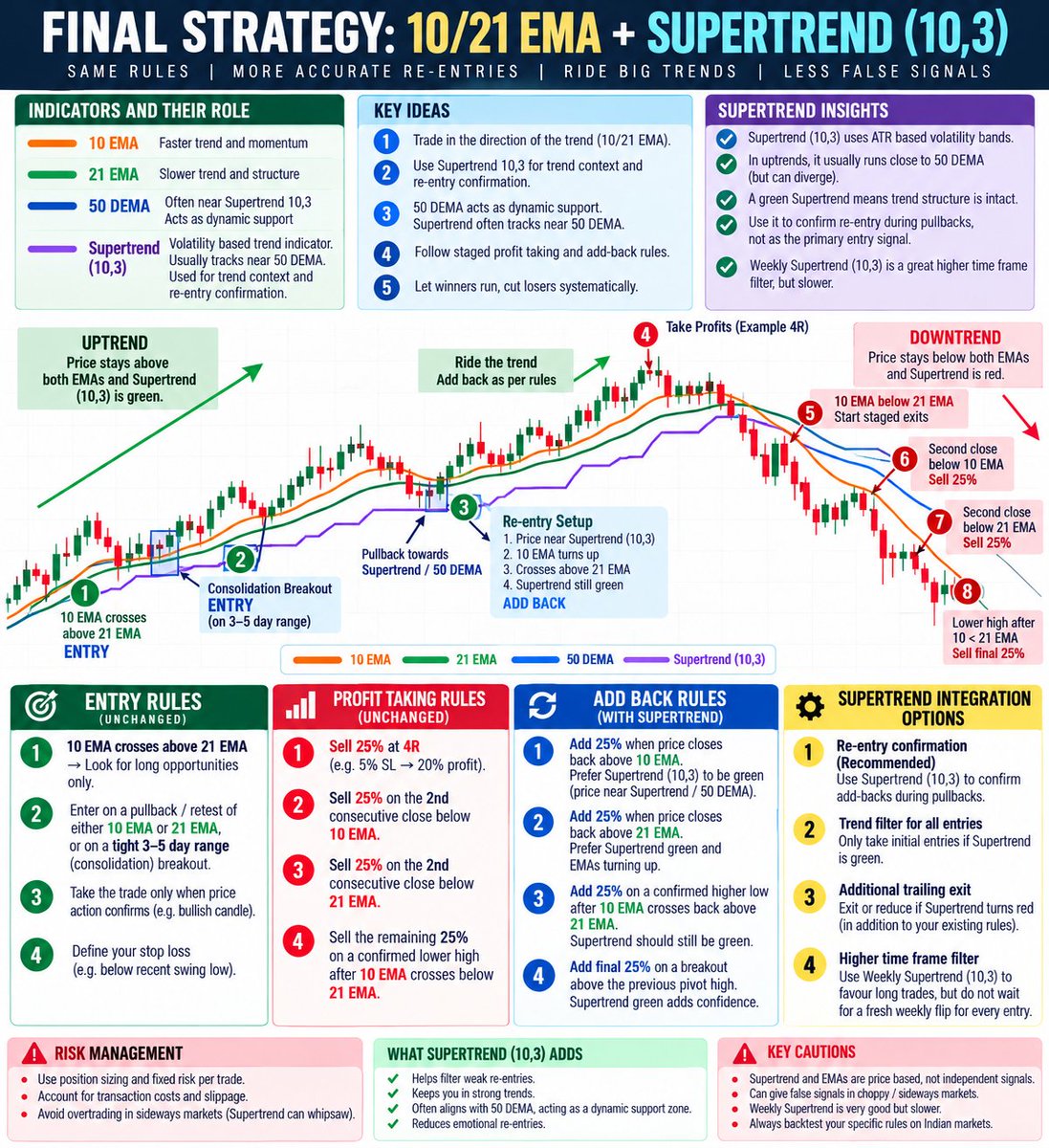
MY FINAL TRADING STRATEGY: 10/21 EMA + SUPERTREND (10,3)
The objective is simple: Catch big trends, protect capital, exit weakness and re-enter strength.
I don't want to predict tops and bottoms. I want to participate in the strongest part of a trend without surrendering my profits to emotion.
Here's my complete framework.
1. INDICATORS AND THEIR ROLES
🟠 10 EMA: Short-term momentum
🟢 21 EMA: Trend structure
🔵 50 DEMA: Dynamic support reference
🟣 Supertrend (10,3): Trend context and re-entry confirmation
2. ENTRY RULES
• 10 EMA crosses above 21 EMA.
• Enter on a pullback/retest of either EMA or a tight 3–5-day consolidation breakout.
• Wait for bullish price confirmation.
• Place the stop below the relevant swing low.
3. PROFIT-TAKING RULES
• At 4R: Book 25%.
• Second consecutive close below 10 EMA: Sell 25%.
• Second consecutive close below 21 EMA: Sell 25%.
• Confirmed lower high after 10 EMA crosses below 21 EMA: Exit the final 25%.
4. RE-ENTRY AND ADD-BACK RULES
• Close back above 10 EMA: Add 25%.
• Close back above 21 EMA: Add 25%.
• Confirmed higher low after bullish 10/21 EMA crossover: Add 25%.
• Breakout above previous pivot high: Add final 25%.
Each addition requires a valid setup and available risk capacity.
5. SUPERTREND (10,3): THE EXTRA EDGE
Supertrend is not my primary entry signal.
I use it to confirm whether the broader trend remains intact during pullbacks.
If price regains the 10/21 EMA while Supertrend remains green, my confidence in the re-entry improves.
If Supertrend turns red, I become more cautious.
Weekly Supertrend provides higher-timeframe context, but daily EMA signals drive execution.
6. RISK MANAGEMENT
• Fixed risk budget per trade.
• Position size determined by stop distance.
• No averaging down.
• No widening stops to avoid losses.
• No overtrading sideways markets.
• Account for slippage and transaction costs.
THE PHILOSOPHY
The 10 EMA tells me when momentum is changing.
The 21 EMA tells me whether the trend is holding.
The 50 DEMA provides another structural reference.
Supertrend helps me distinguish a potentially constructive pullback from deteriorating trend conditions.
None of these indicators guarantees an outcome. Their value lies in making decisions systematic.
I don't need to catch the exact bottom. I don't need to sell the exact top.
I need to enter when strength emerges, reduce exposure when weakness persists and rebuild positions when strength returns.
The goal is not to be right on every trade. The goal is to stay in the game long enough to capture the trends that matter.
Trade the trend. Respect the risk. Let winners run.
Elon Musk, Starlink, and Starshield are being wrongly attacked overnight and Wednesday over a new speed limit SpaceX placed on moving Starshield terminals in Ukraine.
Starlink is the civilian satellite internet service and its consumer terminals. Starshield is the separate military-grade system with hardened terminals, built and operated for the U.S. government.
Ukrainian leaders and officials are criticizing Musk. They claim SpaceX applied a roughly 100 mph limit to moving Starshield terminals overnight without warning. Above that speed the terminals drop connection for 10–20 seconds, disrupting some mid-range and interceptor drone missions. There’s a good reason for that. Neither was ever intended for real-time weapons guidance.
Polish Foreign Minister Radosław Sikorski asked if Musk was playing politics again. Zelensky posted this morning complaining about overnight Russian strikes and demanding stronger U.S. action. Ukraine should be thanking Musk and Trump instead of complaining. Musk isn’t playing politics. He limits the wrongful use of either system by anyone.
Starlink is supposed to help save people, not attack them. It was provided as civilian and humanitarian internet after Russia’s invasion so people could stay connected when Ukraine’s infrastructure was destroyed. It was never intended for guiding offensive strikes, yet that’s what Ukraine has been doing. They’ve also been misusing Starshield the same way. Stationary military communications is one thing. Mobile missile guidance is another and isn’t allowed.
Musk already made the distinction clear in May: Starlink for civilian usage and Starshield built and operated for the U.S. government. He said SpaceX tries hard to keep them separate, and civilian terminals were being improperly used for military purposes in violation of the terms of service. Starshield is meant for secure military communications. It was never supposed to be used to fire weapons.
Ukraine was misusing both for military missile guidance. Neither was ever intended for that. I’m glad SpaceX has taken steps to shut that down for anyone who tries.
The facts are also narrower than the claims. Starlink and Starshield don’t work inside Russia. Long-range strikes on Russian energy infrastructure use other systems. So Musk isn’t stopping Ukraine from carrying out their military goals.
SpaceX previously moved quickly to block unauthorized Russian use of terminals for offensive means. Russia still attacked Ukraine, but not with permission to use either system that way.
A technical limit is not deliberate sabotage. SpaceX controls the terms of the tools and services it owns and operates and doesn’t want them used as weapons.
SpaceX isn’t playing sides or politics. It’s enforcing its terms and its philosophy of using its tools and services to preserve peace. Anyone complaining about that is just interested in war.
Ukraine should use Starlink for saving people and peace like it was intended. Zelensky should end the war by negotiating a truce, then use Starlink to help Ukraine rebuild. He should use Starshield to keep military communications secure so Ukraine can better defend its people. That’s always been the intent. Treating basic ownership and operational limits as betrayal doesn’t match what SpaceX did. Rather it shows a lack of gratitude for the technological gifts Musk gave the people of Ukraine.
Dear Secretary Bessent @SecScottBessent,
My name is Everett Stern. In 2010 I was a compliance officer at @HSBC. From a back office in New Castle, Delaware, I watched billions of dollars move to drug cartels, sanctioned regimes, and terrorist organizations. The enemies of the United States. I documented it, I escalated it, and when the bank would not act, I took it to the @FBI, the @CIA, and eventually the @SECGov.
The result was a $1.92 billion settlement. At the time, it was one of the largest in American history. It was also about five weeks of the bank’s profit. Not one banker was charged. Not one went to prison.
I paid a different price. I lost my career, my savings, and my place in the industry I had trained for. I was blacklisted. Every door in American finance closed at once. I slept on a camping cot in a 300 square foot apartment because I could not afford a bed, and I waited tables at @PFChangs to eat. I tell you this not for sympathy, but so you understand that I know exactly what it costs to do the right thing in American finance, and exactly how little the system does in return.
I made that sacrifice because I believed it would change something.
Yesterday, your department fined @BankofAmerica $1.2 billion for failing to report more than $5 billion in suspicious transactions, some of it tied by your own findings to Chinese laundering networks, narcotics, and the southwest border, alongside 475 apparent sanctions violations touching Russia, Iran, and global terrorism. The bank admitted it willfully violated the Bank Secrecy Act.
Fourteen years after HSBC. A bank with “America” in its name. And once again, not one individual charged.
Secretary Bessent, I want to say plainly what I believe you already know. The fines are not working.
A fine is paid by shareholders, absorbed by the balance sheet, and forgotten by the next earnings call. Bank of America reported earnings this morning. Nobody who set the alert thresholds, nobody who decided the 2024 cease and desist could wait, nobody who chose the backlog over the law will lose a single thing they value. Their lives are untouched. That is the entire reason the behavior repeats.
This is money laundering. This is blood money. Money that reaches a cartel buys fentanyl that kills Americans. Money that reaches a terrorist organization buys the next attack. This country has fought a war on drugs and a war on terror for decades, at enormous cost in lives and treasure, and all the while we have allowed the financing to flow through institutions we charter and regulate. Cut off the money and we win. We have never seriously tried.
There is also a question of equal justice that I cannot let go.
Before I walked into the FBI building to report HSBC, I stopped in front of the Great Seal on the wall and read the words engraved beneath it: “Justice is the defense of our liberty.” I believed that. I still want to. But every day in this country, people go to prison for crimes that are nothing next to moving money for the people who want Americans dead. A suit, a title, and a corporate badge should not be a shield from the consequences that apply to everyone else. If a street dealer goes to prison for what he sells, the banker who moved the cartel’s money should be standing next to him.
I also want to raise something that is rarely said in these conversations. Why has no one inside Bank of America come forward the way I did? The answer is that everyone in American banking knows what happened to me, and to the whistleblowers who came after. The last person who spoke up is the only policy anyone believes. That is a culture problem, and it starts with leadership, in the banks and in the agencies that regulate them.
This is not a political issue. It has spanned administrations of both parties. It is a national security issue, and I am asking you to treat it as one.
Three things would change the math overnight.
Refer individuals for criminal prosecution. Not the analyst in the queue. The executives who set the thresholds and chose the risk. One banker in handcuffs would do more than every fine in Treasury’s history combined.
End “too big to jail.” An institution cannot be too big to fail and too big to jail at the same time. If it is the first, it must be held to a higher standard, not a lower one.
And if Bank of America will not act as America’s bank, review its charter. A national charter is a privilege granted on behalf of the American people. It should be conditioned on not moving money for the people trying to kill them.
Secretary Bessent, you said yesterday that these actions send a clear message that even the biggest institutions are not above the law. With respect, the institution was never the problem. The people inside it are above the law, and they know it. Until that changes, I will keep writing letters like this one, and the next bank will keep paying the next fine.
I gave up everything I had to stop this. I am asking you to use the power you have to finish it.
Respectfully,
Everett A. Stern
HSBC Whistleblower
Founder and Intelligence Director, Tactical Rabbit
My whole pre-market takes 15 minutes. 9:10 to 9:25.
By the time New York opens I already know what kind of day it is.
Here’s the exact checklist. Steal it. 🧵👇
If you trade the opening range breakout, you're chasing the move that's about to turn.
Study this instead:
> 8:12 to 9:12 range marked
> 9:30 takes out one side
>breakout traders chase it
> I wait for buyers or sellers to step in
> target: the opposite end of the range
Literally the same process every day…