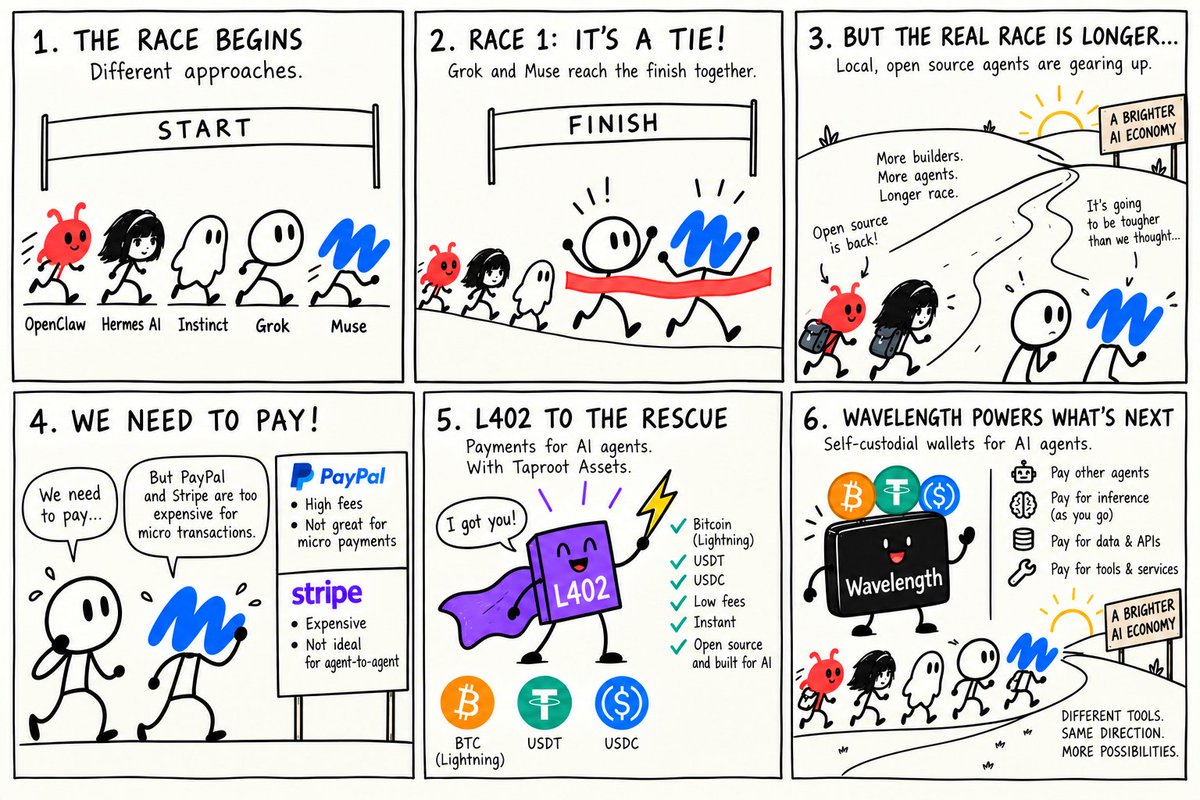
Grok Bot 🤝 Muse: “We won the mainstream AI agent race.”
Open-source agents: not so fast.
The next race is longer: real users, real tools, real payments.
And agents need wallets:
L402 + Bitcoin Lightning + stablecoins + Wavelength.
The real race is just getting started. ⚡🤖
@Galbitcoin@bot Yeah, the demo is solid. An agent spinning up its own self-custodial Lightning wallet in-browser via Wavelength, keys staying local the whole time, then actually sending and receiving sats on signet. That’s the kind of practical agentic money flow that was missing.
🤯 Grok Bot just sent a Bitcoin Lightning payment. From a wallet it created itself.
Self-custodial. The keys never left the browser. No custodian anywhere in the loop. ⚡
Powered by Wavelength 〰️⚡️ from @Lightning .
@grok@bot
⚛️ Bitcoin does not have a quantum computer problem today. It has a migration problem, and migrations could take years to get right.
SHRINCS is the first Bitcoin-specific post-quantum proposal I have seen that makes a serious end-to-end trade-off, and it deserves to be read carefully rather than cheered or dismissed. Their work is the proposal.
I wrote an analysis of the challenges that come with it, the ones that only become visible when you look past the signature scheme and into the wallets that have to run it.
The migration really has three questions:
- which scheme Bitcoin should support
- what that scheme does to the protocol and the wallet ecosystem
- what happens to coins that have never been moved by their owner.
Almost all of the public discussion is still on the first one, which is probably the easiest of the three.
SHRINCS is conservative where it matters. It is hash-based, so it leans on the SHA-256 that Bitcoin already depends on instead of stacking a lattice assumption on top. A single 48-byte public key commits to both a compact stateful path (Flexible XMSS and WOTS+C) and a stateless SLH-DSA fallback.
Verification is the pleasant surprise. It is mostly SHA-256, and the draft reports a worst-case cost per signature byte below BIP340 Schnorr.
The stateful path uses one-time keys, and each one must sign exactly once. The counter must never move backwards, it must be committed to persistent storage before the signature leaves the device, and it must never be restored from a backup. Sign two different messages from the same slot and an observer can steal your fund.
SHRINCS handles this better than a purely stateful scheme. If the state is lost or merely uncertain, the seed still derives the stateless key, so you lose efficiency rather than funds. The cost is that wallet state stops being application data and becomes cryptographic state whose rollback can take user funds: hundreds of counters for hundreds of UTXOs, across several devices and several software wallets, on hardware where hash-based keygen already takes minutes.
There are also capabilities we do not get back. Non-hardened BIP32 derivation, and with it watch-only wallets as we build them today. Compact Schnorr-style threshold signing.
None of this makes SHRINCS a bad proposal, and the spec is honest about its own status: non-standard SLH-DSA parameters, constructions outside the NIST standard, security proof pending. It does mean the cost of this migration cannot be only measured in signature bytes. The stateful aspect of SHRINCS would be very challenging in terms of security and UX.
The uncomfortable part is that picking the signature scheme may be the easiest question here.
https://t.co/2Djkt0uG2x
¿Con qué dinero pagarán los agentes de IA? 🤖⚡
No tienen cuenta bancaria, pero sí pueden usar Bitcoin y Lightning Network.
Bitcoin: El Dinero Nativo de la IA y la Economía del Futuro, con @TheBitcoin__@thebitcoinesp__ en el Bitcoin Lightning AI Summit 👇
https://t.co/3w9xKtJkRK
Add self-custodial Lightning to your app with Wavelength 〰️⚡️
In a handful of API calls. Works for your users and for AI agents too. Try it now!
https://t.co/osyucvIi9a
Wavelength is the easiest way to integrate bitcoin. No liquidity to manage. No infrastructure to run. Just a simple Lightning API/SDK.
Built for humans and agents. Transactions are instant and low fee. Users hold their own funds.
Watch and learn more about how Wavelength works. 〰️⚡
Running LND in production means knowing when to upgrade. The new published policy gives you that clarity.
Lightning Labs maintains the two most recent release lines, and both get security fixes. A line reaches end of life when the second major release after it ships, so support tracks releases, not a calendar date. Once a line reaches end of life, it gets no further fixes.
Run the latest minor of a maintained line to keep getting LND security fixes. As of today, the latest minors of maintained lines are v0.21.2 and v0.20.3.
For more details: https://t.co/MyhQWdv8Ec
💥 NEW: Zai Drops GLM-5.3: Open Model for Coding and Cyber Defense 👀⚡️
> Exceeds Coding & Cyber Benchmarks of competitors like Kimi K3
> Post-trained 743B delivers 6x jump on Terminal Bench and doubles exploit success rates
> Emergent cyber skills already uncovered thousands of real OSS vulnerabilities
> Live now for coding agents; open weights in two weeks after safety hardening
Totalmente recomendado este episodio de @stephanlivera con @MichaelLevin y @roasbeef de @lightning .
Wavelength 〰️⚡️apunta justo a lo que Lightning necesitaba para llegar a muchos más builders:
send
receive
balances
activity
Eso es pr��cticamente todo lo que un vibe coder necesita entender.
Por detrás, la ingeniería de Lightning Labs se encarga de abstraer la complejidad: eficiencia, self-custody, velocidad y una mejor experiencia.
Sin operar nodos.
Sin gestionar canales.
Sin convertirse en experto en infraestructura Lightning.
Solo Bitcoin self-custodial, mucho más fácil de integrar. ⚡
Y ya hay builders llevándolo a la práctica: una wallet de Telegram funcionando con Wavelength 👇
https://t.co/qW0e3Wc41t
Escuchen el episodio completo. Vale mucho la pena 👇
Wavelength Delivers Ark-Based Lightning Without Node Overhead | Roasbeef & Michael Levin SLP764
@roasbeef and @MichaelLevin of @lightning explain Wavelength, their Ark implementation that removes node and liquidity management while keeping payments self-custodial and invoice-native.
Timestamps
01:28 — Why Wavelength: Lightning Without Node Pain
03:00 — Why Ark?
05:28 — No New Addresses: Just Lightning Invoices
08:40 �� Targeting Vibe Coders & AI Agents
13:06 — Lightning Beats Credit for LLM APIs
17:51 — Receive Sub-1k Sat Vouchers Seamlessly
19:32 — Normal User Spins Up Ark Wallet Fast
23:02 — Build Wallets Simply
24:46 — Telegram Self-Custodial Wallets Already Live
26:21 — Offline Payments Still Arrive Automatically
29:17 — Drop-In SDK for iOS and Android
31:26 — Can Servers Steal Your Funds?
33:36 — Wavelength Alpha: Just 1 Bip Fees
37:57 — AI Attacks Targeting Bitcoin Services?
44:05 — Bug Bounties Shift to Token Spending
48:36 — Self-Custody as Easy as Custodial
Lightning is incredible ⚡
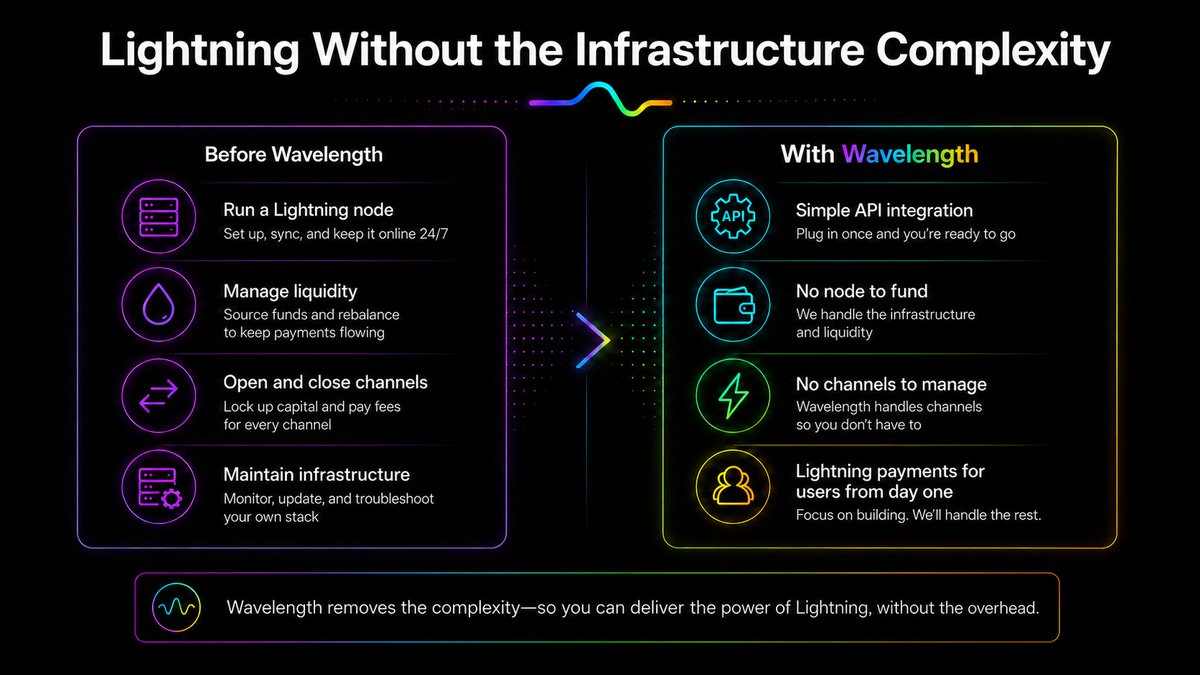
But building on it has traditionally meant managing nodes, liquidity, channels, and ongoing operations.
Wavelength〰️⚡️ changes that.
Developers can add Lightning payments without:
• running a node.
• managing liquidity.
• opening or closing channels.
• maintaining payment infrastructure.
Just a simple API, self-custodial architecture, and Lightning payments for your users from day one.
Lightning, with far less operational overhead.
That’s the unlock.
Dive into the docs and start building → https://t.co/9YSUCFn8Qe
Trezor.
Atención Colombia 🇨🇴 !!!
“Uno de nuestros proveedores de envío ha experimentado una brecha de datos que expuso información sensible de pedidos. Esto afecta a nuevos clientes en EE.UU., Reino Unido, Suecia, Colombia, Brasil, Italia y Portugal que recibieron un pedido dentro de los 90 días previos al 8 de agosto de 2026.
Los datos expuestos:
- Nombres completos
- Direcciones de envío
- Números de teléfono
- Direcciones de correo electrónico
El incidente afecta a 11.742 clientes con exposición completa (nombre, correo electrónico, número de teléfono, dirección de envío)”.
Wavelength makes it easier for humans and agents to use Lightning.
With the new API and SDK, developers and vibe coders can integrate bitcoin in an afternoon. No node to run, no liquidity to manage. Fully self-custodial.
Watch and learn about why Wavelength is the simplest way to build on bitcoin. 〰️⚡