NOV 1–15: EXPOSING THE MATRIX.
If you've been following me for a while, you know what we do here: question the world we live in and the reality we've been taught to accept.
But understanding the Matrix's systems of control isn't enough anymore.
It's time to investigate who's operating them.
The institutions. The intelligence agencies. The secret networks. The people behind the curtain.
Some rabbit holes lead to declassified documents. Others lead to unanswered questions. And some lead straight into elaborate bullshit.
We're investigating all of them.
For the next two weeks, we're going deeper. Three posts a day. No sacred cows. No untouchable narratives.
Question everything. Including the conspiracy theories.
Brace yourself. Hold my beer.
We're going down the rabbit hole. 🐇
🪐
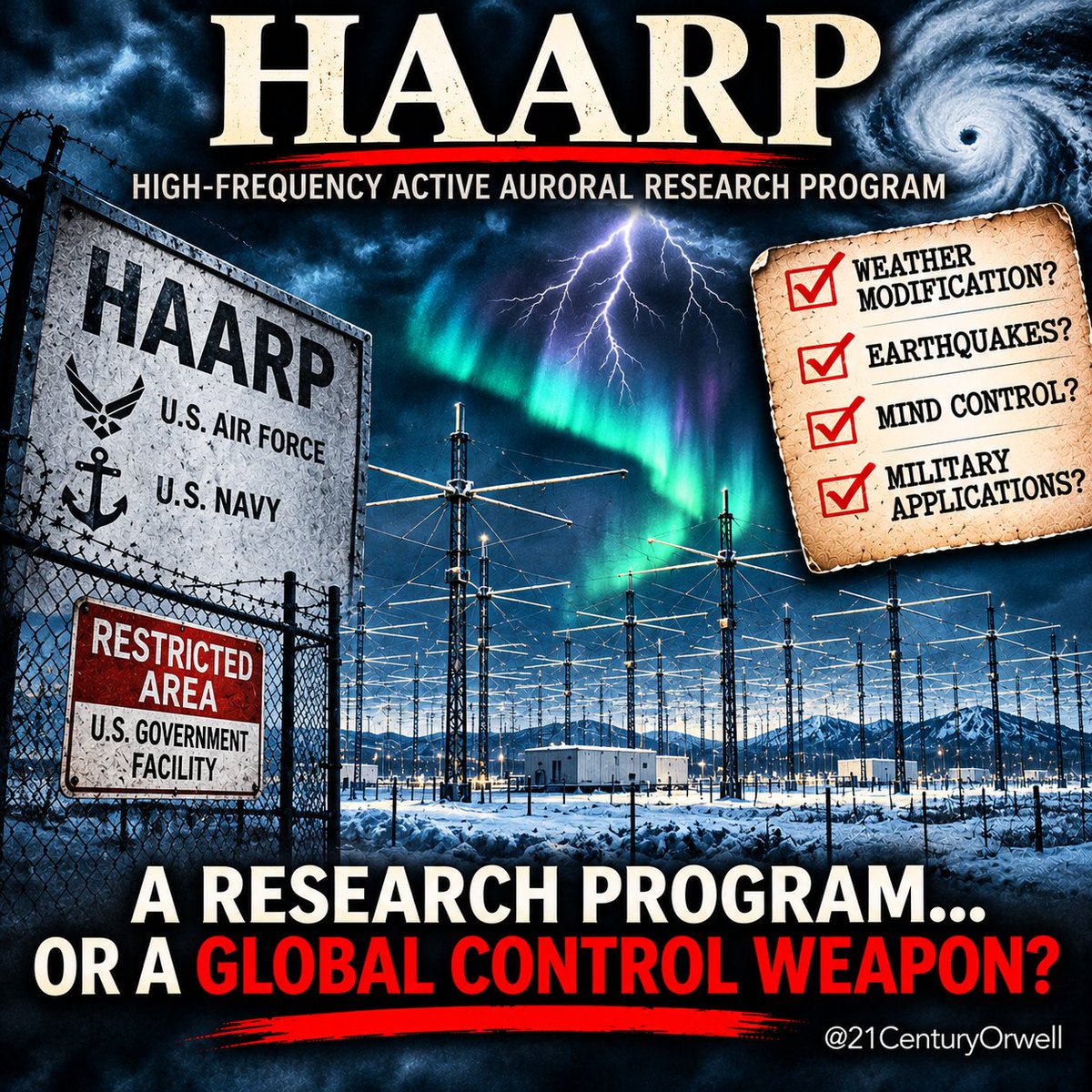
HAARP: SCIENTIFIC RESEARCH OR SOMETHING MORE?
Deep in the Alaskan wilderness stands a massive field of 180 antennas.
Originally developed with U.S. military involvement.
Capable of transmitting powerful radio waves into the ionosphere.
Officially, it's called the High-frequency Active Auroral Research Program.
HAARP.
Its stated purpose is scientific: studying the upper atmosphere, radio propagation, and ionospheric phenomena.
But its military origins and unusual capabilities have fueled decades of speculation.
Weather manipulation. Earthquakes. Mind control. Environmental warfare.
Science fiction? Maybe. But history gives us a reason to keep asking questions.
During the Vietnam War, the United States conducted a classified weather-modification program known as Operation Popeye.
Its objective was to increase rainfall over enemy supply routes through cloud seeding.
This wasn't a conspiracy theory.
It was a real military operation, documented in declassified government records.
And here's where the story gets interesting.
HAARP operates in the ionosphere, far above the atmospheric layers where ordinary weather develops. Its known capabilities do not establish that it can generate hurricanes, trigger earthquakes, or manipulate human behavior.
But its technology can deliberately disturb portions of the ionosphere and generate extremely low-frequency signals through ionospheric interactions.
So where does scientific experimentation end, and potential military application begin?
The facility was transferred to the University of Alaska Fairbanks in 2015.
Does that resolve every question about its historical research, military objectives, and technological potential?
Not necessarily.
History has already demonstrated that environmental manipulation attracted serious military interest, and that some programs remained classified until years later.
That doesn't prove HAARP is a secret superweapon.
But neither should the existence of exaggerated theories prevent legitimate scrutiny of its research and possible applications.
HAARP IS REAL. MILITARY WEATHER MODIFICATION IS HISTORICAL FACT.
THE ALLEGED SUPERWEAPON REMAINS OFFICIALY UNPROVEN. OBVIUSLY.
The real question isn't whether every natural disaster has a secret architect.
It's whether the public has sufficient information to independently evaluate technologies developed at the intersection of atmospheric science and military research.
When governments have previously concealed environmental warfare programs, is public skepticism really so unreasonable?
THE CHURCH COMMITTEE: WHEN THE SPIES WERE INVESTIGATED.
Imagine discovering that your government has been spying on its own citizens.
Opening private mail.
Monitoring political activists.
Disrupting opposition movements.
And exploring ways to assassinate foreign leaders.
Naturally, you demand an investigation.
And for once, Congress actually investigates.
Welcome to the Church Committee.
In 1975, the U.S. Senate launched an extraordinary inquiry into America's intelligence agencies.
Led by Senator Frank Church, the investigation examined the CIA, FBI, NSA, and other federal institutions.
What did they find?
A national security establishment with a remarkable interpretation of constitutional rights.
The FBI had operated COINTELPRO, infiltrating and disrupting domestic political organizations.
The CIA had conducted controversial covert operations and participated in plots against foreign leaders.
The NSA had operated secret surveillance programs known as SHAMROCK and MINARET.
Apparently, the Fourth Amendment came with a classified exceptions manual.
The investigators interviewed approximately 800 witnesses and reviewed 110,000 documents.
In April 1976, the committee published its final report.
The conclusion?
Intelligence agencies had undermined Americans' constitutional rights, while the mechanisms designed to prevent abuses had failed.
Read that again.
The institutions supposedly protecting the Constitution had been violating the rights it guaranteed.
And here's the interesting part.
This wasn't exposed by an anonymous internet account claiming to possess secret knowledge.
It was documented by the United States Senate.
The investigation helped drive new oversight mechanisms, including a permanent Senate intelligence committee and the 1978 Foreign Intelligence Surveillance Act.
Problem solved?
Not quite.
Because secrecy and democratic accountability remain uncomfortable roommates.
Intelligence agencies need to protect legitimate operations.
But who ensures those protections don't become excuses for abuse?
And who watches the people authorized to watch everyone else?
The Church Committee doesn't prove that every modern conspiracy theory is true.
It proves something more important.
Unchecked power can produce documented abuses, even inside institutions sworn to defend freedom.
THE SPIES WERE INVESTIGATED.
THE ABUSES WERE DOCUMENTED.
THE OVERSIGHT RULES WERE REWRITTEN.
And the most Orwellian question remains:
If it took Congress decades to uncover what intelligence agencies were doing, what would meaningful accountability require today?
Because a government that investigates itself only after the scandal breaks isn't exactly a reassuring business model.
WHO WATCHES THE WATCHERS?
BIG PHARMA, MONSANTO AND THE REVOLVING DOOR.
Imagine a system where corporations develop the products.
Government agencies approve them.
Politicians write the regulations.
And industry lobbyists help influence the rules.
What could possibly go wrong?
Welcome to the revolving door.
In 2018, pharmaceutical giant Bayer completed its $63 billion acquisition of Monsanto.
Medicine and agriculture.
Pharmaceuticals and pesticides.
Two industries with enormous consequences for human health and the food supply, operating under one corporate umbrella.
Apparently, controlling what goes into your body is a wonderfully diversified business model.
The merger was so significant that U.S. antitrust regulators required approximately $9 billion in divestitures to address competition concerns.
Then there's the lobbying.
In 2024, America's pharmaceutical and health products industry spent approximately $392 million lobbying the federal government.
That's a lot of money to make sure Washington hears your side of the story.
And the scientific controversies?
Consider glyphosate.
In 2015, the WHO's cancer research agency classified it as probably carcinogenic to humans.
The U.S. Environmental Protection Agency reached a different conclusion.
Same chemical. Different scientific assessments.
That doesn't automatically prove corruption.
But it certainly makes transparency, independent research, and rigorous scrutiny essential.
Now consider the revolving door itself.
Regulators, corporate executives, consultants, and industry lobbyists sometimes move between institutions whose interests overlap.
Not every career change is unethical.
Not every regulator is compromised.
And pharmaceutical innovation has delivered genuine medical breakthroughs.
But conflicts of interest don't disappear because somebody wears a government badge.
Here's the uncomfortable question.
When enormous profits depend on regulatory decisions, how do we guarantee that public health comes before corporate interests?
Who funds the research?
Who reviews the evidence?
Who writes the regulations?
And who benefits when the rules change?
You don't need to believe every conspiracy about Big Pharma or Monsanto.
You need independent science, transparent lobbying records, enforceable conflict-of-interest rules, and regulators who answer to the public.
THE CORPORATIONS ARE REAL.
THE LOBBYING IS REAL.
THE CONFLICTS OF INTEREST ARE A LEGITIMATE CONCERN.
And the most Orwellian part?
The institutions responsible for protecting consumers must continually demonstrate their independence from the industries they regulate.
WELCOME TO THE REVOLVING DOOR.
Where the job titles change.
But the interests don't always stay outside.
BAAL, MOLOCH & LUCIFER: WHO DO THE ELITES REALLY WORSHIP?
What if the rabbit hole goes much deeper than politicians, bankers, and intelligence agencies?
What if the people running the Matrix aren't necessarily the ones at the top?
What if they're serving something else?
Throughout history, powerful civilizations have surrounded authority with gods, temples, sacred symbols, and secret ceremonies.
Baal. Moloch. Lucifer.
Different figures from different religious traditions.
Yet their names keep resurfacing in modern theories about power, sacrifice, and hidden worship.
Coincidence? Symbolism? Or something worth investigating?
Look at Hollywood.
Occult imagery. Ceremonial performances. One-eye symbolism. References to selling souls.
Lady Gaga's famous “I swear to Lucifer” remark circulates across YouTube videos.
Was it a joke?
Deliberate provocation?
Or another example of an entertainment industry fascinated by forbidden symbolism?
Why does the language of darkness sell so well in the business of fame?
Now consider Freemasonry.
Initiation rituals. Hierarchical degrees. Esoteric symbols. Powerful historical members.
And the Vatican?
Centuries of political influence, elaborate ceremonies, sacred architecture, and religious authority.
Two institutions with a documented history of conflict.
But what do their competing claims to spiritual and institutional authority tell us about the relationship between belief and power?
Here's where the questions get uncomfortable.
Why has ritual accompanied political authority for thousands of years?
Why do secret societies place such importance on initiation?
What makes powerful people seek meaning through symbols ordinary citizens rarely understand?
And could some individuals genuinely believe that their earthly power comes from supernatural forces?
Now zoom out.
Governments.
Corporations.
Banking institutions.
Intelligence networks.
Entertainment.
The media.
We've spent weeks investigating who influences these systems.
But what if the ultimate question isn't WHO controls the Matrix?
What if it's WHAT those in power believe they serve?
Ancient Gnostic traditions imagined rulers of the material cosmos whose authority was not ultimate.
A disturbing idea.
Not proof that modern institutions worship ancient entities.
But perhaps a reason to ask whether our understanding of power has been too narrowly materialistic.
BAAL. MOLOCH. LUCIFER.
WHO WORSHIPS WHOM?
Are we looking at mythology, psychological symbolism, private religious beliefs, or something more?
And if the visible rulers aren't the highest authority...
HOW DEEP DOES THE RABBIT HOLE REALLY GO?
AREA 51: THE SECRET BASE THAT WASN'T SUPPOSED TO EXIST.
Imagine a secret military installation in the Nevada desert.
Armed security. Restricted airspace. Classified aircraft. Decades of government secrecy.
And, naturally, aliens.
Welcome to Area 51.
For years, the U.S. government avoided publicly acknowledging the facility's existence.
Then, in 2013, declassified CIA documents officially confirmed what practically everyone already knew.
The base was real.
Congratulations, Washington. Only took you a few decades.
Area 51 played a major role in developing and testing secret aircraft, including the U-2 and A-12 reconnaissance planes.
And here's where things get interesting.
Some unusual aircraft sightings during the Cold War were connected to classified aviation programs.
In other words, people really were seeing things the government wasn't telling them about.
But were those things extraterrestrial?
That's an entirely different question.
Reverse-engineered alien spacecraft?
Recovered extraterrestrial bodies?
Secret agreements with civilizations from other star systems?
Fascinating stories.
But extraordinary claims still require extraordinary evidence.
The existence of a classified military base doesn't prove the existence of alien technology.
It does, however, prove something worth remembering.
Governments can conceal major technological programs for decades while the public argues about what they're seeing.
And sometimes the truth is stranger than fiction.
Not because aliens are secretly running the Pentagon.
But because the Pentagon can spend years developing revolutionary aircraft while insisting the public has no business knowing about them.
So here's my question.
If tomorrow's technology is being developed behind classified doors today, how much of what we consider technologically impossible is simply inaccessible?
And how much is just internet mythology?
AREA 51 WAS REAL.
THE ALIENS? STILL WAITING FOR RECEIPTS.
But don't worry.
I'm sure the government will tell us everything.
Eventually.
Right after the next 70-year declassification delay.
👉 Binance/Wintermute deliberately crashes the crypto market on October 10, 2025;
👉 Binance loses credibility and starts bleeding users;
👉 Exchanges based in offshore jurisdictions, like MEXC, gain market share and start threatening Binance's dominance.
Now, suppose you and I were Binance executives with very questionable ethics. How would we engineer a situation to take down a competitor that could threaten our dominance? 🤔
I've got it! 💡
"Hack" ourselves. Blame North Korea. Pull some strings with the politicians you've got in your pocket. Accuse MEXC of having ties to the hackers. Drive our competitor out of the market. 😉😎
Of course, this is all just speculation straight out of my own head...
🤡
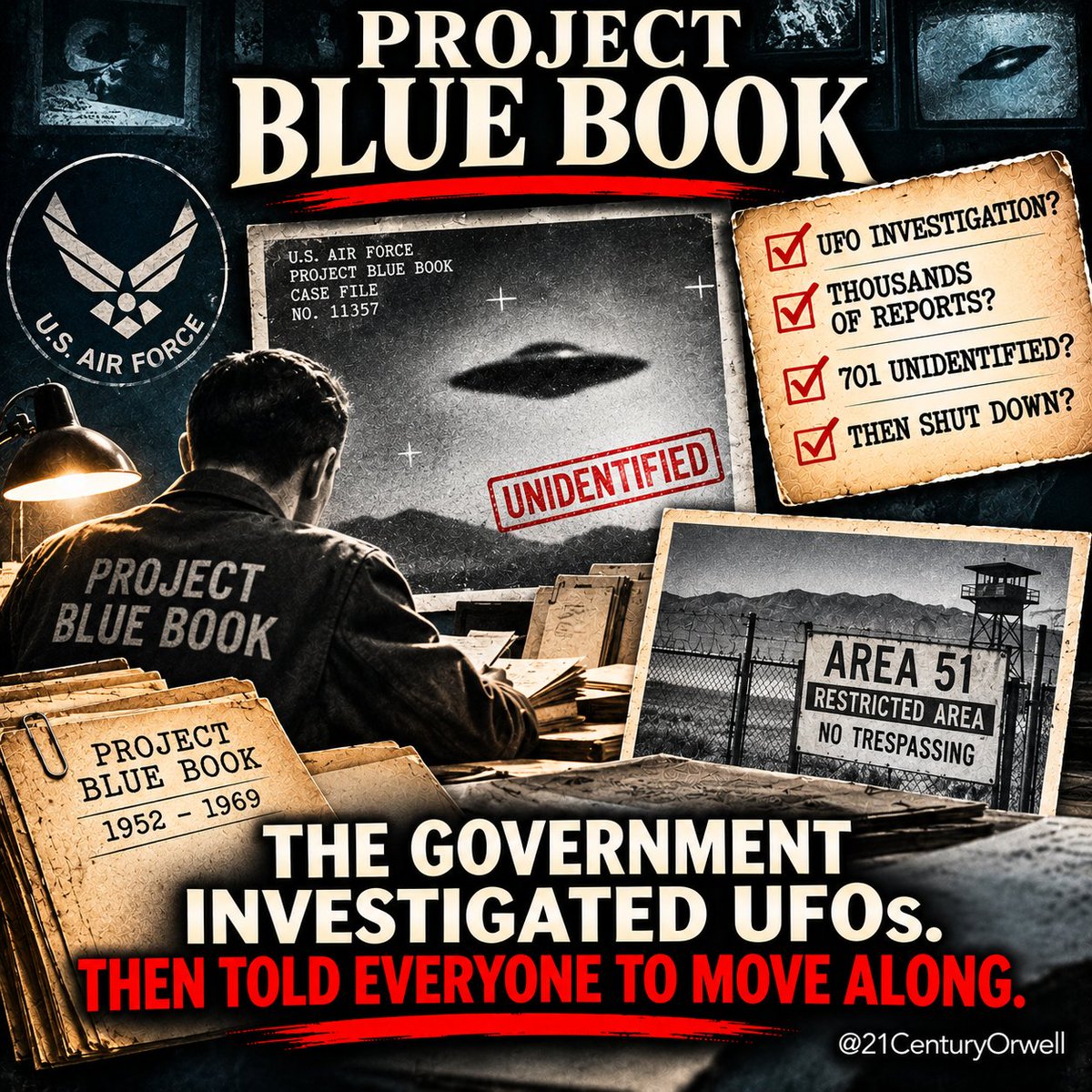
PROJECT BLUE BOOK: THE GOVERNMENT INVESTIGATED UFOS. THEN TOLD EVERYONE TO MOVE ALONG.
Imagine spending years telling people that flying saucers are nonsense.
Then discovering your own Air Force has been investigating them.
Welcome to Project Blue Book.
From 1952 to 1969, the U.S. Air Force investigated thousands of UFO reports.
Pilots. Radar operators. Military personnel. Ordinary citizens.
By the time the program ended, it had examined 12,618 reported sightings.
And 701 remained classified as unidentified.
Wait a minute.
The government investigated thousands of mysterious objects, couldn't explain hundreds of them, and then shut down the investigation?
Apparently, the universe received a government memo.
MYSTERY RESOLVED. PLEASE RETURN TO WORK.
But here's where things get interesting.
During the Cold War, the United States was secretly developing aircraft that looked extraordinary to anyone unfamiliar with the technology.
The U-2.
The A-12.
Aircraft tested around a classified installation in the Nevada desert.
Area 51.
A place whose existence the CIA publicly acknowledged in declassified documents decades later.
So yes, some people really were witnessing technology the government wasn't ready to discuss.
But does that mean every unexplained sighting was an alien spacecraft?
No.
Unidentified doesn't mean extraterrestrial.
And classified doesn't automatically mean a crashed spaceship is sitting inside a hangar.
Still, there's an uncomfortable contradiction worth examining.
When governments conceal advanced technology, the public is left trying to explain what it sees.
And when officials dismiss legitimate questions without providing meaningful answers, speculation fills the vacuum.
Secrecy creates mystery. Mystery creates mythology.
Then the same institutions responsible for the secrecy complain that people believe strange things.
Brilliant system.
So here's my question.
How much of UFO history is misunderstood technology?
How much is misidentification?
And how much remains genuinely unexplained?
PROJECT BLUE BOOK WAS REAL.
AREA 51 WAS REAL.
THE ALIEN COVER-UP? STILL WAITING FOR OFFICIAL EVIDENCE.
But sure.
Trust the people who classified the aircraft to explain what you saw in the sky.
WAR IS DEBT: THE MILITARY-INDUSTRIAL COMPLEX.
Imagine a business model where the government is your biggest customer.
Your products cost millions.
Your contracts last decades.
And every new geopolitical crisis creates another reason to increase the budget.
Welcome to the military-industrial complex.
In 1961, President Dwight D. Eisenhower issued a remarkable warning.
Not some anti-government conspiracy theorist.
A five-star general.
A World War II commander.
The sitting President of the United States.
He warned Americans about the dangerous concentration of influence between the military establishment and the defense industry.
Apparently, even the guy who helped defeat Nazi Germany thought the war business needed supervision.
Fast-forward to today.
In fiscal year 2024, the Pentagon obligated approximately $445 billion in defense contracts.
Five corporations received roughly 30% of that total.
Lockheed Martin. RTX. Boeing. Northrop Grumman. General Dynamics.
That's a lot of taxpayer-funded customer loyalty.
And then there's the debt.
Researchers at Brown University estimate that America's post-9/11 wars have generated approximately $8 trillion in costs and obligations, including future veterans' care.
Much of the spending was financed through borrowing.
Which means the bill doesn't disappear when the soldiers come home.
It keeps collecting interest.
Now, here's an important distinction.
Not every military contract is corruption.
Not every war is fought for corporate profit.
And national defense is a legitimate responsibility.
But incentives matter.
Defense contractors benefit financially from military procurement.
Politicians face pressure to protect jobs, contracts, and strategic commitments.
Taxpayers finance the system.
And future generations inherit part of the debt.
Quite the arrangement.
So here's the uncomfortable question.
What happens when institutions responsible for preventing conflict operate alongside industries that earn revenue from preparing for it?
Who evaluates whether military spending actually makes people safer?
Who benefits when threats grow?
And who pays when the promises fail?
You don't need a secret cabal to investigate these relationships.
The contracts are documented.
The expenditures are public.
The debt is real.
EISENHOWER WARNED US IN 1961.
THE MILITARY-INDUSTRIAL COMPLEX WASN'T A CONSPIRACY THEORY.
And perhaps the most Orwellian part?
The government borrows money to finance today's wars.
The defense industry gets paid today.
And your grandchildren receive the invoice.
WAR IS DEBT.
AND PEACE DOESN'T COME WITH A REFUND.
BAAL, MOLOCH & LUCIFER: WHO DO THE ELITES REALLY WORSHIP?
What if the rabbit hole goes much deeper than politicians, bankers, and intelligence agencies?
What if the people running the Matrix aren't necessarily the ones at the top?
What if they're serving something else?
Throughout history, powerful civilizations have surrounded authority with gods, temples, sacred symbols, and secret ceremonies.
Baal. Moloch. Lucifer.
Different figures from different religious traditions.
Yet their names keep resurfacing in modern theories about power, sacrifice, and hidden worship.
Coincidence? Symbolism? Or something worth investigating?
Look at Hollywood.
Occult imagery. Ceremonial performances. One-eye symbolism. References to selling souls.
Lady Gaga's famous “I swear to Lucifer” remark circulates across YouTube videos.
Was it a joke?
Deliberate provocation?
Or another example of an entertainment industry fascinated by forbidden symbolism?
Why does the language of darkness sell so well in the business of fame?
Now consider Freemasonry.
Initiation rituals. Hierarchical degrees. Esoteric symbols. Powerful historical members.
And the Vatican?
Centuries of political influence, elaborate ceremonies, sacred architecture, and religious authority.
Two institutions with a documented history of conflict.
But what do their competing claims to spiritual and institutional authority tell us about the relationship between belief and power?
Here's where the questions get uncomfortable.
Why has ritual accompanied political authority for thousands of years?
Why do secret societies place such importance on initiation?
What makes powerful people seek meaning through symbols ordinary citizens rarely understand?
And could some individuals genuinely believe that their earthly power comes from supernatural forces?
Now zoom out.
Governments.
Corporations.
Banking institutions.
Intelligence networks.
Entertainment.
The media.
We've spent weeks investigating who influences these systems.
But what if the ultimate question isn't WHO controls the Matrix?
What if it's WHAT those in power believe they serve?
Ancient Gnostic traditions imagined rulers of the material cosmos whose authority was not ultimate.
A disturbing idea.
Not proof that modern institutions worship ancient entities.
But perhaps a reason to ask whether our understanding of power has been too narrowly materialistic.
BAAL. MOLOCH. LUCIFER.
WHO WORSHIPS WHOM?
Are we looking at mythology, psychological symbolism, private religious beliefs, or something more?
And if the visible rulers aren't the highest authority...
HOW DEEP DOES THE RABBIT HOLE REALLY GO?
THE GULF OF TONKIN: THE ATTACK THAT NEVER HAPPENED.
On August 4, 1964, Washington claimed American warships had been attacked in the Gulf of Tonkin. That night, President Lyndon B. Johnson ordered retaliatory strikes.
The problem? The attack that triggered them never happened.
Two days earlier, North Vietnamese patrol boats had clashed with the USS Maddox. That encounter was real. But the Maddox was also on an intelligence mission amid covert South Vietnamese raids. Context the American public wasn't given.
Then came August 4. Radar contacts. Sonar readings. Reports of incoming torpedoes. The Maddox's own captain warned that strange weather and overzealous operators could explain much of the supposed attack.
Yet Washington moved forward.
Johnson presented the incident as renewed aggression. On August 7, Congress approved the Gulf of Tonkin Resolution, granting sweeping authority to expand U.S. military operations in Southeast Asia.
Decades later, a declassified NSA investigation concluded that the second attack never happened. Worse, intelligence reports had obscured contradictory evidence, presenting officials with a distorted picture of events.
So what really happened?
Was it a false flag operation, orchestrated from the beginning?
Or something more subtle: an intelligence failure followed by selective reporting, deliberate political distortion, and a convenient narrative nobody wanted to challenge?
The documents expose serious intelligence manipulation. They don't conclusively prove a preplanned false flag.
But the consequences are undeniable.
An attack that never happened helped justify the escalation of a war that killed millions — the Vietnam War.
You can declassify the truth decades later.
You can't bring the dead back.
THE GREAT RESET: WHO GETS TO REBUILD THE SYSTEM?
Imagine a global crisis.
Businesses collapse. Governments expand their powers. Millions of people become more dependent on institutions they never voted to control.
And suddenly, the world's most influential executives and political leaders announce:
It's time to reset the system.
How convenient.
Welcome to the World Economic Forum.
Founded by Klaus Schwab in 1971, the WEF brings together politicians, billionaires, corporate executives, and international institutions.
Then came 2020. The pandemic.
And a very public initiative called The Great Reset.
The official pitch?
Rebuild the global economy through sustainability, digital transformation, and stakeholder capitalism.
Sounds wonderful.
But who exactly appointed these people to redesign our future?
The WEF also operates leadership networks connecting influential figures across government, business, and civil society.
In 2017, Schwab even boasted about how deeply those networks had reached into political cabinets.
Apparently, networking becomes considerably more interesting when your contacts write national policies.
Then there's the infamous prediction:
“You'll own nothing and be happy.”
Yes, the WEF published that scenario in 2016.
No, it wasn't an established policy to abolish private property.
But the growing shift toward subscriptions, digital platforms, and corporate-controlled infrastructure raises questions of its own.
Now add digital identities, AI, financial surveillance, and debates over central bank digital currencies.
None of that proves a coordinated global dictatorship.
But it makes the concentration of technological and institutional power worth investigating.
Here's the uncomfortable question.
When governments, corporations, and financial institutions increasingly collaborate to shape the rules of society, where does public accountability begin?
And where does private influence end?
You don't need a secret world government to worry about powerful people making decisions without meaningful public consent.
The Great Reset was real.
The proposals were public.
As expected, the global takeover narrative remains unproven.
But the underlying question isn't going away.
WHO GETS TO REBUILD THE SYSTEM?
And more importantly:
WHO GAVE THEM THE AUTHORITY?
Because replacing individual sovereignty with a corporate-approved vision of the future isn't liberation.
It's technofeudalism with a sustainability report.
BILDERBERG: DEMOCRACY IS PUBLIC. POWER PREFERS PRIVATE MEETINGS.
Imagine a gathering of politicians, billionaires, banking executives, intelligence veterans, and corporate power brokers.
No public audience.
No live broadcast.
No detailed minutes.
And no journalists reporting who said what.
Welcome to the Bilderberg Meetings.
Founded in 1954, Bilderberg brings together influential figures from Europe and North America for private discussions about politics, economics, technology, and global affairs.
The meetings are real.
The guest lists are real.
And the conversations?
Those stay behind closed doors.
Naturally, conspiracy theorists have spent decades insisting Bilderberg is where the New World Order receives its annual software update.
A secret world government?
An Illuminati board meeting?
The annual performance review for the Deep State?
Please hold while your democracy is being synchronized.
But here's where the story gets interesting.
As expected, there's no official evidence that the Bilderberg Group operates as a shadow government issuing binding orders to world leaders.
Its organizers say the meetings encourage informal discussion, without votes, resolutions, or official policy statements.
Fair enough.
But that doesn't make the questions disappear.
When elected officials privately exchange ideas with some of the world's most influential business and financial figures, where does legitimate discussion end and privileged access begin?
Who gets invited to shape the conversation?
And who doesn't?
You don't need a secret world government to have a serious problem with concentrated influence.
Sometimes the most consequential advantage isn't controlling the entire system.
It's having a seat at the table where everyone else is absent.
And here's the irony.
The people who constantly lecture us about transparency seem remarkably comfortable with privacy when they're the ones in the room.
BILDERBERG.
THE MEETINGS ARE REAL. SO ARE THE CONSPIRACIES REGARDING THE EXISTENCE OF A WORLD GOVERNMENT.
And the guest list?
That’s worth taking a look at.
OPERATION HIGHJUMP: WHAT REALLY HAPPENED IN ANTARCTICA?
Imagine World War II has just ended.
Nazi Germany has surrendered.
The world is exhausted.
And the United States Navy decides it's the perfect time to send an enormous military expedition to Antarctica.
13 ships. Roughly 4,700 men. An aircraft carrier. Military aircraft.
All headed toward one of the most remote places on Earth.
Just a little sightseeing, apparently.
Welcome to Operation Highjump.
Launched in 1946 under the leadership of Admiral Richard E. Byrd, the expedition officially aimed to map unexplored territory, test equipment in extreme conditions, and improve military capabilities in polar environments.
Perfectly legitimate objectives.
But naturally, some people have different ideas.
SECRET NAZI BASES.
FLYING SAUCERS.
UNDERGROUND CIVILIZATIONS.
Some versions claim the Americans went to Antarctica to destroy a surviving Nazi stronghold.
Others suggest they encountered advanced flying machines and retreated after a disastrous battle.
Sounds like the greatest science-fiction movie Hollywood never made.
But where are the receipts? Officially, nowhere.
The expedition was real.
The military deployment was real.
And the dangers were very real.
Three American servicemen died when a Navy aircraft crashed during the mission.
But credible historical research has found no evidence that Highjump fought Nazi flying saucers or attacked a secret Antarctic fortress.
Now here's what makes the actual history interesting.
The United States was testing its ability to operate in one of the harshest environments on Earth, just as geopolitical competition with the Soviet Union was emerging.
Military logistics.
Aerial reconnaissance.
Polar warfare preparation.
Strategic positioning.
Apparently, even the frozen ends of the Earth weren't beyond the reach of military competition.
And here's the uncomfortable question.
If Antarctica was merely an empty wilderness, why invest so heavily in learning how to operate military forces there?
The documented answer involves geography, research, logistical capabilities, and Cold War strategy.
The more exotic explanations remain unsupported.
OPERATION HIGHJUMP WAS REAL.
THE NAZI UFO BATTLE? STILL WAITING FOR RECEIPTS.
But perhaps the most revealing question isn't whether Admiral Byrd encountered aliens.
It's why the world's most powerful governments were already preparing to compete over the planet's most inaccessible frontiers.
THE ICE WAS REAL.
THE STRATEGIC AMBITIONS WERE REAL.
And once again, the truth is interesting enough without inventing a flying saucer.
WELCOME TO THE BOTTOM OF THE WORLD.
Where even the penguins couldn't escape geopolitics.
THE KING HAS BEEN REBRANDED.
The Dark Enlightenment has a fascinating proposal: democracy is broken, so replace elected politicians with a sovereign CEO.
No elections. No accountability. Just efficiency.
Peter Thiel once wrote: “I no longer believe that freedom and democracy are compatible.”
Fair question. Democracy can become tyranny by majority vote.
But how exactly does replacing politicians with unaccountable billionaires make us freer?
Now add AI, biometric IDs, predictive algorithms, mass surveillance, and corporations increasingly intertwined with government power.
Your identity becomes an account.
Your behavior becomes a risk score.
Your freedom becomes a subscription.
And your rights?
Please scroll down and click “I Agree.”
The Dark Enlightenment calls its escape hatch Exit: don't like the system? Leave.
Brilliant.
But when the same institutions control your money, identity, communications, and infrastructure, where exactly do you exit?
Replacing politicians with CEOs doesn't abolish tyranny.
Replacing bureaucrats with algorithms doesn't create liberty.
And replacing constitutions with Terms of Service doesn't make you sovereign.
Congratulations. We've optimized authoritarianism.
THE KING HAS BEEN REBRANDED.
YOUR RIGHTS ARE NOW TERMS OF SERVICE.