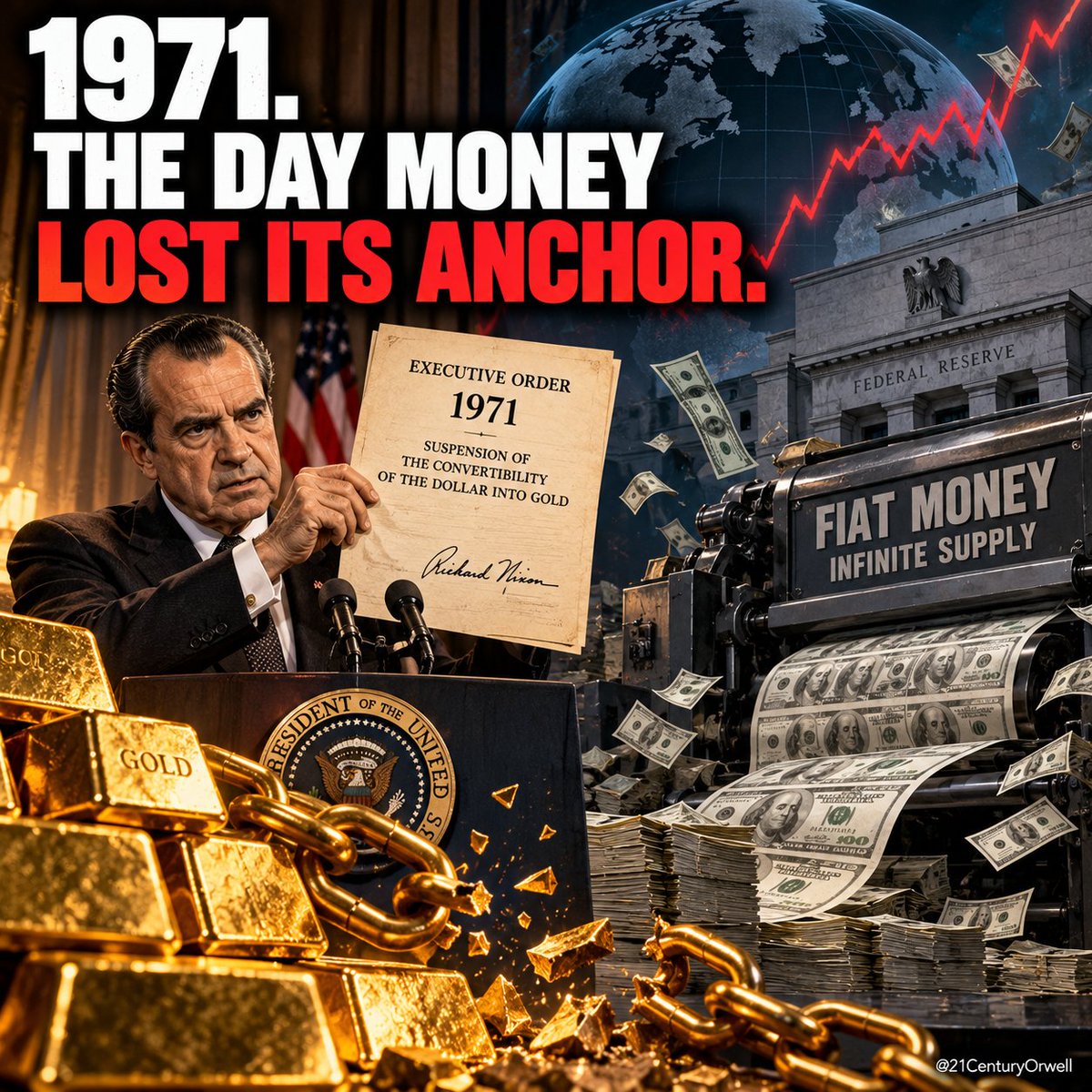
1971: THE LONGEST “TEMPORARY” FIX IN MONETARY HISTORY.
August 15, 1971.
President Richard Nixon addresses the American people and announces a supposedly temporary suspension of the dollar's convertibility into gold.
Temporary.
Fifty-five years later, we're still waiting.
WELCOME TO THE GREATEST MONETARY EXPERIMENT OF THE MODERN AGE.
Before 1971, foreign central banks could exchange dollars for gold at $35 an ounce.
But America had a problem.
Too many dollars circulating around the world.
Not enough gold to redeem them.
So instead of restoring the promise...
THE GOVERNMENT CHANGED THE RULES.
The gold window closed.
The Bretton Woods system collapsed.
And the world's leading reserve currency entered the age of fiat money.
Money backed by government authority, not redeemable for a fixed quantity of gold.
Trust us, bro. We're the government.
Now here's where things get disturbing.
Look at the economic charts after the early 1970s.
Worker productivity keeps rising.
Typical workers' compensation increasingly falls behind.
Housing becomes dramatically more expensive relative to many workers' wages.
The purchasing power of the dollar steadily erodes.
Government debt expands.
And financial assets become an increasingly important path to preserving wealth.
The economy grows. The numbers get bigger.
So why does getting ahead feel increasingly impossible?
One paycheck used to go considerably further toward the dream of owning a home.
Now millions work, borrow, refinance, and pray that the next inflation wave doesn't eat what little they've managed to save.
Congratulations. You're running faster just to stay in the same place.
Now, did removing gold convertibility single-handedly cause every economic problem that followed?
No.
Globalization, technological change, housing policy, labor institutions, and political decisions also shaped those outcomes.
But pretending the monetary regime doesn't matter is equally ridiculous.
Because fiat money fundamentally changes the constraints on governments and central banks.
Money and credit can expand without a fixed gold-redemption commitment.
And when inflation rises, people holding cash and fixed incomes can watch their purchasing power disappear.
Meanwhile, those who already own appreciating assets may be better positioned to protect their wealth.
Here's the uncomfortable question.
If money is the measuring stick for everything we earn, save, and buy...
WHO BENEFITS WHEN THE MEASURING STICK KEEPS CHANGING?
Who gets access to newly created credit?
Who owns the assets?
Who pays the inflation tax?
And who decided ordinary people should trust a monetary promise that was rewritten in a single presidential announcement?
1971 WAS REAL.
THE MONETARY RESET WAS REAL.
THE CONSEQUENCES ARE STILL BEING DEBATED.
And perhaps the most Orwellian part?
They called it a temporary suspension.
THE TEMPORARY FIX BECAME THE PERMANENT SYSTEM.
WHAT THE FUCK HAPPENED IN 1971?
Maybe the bigger question is:
WHAT THE FUCK HAVE WE BEEN ACCEPTING EVER SINCE?
https://t.co/JFmQcrTZZ4
3.5 million pages of Epstein files released.
Congratulations, Washington. Apparently, accountability is now measured in gigabytes.
In January 2026, the DOJ announced one of the largest document releases in American history.
It had collected over 6 million potentially relevant pages. About 3.5 million were published.
The official explanation? Duplicates, unrelated records, legal restrictions, and victim protection.
Fair enough. Some information absolutely must remain private.
Except the release itself exposed identifying information about survivors, forcing the DOJ to remove thousands of files for review.
So we have an extraordinary situation:
Millions of pages released.
Questions about missing records and redactions.
And survivors having to fight to protect their privacy. Again.
Meanwhile, Epstein's abuse was real. Ghislaine Maxwell's conviction was real. And Epstein's access to powerful circles was very real.
That doesn't make everyone in his contact book a criminal.
But it does raise questions that deserve answers:
Who knowingly enabled the abuse? Who ignored warnings? Which institutions failed the victims?
Because releasing a mountain of PDFs is not the same as delivering justice.
Apparently, the government has mastered the art of transparency.
Now comes the difficult part.
Accountability.