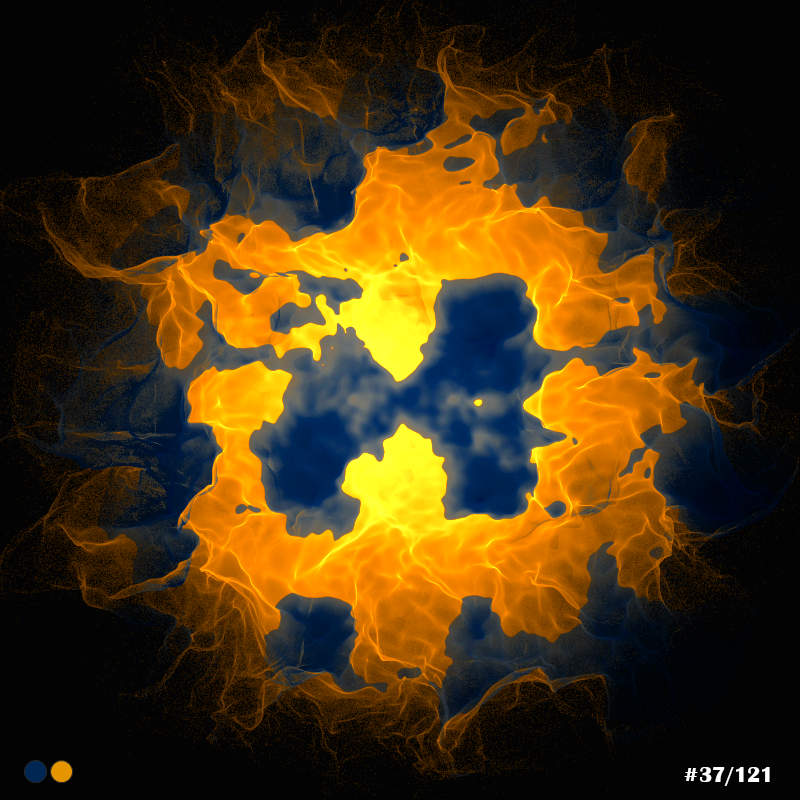
This is Visualising Bitcoin, a generative ordinal collection that attempts to answer the question: What does Bitcoin actually look like?
1⃣A collection of 121 unique 1/1 ordinal inscriptions
2⃣Each created from 100,000,000 pixels, to represent the 100,000,000 sats in each Bitcoin
3⃣The background colour is gold, to reflect the idea of digital gold
4⃣Coloured from the flags of 43 nations to represent the global nature of Bitcoin
5⃣Inscribed in March 2023, super early in the history of ordinals inscriptions
https://t.co/cWccjEW4P4
Thx @trygamma for hosting this on your marketplace and @eliherf1 for giving me the kick needed to explain my work better
Your internet connection has commercial value. UGRID puts it to work.
Businesses use residential internet connections worldwide to verify digital advertising, monitor local markets, collect public data and test online services.
UGRID connects participating Android devices to this growing market, with additional wholesale partners preparing to onboard.
Operators opt in to share their internet connection, using Wi-Fi by default.
You control:
• Mobile data usage
• Connection speed
• Monthly data consumption
Real devices. Real connections. More commercial opportunities.
Explore UGRID in the Android APK:
https://t.co/vKGuo3iFHg
Rewards vary with eligible activity and are not guaranteed
Hey #UDfam. Kindly repost for me if you can.
https://t.co/HsX1t1yWA8 & https://t.co/7CJnQvr6wK have both been accepted for the @RIGHToftheDOT auction at @NamesCon
We know about the @huggingface incident & how agents hacked a system.
Link; https://t.co/AZHU0MmYol
In 1983, a BBC interviewer asked Richard Feynman why two magnets push each other apart — and he refused to answer it.
What he did instead is the best seven minutes on thinking ever filmed.
Bookmark & watch today, no matter what.
@mattgould Yip, its getting like that.
I had a good conversation with bank the other day on the phone. Left the call not 100% sure, am thinking they were too helpful to have been a human?
Thanks @dotlocker for the thoughtful discussion and insights.
My main takeaway is that while ICANN cannot regulate independent Web3 namespaces, it can establish requirements for DNS registries introducing Web3 integration.
The TSG's principle of "same string, same controller" should surely be central to this.
Where established Web3 namespaces such as .crypto already exist (in great depth), applicants should be required to assess and mitigate the risks of conflicting on-chain identities ensuring security, clarity and trust as Web2 and Web3 converge.
Appreciate the conversation!
.@dotlocker I've been tracking ICANN's TSG report timeline, and something interesting is happening.
The Public Comment Summary Report deadline has been extended three times:
5 Oct → 13 Oct → 23 Oct → 16 Nov (42 days in total).
Given Don Ruiz's membership of the TSG and Orange Domains' experience integrating DNS and Web3, I'd be interested in your perspective.
Are these repeated extensions simply administrative, or do they suggest the TSG is working through more complex issues raised in public submissions?
More importantly, what could this mean for the 2026 ICANN gTLD applicants looking to integrate Web3, particularly those applying for already-populated namespaces such as .crypto, .wallet and .nft?
Could the additional time influence how existing Web3 holders and digital twins are addressed in the eventual technical framework and registry agreements?
I’d also be interested in hearing the perspectives of others, including: @mattgould@InderpreetSingh
Thanks @dotlocker, that raises a question.
When a gTLD such as .crypto, which already has a deeply populated Web3 namespace, is awarded to a new registry operator, I would expect ICANN and the registry's legal and risk teams to be particularly interested in how existing registrations are handled, when the registry plans to offer on-chain functionality.
There appear to be two approaches if a Web3 digital-twin model is adopted:
1. Integrate with the existing blockchain namespace:
- Withhold matching DNS names from general registration.
- Offer existing Web3 holders matching DNS domains, either free or for a fee.
- Negotiate the transfer or acquisition of existing Web3 rights to establish unified ownership.
2. Establish a separate blockchain namespace:
- The registry creates new Web3 twins linked to its DNS domains.
- bob.crypto could exist on two different blockchain naming systems, owned by different people.
- This creates potential confusion, conflicting ownership claims, impersonation and misdirected transactions.
While the TSG focuses on technical requirements, (IMHO) ICANN needs to address the risks of competing on-chain namespaces using the same TLD?
I'm not advocating automatic DNS rights for existing Web3 holders, but clear, enforceable rules to protect existing registrations, prevent conflicting ownership and avoid user confusion.
@dotlocker, shouldn't applicants be required to demonstrate how they'll manage these risks before ICANN approves their Web3 integration?
@InderpreetSingh And again.... interesting. That's after the String Replacement Period. Seems to me that what is agreed in this might be material to choices made by applicants.
Interesting analogy. Also worth remembering that millions of Web3 domain sales have already taken place on-chain across many of the prospective new gTLDs. That is a significant, existing demand signal.
Some of these new gTLD applicants are not starting from zero. They already come with established Web3 communities, existing domain holders, transaction history, and demonstrated market demand.
Today Microsoft announced Autopilot, an always on agent built on OpenClaw
The best part of this collaboration is how much @OmarShahine and others at Microsoft have contributed BACK to OpenClaw
Read all about the contributions Omar and his team made here: https://t.co/JOXd6sswZ2
Stroke of a Pen
I told Opus 5.5 to read my Bitcoin & monetary-history wikis & make a music video with code only.
it used ElevenLabs for the track.
Then a swarm of agents storyboarded and coded a 3:23 portrait reel. ~75 shots cut on the beats.
Had to do 2 revisions - first the people looked like poorly animated stick figures & it rewrote the rigs.
Then I said use matrix code to make it more interesting.
Impressive!