THE NIGHTMARE SCENARIO NOBODY IS TALKING ABOUT
AN OIL + DOLLAR SHORTAGE
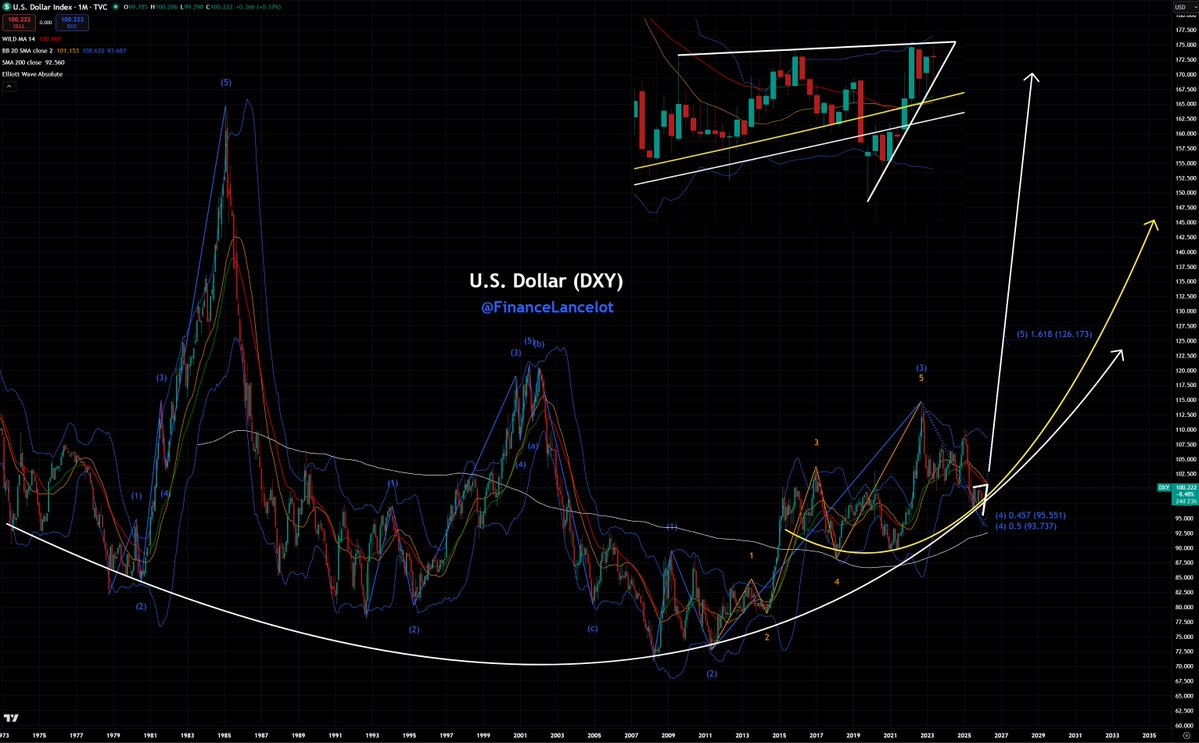
The nightmare scenario nobody is talking about right now is what happens if the Dollar skyrockets at the same time as oil.
Since the world's oil supply is purchased in Dollars, they are typically inversely correlated. A lower Dollar = increased international demand for oil.
The only time we've seen a brief period of oil 🔼 Dollar 🔼 was in 2022, during the economic slowdown.
The nightmare scenario we're facing is a global oil supply shortage at the same time as an economic crisis.
Both of these compound the demand for Dollars because not only are nations forced to liquidate greater assets to purchase oil, but servicing sovereign debt becomes much more expensive because it's denominated in Dollars.
This energy crisis could very well be the beginning of Brent Johnson's @SantiagoAuFund Dollar Milkshake Theory and the United States' plan to take a large portion of its debt out of circulation.
We analyzed median asking prices on Idealista and found that Portugal's apartment market has changed dramatically over the past three years.
1-bed apartments (2023 to 2026)
Lisbon: €380,000 -> €440,000 (+16%)
Faro: €235,000 -> €325,000 (+38%)
Porto: €235,000 -> €300,000 (+28%)
Aveiro: €190,000 -> €245,000 (+29%)
Braga: €160,000 -> €220,000 (+38%)
2-bed apartments (2023 to 2026)
Lisbon: €420,000 -> €620,000 (+48%)
Faro: €335,000 -> €475,000 (+42%)
Porto: €325,000 -> €440,000 (+35%)
Aveiro: €210,000 -> €280,000 (+33%)
Braga: €200,000 -> €275,000 (+38%)
The biggest gains are no longer limited to Lisbon. Regional cities such as Faro, Braga, Aveiro and Porto have seen some of the strongest price growth in the country.
@satoshituga O objetivo não é banir os jovens, é provar que és maior de idade para entrar (por isso, precisas de id para entrar - acabar com o anonimato nas redes)
The Western colonial empire is dying in the very cities where it was born. London, New York, Paris, Berlin, Sydney.
You can see it in rents, in food prices, in the price of a doctor's visit, in the closed factory at the end of every regional town.
The headlines call it recession.
But its actually the empire eating itself, because the outside has stopped feeding it.
For 300 years the deal was to extract from the Global South, subsidize the Global North. Cheap cotton, cheap rubber, cheap oil, cheap tin, cheap cobalt, cheap labor, cheap everything. The Western worker was poor by global standards but rich by global standards at the same time, because the rest of the world was bleeding out so they didn't have to.
That deal is over.
Because the people doing the bleeding stopped agreeing.
The Gulf states have quietly dropped petrodollar exclusivity. China and Russia settle in yuan and ruble. India buys Russian oil in rupees. Brazil and Argentina trade in local currency. The African Sahel kicked French troops out of 4 countries in 24 months. Niger nationalized its uranium. Burkina Faso is mining its own gold. Mali built a refinery for the first time in its national history.
None of this was supposed to happen.
It is happening anyway.
I think most Western analysts cannot see this because they were trained to look upward at presidents and downward at GDP, and the actual movement is sideways across capital flows.
Notice how the headline countries, the US, UK, France, keep losing wars they pretended to win.
Afghanistan. Iraq. Libya. Syria. Niger. Ukraine.
The military is still the loudest instrument in the toolkit. It is also the only one left that still works, not by serving its colonial states, but by fattening private sector profits.
When a hegemon's only working tool is the gun, and the gun keeps missing, that is what decline looks like in real time.
Now, the toolkit the West built to control the colonies is being repointed at its own population.
Debt traps. Criminalization. Prison labor. Surveillance. Mass eviction. Drug-economy management.
Engineered scarcity.
Permanent renter classes.
Two-tier policing.
The same playbook that flattened Congo, Indonesia, Honduras and the Philippines is now being applied to Detroit, Marseille, Manchester, Newcastle. The boot is the same boot.
This is the part that should make a working-class American or a British retiree or a single mother extremely angry, and unfortunately not at the people they're being told to be angry at.
Migrants did not cause this.
Welfare recipients did not cause this.
China did not cause this.
The class that owns the boot caused this, and it owns the boot in every country including yours.
Some of you might call this overblown.
You might say the West is still rich, still strong, still the world's reserve currency, still where the world's billionaires want to live.
All true. For now.
Empires take a long time to fall, and the rich exit the building decades before the lights go out.
They have already exited.
Watch where the wealth is parked. Not in the country it was extracted from. The capital has gone where the growth is, which is not London and not New York.
It is Riyadh, Dubai, Mumbai, Jakarta, Shenzhen, Sao Paulo. The owner class moved their money. Then they will move their passports. The flag will be the last thing they put down.
For the everyday person in the West, the next 20 years is going to be a managed contraction.
Real wages flat or falling. Public services rationed. Pensions clipped. Insurance unaffordable. Housing impossible.
They will tell you it is the migrants, then China, then the climate, then a new virus, then the algorithm.
It will be none of those.
For the everyday person in the Global South, the next 20 years is messier but freer. New patrons, new dependencies, but also new bargaining power. The petrodollar is no longer the only door. BRICS is no longer aspirational. The IMF is no longer the only lender. Africa is no longer waiting for permission. Latin America is choosing its own debtors.
I do not think this is a happy story for everyone.
Multipolarity is not peace. It is a different kind of pressure, distributed differently, with the violence rotating to new edges.
But the colonial age that started in 1492 is closing. Not gracefully. Not neatly. Not with a flag-lowering ceremony.
But forcefully.
Because capital dictates.
And it is dictating that the Western colonial empire is over.
Thank you. I will chew on that, but the reason that I drew the distinction between job displacement and AI as a productivity tool is because I thave seen some argue that you can have your cake and eat it too, with AI. I, for one, am glad you put out your doomsday scenario and the degree of backlash tells me that you hit a nerve. Keep up the good work!
Virtually every major war begins under false pretenses. German economist Richard Werner explains what the current global conflict is actually about.
0:00 The Effect of Propaganda in Wartime
11:52 The Return of Total War
21:50 Rivalry, Concentration Camps, and the First World War
39:55 Is China the New Germany?
51:18 The Bombing Campaigns Against Iran
53:28 Is There Danger of Japan and China Collaborating?
57:34 Why a Proper War Requires a Built-Up Enemy
1:00:47 Engineering Famine
1:07:51 China's One-Child Policy and Anti-Population Growth
1:18:17 The Great Deception
1:28:53 What Would a One-World Government Look Like?
1:37:49 The Man Who Helped Bring Hitler to Power
1:43:08 The Rothschilds and the Birth of Modern Economics
1:48:10 Where Does the Real Power Lie?
1:51:02 Are We Moving Closer to Centralization?
1:56:36 What Happens to US Assets as the Global System Changes?
The line that Americans live in the freest country in the world is one I will not argue with. They do. They have for 70 years. I just think people misread who the freedom was actually for.
Every country is a platform for something. The British state was a platform for the East India Company for two centuries, and when that wound down it became a platform for the City of London, which is the same operating system with different shareholders.
The French state has historically been a platform for its industrial champions, which is why TotalEnergies and Airbus get treated as French nouns rather than companies.
The Chinese state is a platform for the Party, which uses its corporates as instruments rather than the other way around.
The American state is a platform for the four sectors of capital. Finance, military, consumer, tech. They share an operating environment that rewards the same behaviour, and the country has been organised around their convenience since the late 1970s.
This is where the freedom narrative is.
Because the freedom is real. Capital is freer in America than in any comparable country. It is free to enter, exit, restructure, lay off, relocate, lobby, deplatform, sue, settle, write its own regulations and then write the press releases announcing the new regulations.
It is also free to outlive any single administration that tries to constrain it, and it does. The military sector outlived three wars. The financial sector outlived two collapses it caused. The consumer sector outlived an opioid crisis it engineered. The tech sector is currently outliving the antitrust posture aimed at it. This is what freedom looks like at the level it was actually granted.
The citizen receives a different version of the same word. The citizen is free in the sense that nothing is illegal about being poor, sick, indebted, uninsured, undertrained, surveilled or replaced.
Nothing is illegal about being abandoned by a town that lost its industry. Nothing is illegal about being aged out of an office job by an algorithm.
The freedom is the absence of obligation running both ways.
And it's beautiful how the system does not discipline itself. A country with this much inequality should produce a class-aware politics.
America does not. Why?
Because the freedom narrative does the work. The American is told, from kindergarten, that he is in an open free for all game where the prize is unlimited and the only thing between him and the prize is the next guy.
So he watches the next guy. He resents the next guy. He votes against the next guy. He never looks upward.
And as long as a small number of winners can be paraded as evidence that the game is open, the rest of the field stays heads-down. The lottery ticket is the political tranquiliser.
In effect, the freedom Americans celebrate is the freedom to compete with each other for resources their economy is no longer generating in the volumes it advertises.
Real wages flat since the late 1970s. Housing tripled in 20 years. Healthcare effectively privatised at the point of bankruptcy. The bottom 50% of households holding around 2% of the wealth. Inter-generational mobility, which used to be the country's identity, now lower than most of Western Europe.
These are the readings of a closed game packaged as an open one.
You will hear the counter, which is that America still produces the world's largest GDP, the dominant currency, the deepest capital markets and most of the world's frontier technology.
But a country can be the wealthiest in the world while the median citizen sees almost none of it, and you cannot read America properly without sitting with that line until it stops sounding like a slogan and starts sounding like an accounting question.
The American state stopped being a state in the conventional sense decades ago and started being a hosting environment.
Most of the things a state is supposed to do for its citizens, healthcare, retirement, housing, education, child welfare, are run as private products with the state acting as the billing layer.
Most of the things a state is supposed to do externally, war, sanctions, trade, energy, are run on behalf of one or another of the four sectors, which is why the foreign policy across Obama, Trump and Biden has been operationally indistinguishable to anyone outside the country.
The slogans rotate. The contracts continue.
And the slogan has to stay. The moment the freedom narrative cracks the disciplinary fiction goes with it, and you cannot run an arena economy without the participants believing they are competing on level ground.
The freedom story is the moat around the whole arrangement. It is the most load-bearing piece of fiction in the country, and it is defended accordingly, by both parties, by Hollywood, by the academy, by the press, by anyone whose own position depends on the arena continuing to function.
I think Americans will figure this out. Not soon. But the arena has been showing strain for a decade in opioid death rates, in deaths of despair, in the political extremity that arrives when people who were promised mobility realise they were sold an advert.
The system's response so far has been to push the freedom slogan harder, which is what every empire does in the late phase, when the substance has thinned and only the wrapper is left. The wrapper is louder right now than at any point I can remember.
Americans really do live in the freest country in the world.
They are correct.
The question they have not yet asked, in numbers that would matter, is what the freedom is for, and whose.
When that question is asked seriously, the four sectors will quietly move their operating environment elsewhere, the way capital always does when the host runs out of substrate.
The British did not collapse. The City of London simply moved upstairs. The American version of that move, when it arrives, will look the same on the flag and feel the same in the press releases.
The citizens will be told they won.
🇵🇹 Portugal: AT binding opinion regarding Crypto-to-Stablecoin Swaps🫴
Binding tax ruling (Processo 28969) from the Portuguese Tax Authority (AT), has clarified the tax treatment for investors using stablecoins as a technical bridge to cash out.
If you’ve ever had to swap a token for USDC or USDT simply because there wasn't a direct Euro (EUR) trading pair, this update is for you🫵
🔍 The Key Takeaways:
1⃣No Tax on Crypto-to-Crypto Swaps: The AT confirmed that swapping one cryptoasset for another (including stablecoins like USDC) is not a taxable event. The tax liability is deferred until you convert to fiat currency (like EUR).
2⃣The 365-Day Rule Remains Strong: Capital gains from crypto held for 365 days or more are exempt from IRS (Personal Income Tax).
3⃣Technical Swaps Don't Reset the Clock: If you hold a token for over a year and perform an immediate "technical swap" to a stablecoin just to facilitate a final sale to EUR, the exemption still applies. The AT views this as a single continuous process of realization.
4⃣A Caveat on Jurisdiction: ⚠️This deferral and exemption only apply if the entities involved (like the exchange) are resident in the EU, EEA, or a jurisdiction with a tax information exchange agreement with Portugal.
💡 Why This Matters
This ruling reinforces Portugal's "Realized Gains" principle. It acknowledges the technical realities of the crypto market, where direct fiat pairs aren't always available, ensuring that investors aren't unfairly penalized for the lack of market liquidity.
The Bottom Line: If you've held your assets for over a year, you can navigate through a stablecoin to reach EUR without losing your tax-exempt status, provided the move is immediate and technical.
✉️ If you want to have a copy of this binding opinion. Please drop me your email, as X does not support PDF.