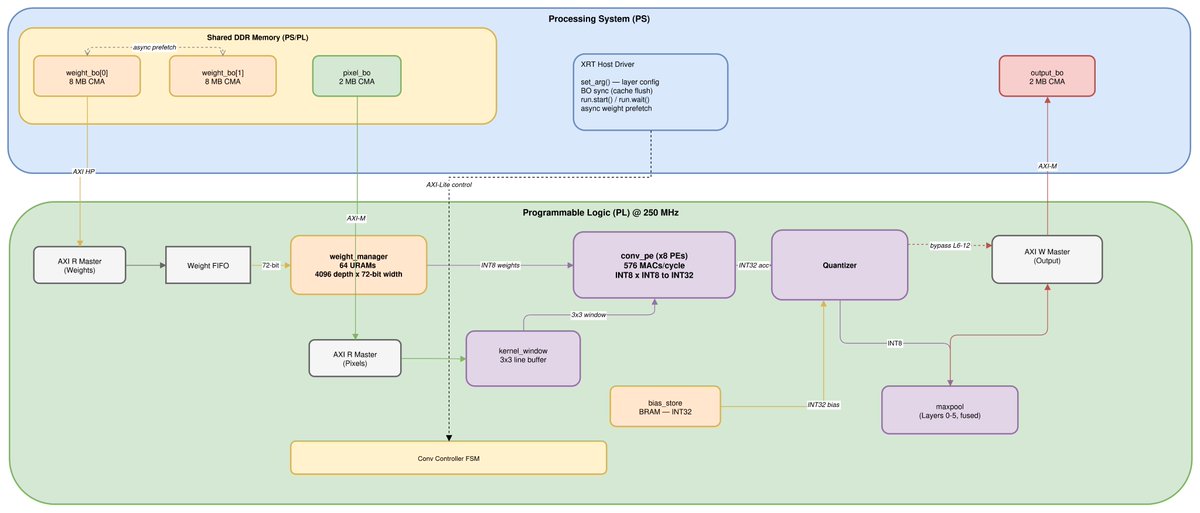
Deployed TinyYOLOv3 (8.7M params) on a custom FPGA accelerator (KV260)
• 576 MACs/cycle
• INT8 pipeline
• ~16 FPS real-time inference
All on a low-cost edge device with headroom to scale further.
https://t.co/pjkPhnlMeL
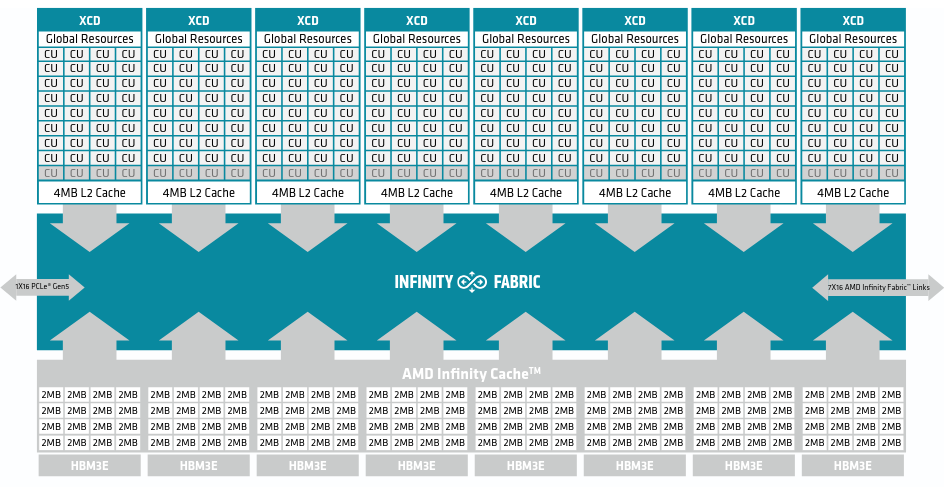
Wrote some microbenchmarks to reverse engineer some undocumented aspects of cache coherence and cache design on AMD CDNA 3 GPUs
https://t.co/2MsYslhERe
Wrote a blog post on the #AMD CDNA #GPU memory model and how synchronization between thousands of threads is made possible in a scalable manner by the LLVM compiler.
read it here - https://t.co/mWiEeHcRyG
Our FPGA based accelerator for CKKS-based CNN convolutions for secure inference was selected as one of the winning projects in the AMD Open Hardware Competition! With @sp0oky_daksh
https://t.co/BQvhP2wWqP
https://t.co/3Ka26PYZiT
Wrote a short blog post on Subgraph Isomorphism - A problem that shows up everywhere from program analysis to computer vision.
The question is simple: how do you find if a smaller pattern is embedded within a larger network?
https://t.co/e16b4ncMdN
https://t.co/GPtySan3XI
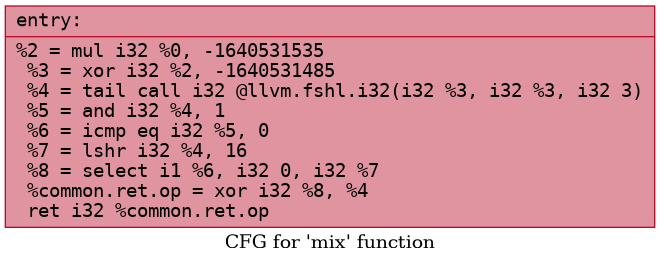
An attempt to use taint analysis to deobfuscate virtualized binaries by lifting to LLVM IR and performing dynamic slicing analysis
https://t.co/QPnZIZn17K
Interesting read on leveraging LLVM for removing software obfuscations. Consistent with my experiments that LLVM cannot remove virtualized functions automatically but it deals well with Opaque predicates.
Our team comprised of @21verses , @PTRACE_TRACEME ,@krishna_2803 and myself recently won the Segfault Hackathon, organized as part of IICT ( Innovations in Compiler Technology ) Workshop by @compiler_tech .
Huge thanks to the organizers for putting together such an amazing event
Published the first part of my blog series on Homomorphic Encryption and the CKKS scheme.
We'll gradually dive deeper into the mathematics in future posts. Hope you enjoy this introduction!
https://t.co/uc1Gixr3Fe
https://t.co/Hi2X9OHjvI
Great resource for studying the NTT algorithm, commonly used for Post Quantum lattice based cryptography to speed up polynomial multiplication
So much fun working on an LLVM based taint engine to attack Virtualization obfuscation. Lot of challenges atm, but results seem promising.
Great resource btw -> https://t.co/rns5CsNGEm
Obfuscated -> Deobfuscated
@expend20@krishna_2803@PTRACE_TRACEME@cystariitm Sure. I would recommend testing the passes. It’s something we plan to work on as well when time permits. The competition only required a POC, so more thorough testing is due.
Had a great time designing an obfuscation engine with @krishna_2803 and @PTRACE_TRACEME for BinaryClash360 by @cystariitm.
Found out about a lot of cool stuff - obscure compiler flags, LLVM tricks. Ended up winning second place in the competition too
https://t.co/n8ysCmBvUt
I wrote a blog post exploring the math behind #dataflow analysis. Frequently used in #compilers, #decompilers, static analyzers, etc.
Hope you enjoy it!
https://t.co/Of75s3V9QE