How do you genuinely teach someone when AI is this good?
Knowing what feels dismissible at this point. What's more interesting is knowing how.
People don't hand off the things they're genuinely good at. Or the things that give them a sense of satisfaction. If you're an exceptional public speaker, you wouldn't hand your words to AI. If you're an expert designer, you wouldn't sign your name on an obviously AI-generated image.
What people do hand off are the chores. And the things they simply aren't good at (or not yet).
So maybe teaching, whether it's people or AI, looks more like helping them build taste and skill in what they care about, and letting it still feel like theirs so they could offload it in the next encounter.
Sounds like evals?
@zarazhangrui This is great feedback, a trap in growth marketing I see is slop generation disguised as attempting to scale.
Eg, without proper taste and your own voice, having AI generate 50 comments a day doesn't mean any of them will land (most probably won't).
How well an organization uses AI hinges on how much internal knowledge gets captured by AI - ie making sure agents share the same visibility as people.
With embedded html, agents can now communicate in interactive visuals. Excited to see what PRDs would now look like.
New block in Notion: HTML.
Build interactive HTML right on your Notion page. Ask AI to turn your content into interactive explainers, prototypes, or diagrams.
Share with your team to use and tinker together.
@tanayj I think this comes down to whether you are building a system of record or a workflow. If the value lies in being the source of truth, plugging into existing harnesses would ease adoption. If your value is on covering the entire workflow, then a standalone agent makes more sense.
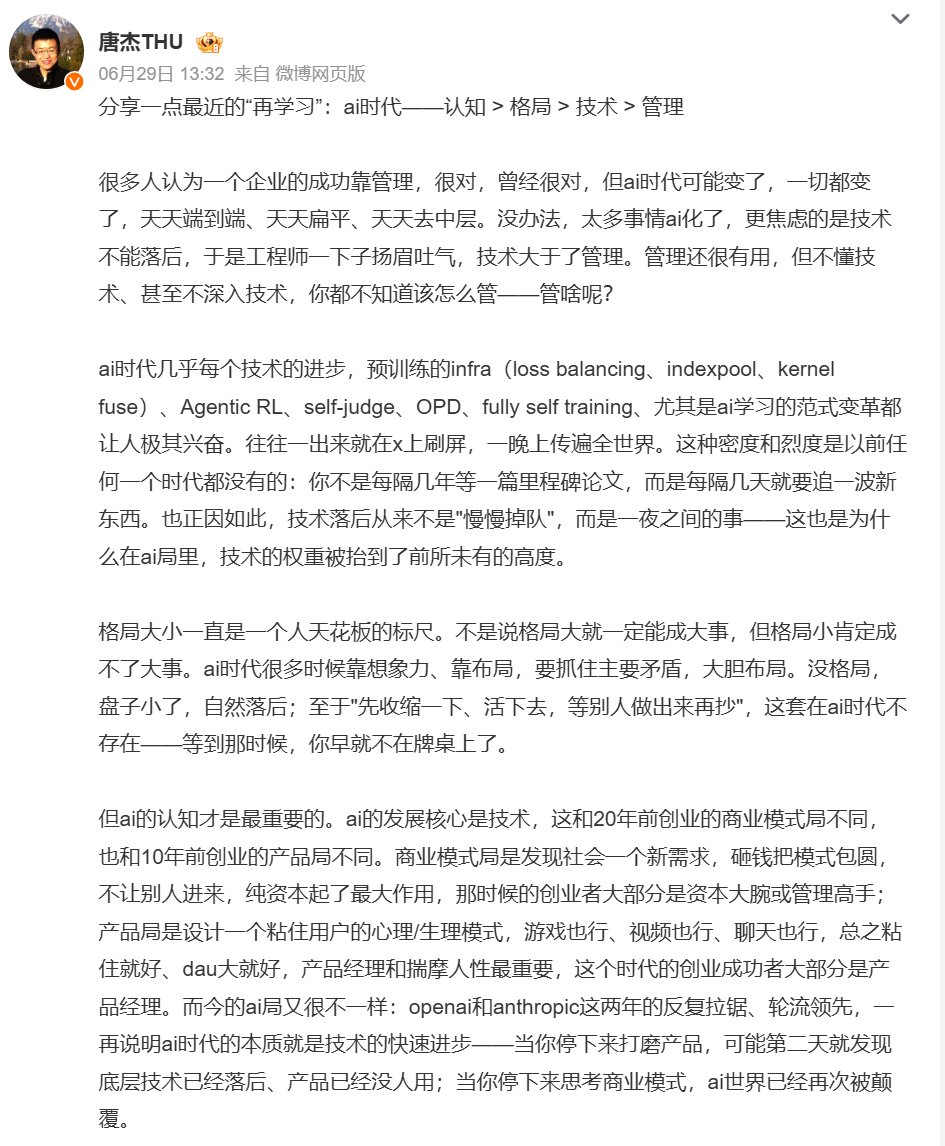
1/ Recent "re-learning": the AI era ranks cognition > vision > technology > management.
Many believe a company's success comes down to management. True once, but the AI era changed everything: end-to-end, flatter, middle layers stripped out. Too much got AI-ified, and the deeper fear is falling behind technically. Engineers can suddenly hold their heads high; technology now outweighs management. Management still matters, but if you don't understand the tech, you don't even know what to manage.
2/ In the AI era almost every advance, pre-training infra (loss balancing, indexpool, kernel fuse), Agentic RL, self-judge, OPD, fully self-training, and above all the shift in how AI learns, is intensely exciting. The moment something ships it floods X and circles the globe overnight. You're no longer waiting years for a milestone paper; you chase a new wave every few days. So falling behind is never a slow drift, it happens overnight. That's why technology now carries unprecedented weight.
3/ The size of your vision (格局) is the measure of your ceiling. A big vision doesn't guarantee great things, but a small one guarantees you'll never achieve them. The AI era runs on imagination and bold positioning: seize the principal contradiction, place big bets. As for "contract, survive, and copy others once they've built it," that doesn't exist in the AI era. By then you're long off the table.
4/ But AI cognition matters most. AI's core is technology, unlike the business-model game of 20 years ago or the product game of 10 years ago.
The business-model game: find a new social need, throw money at it to wrap up the whole model and keep others out. Capital was decisive; the winners were capital heavyweights and management masters.
The product game: design something psychologically sticky (games, video, chat). As long as it sticks and DAU is large, you win. Product managers who read human nature won.
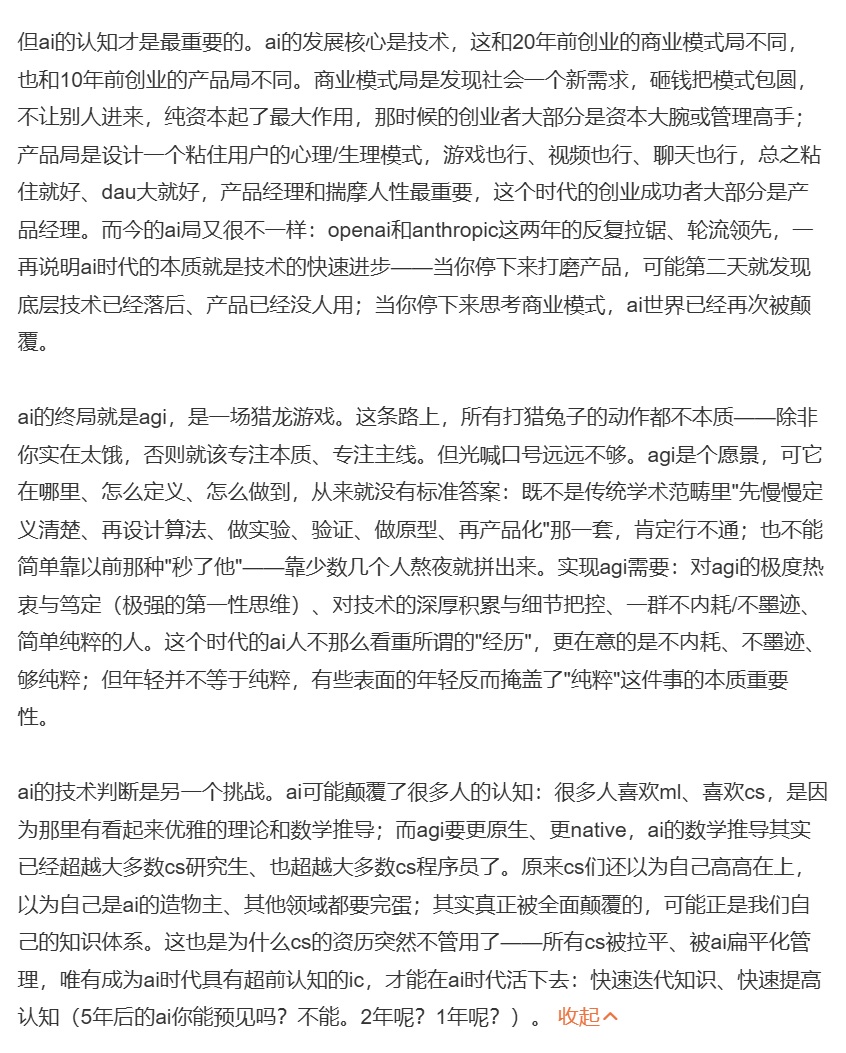
5/ Today's AI game is different again: the back-and-forth between OpenAI and Anthropic these past two years, trading the lead, proves the essence of the AI era is the rapid progress of technology. Stop to polish the product and the underlying tech may already be obsolete by tomorrow, with no users left; stop to think about the business model and the AI world has been upended once more.
6/ The endgame is AGI, a dragon hunt. Every move spent hunting rabbits is non-essential; unless you're starving, focus on the main line. But slogans aren't enough. AGI is a vision with no standard answer for where it is or how to reach it. The old academic routine (define it, design the algorithm, experiment, validate, prototype, productize) won't work; nor will a handful of people grinding all-nighters to hack it out.
7/ Reaching AGI needs: extreme conviction about AGI (very strong first-principles thinking), deep technical accumulation and command of detail, and a team of simple, pure people with no internal friction and no dithering. This era's AI people care less about "experience" and more about being un-conflicted, no-nonsense, and pure. But youth isn't purity; surface-level youth often hides how essential purity really is.
8/ Judging the technology is another challenge. Many loved ML and CS for their elegant theory and math. But AGI is more native, more primal, and its math has already surpassed most CS grad students and engineers. CS people thought they sat above everyone, AI's creators, every other field doomed. But what's being overturned may be our own body of knowledge. CS seniority suddenly stops working; everyone gets flattened by AI. Only by becoming a forward-looking individual contributor, iterating your knowledge and raising your cognition fast, can you survive. (Can you foresee AI 5 years out? No. 2 years? 1 year?)
Jie Tang, co-founder of https://t.co/DOhakxhYiZ (Zhipu, maker of the GLM models), on why building in the AI era is unlike any startup wave before it:
"20 years ago, startups won on the business model. 10 years ago, on the product. Today, on the speed of the technology itself. If you stop to polish the product, the tech would be obsolete by tomorrow. Stop to think about the business model, and the AI world has already moved on."
Full translation linked in comments.
@zarazhangrui The bottleneck on new products was never demand or ideas. It was the supply of people who could build. Now the people who actually understand what's worth making can ship it themselves, and all that overlooked demand finally gets served. Can't wait to see what you ship next!
"Why'd you move to SF?"
South Bay felt a little "too sleepy." Now I overpay $5k for a studio in Rincon Hill and spend my first month learning which blocks to hold my breath on. Don't even mention Woodlands Market...
Most agent skills rot the second your docs change.
Fix it with two moves:
(1) progressive disclosure (a tiny router fetches only the doc a task needs, on demand)
(2) sync by design (live-doc refs, drift checks, auto-update).
Skills that stay correct as your product moves.
@a16z Having access to large volumes of cheap tokens and the right harness for running agent loops should now a measure of company productive capacity.
Open vs closed, per 1M output tokens:
• DeepSeek V4 — $3.48 → 7× cheaper
• Kimi K2.7 — $4.00 → 6× cheaper
• GLM-5.2 — $4.40 → ~6× cheaper
• Qwen 3.7 — $1.60 → 16× cheaper
vs Claude Opus at $25.
You don't need God to write your emails.
At low volume the price gap is rounding error, but as usage scales, paying frontier rates for non-frontier tasks eats away at your margins. For a lot of products, you're better off on open source.
@AnatoliKopadze This is gold. The one thing I’ve found is that loops can burn through Claude Max fast. I’ve recently been routing Claude Code through GLM on Fireworks, and for a lot of these workflows the performance has been roughly on par at a much better cost profile.
# Paste-to-agent: add a GLM (Fireworks) side profile to Claude Code
Copy everything in the block below, replace `fw_YOUR_KEY_HERE` with your own
Fireworks API key (get one at https://t.co/pYwWGxCnHi), and paste it
to your coding agent.
---8<--- PASTE FROM HERE ---8<---
Set up a side profile so I can run Claude Code on Fireworks' open-weights GLM
model alongside my normal Opus session, without changing my default setup.
My Fireworks API key: fw_YOUR_KEY_HERE
Do the following:
1. Find my `claude` binary's absolute path (check `command -v claude`, and if
that fails, `ls -l ~/.local/bin/claude`). Use the absolute path in step 3 so
it works even when ~/.local/bin isn't on PATH.
2. Sanity-check the Fireworks Anthropic-compatible endpoint with my key before
touching any config:
curl -s https://t.co/xKgD24qSTX \
-H "Authorization: Bearer fw_YOUR_KEY_HERE" \
-H "anthropic-version: 2023-06-01" \
-H "Content-Type: application/json" \
-d '{"model":"accounts/fireworks/models/glm-5p2","max_tokens":64,"messages":[{"role":"user","content":"say hi"}]}'
A JSON response with a `content` array means it works. If it 401s, stop and
tell me the key is bad.
3. Append a shell function to my shell rc (~/.zshrc for zsh, ~/.bashrc for bash).
Set the env vars INLINE on the command — not via settings.json — because real
env vars override settings.json and avoid being shadowed by an inherited
ANTHROPIC_BASE_URL. Use the absolute claude path from step 1:
# Claude Code -- GLM (Fireworks open-weights) side profile.
claude-glm() {
ANTHROPIC_BASE_URL="https://t.co/kGWyWZwCTP" \
ANTHROPIC_AUTH_TOKEN="fw_YOUR_KEY_HERE" \
ANTHROPIC_MODEL="accounts/fireworks/models/glm-5p2" \
"<ABSOLUTE_PATH_TO_CLAUDE>" "$@"
}
4. Verify end-to-end by running the inline-env command directly (don't rely on me
sourcing rc yet):
ANTHROPIC_BASE_URL="https://t.co/kGWyWZwCTP" \
ANTHROPIC_AUTH_TOKEN="fw_YOUR_KEY_HERE" \
ANTHROPIC_MODEL="accounts/fireworks/models/glm-5p2" \
"<ABSOLUTE_PATH_TO_CLAUDE>" -p "which model family are you?"
Expect it to identify as GLM. Report the actual output.
5. Tell me to run `source ~/.zshrc`, then use:
claude-glm # interactive session on GLM
claude # unchanged, still my normal Opus setup
Notes to keep in mind and relay to me:
- This redirects the WHOLE CLI per-invocation; the endpoint is fixed at launch,
so I can't /model-swap between Opus and GLM mid-session.
- The key will sit in my shell rc in plaintext (fine locally; rotate if leaked).
- GLM-5.2 is the strongest open-weights coding model on Fireworks but is a notch
behind Opus on hard multi-step tool use -- don't claim parity.
---8<--- PASTE TO HERE ---8<---
## Reference docs
- Claude Code third-party endpoints: https://t.co/cg6ge5zyOa
- Claude Code env vars: https://t.co/YZiyPsEx0A
- Fireworks API keys: https://t.co/pYwWGxCnHi
- Fireworks FireConnect (official one-command alternative): https://t.co/hT9QjYU6Sm
How I cut my Claude Code bill by hundreds a week by running it on open source GLM model to get near Opus coding quality.
1. Make a Fireworks account, grab an API key
2. Paste this prompt below + your key into Claude Code, it sets itself up