Trump will not attend the Super Bowl because he can’t take being booed mercilessly.
He has canceled the F-22 flyover because if he can’t be there so he’s taking his toys and going home.
Meanwhile, the Pedo Bowl is being projected on buildings.
WOW! Emily Heller, who was an eyewitness, is now speaking out to set the record straight.
Officers were screaming at Renee Good, “Move, move, move.”
So she moved, and they shot her multiple times? Then Noem and Trump branded her a domestic terrorist.
Stephen Colbert on the ICE murder of Renee Good: “The message from this administration is clear. Only they determine the truth. And when their forces come to your city, obey or die. And if you die, you clearly didn’t obey. This should be an alarm bell for the entire country.”
Gallego just dropped a nuke:
“How can I negotiate? The president’s in Asia for five days. Johnson’s keeping the House out until January to protect pedophiles. So who am I negotiating with?”
That’s an obituary for congressional leadership.
A young statistician saved their lives.
His insight (and how it can change yours):
During World War II, the U.S. wanted to add reinforcement armor to specific areas of its planes.
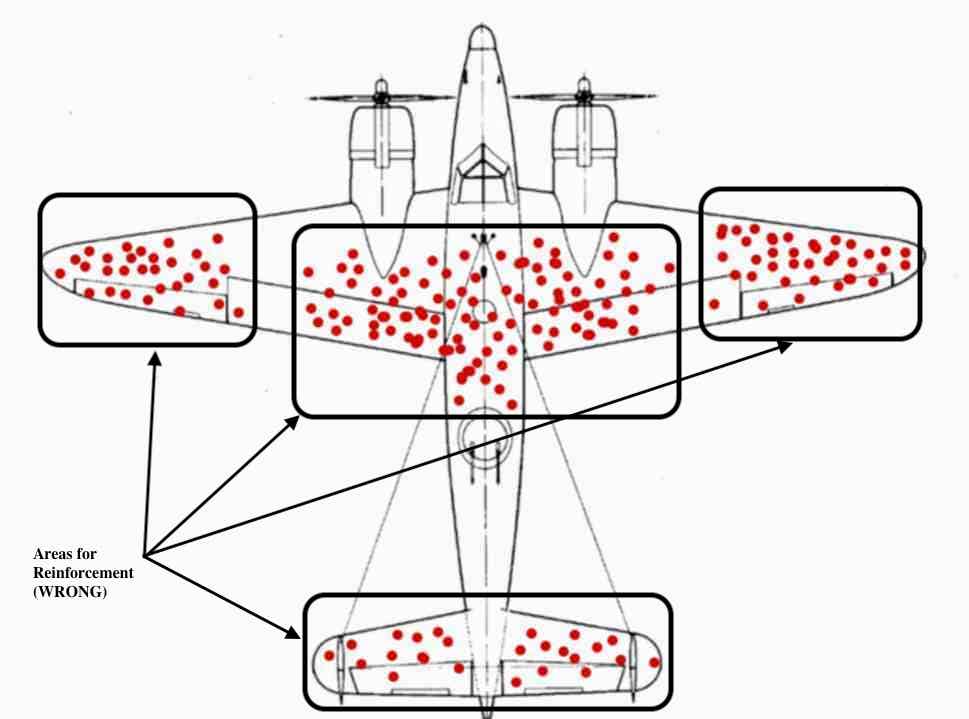
Analysts examined returning bombers and plotted the bullet holes and damage on them (as in the image below).
Based on this analysis, they came to the conclusion that adding armor to the tail, body, and wings would improve their odds of survival.
But a young statistician named Abraham Wald noted that this would be a tragic mistake.
By only plotting data on the planes that returned, they were systematically omitting the data on a critical, informative subset:
The planes that were damaged and unable to return.
Abraham Wald recognized a key fact:
• "Seen" planes had sustained damage that was survivable.
• "Unseen" planes had sustained damage that was not survivable.
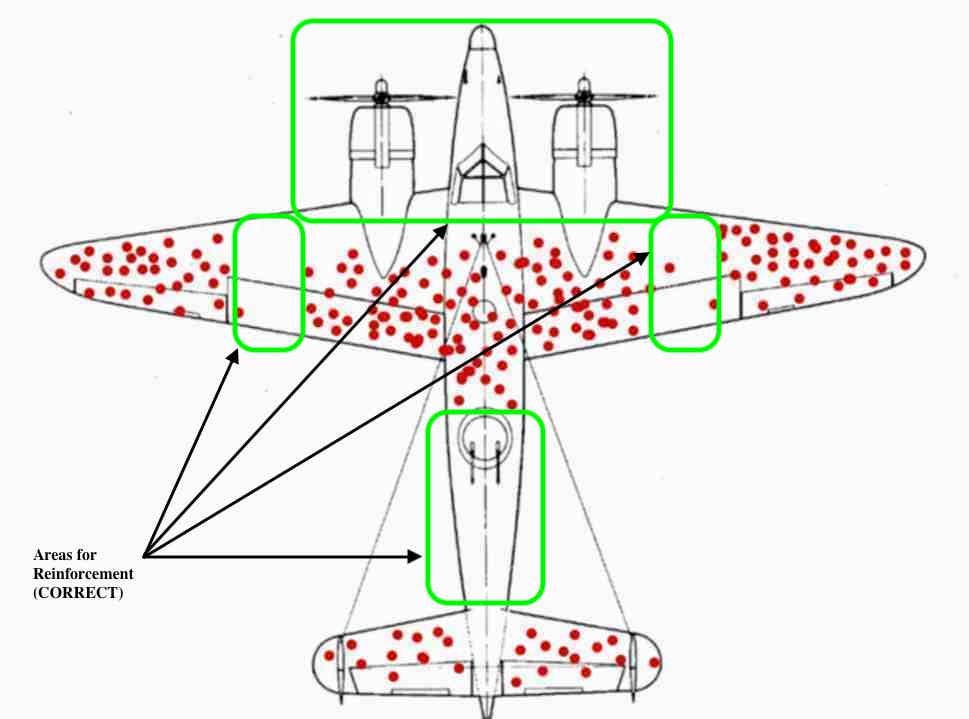
Wald concluded that armor should be added to the *unharmed* regions of the returning planes (the areas without bullet holes on the image below).
His profound logic:
Where the survivors were unharmed was actually where the planes were most vulnerable.
Based on his insight, the military reinforced the engine and other vulnerable parts, significantly improving the safety of the crews during combat and saving thousands of lives.
Abraham Wald had identified a cognitive bias called "Survivorship Bias":
The error resulting from systematically focusing on survivors (successes) and ignoring casualties (failures) that causes us to miss the true base rates of survival (the actual probability of success) and arrive at flawed conclusions.
We see examples of Survivorship Bias all around us:
1. We read books on the common traits of successful people, but fail to consider all of the unsuccessful people who possessed those same traits.
2. We applaud the belief when we hear that an entrepreneur took out a second mortgage and succeeded, but fail to consider all of the entrepreneurs who did the same and went bankrupt.
3. We study the cultural strategies of the most successful companies, but fail to consider all of the companies that followed those same strategies and fell apart.
When we fail to consider the range of outcomes and the hidden evidence, we develop a skewed (and often incorrect) view of reality.
It cannot be avoided altogether, because the vast majority of books and history are written by and about the survivors and victors, but wherever possible, consider the unseen evidence.
Remember: What is unseen often has just as much value as what is seen.
***
If you enjoyed this or learned something, follow me @SahilBloom for more in future!
Blackstone when their only competitor in buying a single family home they can turn to a rental is a first time millennial homeowner with a child on the way:
Catalina Usme’s goal sends Colombia to the quarter-finals for the first time at the #FWWC! 😍
Las Superpoderosas will face England on Saturday at 6:30 AM EST. 🫣🔥
https://t.co/alLoiZVHC1
@mattytay@solana@coinbase What blogs, articles, or sources can you point me to where I can get smarter on the use case of crypto payments being used by retailers? Is there anything on cross-border payments?