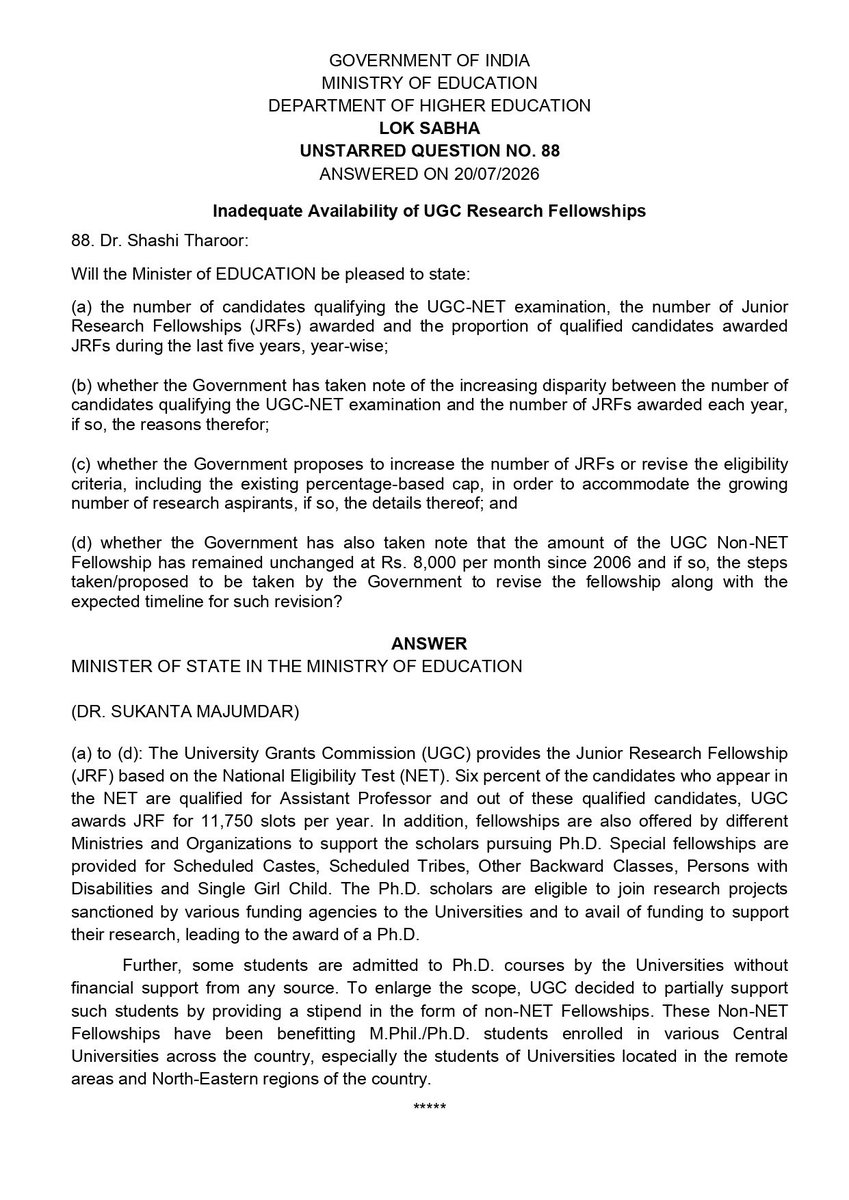
This is a disappointing answer. While the Ministry's response merely provides a broad overview of the existing UGC fellowship framework, it fails to address the core concerns raised. Instead of furnishing the requested year-wise data on UGC-NET qualifiers and JRF awardees, it relies on a general description of the existing scheme and alternative sources of research funding.
The reply also sidesteps the question of whether the Government has examined the widening gap between qualified candidates and available fellowships or whether it intends to expand JRFs or revise the eligibility criteria. Most notably, it remains silent on revising the Rs. 8,000 UGC Non-NET Fellowship stipend—unchanged since 2006 despite periodic revisions being the norm.
I also raised this issue through my Zero Hour intervention in 2023, yet the Government continues to offer neither a commitment nor a timeline for its revision.
Beyond financial support, there is also a pressing need to strengthen institutional research infrastructure, ensure adequate academic supervision, establish effective grievance redressal mechanisms, and undertake a comprehensive review of research fellowship support so that India's research ecosystem keeps pace with the aspirations of its scholars.
“इंसाफ दो… वरना मौत ही दे दो!”
मध्य प्रदेश के छतरपुर और पन्ना में आदिवासी समाज अपनी ज़मीन, घर, जंगल, संस्कृति और अस्तित्व को बचाने के लिए ‘चिता आंदोलन’ करने को मजबूर है।
जब इंसाफ के सारे दरवाज़े बंद हो जाते हैं, तब लोग अपनी जान दांव पर लगाकर सड़क पर लेटते हैं। उनके लिए अपनी पुश्तैनी पहचान को डूबते देखना, मौत से भी बड़ा दर्द है।
केन–बेतवा लिंक परियोजना के तहत बनने वाले दौधन बांध से लगभग 22 गाँव और 7,000 से अधिक परिवार प्रभावित होंगे।
विकास तभी सार्थक है, जब वह लोगों के अधिकारों और सम्मान को साथ लेकर चले। अगर विकास की कीमत किसी का पूरा जीवन और पहचान है, तो सवाल उठना स्वाभाविक है।
#KenBetwa #Chhatarpur #Panna #Adivasi #Justice #MadhyaPradesh
An Open Letter to the Jantar Mantar protestors:
My dear young friends,
I address you today not as a politician or an MP, but as someone deeply troubled by what is happening to your generation of young Indians.
This is personal for me. I was born to a middle-class family: my father was a salaried newspaper employee, my mother a homemaker, with three children to educate on one income. For a family like ours, merit was not a slogan. Scholarships, fair examinations, honest results — these were the only way one salary could carry three children's dreams.
I went to school in Mumbai and Kolkata, to college here in Delhi, topped the University and earned admission into IIM — and chose instead to follow my passion for international affairs, in America, on a scholarship. Nothing was inherited; everything was earned by hard work and yes, Exams.
So I know that a fair, merit-based system is the only ladder for young people from lower and middle-income families to climb up. When that ladder is broken — papers leaked, examinations cancelled, trust destroyed — the children of the rich and powerful do not suffer. They have other ladders. It is your dreams, and your families' sacrifices (and tragically, in some homes, young lives themselves) that are betrayed.
To the young people gathered at Jantar Mantar, and those raising your voices peacefully across India: this country hears you. Your anger is not indiscipline — it is the anguish of a generation that did everything right and was still betrayed . You are not alone.
And to the millions of young Indians watching quietly: your generation is not a problem to be managed. You are the answer to India's future. Do not lose hope. This ladder will be rebuilt — by you, and by every Indian who stands with you.
To Shri Sonam Wangchuk-ji, my heartfelt appeal: please end your fast. You have awakened the conscience of the nation; that is what a fast is meant to do. India needs your voice for the long road ahead.
With Parliament in session again from Monday, we will have an opportunity to raise the students’ issues in the highest forum of our democracy. That’s where the problem should be addressed, not by fasting unto death. Please heed my plea.
And finally, to the Government: I respectfully urge you to reach out and engage in the dialogue our democracy owes its young citizens. That is not weakness; that is statesmanship.
Students are devastated after two student leaders from Rohtak issue a video and a copy of original handwritten question paper made by the makers went viral on 6th July. The PDF creation meta data shows 30th June 4:08am and the exam was held on 30th June 3pm. This has created severe moral panic raising doubts on how the original paper copy was found and where all they have gotten circulated. @NTA_Exams@ugc_india please take cognisance of this matter and issue an official statement asap on what are the aspirants supposed to do now? If there is any truth to such severe allegations then please let us know. We all are helpless and broken at this point.
An investigation by The Indian Express into the 104 candidates selected under the EWS (Economically Weaker Sections) quota in the 2025 UPSC Civil Services Examination raises important questions about how India defines economic disadvantage.
A quick primer: What is EWS?
The EWS quota introduced in 2019 provides 10% reservation in education and government jobs for candidates from the "General Category" who are not eligible for reservations under SC, ST, or OBC categories and who meet prescribed income and asset criteria.
Today, a family with an annual income below ₹8 lakh, and within specified asset limits, can qualify for EWS benefits.
So why does this matter in UPSC?
The UPSC Civil Services Examination is among the most competitive exams in the world.
Nearly 10 lakh candidates apply each year.
~6 lakh actually appear for the Preliminary Examination.
~15,000 reach the Mains stage.
~3,000 are interviewed.
Just 1,000-1,100 candidates are finally selected for the IAS, IPS, IFS and other central services.
In 2025, 104 candidates were selected under the EWS quota.
So what did the investigation find?
Among the 104 EWS candidates selected:
At least 84 had received formal UPSC coaching.
At least 67 attended some of India's most prominent coaching institutes, where fees can run into lakhs of rupees.
At least 46 studied in private schools.
At least 28 came from business families.
At least 10 had prior corporate-sector experience.
At least 14 were IIT graduates, with others coming from NITs, Delhi University and JNU.
At the same time, the investigation also found many candidates who clearly fit the intended spirit of the quota — children of farmers, labourers, security guards, bus conductors and other economically vulnerable families.
The investigation does not suggest that these candidates were ineligible.
Instead, it raises a deeper policy question: Does an income ceiling of ₹8 lakh adequately identify India's economically weakest citizens, or does it allow many socially and educationally advantaged families to qualify for benefits intended for the disadvantaged?
The debate is no longer about legality.
It is about whether the current definition of "economically weaker" is serving the purpose for which the EWS quota was created.
Read the full story here:
https://t.co/clwlWMq3Ga
A key finding from AIIMS New Delhi research highlights that increased screen time in children under one year of age is associated with a higher risk of autism by the age of three.
The study suggests that greater screen exposure may increase the likelihood of autism-related concerns. Experts recommend keeping children below 18 months away from screens.
Dr. Shefali Gulati, Professor, Department of Pediatrics, #AIIMS
#ChildHealth #ScreenTime #ParentingTips #AutismAwareness @aiims_newdelhi
➤ Census is a Union subject and is listed at serial number 69 in the Seventh Schedule of the Constitution. The legal framework governing it is provided by the Census Act, 1948 and the Census Rules, 1990
➤ The Census Act contains a significant provision Section 15 under which personal information provided is treated as strictly confidential. It cannot be made public under the RTI Act, used as evidence in any court of law, or shared with any institution
➤ States and Union Territories play a crucial role in this process; their entire administrative machinery is mobilised to complete fieldwork at the grassroots level
➤ The previous census was conducted in the year 2011. Census 2027, 16th Census in the series and 8th since independence
➤ Census - 2027 will be conducted in two phases:
Phase 1: House Listing and Housing Census (HLO)
Phase 2: Population Enumeration (PE)
-Mritunjay Kumar Narayan, Registrar General and Census Commissioner of India
#Census2027 @CensusIndia2027
Not Delhi. Not Mumbai.
India’s best public transport system is in Bhubaneswar.🚌
While cities chased metros, Bhubaneswar fixed its buses — launching Mo Bus with CCTV, panic buttons, real-time tracking, clean shelters, and last-mile e-rickshaws.
Ridership jumped 200%. 57% shifted from private vehicles.
40% conductors are women. Inclusivity isn’t a slogan here.
Cleaner air. Safer streets. Rebuilt trust.
If Bhubaneswar can do it, why can’t your city? Tell us in the comments below.
#PublicTransport #UrbanMobility #SustainableCities #SmartCity #Solutionaries
[Solutionaries, Best Public Transport In India, Bhubaneswar Bus System, Odisha, Urban Transport Model, Smart Public Transport India, Sustainable City Mobility India]
I am fully convinced that 2019 was the last normal year we ever had. Ever since then, it feels like everything’s broken. Everyone is constantly anxious, time moves too fast, and nothing actually feels real anymore. The world as we knew it is just gone
Indian parents, this is important.
Short video apps: Reels, Shorts, TikTok-style content are not “just harmless entertainment.” A 2024 EEG study @FrontNeurosci found that higher short-video addiction scores were linked to reduced theta activity in the prefrontal cortex (the brain area responsible for attention and self-control).
Lower self-control. Weaker executive focus.
Another study in @JAMAPediatrics (2023) linked excessive early screen exposure to delayed language and executive development.
Children’s brains are highly plastic. Rapid, algorithm-driven dopamine bursts condition them to crave constant novelty. Over time, attention shortens. Irritability rises. Homework suffers. Social withdrawal increases. This is not about banning technology. It’s about boundaries.
@WHO guidance is clear:
• No screens under 2 years
• Max 1 hour/day (2–5 years)
• Structured limits for older children
*Create screen-free zones (meals, bedrooms).
*Use timers & parental controls.
*Model what you preach- children copy us.
*Replace scrolling with play, sports, reading, art.
Watch for warning signs:
Can’t stop? Angry without device? Falling grades? Seek early help.
A balanced childhood builds resilient adults.
Protect attention. Protect childhood.
#ChildMentalHealth #ParentingIndia #DigitalWellbeing #ScreenTime
The war on Iran has little to do with nuclear or missile proliferation or state-sponsored terrorism. If those were the real concerns, the more obvious U.S. target would be Pakistan: a declared nuclear-armed state with an estimated 170+ warheads; a country that U.S. intelligence assesses is developing intercontinental-range ballistic missile capabilities that could reach the United States; and one whose state-backed terror networks have been linked to major transnational terrorist attacks, including in the West. The principal architects of 9/11 were ultimately found in Pakistan, among them Osama bin Laden and Khalid Sheikh Mohammed.
Iran, by contrast, remains a signatory to the Nuclear Non-Proliferation Treaty and, although it enriched uranium up to 60% (just below the 90% weapons-grade level), is still widely assessed to be far away from building a functional nuclear weapon. Yet Washington has chosen to wage war on Tehran while effectively mollycoddling Pakistan — justifying its actions with claims that Iran poses an existential threat to the U.S.
The logic of this war is therefore geopolitical, not defensive. It is about reshaping the regional balance of power, installing a pliable regime in Tehran, and weakening Iran’s network of regional influence. Control over the Strait of Hormuz — through which roughly a fifth of the world’s traded oil passes — and the broader project of rolling back Iran’s strategic reach are integral to this regime-change agenda.