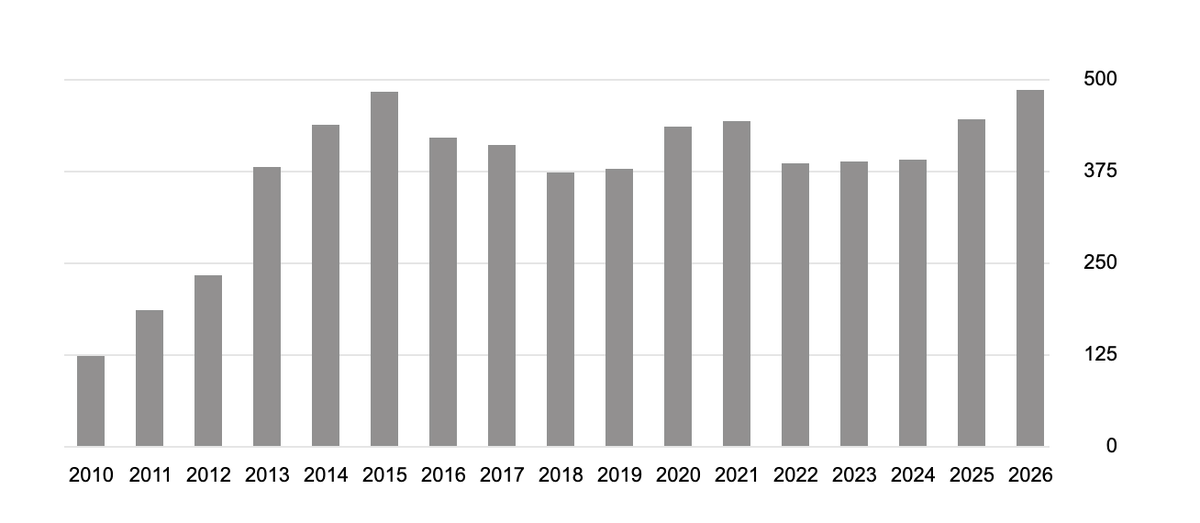
The funny thing is that Reinhart & Rogoff's American Economic Review paper has not been retracted following the Excel error scandal. It indeed continues to receive a significant number of citations (6,575 to date), and its citation rate did not fall after the scandal; in fact, it has started to rise again.
https://t.co/JaKHck9k6v
A 28-year-old UMass graduate student got a homework assignment to reproduce a famous economics paper, couldn't make the numbers match, and found a spreadsheet mistake in a study that politicians had used to argue for budget cuts.
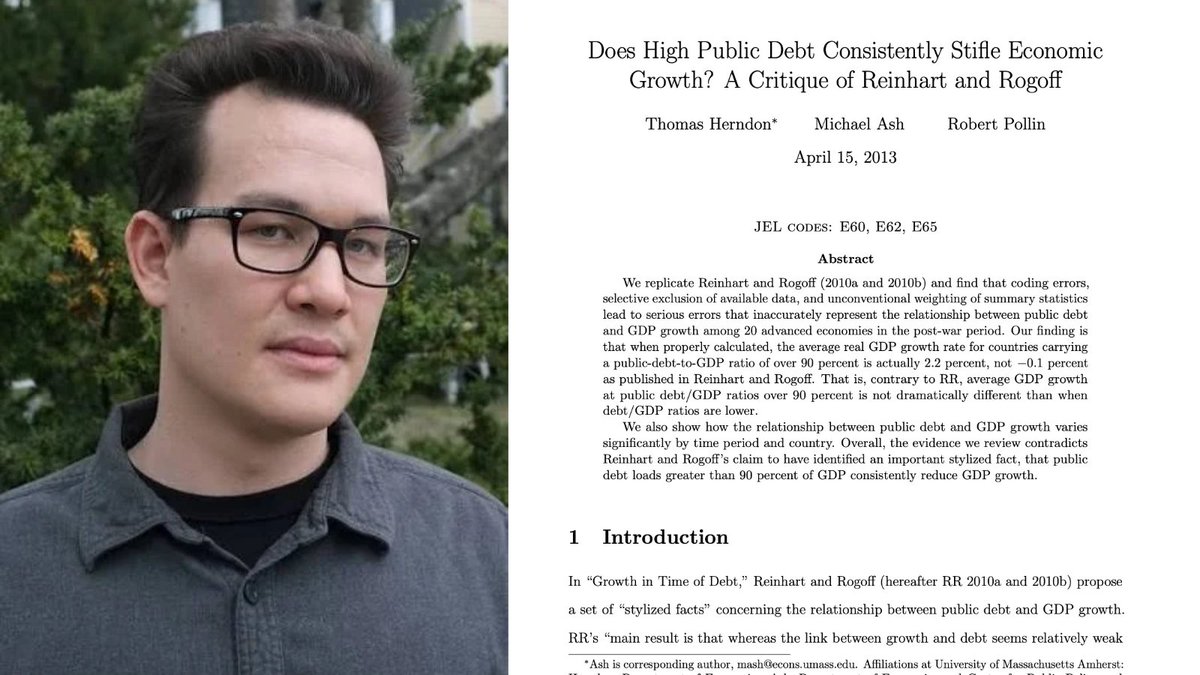
His name is Thomas Herndon.
In 2010, two Harvard economists, Carmen Reinhart and Kenneth Rogoff, published a short paper called Growth in a Time of Debt. Its headline finding: once a country's public debt goes above 90% of its economy, growth falls off a cliff. In their numbers, average growth for that group was minus 0.1%.
It came out right after the 2008 financial crisis, and it spread fast. In the US, the Paul Ryan budget cited it as its only evidence on what high debt does to growth.
In Europe, an EU commissioner pointed to the research in a speech. In Britain, George Osborne cited the authors by name.
Herndon was a PhD student at the University of Massachusetts Amherst, taking a class called Econ 753: Applied Econometrics. The big assignment was to pick a well-known paper and replicate it.
He picked this one. He couldn't get the same results.
He asked the authors for their spreadsheet, and they sent it. When he spotted the problem, he called his girlfriend over to make sure he wasn't seeing things.
He wasn't.
> One formula stopped five rows short
> That quietly left out five countries: Australia, Austria, Belgium, Canada and Denmark
> Some available years of data for other countries weren't included
> The way the averages were weighted let a single bad year in one country count as much as decades in another
Herndon and his professors, Michael Ash and Robert Pollin, published the critique in April 2013. Fixing the problems, average growth for the high-debt countries came out to 2.2%, not minus 0.1%.
Reinhart and Rogoff publicly admitted the spreadsheet error. They disputed the other criticisms and defended their broader view. Economists still argue about debt and growth today.
But the formula was wrong, and for about three years nobody had publicly caught it.
A student doing homework did.
Most people assume famous research has been checked many times. Often the first person to really check it is someone with nothing to lose and an assignment due.
Have you ever found a mistake in your boss's spreadsheet and kept quiet?
“MMT says we can print money without limits".
No. It says a currency issuer doesn't face the same constraints as a household.
The limits are real: labor, energy, technology, productive capacity, and inflation.
The money printer is yours. So is the straw man.