On the issue of fuel subsidy, it took @Atiku Abubakar and @ChibuikeRotimi1 nearly a decade to catch up with the position we have consistently maintained in the @aacparty.
We warn that subsidy removal would simply transfer the cost of government failure to ordinary Nigerians. Now, after Nigerians have been brutally impoverished by the consequences, the same political establishment is beginning to repeat what we said all along.
We don’t need leaders who discover the truth only after millions of Nigerians have paid the price. #Sowore2027 #RevolutionNow #NBAAGCPortHarcourt
"The coalition should be based on performance. Access us by our last performance and choose"
- HE Rotimi Amaechi speaking at the ongoing NBA Annual Conference in Port Harcourt
Update on the peaceful demonstration against One Chance currently happening in Port Harcourt.
Kudos to the group for being resilient even with the rain.
We heard they've just passed GRA Junction and heading to Abali park.
Destination : Government House, Police HQ Moscow Road.
Rufai: You hardly offer solutions. For instance, while speaking recently you talked about adding extra megawatts and targeting 10,000 megawatts. Can you give a breakdown of how you are going to achieve that 10,000 megawatts of electricity?
Peter Obi’s response: Somebody said, “If I don’t give you power, don’t vote for me.” Did he tell you how he is going to give you power? So why must my own be in the marketplace?
Beyond Football: The Match for a Better Nigeria
This weekend, Europe comes alive again with football. Millions of Nigerian youths will be glued to television screens, streaming matches, debating tactics, celebrating victories, and admiring the organisation, discipline, and excellence that make European football the envy of the world. But here is a question worth asking: Why can’t Nigerian football be just as good?
The answer is not a lack of talent. Nigeria has produced world-class footballers who have excelled in Europe because they found systems that reward merit, invest in infrastructure, ensure security, and are governed with competence and accountability. Great football does not exist in isolation. It grows where there is good governance.
The stadiums, academies, transport systems, healthcare, security, electricity, and institutions that support football are products of leaders who make the right choices and citizens who insist on accountability. Nigeria has the talent. What we have lacked is leadership that creates an enabling environment for that talent to flourish.
As I have decided, in the next 150 days, to engage Nigerian youths wherever they gather—in town halls, campuses, online spaces, and even football communities—my message is simple: The future you admire in Europe can be built in Nigeria. But it starts with your vote.
Imagine a Nigeria where our local league is competitive, our stadiums are full every weekend, our clubs attract sponsorship, our coaches receive proper training, and young footballers no longer see emigration as their only path to success.
Nigeria will not emerge through wishful thinking. It will emerge when young Nigerians decide that elections matter as much as football matches. Every goal scored in Europe is a reminder that excellence is possible. Every well-managed league is proof that systems work when honest leadership is in place.
The 2027 presidential election is therefore more than a political contest. It is an opportunity for Nigerian youths to choose the kind of country they want—a nation that exports talent because it is respected, not because its citizens are escaping failed governance.
Cheer for Manchester United, Arsenal, Chelsea, Liverpool, Manchester City, Barcelona, Real Madrid, Bayern Munich, PSG, Inter, AC Milan, or any club you support. Enjoy every match. But when the final whistle blows, remember that the greatest match awaiting Nigerian youths is not in Europe. It is in Nigeria.
It is the match for good governance. It is the match for jobs, security, education, sports development, and national renewal. And unlike football, where only twenty-two players are on the pitch, every Nigerian youth has a place in this match.
Stand up. Mobilise. Vote. Defend your vote.
If Nigerian youths can passionately follow European football every weekend, they can also passionately build a Nigeria where our own football—and our nation—becomes a source of pride.
The journey towards better Nigerian football begins with the path to good governance. And the path to good governance begins with the decision of Nigerian youths to stand up and be counted in 2027.
Every weekend, starting today, I will come to you with a reminder of January 16, 2027, and our future. We can create world-class standards right here at home.
It’s in your hands, and that new Nigeria is POssible. -PO
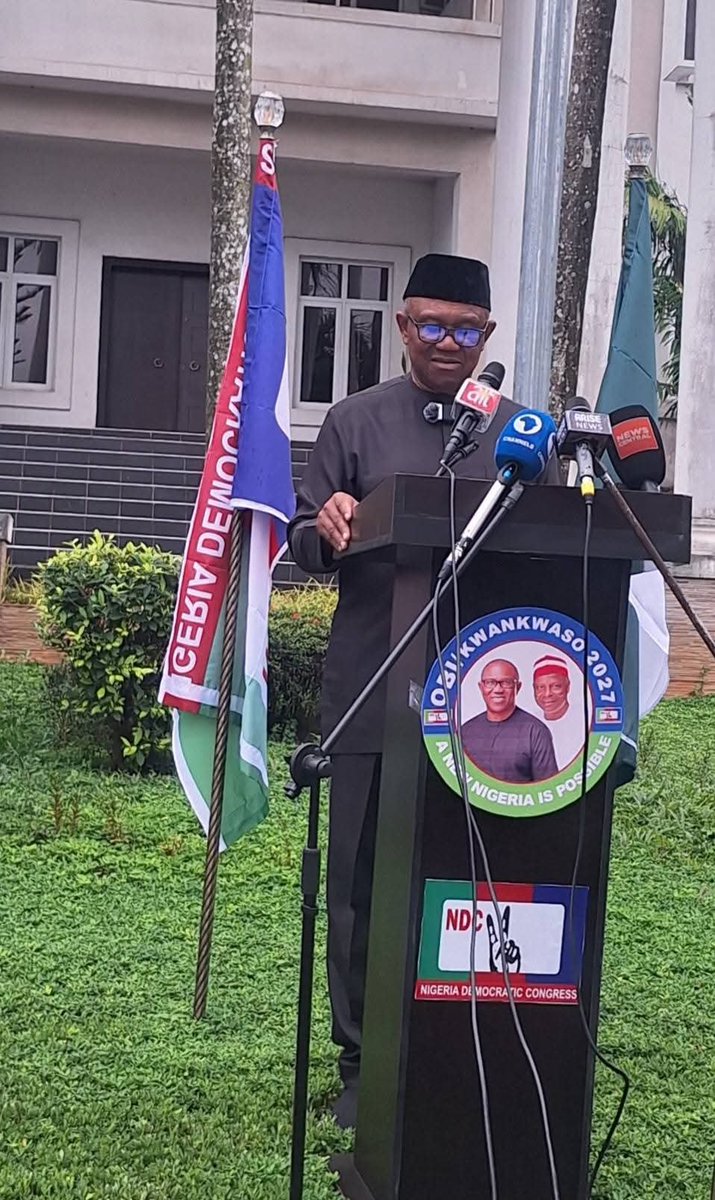
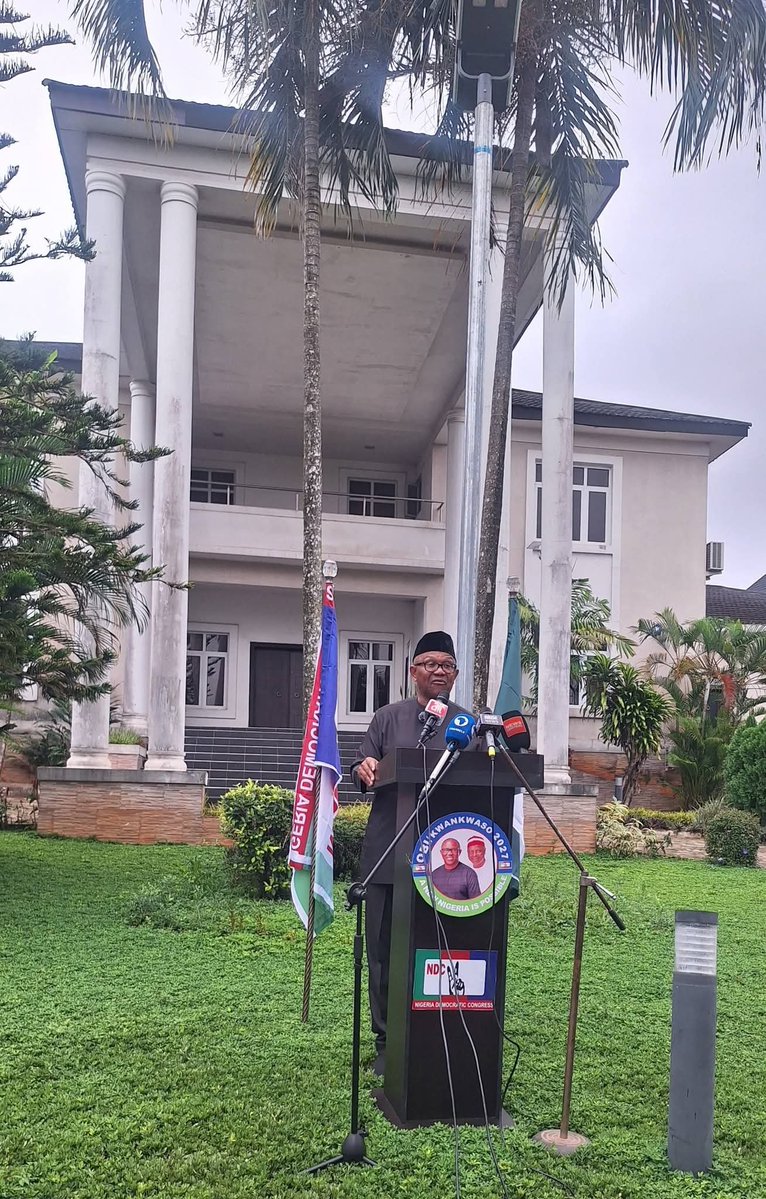
MY ADDRESS TO MARK THE COMMENCEMENT OF THE 2027 PRESIDENTIAL AND NATIONAL ASSEMBLY CAMPAIGNS
21 August 2026
Dear Compatriots,
Members of the Press,
Distinguished ladies and gentlemen,
Wednesday, 19 August 2026, marked the official start of the campaign period for the 2027 Presidential and National Assembly elections.
There is no doubt that this is a defining moment for our democracy. This moment gives Nigerians the opportunity to assess the records, ideas, and plans of those seeking their mandate to lead their country at a time of grave uncertainty in our rapidly changing world.
I consider myself quite privileged to be one of those seeking your mandate to deal with these challenges facing our country.
I enter this contest with one firm conviction: Nigeria can work, and Nigeria must work.
Nigeria faces several serious challenges. Some of them are indeed of existential proportions.
According to the IMF, 63%, or over 140 million Nigerians, live at or below the national poverty line, while humanitarian agencies estimate that 35 million people will need food assistance during the 2026 lean season. About 3.6 million Nigerians remain internally displaced, largely because of conflict and insecurity. Each year, millions of young people enter the labour market, yet too many struggle to find productive opportunities. Weak infrastructure, unreliable power, insecurity, and the excessive cost of doing business continue to burden households and constrain enterprise.
These are more than statistics. They reflect the daily realities of Nigerian families, farmers, workers, students, and businesses.
Yet I do not believe Nigeria lacks the ability to overcome these challenges. We have the people, resources, market, talent, and enterprise. What we must do now is turn these strengths into security, productivity, and shared prosperity.
LEADERSHIP MUST DELIVER RESULTS
My successful private-sector experience, studies in institutions of repute on policy and business matters, and my service as Governor of Anambra State have shaped my understanding of public leadership. Government must manage resources responsibly, set clear priorities, and measure the outcomes of its decisions. Public office is not a reward; it is a responsibility to the people.
In Anambra, I prioritised the foundations of long-term development: education, healthcare, infrastructure, fiscal discipline, and institutional capacity. I do not present that record as perfect, but as an experience from which Nigerians can draw their own conclusions.
Senator Rabiu Musa Kwankwaso brings a different but complementary governing experience.
As Governor of Kano State, he focused strongly on education, technical training, scholarships, infrastructure, and human-capital development. His administration’s investments in education and skills showed an understanding that the people are a state’s most important long-term resource.
Our experiences are different, but our conclusion is the same: Nigeria must invest in its people and manage public resources with discipline.
BUILDING AN ECONOMY THAT WORKS
Nigeria needs more than reactive reforms. We must focus on the questions that matter:
Are Nigerians better off than they were four years ago? Can they afford food, education, and healthcare? Can businesses produce, expand, and create jobs? Can young people find productive work? Can farmers work safely and get their produce to market?
PORT HARCOURT, THIS IS OUR TIME TO SPEAK!!!
The safety of our people, especially women and other vulnerable passengers, should concern every one of us.
There will be a Peaceful Demonstration Against One Chance Røbbëry in Port Harcourt as follows:
Date: Saturday, 22nd August 2026
Meeting Point: Pleasure Park, Port Harcourt
Destination: Rivers State Government House
We are calling on everyone who cares about the safety of our city to come out peacefully and demand action.
The Nigerian elite and politicians has hijacked the electoral process using the judiciary and the university professors.
They believe they can rig elections unchallenged.
- Mike Igini
“Where professors are aiding illiterates to rig elections... and people sing 'On your mandate we shall stand', whether stolen or not.”
Speaking at the 2026 Goodluck Jonathan Democracy Dialogue in Bauchi State, NDC Presidential Candidate Peter Obi decries the decline of democratic integrity and judicial independence in Nigeria, calling on citizens to reject the normalisation of electoral malpractice.
By Making Excuses for Unverified Certificates, We Are Planting Poison in the Soul of Our Society
A nation that tolerates unverified academic credentials at any level of leadership, regardless of who is involved, risks destroying the very standards upon which a society is built. The issue is not about an individual. It is about standards, accountability, and the values we choose to pass on to the next generation.
We cannot continue to excuse blurred, missing, questionable, or unverified credentials simply because they belong to someone we support. The process through which people attain positions of responsibility matters greatly. How we get into leadership is as important as what we do with leadership.
If we normalise the abandonment of basic verification today, tomorrow we may have professors who never attended a university, doctors who never studied medicine, and judges who never studied law.
That is the dangerous precedent we must never allow. Nigeria cannot sacrifice its future on the altar of today's transactional politics. We must build a society where truth is not partisan, standards are not negotiable, and accountability applies equally to everyone.
History will judge us not only by those we defended, but by the principles we were willing to defend. We must choose truth over convenience, standards over sentiments, and the future over political expediency.
A New Nigeria is possible, but only if we are willing to do the right thing, even when it is inconvenient. -PO
2027: Tinubu Government Bent On Winning By All Means — Onaiyekan
Unfortunately they have a lot of means at their disposal and they’re deploying all those means in a way that eventually, even with a free and fair election the votes of the people may not count.
John Cardinal Onaiyekan
Archbishop Emeritus, Catholic Diocese of Abuja
Hunger and the Insensitivity of Mr. President
I watched with deep concern the statement made by President Bola Tinubu to the Catholic Bishops who visited his office, that there has always been hunger in Nigeria, even before he was born.
While it is true that hunger has been a part of human life and has existed in our country for decades, such a statement appears insensitive to the plight of the millions of Nigerians who face worsening economic hardship today. More importantly, we must focus on the facts and the measurable outcomes of governance.
Before the present administration assumed office in 2023, an estimated 17 million Nigerians were facing acute food insecurity, primarily caused by insecurity, armed conflict, widespread banditry, and devastating floods. Today, less than three years later, that number has risen to about 35 million Nigerians. Instead of improving the situation, the crisis has worsened significantly under the current administration.
The same trend is evident in poverty. Before this government took office in 2023, Nigeria’s extreme poverty was estimated at 87 million people. Current projections suggest that this number is approaching 140 million people, making Nigeria home to the largest population of people living in extreme poverty anywhere in the world.
No one disputes that this administration inherited serious challenges. However, leadership is measured not by the challenges inherited but by the results achieved. The government must honestly acknowledge that its response has fallen far short of what the situation demanded, with millions more Nigerians pushed deeper into poverty and hunger.
The combination of persistent insecurity, poor economic management, fiscal indiscipline, wasteful public expenditure, and inadequate investment in productive sectors has compounded the suffering of ordinary Nigerians.
A responsible government must prioritise investment in education, healthcare, agriculture, security, and small businesses while pursuing policies that create jobs, expand production, and lift people out of poverty. That remains my commitment to the Nigerian people.
A New Nigeria is Possible. PO
MOURINHO, a three-part documentary, is coming to Netflix August 11.
With exclusive access to Mourinho himself plus interviews with Sir Alex Ferguson, John Terry, Iker Casillas, Zlatan Ibrahimović, Didier Drogba, Marcelo, Samuel Eto'o, Javier Zanetti, Frank Lampard, Petr Čech, and more of football's greatest names.
"The only people in today's Rivers State that were not part of the Aro Confederacy are the Ogoni. Ogoni's came from Bakongo. Bakongo today is shared into three countries: Congo Kinshasa, Congo Brazzaville, and Angola. we are all people who were under the Igbo Aro Confederacy that lasted from 1640 to 1900."
~Dr Kenneth Ononuju
He accused Ali Ndume of being a mediator between terr0rists & Nigerian Government.
He accused Tinubu of releasing money for ransom payment to terr0rists.
He accused government of blocking the media from reporting the incidents.
He said he has evidence for all.
GOOSEBUMPS 😭😭
Roadmap to a New Nigeria That Is Possible – Part II
Education and Healthcare: The Foundation of a Renewed Nigeria
Recall that on July 1st, in Part 1 of "My Vision for a Productive and Prosperous Nigeria," I outlined the broad framework of my proposed roadmap for national renewal. In it, I emphasised that the transformation of Nigeria must begin with rebuilding our human capital through quality education and healthcare, supported by reforms in Technical and Vocational Education and Training (TVET), character and civic education, and strategic investments that will move our nation from a consumption-driven economy to a production-driven one. I promised to follow up with other parts in the coming weeks and months.
Today, July 16th, in the middle of July, I wish to expand on these two critical pillars - education and healthcare - because they are the bedrock upon which every prosperous nation is built. They are the cornerstones of the foundation that will ensure that a son of nobody can become somebody and remove many from the ranks of the disaffected who often become tools in the insecurity challenges confronting us.
Evidence from around the world shows that quality education and accessible healthcare are among the clearest distinctions between thriving nations and lagging ones. Princeton University Nobel Prize-winning economist Angus Deaton highlights this reality in his book, “The Great Escape: Health, Wealth, and the Origins of Inequality.”
Nothing, therefore, could be further from the truth than the claim by some young people that “education is a scam.” Education, when combined with good health, provides the ladder for individual upward mobility and drives economic growth for the nation.
We must become more intentional about aligning education with our national priorities, as Singapore did, and challenge our country to value education in the same way Deng Xiaoping repeatedly urged China to do from 1978 onwards, with the remarkable transformation we see today.
We will work through commissions that strengthen collaboration among the tiers of government, ensuring that primary education is domiciled at the community and local government levels, with strong parental involvement and curricula that are sensitive to local economic factor endowments and the value chains derived from them.
State governments will be supported to expand high-quality Technical and Vocational Education and Training (TVET), as well as general secondary education, through targeted grants and incentives.
We are also developing schemes that will enable universities to focus more deliberately on specialised areas of teaching and research, making them globally competitive while producing a workforce equipped for the demands of the future.
A NEW Nigeria is POssible. -PO