Ho quasi 40 anni, abito da sola da 9, sono orfana di madre da 17, ma comunque quando sto male fisicamente vorrei avere 10 anni ed essere nella mia cameretta a guardare i cartoni mentre la sento cucinare di là, consapevole che poi verrà a portarmi il mangiare a letto col vassoio.
Rajdeep @sardesairajdeep , you are absolutely shameless.
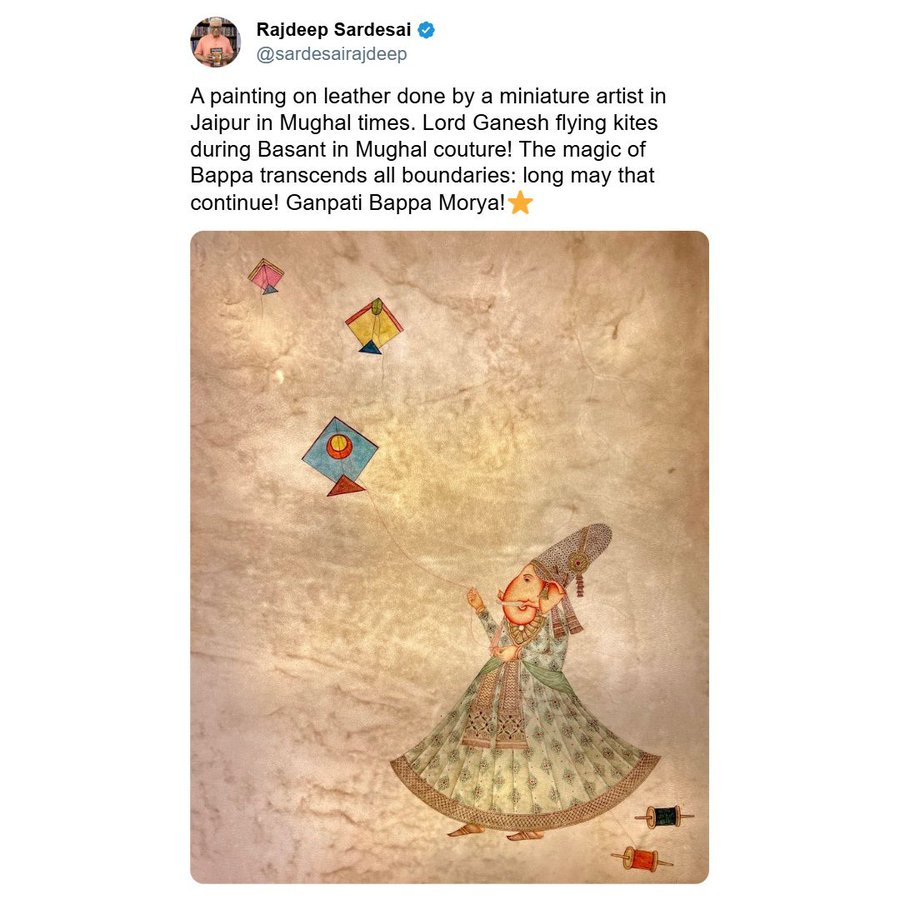
This dress is distinctly Hindu and distinctly Rajasthani, it has nothing to do with "Mughal couture".
This is Hindu Angarakha which predates Islam by 1000 years.
1. Jama Silhouette
The Mughal jama wraps asymmetrically, one side crossing over and tying to the other. Ganesha's garment is symmetrically full-skirted with no side fastening visible at all. That puts it in angarakha territory, which is older than the jama tradition entirely. Even within the jama, Muslims tied right, Rajputs tied left. This garment does neither.
2. The Hem
The distinctively Mughal-looking hem (chakdar, with 4-6 pointed edges) was likely borrowed from Rajput courts in the first place. The hem here is smooth and circular, a pure ghera, which is pre-Mughal angarakha all the way.
3. Headgear
Mughal turbans ran tall and conical, heavily Persianate, with Akbar explicitly copying the Safavid upright-plume style. What Ganesha wears is low, rounded, and flat-profiled with jewel ornamentation, which is Rajput pagri. Worth noting: even the Mughal turban style was partially borrowed from Rajput practice to begin with.
4. The Shoulder Drape
The odhni draped over the shoulder is a Rajput convention documented consistently across Rajput court paintings. The Mughal equivalent was the patka, a horizontal waist sash, sometimes doubled. These serve completely different functions and sit on entirely different parts of the body. What's in this painting is unambiguously Rajasthani and unambiguously Hindu.
I agree. From a GC perspective, fighting for the implementation of creamy layer within SC/ST reservations is largely pointless.
Yes, certain communities within SC/ST have exploited reservation to their advantage. But what does introducing creamy layer actually achieve? It would push out the more affluent SC/ST communities, but those seats would simply be filled by less represented communities within the same bracket. With a population of over 35 crore, a large section of which is poor and underrepresented, SC/ST communities will have adequate replacements for at least the next hundred years. The math is simple: not a single additional seat opens up for GC candidates. The numbers stay exactly the same.
Then there is the question of implementation. Creamy layer already exists for OBCs, and it is farcical. The threshold is 8 lakh per annum from non-salary and non-agricultural sources only. This means a Staff Engineer at Google earning 2 crore annually does not fall under creamy layer, because his non-salaried income is below 8 lakh. The policy has been deliberately structured so that nearly everyone is exempt. And this is before accounting for the income certificates, which are largely fraudulent documents anyway.
Finally, this is simply not our fight. Anyone who believes championing creamy layer will generate goodwill is mistaken. It will be seen as interference in their internal affairs, nothing more. VP Singh, himself a General Category politician, was instrumental in implementing the Mandal Commission and OBC reservations. When his government was collapsing, he expected OBC MPs to cross party lines and save him. He declared they would vote from conscience. They did not. His government fell. Generations of GC reformers poured genuine effort into their empowerment. The returns speak for themselves.
Save that energy. The real fight is for the complete removal of reservations. Reservations are inherently unjust, explicitly discriminatory, and anti-merit by design. That alone is justification enough.
पूरे इतिहास में सवर्ण समाज ने ऐसे अभिजात वर्ग को भी जन्म दिया है, जिसने अपने ही समाज और राष्ट्र के साथ विश्वासघात किया। प्रस्तुत है भेड़ की खाल में छिपा एक और भेड़िया।
यह वही व्यक्ति है जिसने कभी बसपा के प्रत्याशी के रूप में निर्वाचन लड़ा था, उसी राजनीतिक परंपरा से जिसका उद्घोष था: “तिलक, तराजू और तलवार, इनको मारो जूते चार।” तब इसने अपनी सवर्ण पहचान भुलाकर उन लोगों से गठजोड़ किया, जो सवर्णों को अपशब्द कहते थे और उनके अस्तित्व को मिटाने की राजनीति करते थे।
आज राजनीतिक वेश परिवर्तित कर भाजपा में आने के उपरांत इसे सवर्ण पहचान तभी स्मरण आती है, जब उसका उपयोग सवर्णों पर प्रहार करने और भाजपा के शीर्ष नेतृत्व की चाटुकारिता करने में हो।
यह सवर्ण आंदोलन को राष्ट्रविरोधी बताता है और स्वयं को सवर्ण समाज का प्रतिनिधि प्रस्तुत करता है। इसका नवीनतम तर्क तो और भी अद्भुत है: सवर्णों को संपन्न वर्ग अथवा उपवर्गीकरण की चिंता क्यों हो, क्योंकि उन्हें आरक्षण नहीं मिलता।
अर्थात् सर्वाधिक कर दो। उन्हीं करों से संचालित योजनाओं का दासों की भाँति वित्तपोषण करो। अपने ही धन से व्यवस्था चलाओ। परंतु यह प्रश्न पूछने का दुस्साहस मत करो कि तुम्हारा धन कहाँ जा रहा है। भार वहन करो, जातिगत भेदभाव सहो और मौन रहो।
और यह महोदय हमें त्याग का पाठ पढ़ा रहे हैं।
इसका पाखंड यहीं समाप्त नहीं होता। इसके अपने बच्चे अमेरिकी नागरिक हैं। भारत की जातिगत राजनीति से इसके पास खोने को कुछ नहीं, पाने को बहुत कुछ है। यह चाहता है कि भारतीय नागरिक अपने बच्चों के भविष्य की बलि दें, ताकि यह और इसके राजनीतिक स्वामी उस राजनीति से लाभ उठाते रहें।
अर्थात् स्वयं का भविष्य सुरक्षित रखो, अपने बच्चों को विदेश भेजो और फिर भारत में रहने वाले भारतीयों से कहो कि वे अपने बच्चों का भविष्य जातिगत राजनीति की वेदी पर चढ़ा दें।
वाह रे त्याग!
जिस व्यक्ति का इस व्यवस्था के परिणामों में कोई वास्तविक हित नहीं है, वही चाहता है कि उसके समस्त परिणामों का भार आप उठाएँ।
यह सामाजिक न्याय नहीं है। यह सिद्धांत का मुखौटा धारण किए राजनीतिक अवसरवाद और विश्वासघात है।
Death is one of my greatest teachers. Let me share how I see it.
Humans truly surrender only at death or near it. Watch anyone in their final days. The arrogance drops, the humility rises, the sensible elements of the being finally awaken. Even an animal softens near its end. Death extracts a surrender that no scripture, no lecture, no guru could extract in a whole lifetime.
Now imagine a world without death.
Or imagine a system like Shishupala's. He had a fixed quota of 100 offences, and the moment he crossed it, Krishna's chakra ended him. Imagine if every human walked around with a visible ledger. This many sins allowed, redemption possible up to this point, instant removal after that. If killing or cheating meant your life was taken on the spot, yes, the world would be more peaceful. But it would also be mechanical. Pure machinery. No free will, no real choice, no genuine transformation. Goodness under threat is not goodness at all.
So the Lord kept things hidden. And this hiding is His compassion.
Look at how people judge. A man committed fraud 15 years ago. Today he has awakened, he is sincerely improving. But society still holds his old picture, still reminds him of how he failed, how weak he was.
Death is what deletes that picture.
Think about this. If a person were shown even 100 of his past human births at random, he would die of guilt on the spot. Because in those births, he has certainly committed the very crimes he hates today. The murderer he condemns, he has been. The cheat he despises, he has been.
Death draws a curtain over all of it. It protects us from a mental melancholia no mind could survive. It gives us a clean page, birth after birth.
This is why I learn from death. It is not the enemy of life. It is the mercy that makes life possible.
Today, my APAAR–Aadhaar writ petition was heard by a CJI-led Bench in the Supreme Court.
The Court says CBSE will be asked to add a clear opt‑out/refuse consent option in APAAR forms. The Court notes APAAR must comply with the DPDP Act, 2023.
https://t.co/rJaVqHPrOb
the figs will rot if you don’t eat them. the jasmine blooms for three weeks and then it’s over. your body at twenty-five will never come back, and neither will your body at forty-five. everything you’re saving for later spoils in the waiting. 1/6
80% of all autoimmune disease patients are females.
Lupus, Rheumatoid Arthritis, Hashimoto's... the disparity is massive.
But WHY is the female immune system so prone to attacking itself?
Not everything in your life is fixed. This is something I want people to understand clearly.
The more a person is driven by the ṣaḍ ripu, the six inner enemies, the more fixed his life becomes.
काम (kāma), desire.
क्रोध (krodha), anger.
लोभ (lobha), greed.
मद (mada), pride.
मोह (moha), delusion.
मात्सर्य (mātsarya), envy.
The deeper a person is sunk in these 6, the more predictable his chart becomes. He is running on autopilot. The planets move him, the daśās move him, his patterns move him. He has no real say in any of it. He thinks he is choosing, but he is only reacting.
This is exactly why we can predict so confidently for most people. We are not reading the future. We are reading how tightly the 6 enemies are gripping the person.
The freer a soul becomes from these, the less his life can be predicted. His chart starts behaving differently. Yogas that should have given trouble do not bite.
Daśās that looked harsh pass softly. Grace begins to enter the gaps that karma had locked shut.
Predictability is bondage. Unpredictability is sādhanā working.
A Japanese immunologist spent 20 years proving that the chemicals trees release into the air walk into your bloodstream, hunt down your stress hormones, and arm your immune system in ways no therapist or pharmaceutical has ever matched, and most of the data has been sitting in Japanese medical journals for two decades waiting to be translated.
His name is Qing Li.
He is a clinical professor at Nippon Medical School in Tokyo and the president of the Japanese Society of Forest Medicine. The Japanese government has been funding his research since 2004, and the body of work he has produced is the reason forest bathing is now an officially prescribed clinical therapy in Japan and Korea.
The story actually starts in 1982, when the Japanese Ministry of Agriculture, Forestry and Fisheries coined the term shinrin-yoku to describe the practice of slow, mindful walking in a forest. They did it for a practical reason.
Japan was urbanizing fast, stress-related illness was climbing, and the country had thousands of square kilometers of forest sitting unused. The idea was to give people a reason to walk into the trees... They had no idea what was actually happening to the human body during those walks until Qing Li ran the first proper experiment in 2005.
He took twelve healthy adult men on a three-day, two-night trip to a forest park. They walked for a few hours each day. Nothing strenuous. No prescribed routes or breathing exercises. They simply walked slowly through the trees, breathing the air, looking at the forest.
Li drew blood and urine samples before the trip, on the second day, on the third day, on day seven after returning home, and again on day thirty.
The numbers that came back from the lab were not what anyone expected.
The activity of a specific type of immune cell called the natural killer cell, which is the cell your body uses to hunt down cancer cells and virus-infected cells before they can spread, had jumped by roughly 50 percent during the forest trip. The actual number of natural killer cells circulating in the bloodstream had increased significantly.
Three different anti-cancer proteins that those cells produce, called perforin, granzymes, and granulysin, had all risen sharply. And the effect did not disappear when the men went home. The immune boost was still measurable on day seven and was still partially present on day thirty.
Two hours a day in a forest had upgraded the immune system for a full month.
Li ran the same experiment with women a year later and found nearly identical results. Then he ran it with a control group who took a three-day trip through an urban area with the same amount of walking, the same hotel quality, and the same diet.
The urban group showed no measurable change in natural killer cell activity at all. The forest was doing the work, not the vacation.
The mechanism turned out to be a class of airborne molecules called phytoncides. Trees produce these compounds to defend themselves against insects, bacteria, and fungi. Pine, cedar, oak, and cypress trees release them in particularly large amounts, especially in warmer weather and after rainfall.
When you walk through a forest, you are inhaling those molecules into your lungs and absorbing them through your skin, and once inside your body they appear to directly stimulate the production and activity of the very immune cells Li was measuring in his lab.
Roughly 50 percent of the health benefit of a forest walk, according to Li's data, comes from the chemistry of the air itself. The other half comes from what the forest is doing to your nervous system.
This is where it stops being only about the immune system and starts being about stress.
A separate Japanese research team measured cortisol, the body's main stress hormone, in 84 participants across 35 different forest sites. They drew samples before and after a 30-minute walk in each forest and compared them to control walks in matched urban environments. The cortisol levels of the people who walked in the forest were lower than the cortisol levels of the people who walked in the city by a significant margin. Their heart rates were lower. Their blood pressure was lower.
The activity of their parasympathetic nervous system, which is the part responsible for rest and recovery, had gone up. The activity of their sympathetic nervous system, which is the part that drives fight or flight, had gone down.
Then a researcher at the University of Michigan named MaryCarol Hunter ran the cleanest version of this experiment ever done. She recruited participants from a city and told them to take a nature pill three times a week for eight weeks.
They were free to choose the time, the place, and the duration of the nature experience, as long as it was outside, in daylight, and free of phones, conversations, and aerobic exercise. They sent her saliva samples before and after each session so she could measure cortisol changes accurately and rule out the normal daily drop in stress hormones that happens to everyone.
The result was that participants experienced a 21.3 percent drop in cortisol per hour spent in nature, with the biggest payoff happening between minutes 20 and 30 of the walk.
After that, the cortisol kept dropping, but more slowly. The threshold dose for measurable stress relief was just 20 minutes outside in something that looked and felt like nature.
What none of this means is that nature is a substitute for therapy or for medication when someone genuinely needs them. Therapy treats different things than a walk does, and Li himself has been careful in interviews to call forest bathing a complementary intervention rather than a replacement for clinical care.
But what the research has settled is that the human body has a physiological response to being among trees that operates on the same biological systems modern medicine is trying to reach with drugs and clinical protocols, and that response is fast, measurable, and free.
The strangest part of Li's work is the implication he keeps repeating in interviews. The average person now spends more than 90 percent of their life indoors. Their cortisol stays elevated. Their natural killer cells stay sluggish.
Their parasympathetic nervous system rarely gets a chance to take over. The system that was tuned by millions of years of life under a canopy of trees is being asked to run permanently inside a box made of drywall and screens.
Your body has not forgotten what it is supposed to do in a forest. It is waiting for you to walk into one.
once you turn 20 you have to fight everyday for the rest of your life to not lose your personality & spirit...bc what once came naturally to you will be exhausted into nothing if you don't actively Try. it's terrifyingly easy to become a lethargic, soulless adult
I'm glad to see many Indians, including media and ministers, waking up to the online infowar on India and Indians being waged by China, Pakistan, and their account farms around the world.
(Long post, you may skip to read just the 7 steps below)
This is in part thanks to Singapore for taking action (for their own good) thus making it news. While also clearly and decisively naming where the infowar on Indians in Singapore was coming from.
This has opened the eyes of many in India. Now people seem to understand that the anti-India sentiment around the world is being instigated by an ongoing state sponsored operation. It is not just organic.
I have been claiming this for years. The hate and racism against Indians in the US, the EU, Africa, and many parts of Asia was not organic but being orchestrated by state funded warfare. It's 101 of communist warfare.
The same goes for much of inter-community hate generated within India. And neighbors/partners of India being made to hate India. They are using psyops on citizens of friendly countries against India to influence their politics and govt's policies to be anti-India.
We saw this in Maldives, Bangladesh, Sri Lanka, Middle East, US, and Nepal. It is not possible for individuals to fight this infowar no matter how much we organize, though we are already doing it. Most people tend to react and it only amplifies their infowar.
7 steps India can take:
1) India needs to first acknowledge this infowar on the country and start an investigation. This is the least that can be done. If Singapore is able to acknowledge and call it "China based" immediately on one interference, why can't India?
2) Once the investigation proves an organized infowar, which even OSint handles are finding and laying out clearly, publicly name the countries doing this against India. Let Indians know. Warn them of consequences.
3) India needs to take the investigation to partner countries and let them know about what's going on via social media. Ask them to take action on these account farms spreading hate against Indians in their countries and creating diplomatic problems with India.
4) Then, most importantly, work with social media platforms, which rely on India's vast userbase, forcing them to take down these account farms *worldwide* for spreading hate against India.
5) Set up a social media & media monitoring and rapid response cell. Run studies on algorithms and kind of narratives being pushed to different demographics in India, and about India to the world by SM cos. Act swiftly to mitigate harmful narratives like Singapore.
6) Again, like Singapore, GoI needs to constantly remind citizens to be mindful of online narrative that instigates hate between communities, countries, and amplifies smaller local issues into some nationwide problems.
7) Lastly, I believe, offense is the best defense. There must be real world consequences for those perpetrating such hate against India and Indians costing India economically (exports and inbound tourism are severely getting affected), intangibly, and in actual Indian lives.
A power like India needs to impose costs on the countries that do this. Everything can start with an acknowledgement of this issue by govt, a reassurance that GoI is working on it, an investigation, a public report naming the adversaries, and based on the report - action as outlined above.
If all this is already being done like some claim, and GoI knows everything and also what to do, just that they don't need to inform the public, then fine. I am only laying out a strategy here. Not claiming I know better.
And I only hope for the best since many, many years - let our people not get killed by hate crimes, let our exports and inbound tourism boom without being hit by psyops, let our relationship with neighbors grow without hate, let there be no riots or protests instigated by social media, and let Indians not be targeted in countries around the world.